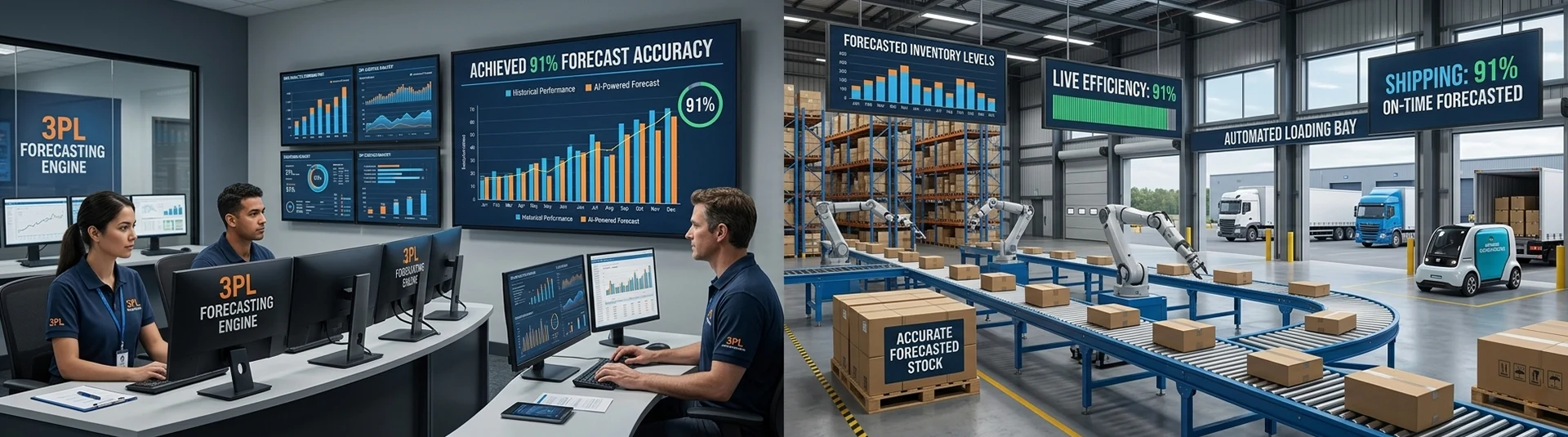
NineHertz worked with the United Kingdom-based third-party logistics firm that manage end-to-end supply chain operations. The company serves 50+ retail and manufacturing customers worldwide with services such as warehousing, cross-border freight coordination and last-mile delivery.
The company relied on the outdated spreadsheet model and rough forecasting that often failed to meet the grwoing client base and increasing demand cycles. At the same time, inventory and delivery commitments were often missed due to lack of visibility. The company needed to build an AI-powered solution that can analyze data to offer better view of demand and supply.
Lower accuracy in the forecasting and constant firefighting were the biggest challenges for the company. The firm relied on gut-feel forecasting that often failed to predict demand spikes during promotional windows, seasonal events, and supplier availability. At the same time, rising holding cost and increasing inventory was another challenge that significantly impacted the warehouse utlization.
The company also witnessed frequent stockout that led to damaging client relationships. Continuous SLA penalties from retail clients increased the overall operational costs. Moreover, lack of visibility into supply chain made it nearly impossible to identify bottlenecks before they turned into delivery failure.
The NineHertz developed a predictive analytics engine, customized for real time business needs that replaces the outdated spreadsheet-driven system.

We built and deployed a smart demand forecasting engine that would analyze years of historical order data, promotional calendar, and demand patterns to accurately suggest SKU-level forecasts.

A centralized dashboard was installed that aggregates the data from multiple sources, like clients’ WMS, ERP, and carrier APIs, under one umbrella, offering a more structured and unified view for better decision making.

The new ecosystem generates the replenishment recommendations on the basis of reorder points, warehouse capacity constraints, and supplier lead times. Planning coordinators can review and approve the recommendation.

The NineHertz implemented an automated anomaly detection layer that could monitor the sudden demand shifts, unusual outbound patterns, and supplier delays. It alerts the relevant team members as soon as deviation crosses the configurable threshold.
The deployment of a predictive analytics engine resulted in tangible benefits in inventory, planning and service delivery operations.
Higher forecast accuracy put a solid base in place for staffing and inventory planning. There was a 91% accuracy increase which led to less time on reactive problem solving.
Better visibility into demand patterns allowed the firm to reduce the safety stock buffers, that free up warehouse capacity and improves margins.
Proactive replenishment recommendations and early warning alerts eliminate the stockout events, reducing SLA penalties and escalating client satisfaction.
The improved on-time delivery rates strengthened the firm’s position among key retail accounts. The firm also resolved two active service escalations within the first operating quarter.