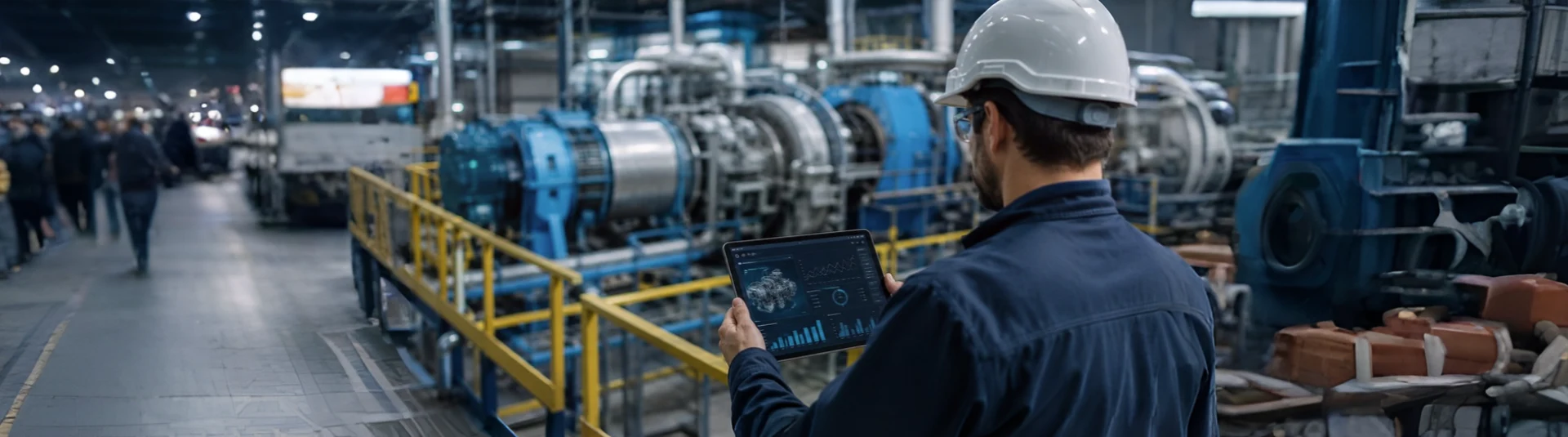
The client was a discrete manufacturing company that operates in the Midwest of the United States. The company runs a production floor consisting of 100+ CNC machines, hydraulic press units, and conveyor assemblies across three shifts to produce precision metal components for the aerospace sector.
The manufacturing plant was dependent on its 14 technicians to identify any machinery failure and fix it. But its reactive maintenance meant it would cause a delay in manufacturing, which resulted in a loss of productivity. As the business scaled further up and production volume grew, it was imperative for the company to employ a surefire system that could act proactively in alerting to machine failure in advance before the incident occurs.
The manufacturing company lacked centralized visibility into machine health as the data existed in silos across multiple PLC systems. Unplanned downtime often disrupted the production schedules with an average of 11-14 unplanned machine stoppages every month, causing lost output worth $80,000-$120,000 per month. There were no early signs of damage or malfunctioning, and the technical team had no means of identifying the breakdown in advance.
Paper-based maintenance logs were another challenge, which makes it impossible to retrieve the historical data for quick resolution of different types of machine downtime. Also, there was no unified interface even when the sensors were installed on the critical equipment. Datastreamed steamed into three different PLC systems.
The NineHertz developed an AI-based predictive maintenance system that helps the client to detect patterns, identify the chances of malfunctioning, and take preventive measures in advance.

We built a middleware integration layer connected to the existing PLC system. It standardizes the data coming through sensors into a single data stream without any hardware replacement.

Our team deployed a machine learning model trained on 18 months of historical machine and failure data, along with the sensor readings. This would analyze the pattern and predict the anomaly before it happens.

A web-based dashboard was configured to provide a role-specific view where the dashboard shows a floor-level heatmap for the supervisor, a machine health panel for the technician, and an executive summary view for the plant manager.

Digitized trace logs on maintenance records, where PoI alert triggers to draft work orders. It reduced the documentation time from 45 minutes to 8 minutes.
Within the 3 months of software implementation, the platform showcased measurable improvements across the production facility.
The new anomaly detection engine now flags the developing fault 40% faster as compared to the reactive malfunctioning identification process.
The unplanned stoppage reduced from 13 per month to 5 per month, saving more than $65,000-$100,000 per month.
The alert is sent to the technicians before the fault completely takes place. Thus, the engineers are ready with their tools and spare parts to repair the machine in the least time.
Automated work order generation capability eliminated the need for manual reporting and drafting, which reduced the documentation time from 45 minutes to 8 minutes.