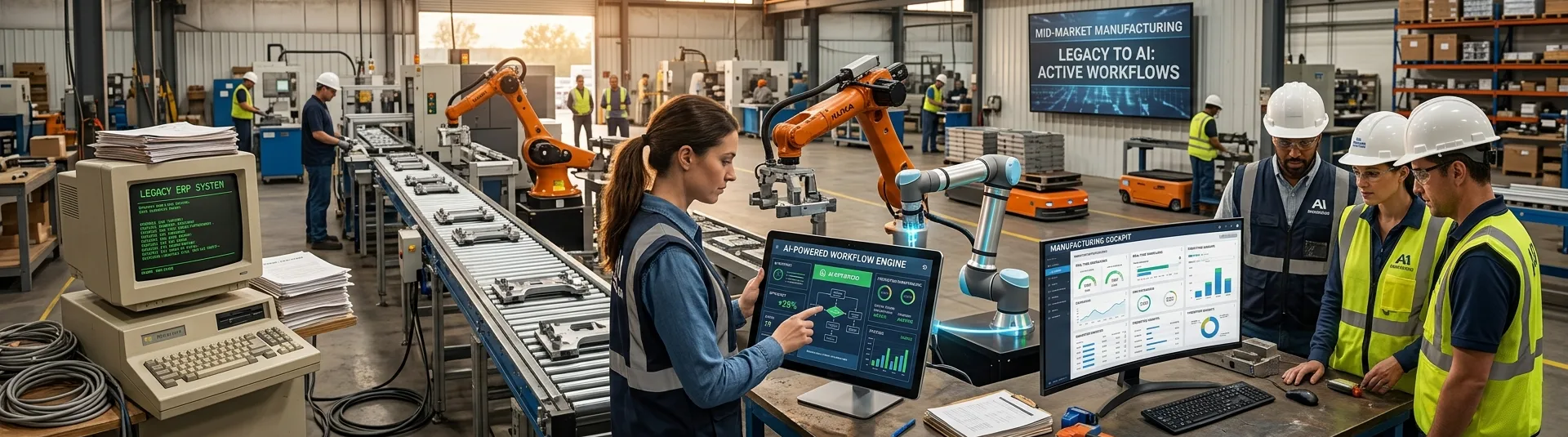
The client was a mid-market industrial manufacturing firm that produces precision components for heavy machinery and the automotive sectors. The company operates with its three production facilities in Germany with a vast network of warehouses, suppliers, and regional sales teams.
For more than 10 years, the company relied on legacy ERP software to manage inventory, planning, procurement, and finance. However, as the order volume increased, the supply chain complexity increased, and it became difficult to make real-time decisions and keep production smoothly moving.
The company was dependent on an outdated monolithic architecture that could not iterate with the new-age software. Even the small process changes required 4-6 weeks for custom development, which ultimately slows down the entire business process. At the same time, data was fragmented across the departments through disconnected modules. Thus, it required 25-30 hours per week to reconcile data.
Reactive decision-making was another challenge as the team had no predictive capabilities. Problems such as machine downtime, out-of-stock products and supplier delays were only discovered and resolved after they had caused a problem. Furthermore, too many manual approvals with lengthy email threads and manual sign-offs typically take over 5-7 days to complete.
The NineHertz developed an AI-powered workflow engine that automates decision-making, offers real-time control over leadership tasks, and unifies data.

Our team migrated the monolithic ERP into a modular, microservice-based platform, hosted on the cloud. It offers a unified data layer that reduces change-deployment time from weeks to hours.

We created a smart workflow engine that could automate workflows like routing, exception handling between departments, approvals, and many more. The engine would be able to learn from historical data, and make a recommendation for the next action with a high level of accuracy.

Teams can now make informed decisions and predictions with the predictive intelligence layer. Predicts inventory needs, machine maintenance needs, and reduce supplier delays.

The NineHertz consolidated data across three facilities into a single dashboard that offers analyzed information to plant heads, executives, and operations teams. Esports can be generated in real time.
The client witnessed a measurable impact after two quarters of the implementation of the new platform.
The advanced workflow engine reduced the procurement time from 7 days to 24 hours, fostering faster supplier changes and accurate demand.
The new unified layer of data now eliminates the need for those 30 hours weekly to reconcile work. Saved time is now invested in strategic planning.
The real-time dashboard allows the decision makers to have a clearer picture of the business and make informed decisions in a margin-sensitive business.
Unplanned downtime reduced by 22% across all the facilities with predictive maintenance, inventory alerts, etc. 35% reduction in production downtime.