Rigid Workflows Can’t Anticipate Every Scenario
Predefined conditions break on unfamiliar combinations and exceptions.
Orchex by NineHertz turns your policies and processes into agentic workflows. AI agents interpret requests, decide the next step within your guardrails, work across connected systems and bring people in when approvals or decisions are needed. Decisions stay traceable, actions stay governed and people stay in control.
Governed outcome
Orchex is a solution from The NineHertz, an AI-native engineering partner
Orchex is an agentic workflow orchestration platform that lets organisations design, deploy and manage AI-powered business processes. It brings visual workflow design, AI agents, system integrations, conditional logic, guardrails and human approvals into one orchestration environment.
Traditional automation follows paths defined in advance. Orchex puts intelligence inside the workflow: agents interpret requests, select the right tools and decide the next step based on context and your policies. Business teams build workflows visually without code, engineering teams extend them with custom tools and APIs, and workflows can be embedded directly in your own product.
Your policies define the boundaries. Your agents handle the complexity. Your business stays in control.
Traditional automation works when inputs are structured and every route can be mapped in advance. Real operations are messier: a customer email with two requests, an informal purchase request, a submission with missing documents. When work falls outside the predefined path, people end up interpreting, fixing and restarting it by hand.
Predefined conditions break on unfamiliar combinations and exceptions.
Emails, documents and chats have to be read, classified and re-keyed before the real process can even start.
One process can touch CRM, ERP, databases, ticketing and external APIs, and every handoff adds delay and risk.
Putting AI into processes raises hard questions about permissions, approvals, traceability and accountability.
The next evolution of automation isn’t adding AI to every step. It’s adding intelligence where judgement is needed, while keeping the whole process governed.
Six capability pillars that take a business request from first input to a governed, recorded outcome.
A visual canvas brings agents, tools, conditions, guardrails, approvals, forms and reusable sub-workflows together. Business analysts shape the process, engineers extend it with custom integrations, and workflows can be tested before they go live.
Agents interpret a request, weigh the available information and choose from their configured tools, using their own instructions, reusable skills and a selectable model. They adapt within each step, while the overall route stays governed by the workflow design.
Agents and workflows retrieve data, query databases, call REST APIs and MCP servers, and act through connectors for business applications and data platforms. Custom tools cover specialised requirements, and system interactions can be reused across workflows.
Workflows pause for forms, information or approvals, then resume once input is given. Approvals support approve and reject paths, multiple levels and a maker-checker control that stops anyone approving their own request.
Validate inputs and outputs, restrict which tools each agent can use and enforce approvals. Retries, circuit breakers, step and run-time limits, credential encryption and data masking keep execution safe and predictable.
Searchable run history shows every step, tool call, intermediate result and approval decision, along with state, variables and per-step model cost. Full tracing makes it easy to debug workflows and review how decisions were made.
Teams define the workflow, agents and controls once. At run time, agents interpret each request and choose their tools, while the workflow manages the sequence, applies conditions, brings in people when needed and records the outcome.
Map the process, its policies, inputs, decision points, integrations and approvals, then configure it visually.
An agent reads the request, identifies what matters and uses its tools to gather the context it needs.
The agent picks tools within its scope while the workflow applies conditions, guardrails, routing and sub-workflows.
Configured system actions run, pausing for human approval wherever the process requires it.
The result is returned and every step, tool call and decision is recorded for review.
Where people and context come in
That’s the difference between an agentic workflow and a simple chain of automated tasks.
Orchex delivers most where unstructured inputs, multiple systems and frequent exceptions create manual work.
Interpret customer requests, pull relevant knowledge, investigate through connected systems and prepare responses, routing cases for review when they need a person.
A request like “laptops for a new team” becomes a workflow that gathers missing details, checks purchasing rules and routes to the right approver.
Bring invoices, purchase orders and receipts together, investigate mismatches and propose next steps, with financial adjustments kept under your controls.
Check submitted documents against requirements, identify what is missing and trigger follow-ups automatically.
Orchestrate access requests, device issues and leave queries across systems, with policies deciding what proceeds automatically and what needs approval.
Turn calls, emails and customer interactions into CRM updates, account research and follow-up preparation, with oversight on sensitive changes.
When requests stop waiting in queues and exceptions stop landing on people, the value shows up in speed, cost, capacity and control. Here is where Orchex creates it.
Requests move through one orchestrated flow instead of queues and handoffs between teams and systems, so work that took days of back-and-forth can close in a single run.
Agents take on the reading, classifying, re-keying and chasing that consume skilled time, cutting the manual touches each request needs.
The same team handles more requests, and peaks are absorbed by workflows rather than overtime or new hires.
Context-dependent requests that used to fall out of fixed automation are resolved within policy, so only true exceptions reach people.
Approvals are enforced, tool access is restricted and every decision is recorded, turning audit preparation into a search, not a project.
Many changes are made by updating agent instructions or policies, not rebuilding workflow logic, so the business adapts in days, not release cycles.
One customer email. Two requests: a refund for a duplicate payment and an address change.
A conventional workflow has to split the email into separate cases before predefined processes can run. With Orchex, an agent identifies both tasks, retrieves the relevant records, applies the policies and approval rules for each, and prepares one consolidated response, with every step recorded.

What you’ll see
Traditional automation is still the right tool for stable, predictable processes. Orchex is built for the processes where requests vary, context matters and the next action depends on what an agent discovers. The two complement each other.
| Dimension | Traditional workflow automation | Orchex |
|---|---|---|
| Decision-making | Routes are generally defined in advance. | Agents make decisions within configured workflow boundaries. |
| Inputs | Optimised for structured forms and predefined fields. | Handles unstructured inputs alongside structured data. |
| Exceptions | Routed to predefined exception paths or manual queues. | Agents interpret context and decide the next step within their permitted scope, escalating when necessary. |
| Role of AI | Used for a specific task within a workflow. | Agents select tools and make decisions within individual workflow steps. |
| Process changes | Require changes to workflow logic and retesting. | Some behaviour can change by updating agent instructions or policy documents, subject to validation. |
| System interactions | Predefined integrations at specific steps. | Agents choose among configured tools according to the task and context. |
| Governance | Depends on the workflow engine and its configuration. | Guardrails, approval mechanisms and execution records built into every workflow. |
| Best suited for | Stable, predictable processes with known paths. | Context-dependent processes with varied inputs and exceptions. |
Not every workflow needs an agent. Orchex brings agentic decision-making to the processes where fixed automation becomes hard to maintain.
Enterprise orchestration takes more than connecting apps to AI models. It needs separation between customers, controlled access, clear approvals, visibility into execution and the flexibility to deliver workflows inside your own products.
Each customer organisation gets its own environment for users, workflows, connections, knowledge bases and model credentials.
Decide exactly which tools and systems each agent can use, limiting it to what the workflow needs.
Require approval for sensitive actions and keep a record of every decision made during execution.
Encrypted credentials and data masking protect information moving between workflows, systems and AI models.
Deliver workflows through an embedded chat or a full-page interface inside your own product.
Inspect runs, tool calls, intermediate results and approvals for debugging and operational oversight.
Your processes span applications, databases, APIs and documents. Orchex is the orchestration layer that connects them into one governed workflow, so you don’t have to replace the systems you rely on.
Integrations for your environment are confirmed during scoping.
Enterprise autonomy isn’t all or nothing. Introduce agentic workflows with the right controls, measure them against real cases, and increase autonomy as confidence grows.
The agent analyses the request and recommends the next action. A person reviews and executes it.
The agent prepares the action, which runs only after the required approval.
The agent acts within defined limits and notifies the right person, who can step in where supported.
The agent handles eligible tasks independently within your policies and permissions. People focus on exceptions.
Start with control. Build trust through evidence. Expand autonomy where the results justify it.
Deploying agentic workflows in an enterprise takes more than configuring an agent. Policies have to become executable processes, the right systems have to be connected, controls defined, outcomes validated and the role of people agreed.
NineHertz pairs the platform with hands-on engineering, taking you from process discovery to working agentic workflows.
Accelerators built by the same AI-native engineering team.
From an idea to a production-ready application.
Turn application concepts into working software with AI-assisted development, and engineering support to take the product towards production.
Governed automation for operational incidents.
Connect incident detection, policy-driven remediation and recovery verification into one controlled workflow.
Reduce the friction in sales operations.
Streamline CRM workflows, improve visibility and reduce repetitive sales administration.
Make support workflows more efficient.
Apply AI to ticket handling and support operations.
Pick one process where exceptions, unstructured inputs and disconnected systems slow your teams down. We’ll turn its policies into a governed agentic workflow and prove the results before you scale.
Answers for business and technology leaders evaluating agentic workflow orchestration.
Orchex is an agentic workflow orchestration platform by NineHertz that enables organisations to design and run AI-powered business processes. It combines AI agents, workflow logic, system integrations, guardrails and human approvals to coordinate work across applications and teams.
Agentic workflow orchestration combines structured workflow execution with AI agents that can interpret context, select from their configured tools and decide the next step within defined boundaries. Unlike conventional automation that relies entirely on predefined routes, agentic workflows adapt their decisions to the information available during execution.
Traditional workflow automation follows predefined steps and conditions. Orchex adds agent-driven decisions inside a governed workflow, so processes can handle varied inputs and context-dependent situations while keeping defined controls and approval requirements in place.
No. Business teams can design workflows on a visual canvas without writing code. Engineering teams can extend workflows with APIs, custom tools and integrations where additional functionality is needed.
Yes. Orchex connects to REST APIs, databases such as PostgreSQL and MongoDB, MCP servers, and connectors for business applications and data platforms including Salesforce, ServiceNow, Jira, Zendesk, Stripe, Airtable, Databricks, Snowflake and Elasticsearch. Integrations for your environment are confirmed during scoping.
Each agent can only use the tools it has been given. Guardrails validate inputs and outputs, approval steps hold sensitive actions for a person, execution limits cap steps and run time, and every run is recorded so decisions and actions can be reviewed.
Yes. Workflows can pause for approval, with separate approve and reject paths, multi-level approvals and a maker-checker control that stops a person from approving their own request. Workflows can also pause for forms or additional information and resume once it is provided.
Yes. Workflows can be delivered through an embeddable chat experience or a full-page interface inside your own application, so your customers and teams use them where they already work.
Orchex suits processes that involve unstructured inputs, multiple systems, recurring exceptions and policies that can be documented. Typical examples include customer support, procurement, accounts payable, insurance document processing, IT and HR service requests, and sales operations.
Start with one business process that has a clear operational problem and measurable outcomes. NineHertz reviews the applicable policies and representative past cases, builds the workflow with the necessary controls, and validates its behaviour before the level of automation is increased.
Perspectives on AI, engineering, and the future of software development
Key Takeaways Staff augmentation buys capacity that you direct. Project outsourcing buys…
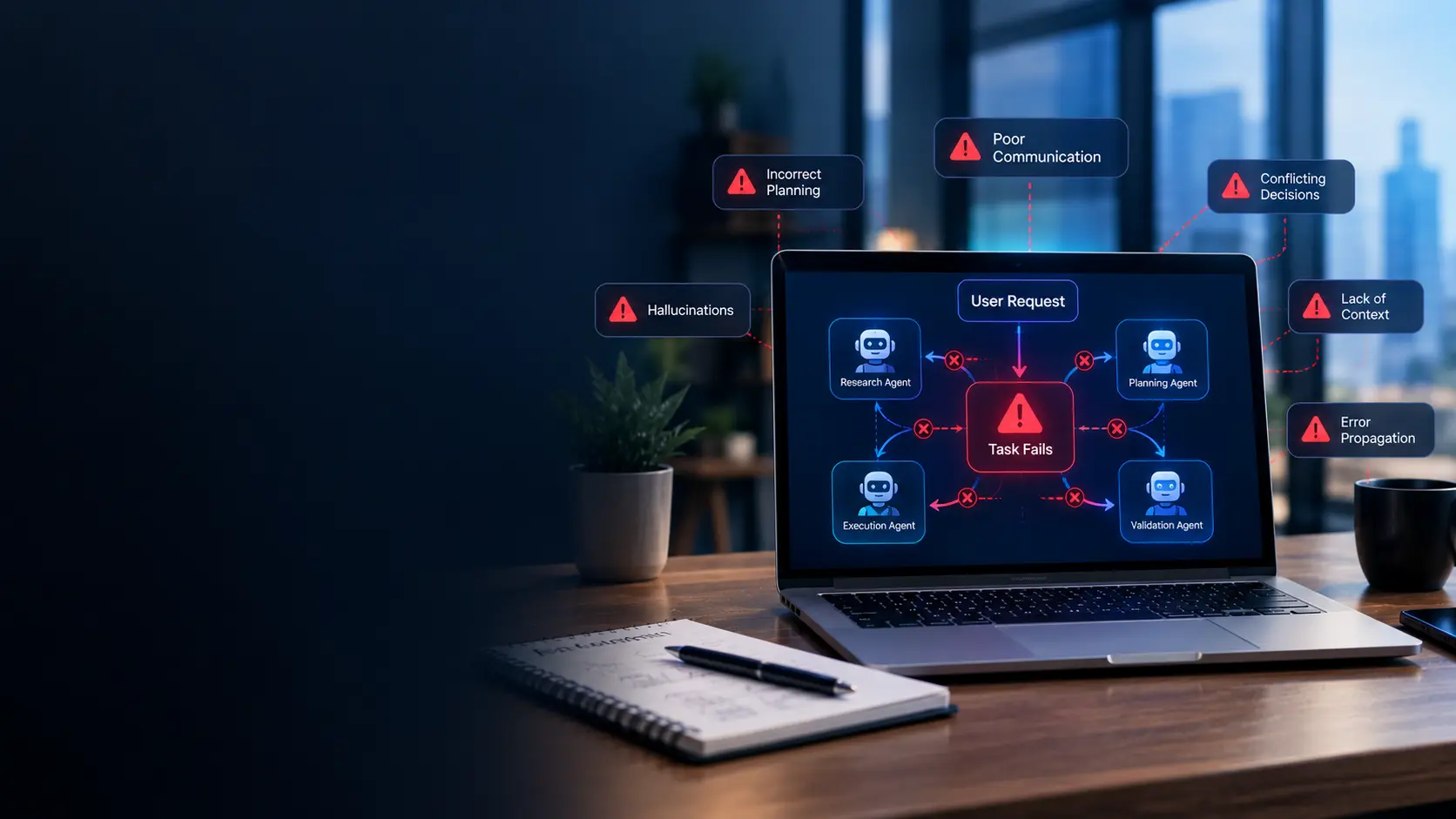
Key Takeaways According to statistics, multi-agent systems have a 41% to 86.7%…

Have you ever created a super-smart AI agent that no one actually…

Technology surrounds our lives like for real! We can use Gmail, WhatsApp,…

Key Takeaways IP architecture is not a legal formality bolted onto an…

Key Takeaways Offshore software development is a hiring model which enable the…