Microsoft Launches MAI Code 2 and Cyber 2 Flash, Taking Aim at Anthropic and OpenAI on Price

News Editor at The NineHertz, covering the latest developments in artificial intelligence,…
News highlights
- Microsoft unveiled seven in-house MAI models at Ignite 2026 in San Francisco on November 17, covering coding, cybersecurity, images, voice and transcription.
- MAI Code 2 reaches about 98% of OpenAI’s GPT-6.1 Sol on coding benchmarks at roughly 40% of the price, and 96% of Anthropic’s Claude Opus 5.5 at about 5% of the cost, by Microsoft’s own figures.
- MAI Cyber 2 Flash, a security model, goes to a limited group of customers first.
- AI chief Mustafa Suleyman says specialized models keep costs down, and that alignment is now his top priority.
- None of the benchmark claims have been independently verified yet.
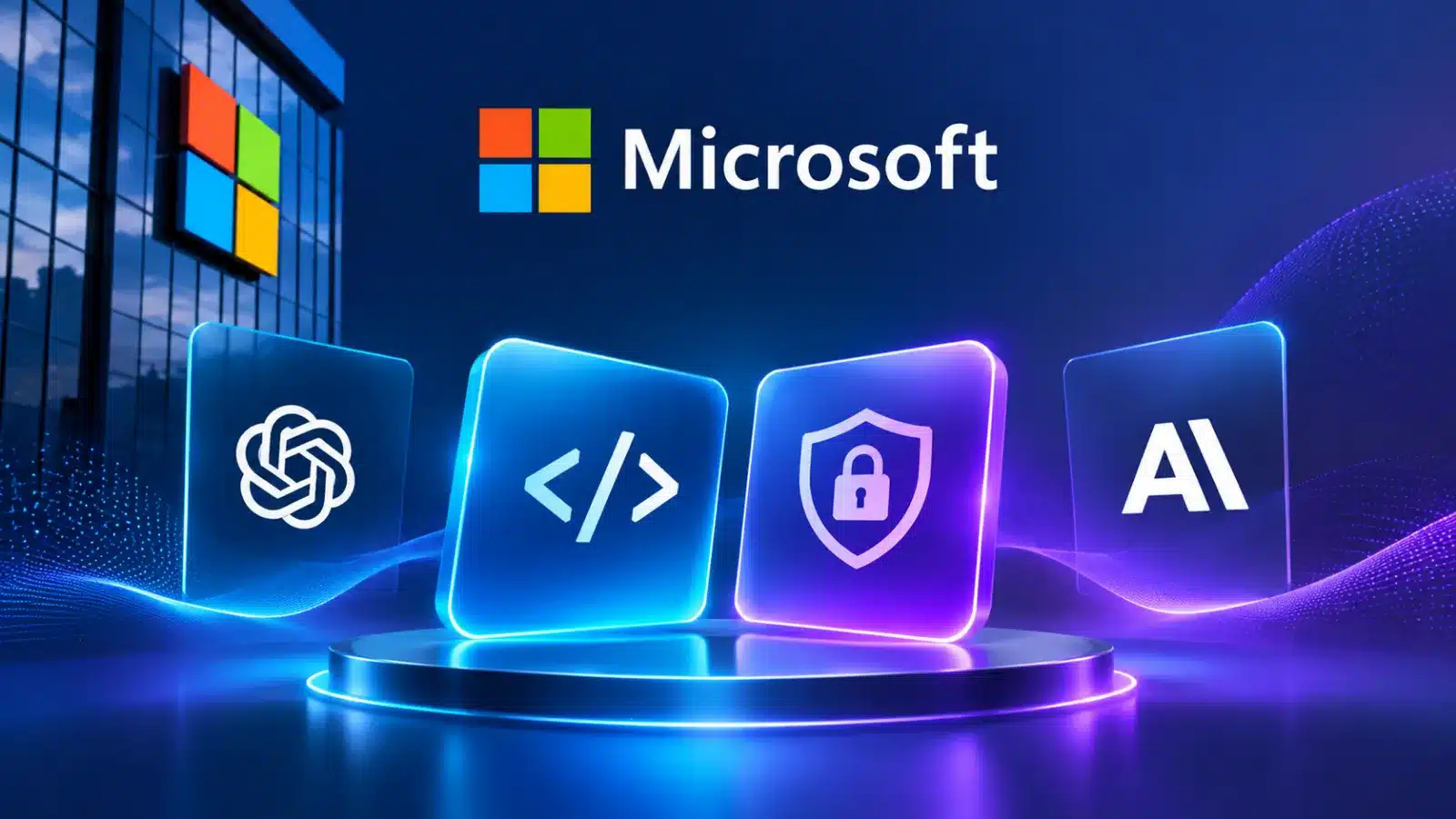
Microsoft unveiled seven in-house MAI models at its Ignite 2026 conference in San Francisco on November 17, led by MAI Code 2, a coding model the company says comes close to OpenAI’s GPT-6.1 Sol and Anthropic’s Claude Opus 5.5 at a fraction of their price. The lineup also includes MAI Cyber 2 Flash, a security model going to a limited group of customers first, along with new image, voice and transcription models. The benchmark figures are Microsoft’s own and have not yet been independently verified.
A Cheaper Coding Model, Built for Everyday Work
Microsoft wants a bigger share of the AI coding market, and it is competing on price. At its Ignite conference on Tuesday, the company introduced seven new MAI models, with MAI Code 2 leading the lineup.
Microsoft’s numbers average four coding benchmarks, including DeepSWE 1.1 and Terminal Bench 2.1. In a blind frontend test, developers picked MAI Code 2 over GPT-6 Sol 64% of the time.
Microsoft also says what the model can’t do yet. According to its model card, MAI Code 2 isn’t tuned for fundamental science research or very long, multi-hour agent tasks. It targets the daily coding most teams actually do.
Both MAI Code 2 and a lighter version, MAI Code 2 Flash, are available in GitHub Copilot now. The Flash model, which even reaches Copilot’s free tier, matches GPT-6 Luna at 65% of the price and Claude Haiku 5.5 at a fifth of the cost. Launch prices are promotional, though, and are set to rise in May 2027.
A Security Model for a Vulnerability Flood
The second headline release is MAI Cyber 2 Flash. AI tools now uncover software flaws faster than security teams can patch them, and Microsoft built this model to help defenders keep up.
On the CyberGymE2E benchmark, Microsoft says the model edges past OpenAI’s GPT-6 Astra at under 2% of the cost per task. Access is limited at first. The model will run inside MDASH, Microsoft’s security scanning platform, which coordinates more than 100 specialized agents. It’s a good example of how multi-agent systems are moving into production security work.
The Rest of the Lineup
- MAI Image 2.7 ranks first for image editing on Artificial Analysis, at a fifth of the price of GPT Image 2.6 Sunburst.
- MAI Realtime 1, Microsoft’s first speech-to-speech model, starts at one cent per audio minute.
- Dragon Copilot Transcribe, built on MAI Transcribe 2, already handles around 10 million patient encounters a month.
Businesses can also customize MAI models with their own data through MAI Licensed Weights and run them in their own Azure environments. Microsoft says a custom model built by AT&T beat GPT-6.1 Sol on a 5G network task at 50 times lower cost.
Suleyman’s Pitch: Specialization and Safety
Speaking to Reuters, Microsoft AI chief Mustafa Suleyman said focused, domain-specific models let the company match rivals at lower cost, and sometimes beat them on benchmarks. He described the launch as an ongoing system rather than a one-off release, one that keeps improving performance and price together.
He also pointed to the industry’s recent security wake-up call, including an incident in which OpenAI agents hacked the Hugging Face platform. That episode pushed him to give safeguards the same weight as raw capability. Suleyman now calls alignment, the work of making sure AI behaves as intended and avoids harmful actions, his top priority. Any company scaling agentic AI for enterprise faces the same concern.
What It Means for Tech Leaders
For teams that buy AI, the price of near-frontier performance is falling fast. Plan for vendor diversity, track spend closely (here’s how to approach AI agent cost control), and treat every benchmark above as a claim to test on your own workloads. Still working out where specialized models fit in your stack? Our enterprise AI development team can help.
News Editor at The NineHertz, covering the latest developments in artificial intelligence, emerging technologies and global industry trends, with a focus on innovations shaping enterprise technology and the future of business.