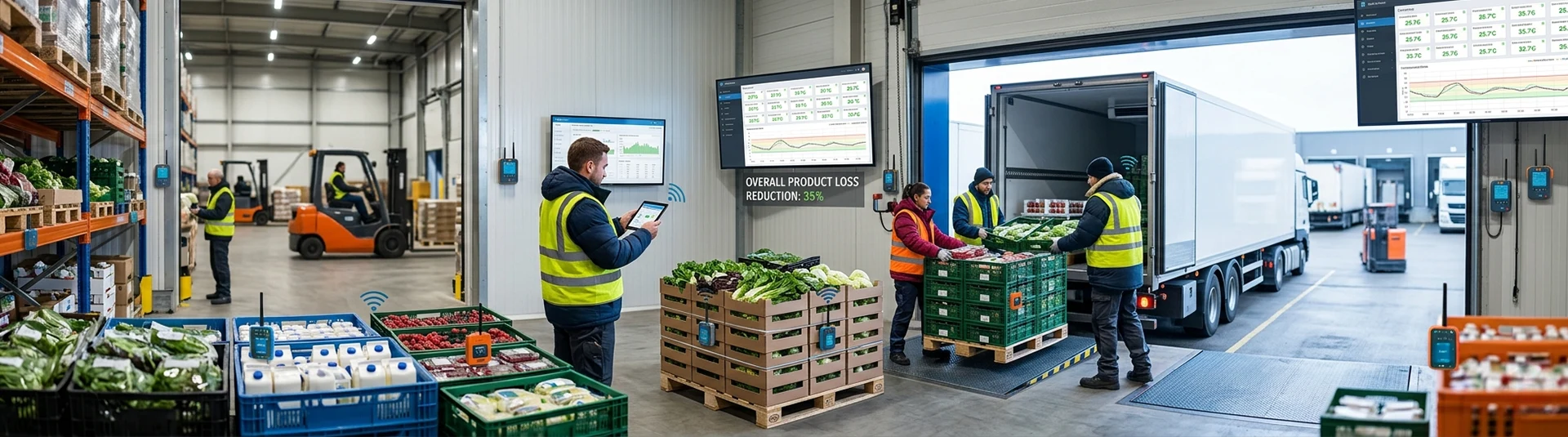
The client is a perishable goods distribution in the northeast United States that manages end-to-end cold chain logistics for fresh produce, pharmaceutical products, and dairy businesses. The company runs a fleet of 60 refrigerated trucks to serve more than 30 healthcare and retail delivery points every day.
The company operates in a vast region where the multiple climate zones and even a short period of excursion to temperate zones can lead to the decay of the entire consignment, leaving zero margins or profit for the firm. As the delivery volume grew for the client, their existing temperature tracking system turned inefficient, leading to frequent inventory damage and profit impact.
The major challenge for the client was no visibility across the fleet and the temperature inside the consignment, along with an active control configuration. The temperature data from the vehicles was only available when the trucks returned to the depot. Moreover, the company was writing off 8-11% of dispatch goods monthly due to temperature-led spoilage.
Compliance risk for the transport of pharmaceutical products was another challenge, as it required the continuous cold chain documentation compliance with the GDP standard. Moreover, the decision makers only got to know about the temperature inefficiency or leakage when the driver noticed the same and called in the headquarters.
The NineHertz deployed a team of dedicated experts to understand the real-time business solutions and developed a real-time cold chain monitoring platform that connects all the stakeholders and units to each other.

Our team installed a cellular-connected humidity and temperature sensor in the entire fleet that transmits readings to the cloud every 90 seconds. Thus, a live reporting of temperature and humidity was available.

We configured the threshold profiles of each product category and set the pre-breach warning levels to 1.5°C above the critical limit. Thus, whenever the temperature reached the warning level, the concerned team was informed, and action was taken.

The NineHertz deployed a live operations dashboard that would offer a real-time map view for all vehicles, combined with the colour-coded temperature status of the fleet.

All the alert events, temperature readings, and acknowledge actions were not logged to an audit trail. The platform generates the GDP-compliant temperature certificates automatically at the end of each trip.
Within the 2 quarters, the platform brought significant financial and productivity results while reducing product loss, enhancing compliance adherence, and reducing response time.
The company reported a reduced of monthly spoilage rates from 9.5% to 6.2%, recovering $45,000-$60,000 in stock monthly.
All it takes to notify and handle the temperature excursion is now 11 minutes with help of real-time telemetry and automated alert system.
GDP-compliant certificates are generated automatically after the completion of each trip. The process took more than 3 hours for the coordinators when relying on manual consolidations.
Within 6 months, average supervisor response time to handle the confirmed breach instance dropped from 54 minutes to 17 minutes across the entire fleet.