Multi-Agent Systems: Infrastructure, Architecture & Examples
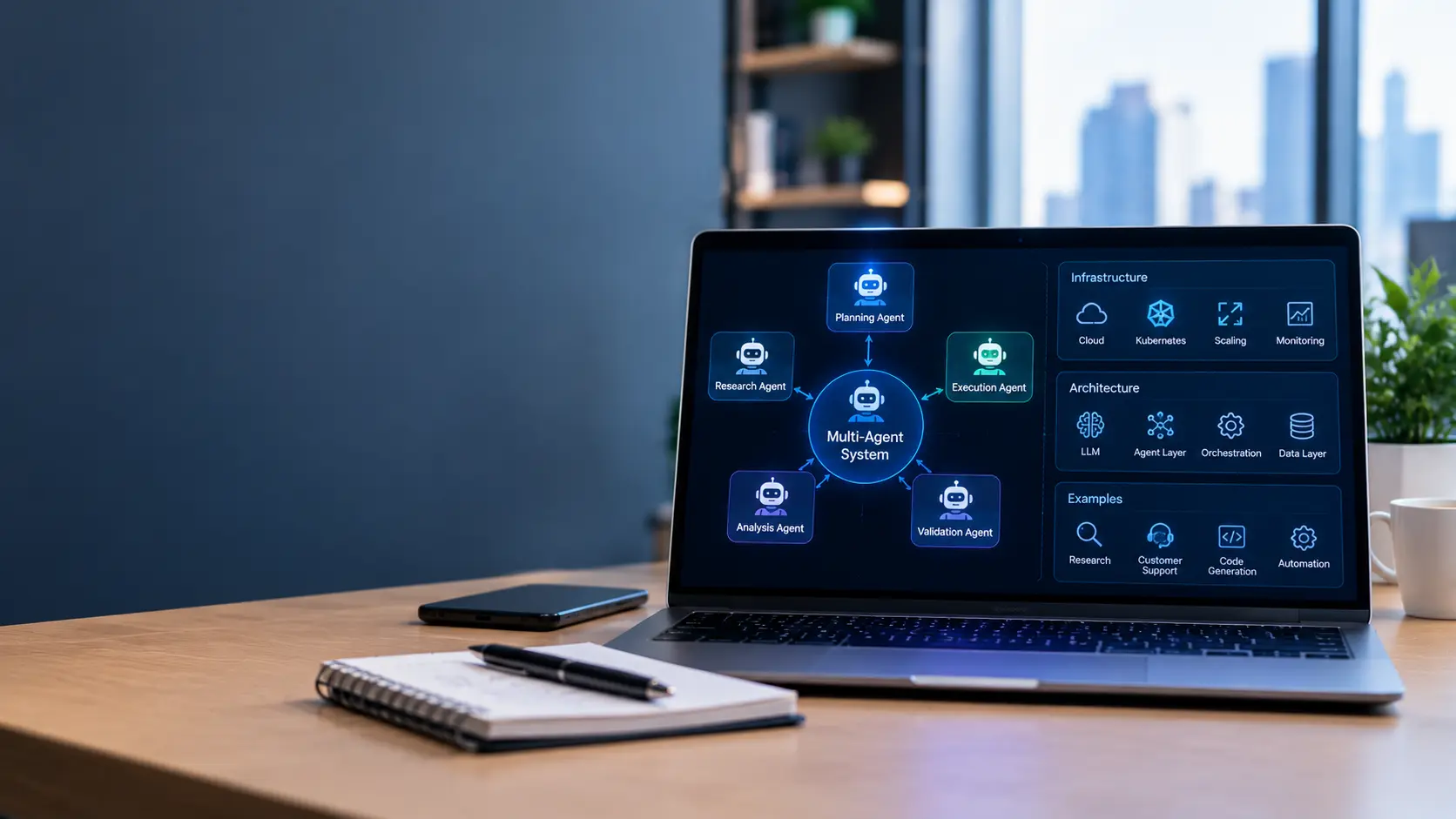
- Multi-agent systems can improve task specialization, coordination, and scalability by distributing complex workflows to specialized AI agents.
- Sequential, parallel, hierarchical and dynamic architectures enable organizations to align the coordination of agents to the needs of a particular workflow.
- CrewAI, LangGraph, and AutoGen are frameworks that provide different approaches to agent roles, orchestration, state, and collaboration.
- Multi-agent AI systems require production deployment, security, observability, governance, memory, and reliable communication.
- Gartner predicts that 40% of enterprise applications will be using task-specific AI agents by the end of 2026, up from less than 5% in 2025.
Key Summary: Multi-agent systems allow for cooperative, multiple specialized AI agents to coordinate tasks and work on complex business workflows. In this guide, we will explore the architecture, infrastructure, frameworks, benefits, downsides, use cases, development costs and future potential of these, in order to aid enterprises in assessing and developing scalable multi-agent AI solutions.
AI is moving from answering questions to completing tasks, connecting to tools, making decisions, and doing real work. As enterprise workflows get more complex, it may no longer be possible for one AI agent to control all of its steps.
This is where multi-agent systems (MAS) come in.
The work is distributed among different AI agents in a multi-agent system. Each agent specializes in one job, with a layer of orchestration on how they work together.
This approach is gaining attention as enterprises move AI from experimentation into real business processes. Gartner predicts that 40% of enterprise applications will feature task-specific AI agents by the end of 2026, compared with less than 5% in 2025. Gartner also estimates that by 2027, one third of the agentic AI deployed will involve agents with diverse capabilities working together to accomplish complex jobs.
At the same time new standards are making it easier for AI agents to communicate with tools and with other agents. MCP is about linking agents to tools, APIs and data, whereas A2A is about communication between autonomous agents.
Poorly designed multi-agent systems can be expensive, slow, hard to debug and cascades of errors can occur. In this guide, we’ll explain what multi-agent systems are, why enterprises use them, how to build multi-agent systems, their infrastructure and architecture patterns, popular frameworks, real-world examples, costs, challenges, and why multi-agent LLM systems fail.
What Is a Multi-Agent System?
A multi-agent system is an AI system, in which several specialized agents cooperate to perform a larger task or business workflow.
Think of it like a group of employees.
Instead of assigning a researcher to do all the work of researching a market, checking financial information, legal requirements, writing a report and sending it to a customer, you can divide the work up among specialists.
For example:
Research Agent → Data Analysis Agent → Compliance Agent → Report Agent
While most AI agents consist of an LLM that serves as the reasoning engine of the agent, an agent is more than an LLM. It can also have:
- Instructions
- Tools
- APIs
- Databases
- Memory
- Business rules
- Access permissions
- Guardrails
- Workflow responsibilities
Why Are Enterprises Adopting Multi-Agent Systems in AI in 2026?
Businesses have started deploying the technology for functions like content creation, file summarization, question answering, and coding.
1. Growing Enterprise Adoption
Gartner also estimates that 40% of enterprise apps will contain task-specific AI agents by the end of 2026, as opposed to less than 5% in 2025. Gartner also anticipates that collaborative agents will play a growing role as organizations take on more advanced workflows.
2. Infrastructure Is Becoming More Mature
Building agents used to take a lot of custom engineering. These days, developers have more standardized options for connecting agents to tools and to one another. Two illustrative examples in this regard are:
- MCP: Hooks up AI apps and agents to tools, APIs, data sources, and resources.
- A2A: Enables AI agents to find other AIs, assign them tasks, talk to them and share outputs.
3. AI Is Moving From Experiments to Production
Modern agent frameworks now provide capabilities such as:
- Agent handoffs
- Workflow control
- Tool calling
- Structured outputs
- Memory
- Guardrails
- Tracing
- Evaluation
- Human approval
- State management
Multi-Agent Systems vs. Single-Agent AI – When Do You Need MAS?
A single AI agent can perform many business tasks reasonably well when the workflow is simple, only a few tools are required, and one model can capture all the relevant context. A multi-agent AI system is one in which specialized agents deal with different tasks that are components of a more complex workflow.
| Dimension | Single-Agent AI | Multi-Agent AI |
|---|---|---|
| Task Complexity | Best for simple to moderately complex tasks that one agent can complete with its available context and tools | Better for complex workflows that contain multiple specialized tasks or decision points |
| Error Handling | A single error can affect the entire workflow because the same agent manages most or all steps | Specialized agents can validate, review, or correct outputs before the workflow continues |
| Scalability | Scaling one agent can become difficult as tasks, tools, instructions, and context increase | Workloads can be distributed across specialized agents and processes |
| Cost | Usually lower because fewer model calls and components are required | Can cost more due to multiple agents, model calls, coordination, memory, and monitoring |
| Maintenance | Simpler to develop, test, monitor, and update | More complex because teams must manage agent interactions, state, dependencies, and failure paths |
How to Build a Multi-Agent System – Step-by-Step
A multi-agent system requires more than just interlinking several LLMs and asking them to collaborate. If you are thinking about how to build a multi-agent system, the next steps represent a practical guide for multi-agent AI development.
Step 1: Define the Workflow and Agent Roles
Start with the business process, not the AI models.
Map the complete workflow and identify where the system needs reasoning, data retrieval, decision-making, validation, or action. Divide those responsibilities into logical agent roles. An enterprise customer service workflow, for example, might involve:
- Intent Agent
- Knowledge Agent
- Resolution Agent
- Validation Agent
- Action Agent
Step 2: Choose Your Architecture Pattern
After knowing what is to be done by each agent, a multi-agent architecture pattern suited to your workflow should be chosen. A sequential architecture is appropriate when one task is dependent on the output of another.
Step 3: Select the Framework and Tech Stack
The framework you choose will have lots of influence on how easy it is to build, coordinate, test and operate the system. Popular choices are CrewAI, LangGraph, AutoGen/AG2, Google ADK, and OpenAI Agents SDK. Your technology stack may include:
- LLMs
- Agent framework
- APIs and enterprise systems
- Vector database
- State and memory layer
- Observability tools
- Security layer
If your team lacks in-house agent expertise, you can hire AI engineers experienced in multi-agent orchestration.
Step 4: Design the Communication and Memory Layer
There must be some reliable means for agents to communicate information. They also need to be able to have the right context available to them without having to bring the entire workflow history with them to each model call. Protocols like MCP can provide a means for agents to manipulate tools and data, whereas A2A can enable communication between them.
Step 5: Build, Test, and Iterate
Do not roll out the entire agent network in one go, but incrementally build the system up.
Start with the smallest useful workflow. Connect two or three agents, test the handoffs, and see if the workflow works as anticipated.
Agent-level testing should examine:
- Instruction following
- Tool selection
- Output accuracy
- Failure recovery
- Permission boundaries
- Response consistency
System-level testing should examine:
- Agent handoffs
- Workflow completion
- State management
- Error propagation
- Latency
- Token usage
- Model costs
- Conflicting agent outputs
- Human escalation
Step 6: Deploy with Observability and Guardrails
It is more than just hosting the agents and connecting the APIs to get this into production. You need visibility into what each is doing, and control over what it is allowed to do. Incorporate observability early on. Your production controls should cover:
- Authentication and authorization
- Tool permissions
- Data protection
- Output control
- Human-in-the-loop controls
- Audit trails
- Failure recovery
- Quality assurance
Get the right agent roles, architecture, and framework in place before you write a single prompt.
How Do Multi-Agent Systems Work?
A multi-agent system is one where a complex goal is decomposed into smaller goals, which are then assigned to specialized AI agents who will be coordinated by means of a workflow. A typical multi-agent system architecture follows a flow such as:
1. Perception: Breaking Complex Goals into Subtasks
It begins with a business goal or a user request that comes to the system. One perception or planning component takes that goal and analyzes it to find the individual tasks it will take to accomplish it.
2. Agent Specialization: Predominantly Powered by a Large Language Model (LLM)
Each agent generally has a large language model (LLM) working as its reasoning engine, but the LLM is not alone. The agent is provided with the model as well as role instructions, tools, data sources, memory, and permissions. For example, a multi-agent AI system might include:
- Authentication and authorization
- Tool permissions
- Data protection
- Output control
- Human-in-the-loop controls
- Audit trails
- Failure recovery
- Quality assurance
3. Inter-Agent Communication and Coordination
Once agents have started working on different subtasks, they need a way to communicate results and request additional work. This is where communication between the agents has significance in multi-agent systems.
4. Orchestration: Managing the Workflow End to End
Orchestration manages how the entire multi-agent workflow runs. It determines which agent should act, when that agent should act, what information it receives, and where its output goes next.
An agent orchestration layer can manage:
- Agent sequencing and dependencies
- Parallel task execution
- Agent handoffs
- State and workflow memory
- Tool calls
- Retries and failure recovery
- Human approval steps
- Output validation
- Model routing
- Workflow completion
Core Infrastructure for Multi-Agent AI
An LLM and a prompt are not all that is needed for a robust multi-agent system infrastructure. It has to support coordination, communication, memory, selection of models, security, and monitoring of agents.
1. Agent Orchestration Layer
The orchestration layer is the multi-agent system’s control centre. It decides who should perform a task, when to perform it, what input/context to provide to it, and where to direct its output.
Effective agent orchestration should support:
- Task routing
- Workflow management
- Agent handoffs
- State tracking
- Failure recovery
- Human escalation
- Tool management
- Workflow tracing
2. Agent Communication Protocols: MCP, A2A, and ACP
Agents also need a standard way of communicating with tools, data sources and other agents.
- MCP (Model Context Protocol): It provides a standard interface for AI applications to access external tools and sources of data. In practice, MCP protocol agents can now connect to any approved system without every integration needing to be constructed as an entirely distinct custom connection.
- A2A (Agent2Agent): It is about communication between AI agents. The A2A protocol allows agents of different capabilities, frameworks or underlying implementations to cooperate and communicate.
- ACP (Agent Communication Protocol): It is another approach to agent-to-agent communication and interoperability. Just as enterprises should not by default deploy all ACP, MCP and A2A, they should reflect on which one of those protocols fits best to their ecosystem and interoperability needs.
3. State Management and Memory
Multi-agent workflows produce significant amounts of temporary and persistent data. If the state is not properly managed, agents can lose context, repeat work, or act on stale data. The main elements can include:
- Workflow state
- Working memory
- Long-term memory
- Knowledge retrieval
- Session management
- State synchronization
Multi-Agent System Architecture Patterns
The right architecture also determines how agents will divide work, how they will exchange information, or how they will react when things go wrong. The most frequent patterns of multi-agent architectures are sequential, parallel, hierarchical and dynamic.
1. Sequential (Pipeline) Architecture
A serial architecture processes work through agents in a predetermined sequence. Each agent performs its task and sends the output to the next agent.
Best for:
- Step-by-step business workflows
- Document processing
- Research and analysis
- Data transformation
- Processes with clearly defined dependencies
Limitation: If there is a failure or delay in one stage, the whole process becomes stalled.
2. Parallel Architecture
In a parallel architecture the different agents perform separate tasks simultaneously. Instead of waiting for one agent to finish a job for the other to start, this system assigns different jobs to various agents and blends the results later.
Best for:
- Independent research work
- Heavy data workloads
- Multi-source analyses
- Workflows in which response time has a cost; independent tasks
Limitation: Synchronization problems come in as operations run parallel. The system must also know how to appropriately fuse the outputs, handle agents that finish at different times, and know how to deal with conflicting outputs.
3. Hierarchical (Supervisor-Worker) Architecture
There is a hierarchy of supervisor or coordinator agent over specialist worker agents. The supervisor breaks down the goal, assigning broken pieces of it as tasks, evaluates the outcomes, and decides what should happen next.
Best for:
- Complex enterprise workflows
- Multiple specialized agents
- Decision-heavy processes
- Workflows requiring centralized control
- Tasks that may require different execution paths
Limitation: Overreliance on one coordinating agent could mean that the supervisor becomes a bottleneck or single point of failure.
4. Dynamic (Adaptive) Architecture
The architecture is dynamic, so that this system can assign the workflow at runtime. Agents are not necessarily pursued in a pre-established order or within a strictly defined hierarchy; rather, they can be chosen depending on the endeavor, the information accessible, prior outcomes, or shifting conditions in business.
Best for:
- Unpredictable or open-ended workflows
- Complex decision-making
- Adaptive research and analysis
- Agentic systems that need runtime planning
- Business processes where the required steps vary by case
Limitation: Dynamic architectures are harder to predict, test, monitor, and administer.
Structures of Multi-Agent Systems
The multi-agent system structure determines the way agents interact, share tasks, and coordinate to achieve a common goal. If architecture patterns account for agents’ execution of a workflow, system structures account for the organization of agents and their interaction in such an environment.
1. Hierarchical Structure
The agents are organized in a hierarchical fashion. The higher-level agent usually coordinates the lower-level agents, allocates tasks, monitors progress, and integrates their outputs.
Key characteristics:
- Clear chain of responsibility
- Centralized task delegation
- Specialized agents at different levels
- Easier control over complex workflows
- Suitable for supervisor-worker systems
2. Holonic Structure
The agents are organized in groups called holons. A holon is an autonomous functional unit that can be integrated into a larger MAS (multi-agent system). An SCM (supply chain management) system for example could be formed by distinct holons at procurement, inventory and logistics.
Key characteristics:
- Agents can act independently
- A group can have its own internal coordination
- Holons may work with other holons
- Enables modular systems design
- Well suited for distributed environments
3. Coalition Structure
A coalition structure refers to the temporary grouping of the agents to work towards an objective. A coalition is not a stable hierarchy, but one that can form, shift and dissolve according to a particular task.
Key characteristics:
- Task-specific collaboration
- Flexible agent membership
- Temporary relationships
- Useful for changing workloads
- Supports dynamic resource allocation
4. Teams
Agents working within such a framework are working with a shared goal and each agent contributes a certain capability.
Key characteristics:
- Shared objective
- Agent roles defined
- Joint decision-making
- Continuous exchange of information
- Ideal for sophisticated joint processes
Advantages of Multi-Agent Systems in AI
The benefits of multi-agent systems can be seen in workflows that require multiple sequences of tasks, tools, data, and decisions.
Better Task Specialization
Multi-agent AI allows each agent to perform a specific task and have a specific responsibility for things like research, data analysis, compliance checking, coding, customer support and such.
Improved Scalability
Having a multi-agent system means being able to distribute workloads among different agents rather than having the whole workflow on one agent. Agents can be plugged into organizations as processes get more complex without re-engineering the entire AI workflow.
Parallel Task Execution
Agents can work on autonomous tasks simultaneously. One can, for instance, interpret market trends while another agent reads through customer data. An orchestration layer can then combine their results, minimizing delay in the workflow given that the tasks are independent from one another.
Challenges of Multi-Agent Systems in AI
Multi-agent systems offer many benefits for complex AI workflows, but companies must solve several issues before they can roll them out securely, cost-effectively, and reliably.
- Higher Development and Infrastructure Costs: More agents can drive up LLM calls, API usage, compute requirements, and infrastructure costs.
- Conflicting Agent Action: Agents require defined roles, communication protocols, handoff procedures and logic for who decides and on what, to not work at cross purposes or duplicate work.
- Error Propagation: If one agent makes an error, all downstream agents that depend on its output will also be erroneous.
- Increased Latency: Multiple calls to agents and hand-offs introduce delays and processing time, particularly with complicated processes.
- Context and Memory Management: Giving agents too much context will lead to an expensive token use and less pertinent answers.
Top Frameworks for Building Multi-Agent Systems: CrewAI vs LangGraph vs AutoGen
The right one for you will depend on what degree of workflow control, agent collaboration and orchestration you need on your application.
CrewAI: Role-Based Agent Teams
- Strength: Role-based design is simple, allowing specialized agents to work toward a common goal.
- Architecture: Tasks, agents, flows, and crews organize workflows by sequence or by hierarchy.
- Limitation: Not very flexible if you have workflows that need customized transitions between states, and complex routing.
LangGraph: Graph-Based Workflow Control
- Strength: Provides extremely fine control over agent workflows, state, branching and execution.
- Architecture: Defines workflows as graphs of tasks or agents, connected by edges which affect the execution.
- Limitation: Requires more engineering and knowledge of the states that are being represented in a graph.
AutoGen / AG2: Conversational Agent Collaboration
- Strength: Allows agents with different capabilities to work together in structured dialogues.
- Architecture: Supports different team patterns like round-robin or based on a selector.
- Limitation: Use of agent dialogues tends to raise coordination costs and complexities, costs of execution and difficulties in termination.
Google ADK, OpenAI Agents SDK, and Claude SDK
- Google ADK: Offers orchestration of agents and tools within Google’s AI ecosystem, but be aware of ecosystem dependencies before using it.
- OpenAI Agents SDK: Supports agents, tools, handoffs, guardrails, sessions, MCP and tracing, can be used for controlled multi-agent workflows.
- Claude SDK: This is a solid starting point for any application built around Claude, but the level of multi-model flexibility sought by organizations should raise concerns about provider dependency.
| Framework | Core Approach | Best For | Key Strength | Main Limitation |
|---|---|---|---|---|
| CrewAI | Role-based teams | Structured agent collaboration | Simple role and task management | Less workflow-level control |
| LangGraph | Graph-based workflows | Complex, stateful workflows | Fine-grained orchestration | Higher complexity |
| AutoGen / AG2 | Conversational collaboration | Dynamic agent interaction | Flexible agent teams | More coordination overhead |
| Google ADK | Agent and tool orchestration | Google ecosystem applications | Integrated agent tooling | Ecosystem dependency |
| OpenAI Agents SDK | Agents, tools, and handoffs | Controlled agent workflows | Guardrails and tracing | Less infrastructure-level control |
| Claude SDK | Claude-based agent development | Anthropic-focused applications | Strong Claude integration | Provider dependency |
Multi-Agent System – Real-World Examples by Industry
Multi-agent systems are able to deal with complex business processes by assigning different tasks to different specialized agents and coordinating the multi-agent output through a common workflow. Here are industry-specific examples of this approach in action.
1. Financial Services: Fraud Detection and Compliance
Banks can then use these agents to analyze transactions, alerting them to potentially problematic or suspicious patterns, regulatory compliance, and generating alerts.
Multi-agent pipeline: Transaction Monitor → Pattern Analyzer → Compliance Checker → Alert Agent
Potential result: An improved workflow can manage up to 40% fewer false positives while allowing near real-time compliance reporting.
2. Healthcare: Credentialing and Workforce Management
Credentialing and workforce development in healthcare organizations can also be automated by parceling out document review, credential matching, scheduling, and communication to separate agents.
Multi-agent pipeline: Document Verifier → Credential Matcher → Scheduling Optimizer → Notification Agent
Expected outcome: Automation can reduce manual credential verification process to 80% depending on the complexity of the documents and place of integration.
3. Supply Chain and Logistics: Global Operations
Credentialing and workforce development in health organizations can also be parceled out by having separate agents perform document review, credential matching, scheduling and communications.
Multi-agent pipeline: Document Verifier → Credential Matcher → Scheduling Optimizer → Notification Agent
Expected outcome: Automation can reduce this manual process of credential verification by 80% depending on the complexity of the documents and place of integration.
4. Retail and E-Commerce: Personalized Customer Experience
Retailers can string several of these agents together to understand customer intent, recommend products to customers, inquire about inventory, respond to customers using real-time product and availability information, etc.
Multi-agent pipeline: Customer Intent Classifier → Product Recommender → Inventory Checker → Responder
Potential result: A responsive workflow can deliver customer queries to agents as much as 3x faster when integrated with other systems of product data and commerce.
5. Software Development: AI-Augmented Engineering
Teams of developers can offload the coding, reviewing, testing, and deploying to specialized agents.
Multi-agent pipeline: Code Generator → Code Reviewer → Test Writer → Deployment Agent
Potential result: The NineHertz states that its AI-native development approach can deliver 4x to 7x faster velocity where AI use is permitted.
Architecture, orchestration, and observability built for enterprise scale.
How Much Does It Cost to Build a Multi-Agent AI System?
The cost of creating a multi-agent AI system ranges from $30,000 to over $200,000, depending on a variety of factors such as the number of agents, the complexity of the workflows, specific capabilities and types of integrations needed, chosen AI models, the security levels required, and the size of the deployment.
The Future of Multi-Agent Systems – What’s Coming Next
The future of multi-agent systems is now heading towards interoperable specialized AI agents that can collaborate across applications, business functions and enterprise systems instead of being functionally isolated assistants.
Greater Adoption of Agent Interoperability Standards
Protocols like MCP and A2A will become more relevant as companies connect agents that were developed with different platforms and technologies. While A2A is meant for agents to learn capabilities and converse with one another in multi-framework environments, MCP is oriented around linking AI applications to tools and data.
Dynamic Agent Teams
There will not always be a set pool of agents in future systems. Instead, an orchestration layer can choose and coordinate the agents based on the task, expertise needed, data available and state of the workflow.
Stronger Observability and Governance
As organizations deploy greater numbers of agents, monitoring and governance will become a necessary evil. Gartner estimates that by 2028 an average Global Fortune 500 organization could have in excess of 150,000 agents in use and will need centralized visibility, lifecycle management, access controls and policy enforcement.
Partner with The NineHertz for Multi-Agent System Development
As multi-agent AI transitions from experiment to enterprise deployment, just connecting up multiple agents is not enough for success. Organizations require a defined workflow strategy, the appropriate architecture, robust orchestration, secure access to enterprise data, and high observability to help agents collaborate successfully.
The NineHertz uses its AI-native engineering culture and ContinuumAI framework to help companies bring these kinds of needs into production-ready multi-agent AI systems. The NineHertz can assist with every step of an agentic AI project, from defining the roles and workflows of agents to building, integrating, governing and ongoing fine-tuning.
Are you ready to convert your AI workflow into a scalable multi-agent system? Contact The NineHertz to plan, build, and deploy your next agentic AI solution.
Frequently Asked Questions About Multi-Agent Systems
What is a multi-agent system in AI?
A multi-agent system uses a number of specialized AI agents that collaborate, communicate and coordinate to perform more complex tasks.
What distinguishes a multi-agent system from a single AI agent?
In a single-agent system, the workflow is handled by one agent, while in a multi-agent system the workflow is split across specialized agents that coordinate among themselves.
What are the architectures for multi-agent systems?
They support different needs in workflow and coordination, such as sequential, parallel, hierarchical and dynamic communication patterns.
Which framework is best for building multi-agent systems?
CrewAI, LangGraph and AutoGen are just a few examples of the many possible technologies to use; the best option depends on how complex and controlled you want your workflow to be.
How much does it cost to build a multi-agent system?
A multi-agent system cost range is $30,000 to $200,000 or more, depending on complexity, integrations, models, security and deployment needs.
Where are multi-agent AI systems used?
Such multi-agent AI systems are actively deployed in numerous industries such as financial services, healthcare, retail, logistics, manufacturing, software development, insurance, etc.
Can LLMs of different kinds be used in a multi-agent system?
Yes. Multi-agent systems can route different tasks to different LLMs based on capabilities, performance, latency and cost.
Great Together!
Latest Blogs
10+ Top NFT Rarity Tools – How to Calculate it?
The world of NFTs is still very new, and it's hard to predict where the trend will go next. However,…
10 Best Progressive Web Apps (PWA) Examples in 2026
When it comes to PWAs, the sky's the limit in terms of scope and potential. Whether you're looking to create…

How Much Does it Cost to Develop a Car Wash App in 2026?
The global car wash services market witnessed unprecedented growth with the continuously increasing popularity of mobile apps like Spiffy, Washos,…