
The usage of AI in insurance industry is increasing due to rising costs of claims, loss due to fraudulent claims, and rising consumer demands for service at a fast pace. Each year, the FBI estimates that fraudulent activities cost insurance companies $308.6 billion dollars.
The issues also bring operational challenges, causing major “silent losses” within the organization. Due to inefficient workflows, many companies are experiencing high abandonment rates throughout the quote-to-bind process. Deloitte claims that if companies do not implement advanced analytics into daily operations, they will have a competitive disadvantage.
The NineHertz carries the ability to eliminate these issues with personalized, AI-driven solutions in the insurance industry by automating claims processing and reducing fraudulent claims. We are also proficient at building machine learning models that enhance underwriting decisions and overall customer experience.
In this guide, you will learn major developments in the insurance sector, the key benefits of AI within insurance, how AI can be implemented into the insurance industry, and different case studies demonstrating emerging trends in agentic AI and how Gen AI will be utilized by the sector.
The use of AI in insurance industry is growing as companies invest in automation, analytics, and digitization. Market research shows that the sector will grow from USD 14.99 billion in 2025 to almost USD 246.3 billion by 2035, with a CAGR of about 32.3%.
North America is the leader in adoption, accounting for almost 45% of market growth during the forecast period, supported by mature insurtech ecosystems and early cloud adoption. The cloud segment was worth about USD 1.42 billion before, and it is expected to grow as insurers move away from old systems.
About 76% of insurers have already used generative AI in at least one area. Claims automation and fraud detection are still the most popular areas for investment, as they offer measurable efficiency gains and faster processing times.
Fraud schemes are getting complicated, claim types and risk patterns are changing quickly, which puts more pressure on claims and underwriting teams. Traditional models struggle to match the speed and size of today’s data. This is where the insurance sector utilizes AI.
Fraud schemes are becoming more sophisticated, claim types are evolving rapidly, and risk patterns are shifting constantly, putting increasing pressure on insurance teams.
The way customers act has also changed. People who have insurance now expect instant quotes, personalized coverage, and quick responses on all digital channels. Delays that used to be normal now make customers dissatisfied. When insurers do manual reviews, they often fall behind in both speed and experience.
Developing AI systems can look at risk signals, read documents, and find insights in seconds instead of days. Underwriters get clearer information faster. Claims teams get the data quickly. Fraud investigators find patterns before losses get worse.
The level of complexity continues to rise due to changing market dynamics. Older methods can’t keep up with the layers of uncertainty that climate events, cyber threats, and behavioral risks create. Insurers can use machine learning models to constantly process these signals and adapt to new patterns
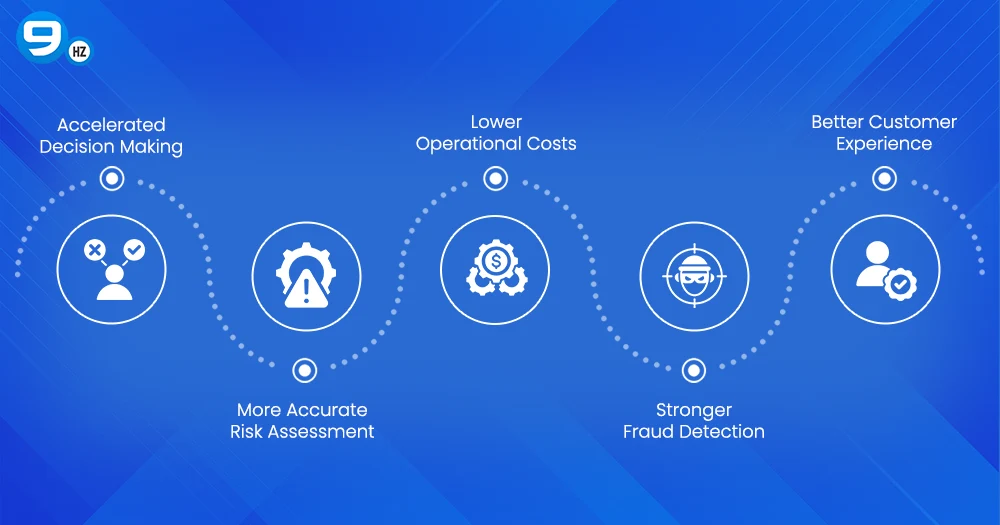
The potential of AI is not only demonstrated in “strategy deck” formats but can also be found within all of our daily decisions. These advantages demonstrate how teams can work faster and provide improved service across all aspects of their roles in underwriting, claims processing, and customer support.
Teams can spend hours reviewing reports, emails, and other documentation before making a decision about an underwriting or claims file. With gen AI in insurance, underwriters and claims teams can quickly summarize all of the documents associated with a claim and identify the most important information contained within those documents. Gen AI allows insurers to respond to customer inquiries faster.
Risk scoring gets better when systems keep analyzing huge amounts of data over time. Agentic AI in insurance can gather data, check the validity of inputs, and help make scoring decisions that are consistent across multiple systems. As a result, policy pricing is more aligned with the real-time risk.
Automation reduces repetition in work across claims and underwriting. Claims intake, document validation, and initial reviews can be run with the least manual involvement. Some industry reports indicate that there is a very high level of automation possible in the typical claims workflows. However, the exact figures differ from one insurer to another and are dependent on the level of maturity of the implementation.
AI systems look at the pattern of claims, policy history, and behavior signals. They mark strange activities much faster than manual checks. Several studies reveal that detection rates increase with machine learning. However, the model efficiency depends on the quality of the data and the design of the model.
AI facilitates quicker and more convenient responses. Chatbots assist with frequently asked questions, aid customers in filing claims, and update customers on claim statuses without long wait times. Industry studies indicate that automated customer support systems are handling a number of customer interactions, particularly for simple inquiries.
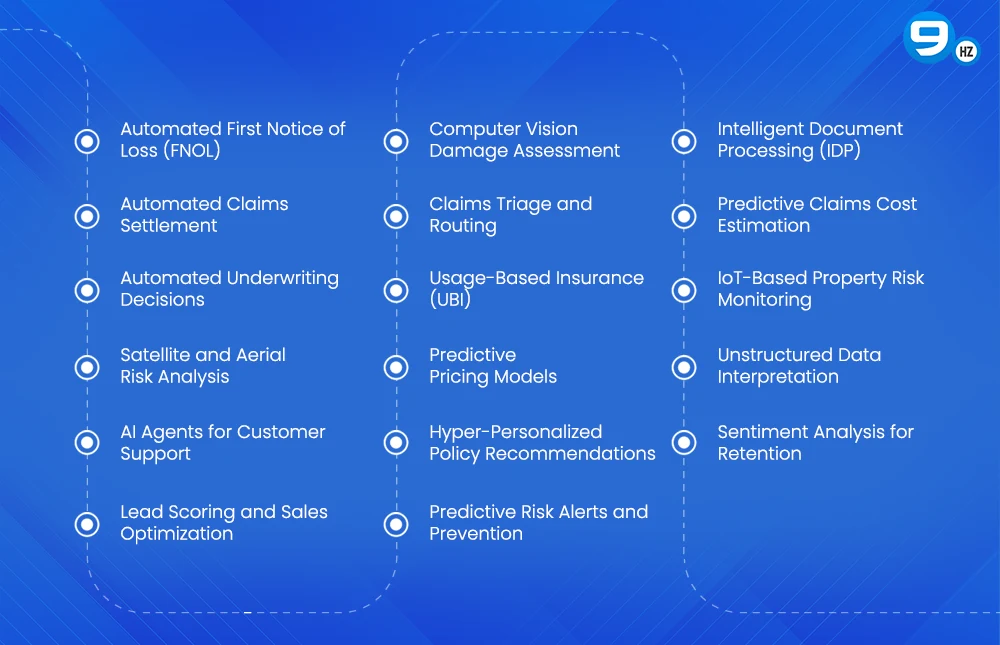
The applications are based on actual AI use within the insurance industry, not just theoretical. These AI use cases in insurance provide faster service, make better risk decisions, and handle higher levels of complexity.
AI agents gather claim data instantly via chat, mobile apps, or voice systems. The program not only logs the incident details but also cross-checks policy numbers, evaluates coverage status, and finally generates a neatly structured claim document. This eliminates waiting times and errors in data entry. AI speeds up the claim initiation, while the cases demanding empathy or clarification are assigned to human specialists to handle them.
AI evaluates the pictures and video recordings of the damaged vehicles, properties, or equipment. It detects the physical damage, calculates the repair cost, and assesses the damage level severity. Adjusters do not use these pictures for their original observations; instead, they use this analysis as a starting point. This way, the professionals are still kept in the loop even though the inspections are sped up.
AI employs OCR and NLP technologies to read and extract data from a variety of documents, such as medical reports, legal files, invoices, and even handwritten forms. The system organizes the data into structured formats, ensuring that teams do not have to sort the data manually. This helps to eliminate delays caused by paperwork and also assists teams in working faster while human reviewers verify the information.
AI verifies the policy and initiates the payments for the standard claims, such as minor car damage. Such straightforward processing not only quickens the settlements but also frees human adjusters from routine. This allows teams to concentrate on complex, high-value, or suspicious cases that require careful judgment, legal negotiation, and emotional understanding.
AI categorizes new claims by reviewed criteria, based on urgency, cost, and complexity. It assigns each claim to the appropriate claims adjuster or specialist independently. This keeps a balance of work and ensures that high-priority claims don’t end up trapped in the system.
AI reviews historical claims data to assist in predicting the settlement amount for a claim. Financial and claims departments can use this information to make more accurate reserve planning and financial forecasts.
AI reviews applicant data, financial records, and previously identified risk signals to expedite the underwriting process. The program quickly identifies low-risk cases and elevates any high-risk profiles for further review. Underwriters spend less time on routine reviews and use specific data points for decision-making.
AI reviews telematics data from vehicles to analyze driving habits, including acceleration, braking, and locations traveled. Using real-time data allows insurers to modify an individual’s premium based on the actual level of risk they are assuming. As a result, pricing will be more equitable and promote safe driving behavior.
AI analyzes data from smart devices in homes that can help detect leaks, fire hazards, and security breaches. Insurance companies then utilize that info in determining the current level of risk and to provide guidance on how customers can reduce that risk.
AI uses satellite images and aerial photographs to check out the environmental risks surrounding properties. It helps identify the exposure of the properties to floods, the availability of green areas, and the structural weaknesses. All these components lead to risk assessment without the need for physical checks.
AI processes large data sets to develop risk trends among different demographics, geographies, and behaviors. The data help curate insurance pricing models, which in turn give insurers insight into where clients can suffer a loss.
Using NLP, AI can analyze inspection reports, health records, and financial statements. The result is a concise summary of essential risk factors that underwriters can quickly review rather than having to spend time reading a long report.
AI reads claim data, timing patterns, and behavioral signals to detect activities that look suspicious. It immediately informs investigators when something is wrong so they can react fast and prevent losses.
AI identifies connections between claimants, repair shops, and service providers. It detects organized fraud networks by searching for invisible links among various claims.
AI verifies your identity by analyzing your voice patterns, face, or other biometric signals. It prevents ID theft and ensures that customer interactions are safe across all digital channels.
AI agents manage everything from policy updates to tracking claims to service requests. These agents differ from traditional chatbots as they can connect multiple systems and perform tasks independently. If emotional support or assistance with a complex problem is needed, human representatives intervene.
AI examines how customers behave, what they do in their free time, and their past purchases. It recommends policies that better suit each person’s needs and help to close the coverage gaps.
AI scans emails, chats, and call transcripts to detect customers’ frustration. This notifies support teams for early intervention and retention of customers.
AI ranks potential customers based on the likelihood of converting. Sales teams focus on the most promising leads and reduce time spent on low-value prospects.
AI utilizes health data, weather forecasts, and driving habits to provide customers with alerts related to the potential risks of driving, experiencing bad weather, or developing health issues. This shifts insurance from reacting to claims toward preventing losses.
For a seamless implementation, companies require a systematic approach for their rollout and focus on pilot projects, integration of workflows, and gradually scaling up. This implementation roadmap has six phases that many insurers follow from idea to execution.
AI systems require clean, structured databases to operate successfully. Before building models, insurers need to bring claims, underwriters, and customer data together at one location. If the data is poor, the predictions created will be inaccurate, and the process will take longer to be adopted.
Most insurers opt for claims automation first since its impact can be observed quickly. Claims activities are characterized by high volume, repetitive tasks, and significant cost pressure, which can be measured. The initial success allows teams to gain trust in the AI systems.
Cloud platforms enable insurers to handle larger datasets and accelerate the deployment of models. They cater to capabilities like real-time data ingestion, scalable computing, and simplified system integration.
Embedding AI within underwriting, claims, and service processes is one of the core ways it generates substantial value. Tools that are kept separate and standalone usually do not get used. Integration guarantees that workers trust the AI-derived information when making the final decisions.
Employees know how to efficiently use and communicate AI outputs. Training can fade away resistance and eventually lead to better adoption. In addition, the team members get to know when it is appropriate to depend on the automation and when it is necessary to use their own judgment.
Following the success of the pilot projects, insurers take the initiative to cover other departments with AI. Governance frameworks are useful for keeping track of performance, handling risk, and ensuring compliance.
Real-world examples show how AI delivers measurable impact. Each AI in insurance case study below highlights how companies improved efficiency and decision speed through practical implementation.
Aviva completely transformed its claims process for customer enterprises by integrating over 80 AI models to enhance each stage of the claims journey. This “domain-wide” approach, which was developed in partnership with McKinsey’s QuantumBlack, aimed not only at reducing industry costs that had risen by 11% higher than the Consumer Price Index by 2023 but also at elevating the customer experience.
The impact was substantial. Aviva revealed that the company’s claims transformation initiative resulted in more than 60 million in savings. The period for determining liability in complex cases was cut down by 23 days. A 30% increase in routing accuracy ensured that the right teams were receiving the claims faster. Customer complaints also decreased by 65%, which is a clear indication that AI can enhance service quality directly as well as operational efficiency.
AI assists with initial assessment, document review, and establishing work priority throughout triage. Humans still handle sensitive or complex claims but day-to-day decisions become faster. This AI in insurance case study illustrates that for real enterprise value to be obtained from an enterprise domain.
Lemonade has forever changed how consumers interact and do business within the insurance marketplace through its chatbot “AI Jim.” It manages the entire process of claims, rather than relying on the traditional, manual claim processes. The “AI Jim” analyzes video submittals and evaluates coverage. After the evaluation, the system automatically approves funds to pay out claims in seconds without any need for human intervention. This not only reduces operating costs, but it also has greatly improved the overall customer experience.
As of 2025, Lemonade automates approximately 55% of all received claims, which is helping them achieve growth in excess of $1 billion in premium volume. The AI-first methodology has also resulted in lower costs for processing loss adjustment costs. The elimination of manual processes through the implementation of AI has also resulted in better operating efficiencies and high customer satisfaction scores.
Even with its success, there are still some issues with privacy and transparency regarding data, algorithms, and their usage. In an effort to mitigate the problems of bias, Lemonade has taken the step of having a human expert review any claim rejections made through AI. This is a good balance of speeding up the use of technology and having fair and correct oversight from a person on complicated insurance claims.
This AI in insurance case study demonstrates how an AI-first business model significantly reduces the amount of time required for processing claims and increases customer satisfaction.
The NineHertz an AI solution development company, helps in AI implementation by developing AI systems that meet the real operational needs. Custom development, secured integration, and deploying solutions across systems related to underwriting, claims processing, and fraud detection are the key areas of focus.
The NineHertz helps insurance companies utilize unique AI models based on their own data and processes. Examples include ways to automate the processing of claims, create risk scoring, identify fraud patterns, and provide predictive insights that allow teams to operate faster. Our AI solutions work seamlessly with existing systems for policies, claims, and customers. This allows the team to utilize the insights derived from the AI solutions without adding additional work to their daily tasks.
By partnering with The NineHertz, insurance companies can easily advance from performing pilots of their AI initiatives to establishing fully operational systems that are clearly established to provide measurable returns.
From early adoption data to strategy for implementation, the path is evident. AI in insurance industry increases the speed, precision, and customer reaction. Robust databases, targeted trials, and organized expansion lead to the realization of genuine AI applications in insurance in the areas of underwriting, claims, and fraud detection.
Companies that take action now will be better able to handle risk, respond quickly, and run their businesses more smoothly. People who wait may find it hard to keep up as expectations keep rising.
The opportunity already exists. The next step is execution.
Underwriting, claims processing, fraud detection, and customer communication are all supported by insurers using technologies like machine learning, natural language processing, computer vision, and GenAI.
Depending on scale and scope, costs can vary significantly. Enterprise deployments can cost several million dollars, while smaller pilot projects might begin at around $40K. Effective implementations frequently result in a multi-year return on investment through increased efficiency and improved risk management.
AI agents automatically gather data, validate documents, and produce early risk insights. This speeds up processing overall by cutting down on manual review time and assisting underwriters in making decisions more quickly.

Are you looking for the top AI development company in the USA? Guess what, you’ve come to the right destination.…

Key Takeaways Multi-agent systems can improve task specialization, coordination, and scalability by distributing complex workflows to specialized AI agents. Sequential,…

Key Takeaways AI supply chain risk monitoring uses real-time data and predictive models to flag disruptions before they escalate into…