How Much Does Wellness App Development Cost?

High costs and limited access to wellness therapies are roadblocks to individuals who seek help related to their issues, but healthcare leaders are addressing them through wellness app development. When it comes to developing it, the universal question is: how much does it cost? Approximately, it ranges from $30,000 to $200,000 or more, depending on precise needs.
Due to challenges in personal and professional life, less physical activity, and a sedentary lifestyle, a significant segment of the global population is experiencing health issues and actively seeking options to overcome wellness issues. This shift presents a critical opportunity for forward-thinking enterprises and investors to deliver holistic healthcare platforms that enable better care, deeper engagement, stronger retention, and recurring revenue.
From a different perspective, healthcare organizations are facing challenges such as scattered patient data, low customer stickiness, and manual support processes that drain time and resources. The best solution is to build an AI-powered wellness app that overcomes the administrative burden, optimizes the resources, saves cost and time, and provides better facilities to the end users.
As demands for modern options are rising, the global wellness apps market is expanding and poised to reach USD 26.19 billion by 2030 at a CAGR of 14.9%(2025-2030). North America is leading with a 36.3% share, and some of the top leading players are apps like Mindscape, Clam, Headspace, and Sleepace.
The industry leaders’ ultimate secret is robust architectures that navigates strict data privacy laws while delivering the intuitive, high-performance experience that modern users expect. Your next move should be creating a competitive app covering all elements, including the surprising idea, especially when it’s your first move in the industry, or you want to modernize your services.
Before you start with your next project, analyzing the wellness mobile app development cost and knowing about the financial and technical requisites is a must. This guide walks you through a breakdown of everything related to the cost to build a market-leading, futuristic wellness app solution.
What is a Wellness App?
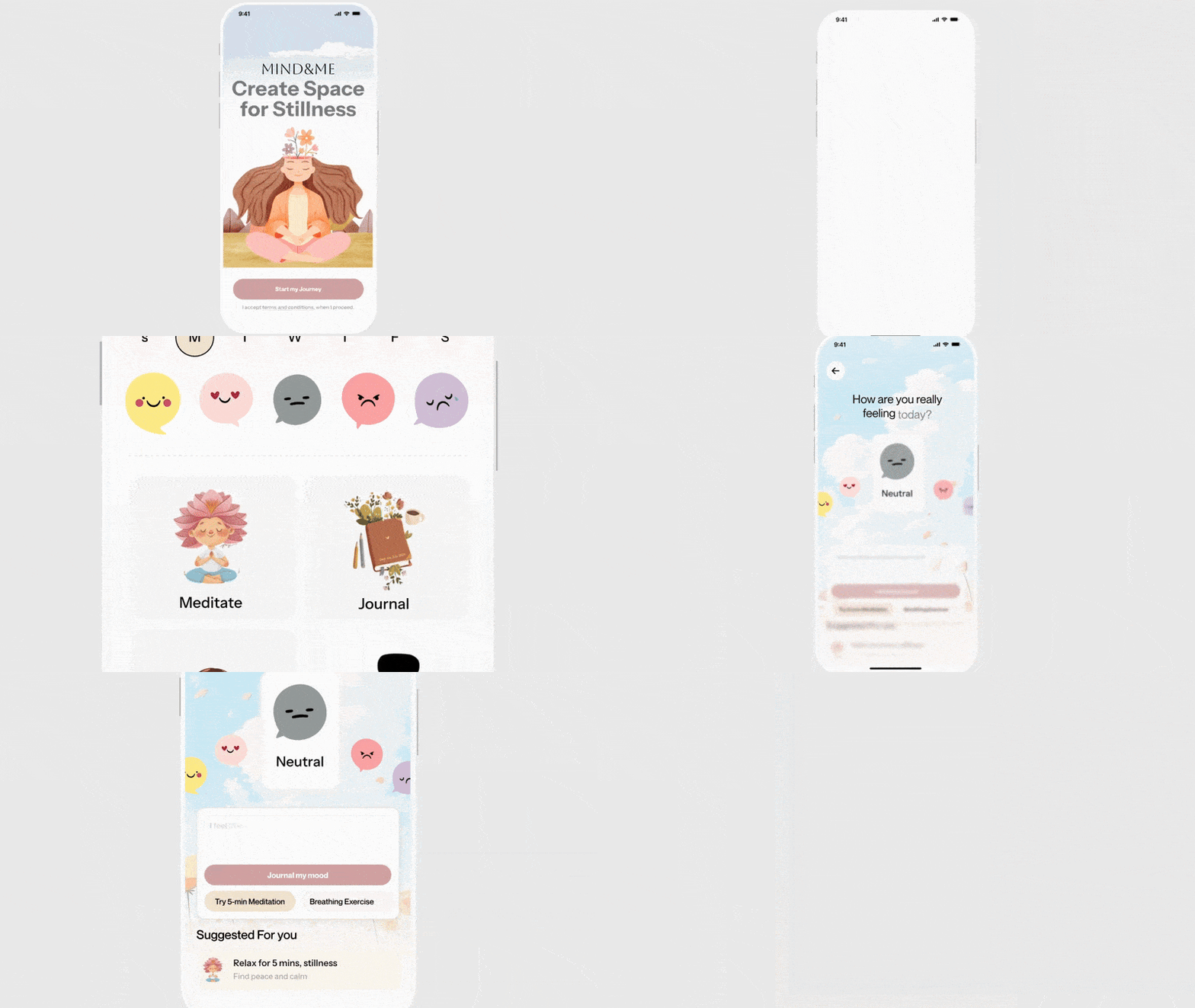
The wellness & fitness app development is all about creating digital products that can assist individuals to be more mindful, body-wise, and habitually healthy.
Wellness apps could be meditation apps, fitness and step-tracking apps, nutrition planners, women’s health, or any solution that improves your overall wellness.
Moreover, modern wellness applications offer users more than just reminders and habit tracking. They offer features as:
- Personalized routines based on user lifestyle.
- Smart mood + activity recommendations.
- Wearable sync for Fitbit, Apple Watch, and Garmin.
- Anxiety and emotional wellness support and chat.
- Meditation and physical exercise sessions.
So, if you are creating a wellness app that helps a person to be healthy throughout the day until bedtime, these features are a must.
However, when it comes to the cost of wellness app development, the first thing you should do is to understand what kind of wellness app you would like to develop. Each group has its own technological requirements, functionality, and price. So, let’s get going.
Types of Wellness Apps
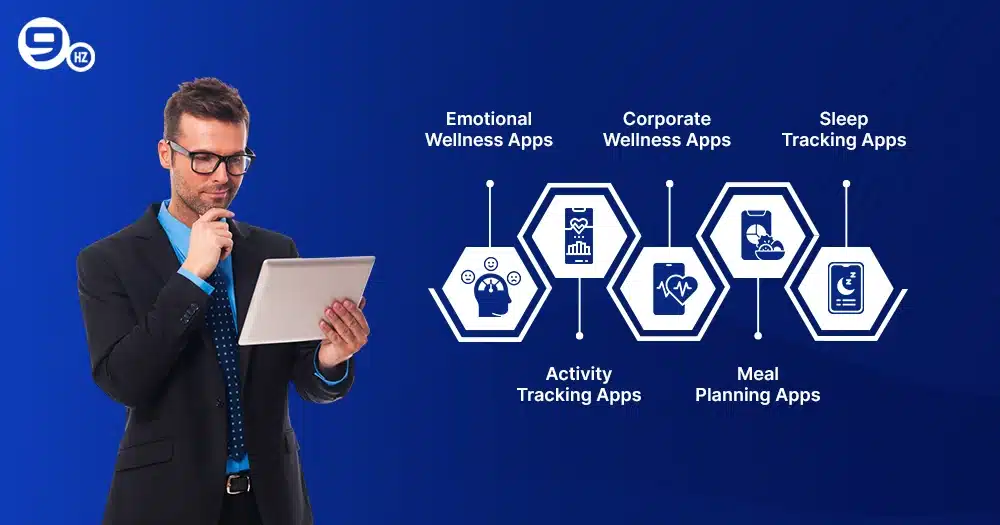
Wellness apps are diverse and serve specific purposes, from emotional to physical wellness. Strategically, it’s important to understand the types of wellness apps, how they work, and what they offer. Therefore, you can decide to launch your app aligned with the preferences of your target audiences.
This includes the following:
#1. Fitness & Activity Tracking Apps
One of the top segments of wellness apps is fitness and activity tracking apps. While reading this article, almost all of us carry it in our phones or smartwatches. These types of fitness apps track body movements, activities, pulse rate, and even the footsteps you take in a day.
The app works in sync with wearable devices and utilizes sensors. Some of its top examples are apps like Fitbit or Strava. These apps are helpful in exercise tracking, personalized workout plans, and progress monitoring.
Pro Tip:
If you have a plan to create an app like MyFitnessPal, for its strategic success, go through all its competitors, features, and add your twist. In terms of cost, the ballpark estimate is $40,000 to $150,000.
#2. Mental Wellness Apps
Wellness is not only about physical fitness, but also about mental fitness, and there are apps available for it to tune the mind and soul to work in sync with the body, control emissions, deal with anxiety, and stay calm. Most of these apps offer guided sessions, meditation and breathing techniques, and track the mood.
Most of the modern apps offer CBT(Cognitive Behavioral Therapy) tools to help users treat depression, anxiety, and PTSD.
Pro Tip:
Here, you can introduce AI avatars as trainers, so in case users are hesitant to tell their issues to the real trainers, they can engage with the AI trainers without fearing for their privacy. Although it may cost you between $30,000 $120,000, this will be a smart business decision to engage and retain users.
#3. Nutrition and Diet Apps
For mental and physical fitness, diet and nutrition are crucial. The diet and nutrition app helps users track their calorie intake, plan their diet, analyze nutrition, and develop healthy eating habits. AI-powered diet management apps offer personalized meal planning, custom diet programs, and AI-based food choice suggestions.
Pro Tip:
Wellness app owners and competitors are focusing on personalization; therefore, the strategic move is to invest in a food database. This will help you make your app learn through machine learning to offer personalized meal plans.
#4. Sleep Management Apps
A sound sleep is one of the crucial elements for a happy and healthy life. Globally, 50% of adults suffer from insomnia at some point in their lives, and 10% to 15% of the global population has chronic insomnia. This creates an opportunity to help those users through sleep management app development and earn revenue for a wellness business.
Sleep management app offers sleep cycle tracking, relaxation music, night-time reminders, smart alarms, and more.
Pro Tip:
While planning wellness app development for sleep, ensure your app connects with wearables. It will improve retention and engage users effectively with your app.
#5. Corporate Wellness Apps
An organization’s real assets are its employees, and modern organizations are focusing on the betterment of their employees’ wellness through sessions and workshops. Consider corporate app development as an innovative advantage that allows employees and organizations to take care of themselves.
Employee wellness platforms offer features like mental health support, fitness challenges, health assessments, anxiety handling exercises, and corporate dashboards for HR teams.
Pro Tip:
While developing a corporate wellness app, focus should be on scalable architecture to onboard large employee groups.
#6. Women’s Health Apps
This is one of the specialized segments of wellness apps. The women’s health apps make their lives easier by providing healthcare and wellness assistance. These applications focus on female health issues and offer features like cycle predictions, symptom and mood logs, health insights, and personalized reminders.
Pro Tip:
Focus on data privacy and compliance, and put it as a top priority when planning for wellness app development.
#7. Addiction Recovery Apps
Addiction recovery apps help users to overcome their addiction to tobacco, sedentary drugs, and substances. These relapse prevention apps work by providing support to the users, tracking habits, and motivating users to overcome their addiction.
Users use these apps to access community support, motivational content, and recovery exercises.
Pro Tip:
The addiction and recovery app handles sensitive data; thus, data protection features are a must. You can engage more users by connecting them directly with healthcare professionals and consultants.
Factors That Affect Wellness App Development Cost
Building a health and wellness app is more than deciding on a fixed budget, getting started, and deploying an app. Things depend on critical factors that determine the entire development cost. Business leaders really need to understand these elements to plan the budget accurately and choose the right development approach for long-term value.
#1. App Type and Core Purpose
Wellness apps are available in a variety, such as fitness trackers, diet management, and more. The concept of one app differs from others, so the budget varies due to features and core purposes. For example, the cost of a simple activity tracker app(~ $20,000-$40,000) is less than an AI-powered one or a simple meditation app compared to an AI/ML-driven mental wellness app($50,000-$120,000+) that offers personalization.
How it affects cost- The functionality, features, mechanism, and components for each type of app are different and determine the cost.
#2. Complexity and Features
Complexity and features of an app are interrelated, and both directly influence the wellness app development cost. The more complex feature requires more effort, specialized expertise, and increases the cost. It dramatically increases the budget.
How it affects cost- An app based on a complex concept requires a strong architecture, security features, and more effort, which significantly increases the cost.
#3. Design and User Experience
The core focus of a wellness app is on end users to facilitate the use of the app at their convenience. A wellness and personal care app heavily depends on a clean interface and intuitive design. Apps with personalized dashboards, custom designs, stunning graphics, and animations take more time and effort.
How it affects cost- Crafting intuitive designs and user experience requires the latest tools and an experienced team. Hiring costs and the sourcing of paid tools increase the budget.
#4. Platform Choice
Platform choice, such as Android, iOS, and cross-platform, also impacts the cost, and it is simple but one of the crucial factors to consider while estimating wellness app development cost. Developing a single platform app is easier compared to a hybrid app that requires additional engineering, tech stack, and tools.
How it affects cost- Development cost fluctuates according to the platform. Ex.- Android native wellness app development cost ($25,000 – $70,000) vs cross-platform wellness app($35,000 – $100,000).
#5. Development Team Expertise
The proficiency and in-depth knowledge of the development team influence the app development pricing directly. Hiring a skilled team is expensive, but for long-term success and value, the investment is worth it.
How it affects cost- The development team comprises cross-functional experts, i.e., designers, developers, QAs, TLs, and project managers. Thus, hiring costs affect the overall development costs.
#6. Security and Compliance
Wellness apps or platforms handle sensitive data of users; therefore, standard protection is not enough. Adherence to HIPAA, GDPR, or region-specific compliance is essential. encryption techniques, robust authentication, high-end security features, and audit trails help in keeping security and privacy at its high-level.
How it affects cost- The components like multi-factor authentication(MFA), role-based access control(RBAC), penetration testing, vulnerability scanning, and compliance premium increase the cost.
#7. Maintenance and Post-Launch Support
Performance optimization is much needed for the smooth execution of an app. Regular updates, new features, security upgrades, server monitoring, and bug fixes increase the cost and time, but are critically crucial for a better user experience.
How it affects cost– The standard maintenance cost is 15-20% of the overall project development cost annually, and the rest of the things depend on the needs.
Cost to Make a Wellness App: According to the Types of Wellness Apps

The budget for wellness app development is based on the type of wellness app you choose. They all have different requirements, capabilities, and complexity of development, which directly affects the overall investment.
| App Category | Features | Estimated Development Cost |
|---|---|---|
| Mindfulness & Emotional Wellness Apps | Guided meditation, breathing exercises, audio library, AI-based suggestions, subscription plans | $30,000 – $120,000 |
| Fitness & Activity Tracking Apps | Workout tracking, calorie tracking, wearable sync, analytics, nutrition database, progress insights | $40,000 – $150,000+ |
| Corporate Wellness Apps | Employee wellness programs, dashboards, engagement tools, challenges, reporting, incentive system | $40,000 – $300,000 |
| Nutrition & Meal Planning Apps | Meal planning, calorie counting, food logging, and AI-powered meal suggestions | $40,000 – $100,000+ |
| Habit-Building & Sleep Tracking Apps | Sleep analysis, habit streaks, bedtime routines, coaching, reminders, health data sync | $30,000 – $150,000 |
How Much Does it Cost to Make a Wellness App?
To get a complete understanding of the cost, you need to analyze the entire wellness app development process. From market research to launching, each stage requires time, talent, and tools, which contribute to the overall budget.
So, let’s discuss each development phase and make a good budget decision.
1. Market Research and Idea Testing
Before investing in the wellness app development, do the market research. This process will help you analyze your idea and gain clarity before you write a single line of code.
By doing market research, you understand the user needs, the type of application, competitor analysis, and monetization plan. Also, this stage safeguards your budget against assumptions. Consider it as planning your way out on the map before beginning the journey.
Estimated cost: $1,500 – $5,000
2. UI/UX Design
UI/UX design is the process by which wireframes turn into physical app screens. And wellness apps are successful because they are built on serene images, easy movement, and user-friendly layouts.
This process includes user flow mapping, wireframes, high-fidelity screens, design kits & interactions. In wellness apps, the experience of the user during the process is as important as the features.
Estimated cost: $4,000 – $15,000
3. Front-End and Backend Development
Frontend and backend development go simultaneously. Frontend includes the displays that the users will operate with buttons, trackers, dashboards, and routines. While in the backend, the code will give life to the frontend features like user accounts, content delivery, analytics, reminders, and cloud databases.
Estimated cost for frontend:
Basic app: $8,000 – $25,000
Advanced + animations + video library: $25,000 – 60,000+
Estimated cost for backend: $10,000 – $70,000+
4. Third-party integration
Allowing third-party integration gives a better user experience. This includes step tracking APIs, calories APIs, payment gateways, and more. Also, provide integration with wearables
such as Apple Watch, Garmin, Oura, and more.
Estimated cost: $4,000 – $40,000+
5. QA Testing and Performance Checks
Users do not want to have to deal with bugs when they are attempting to better their lives. So, before launching, it is crucial to test the app to ensure the performance across all devices. The testing includes UI tests, load checks, device variations, function flows, security, and more.
Estimated cost: $3,000 – $20,000
6. Deployment & Launch
Before deploying your app to the app stores, you need to do the following steps, such as app store optimization, writing metadata, and checking whether your app complies with the app store policies.
Estimated cost: $1,000 – $6,000
7. Continuous Maintenance and Updates
In order to keep your app in the competition, you need to regularly fix bugs, make modifications, and updates. And you will also require content addition and server hosting to keep your app viable in the long run.
Monthly price: between $5,000 and $9,000 + /month.
(or ~15-25% of total build cost yearly)
| Stage | Cost Range |
|---|---|
| Market Research & Planning | $1,500 – $5,000 |
| UI/UX Design | $4,000 – $15,000 |
| Front-end Development | $8,000 – $60,000+ |
| Backend Development | $10,000 – $70,000+ |
| AI/ML (Optional) | $5,000 – $80,000+ |
| Wearables Integration | $4,000 – $40,000+ |
| QA & Testing | $3,000 – $20,000 |
| Launch & Deployment | $1,000 – $6,000 |
| Maintenance | $5,000 – $9,000+/month |
How You Can Reduce the Cost of Creating A Wellness App?
The cost of developing a wellness application does not necessarily need to be high; the cost depends on the smart decisions you take at the beginning. These are some tips to consider to keep the costs low without compromising on quality:
Start with MVP (Minimum Viable Product):
Dwelling on must-have features first. Developing a basic one will enable you to explore the market and have feedback before investing in a sophisticated one.
Select Cross-Platform Development:
With frameworks such as React Native or Flutter, it is possible to create a single app that will run on both iOS and Android. This is cheaper and takes less time to develop than individual native apps.
Use Pre-Existing Modules and APIs:
Rather than developing everything from scratch, use pre-existing modules and APIs. This accelerates the development process and reduces costs.
Opt for Agile Development:
The division of the project into smaller stages and periodic reviews prevents the rework expensive later or the bloat of features.
User-Centric Design:
Easy, intuitive architecture lowers the complexity of development and increases the level of user satisfaction, reducing the cost of support in the future.
Outsource Smartly:
It is worth considering the skilled development teams from areas that have lower rates, possess good communication, and quality control.
Why Choose Us for Your Wellness App Development?
Wellness app development is not only about developing a digital product; it is a long-term strategic investment for businesses and a commitment to help people find better support for their physical and mental wellness. There are myriad development agencies, but finding a team that understands your P&L, your burn rate, and your go-to-market strategy is challenging.
As a prominent healthcare app development company, The NineHertz bridges the gap between technical excellence and business goals. Our standard practice is not just writing code; we help businesses build business assets, mitigate risks, and achieve ROI.
Why startups and enterprises trust The NineHertz?
Expertise
We utilize technologies to build digital products that add value. Our team is proficient in working with modern tools and technologies like AI, ML, NLP, AR/VR, and others to provide personalized wellness solutions, focusing on business and end-customers’ needs.
Speed & Agility
Speed and agility are at our core. While most of the peers are struggling with slow development, we move with agility, achieving milestones within the timeline without compromising quality.
High-velocity Development
When developing the app, we focus on core values, feature that actually drives engagement and adoption. At the end, your end customers will have a wellness app for which they are searching.
Affordability
Serving in the industry for years, we understand budget constraints and timeline pressures. Businesses trust The NineHertz because we know how to reduce costs while maximizing value and enhancing the effectiveness of a solution.
Compliance Adherence
The NineHertz partners with global brands and maintains a high success rate, supported by strict adherence to compliance requirements, regional regulations, and data privacy legislation. We ensure you high-end security, encryption, and protection.
Conclusion: Wellness App Development Cost
Hope you’ve walked through all the aspects related to the wellness app development cost. As a business leader, it’s essential to understand all aspects of development costs, as you’ll be investing in a long-term business goal.
The cost of developing a wellness app relies on factors, i.e., approach, platform, technology, type, and priorities. As a ballpark estimate, it ranges from $30,000-$100,000, and a more advanced app, such as an AI-powered wellness app, can cost you from $120,000 onwards. Everything related to the cost revolves around your business needs, goals, and target audiences.
The needs of end users are dynamically evolving, and we have tried covering all aspects to help you estimate costs & launch your app to solve your target audience’s pain points. As demand for personalized wellness platforms and apps is increasing, it’s the right time to make a decision.
The NineHertz invites you for a free consultation to discuss your requirements & challenges and begin working on the much-needed digital transformation of your organization.
FAQ’s on Cost to Make a Wellness App
1. How much does it cost to build a wellness app in 2026?
The cost to build a wellness app in 2026 ranges between $30,000 $300,000 or more, depending on the complexity of your app. A basic app with minimal features is less expensive than the smart wellness app packed with AI-powered features.
2. Are health apps profitable?
Yes, if they offer unmatched services to the users. When you focus on personalization and retention, revenue can flow easily from subscription plans, premium content, and in-app purchases.
3. What are the factors that affect the wellness app development cost?
Several factors affect the overall cost to develop a wellness app, such as:
- App complexity and features
- Design elements
- Tech stack and integrations
- Chosen platform
- Security and compliance
- Team location
- Post-launch support
4. How to monetize a wellness app?
There are several ways to monetize your wellness app. The most common one is via subscription, freemium model, or in-app purchases. On the other hand, you can generate revenue by paid live classes or coaching, and affiliate partnerships.
5. Ways to reduce the wellness app development cost?
You can reduce the cost without sacrificing the quality of the product by planning properly and partnering with the right development partner. Also, keeping these approaches in mind helps you minimize the wellness app development cost, such as:
- Begin with MVP
- Choose cross-platform tech
- Opt for pre-built APIs and SDKs
- Hire an experienced development team
- Focus on scalable architecture at early stages
Great Together!
Latest Blogs

AI in Live Streaming Apps: How Artificial Intelligence is Reshaping Streaming Platforms?
Key Takeaways AI transforms traditional broadcasting platforms into intelligent, interactive environments by providing automated methods for engaging audiences with real-time…

How Artificial Intelligence Will Change The Future in 2026
Artificial intelligence (AI) is one of the most talked about technologies of recent years. With rapid advancements being made in…
Challenges and Tricks for iBeacon App Development
In this current era, it is easier to locate a food court or a mall using GPS/location based services. But…