
Technology is evolving at breakneck speed, impacting almost every industry vertical, and the construction industry is not an exception!
Gone are the days when the industry was bound by traditional analysis, tight deadlines, and limited resources, which cost them time and money.
That’s why companies nowadays are aggressively adopting modern construction ERP software development to achieve higher profits, faster execution, and complete operational visibility.
Did you know?
The global construction ERP software market was valued at USD 3.7 billion in 2024 and is projected to grow at a CAGR of 7.7% between 2025 and 2034. (Source: Global Market Insights).
Sounds surprising, right?
In other words, the market potential is enormous, and there is mutual benefit for businesses and customers in adopting such a solution.
From predicting project risks and allocating resources to streamlined procurement, AI-driven construction ERP software delivers significant business benefits.
Planning to build construction ERP software? If so, this post will guide you through everything you need to know about construction ERP software development.
In simpler terms, construction ERP software is an integrated system that supports businesses in project scheduling, work site scheduling, facility management, material handling, inventory control, personnel planning, budgeting, and much more. The central role of ERP software is to streamline the entire construction business process, allowing such companies to record all activities under a specific project. Regardless of company size, it helps manage the business’s core processes and provides visibility, control, and accuracy over project costs and margins.
Now, the question arises: Why are companies aggressively considering Construction ERP Software Development?
Cloud-enabled, scalable software platforms are driving the need for increasing complexity in construction projects, demand for integrated solutions, and real-time data access. In addition, pressures on cost control, regulatory compliance, and risk management are driving construction companies to invest in an ERP system that provides complete visibility and automation.
| US Market Size (2034) | $ 2.5 BN |
| Cloud-Based Segment (2024) | 62% |
| Software-Based Segment (2024) | 72% |
| Growth Drivers |
|
| Challenges |
|
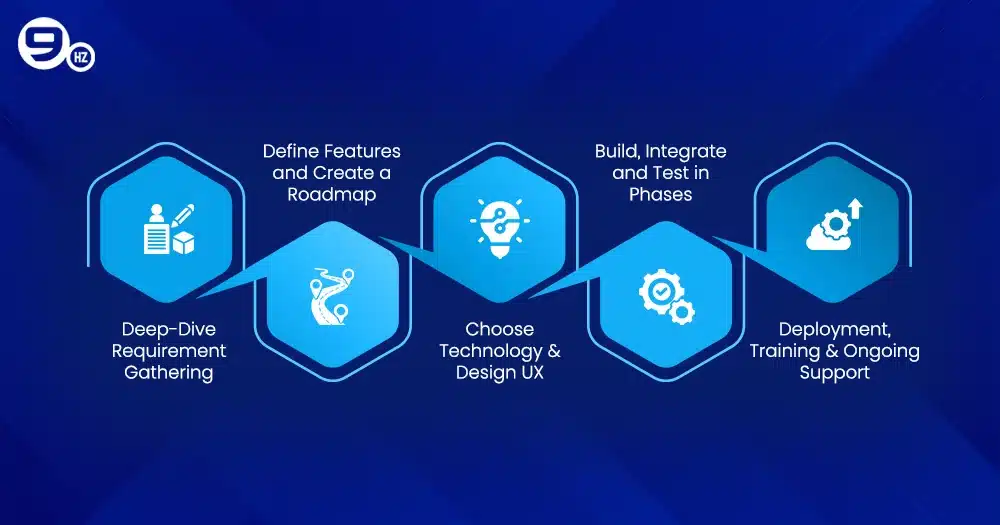
Developing an ERP system specifically for the construction industry requires thoughtful planning, collaboration, and execution. Therefore, it is highly important that you hire the right construction software development company. Here’s a clear, practical breakdown of how the process typically unfolds in 2026:
Before they write a single line of code, developers interact with everyone, including project managers, site supervisors, finance, HR, and more. The objective here is to identify actual pain points across workflows, including project scheduling, procurement, daily costs, compliance, and on-site mobile access.
Once the business requirements are well understood, the next stage is to identify what will be included in the ERP system. There are standard modules that include project management, budgeting, inventory, payroll, and reporting. Such needs are then organized in a development plan with clear controls and deadlines. It is a good way to keep sight and not overchange in the build process.
Choosing the right technology stack is essential, such as cloud platforms, scalable databases, and secure frameworks. Most modern construction ERP software runs in the cloud, making it more accessible and enabling remote work. Since construction crews are frequently in the field, the software must also be accessible on desktops and mobile devices.
Growth is a regulated process. Each team is responsible for developing a module, testing it, solving the problems, and moving on. Integrations also play a role at this stage, as, for example, the link between the ERP and an accounting software, a scheduling software, an IoT sensor, or a BIM platform must allow for continuous data exchange between these systems. Regular testing should detect functionality, security, and performance issues as early as possible and stabilize after launch.
Once the software system is complete and tested, it is provided to users so they can receive training on how to use it. These can include cloud deployments, data migrations, performance testing, and more. The software system is user-friendly and includes user guides and training sessions to facilitate quick adoption by teams. While the launch is essential, the ERP needs to be supported and updated to remain relevant to the industry’s changing requirements.
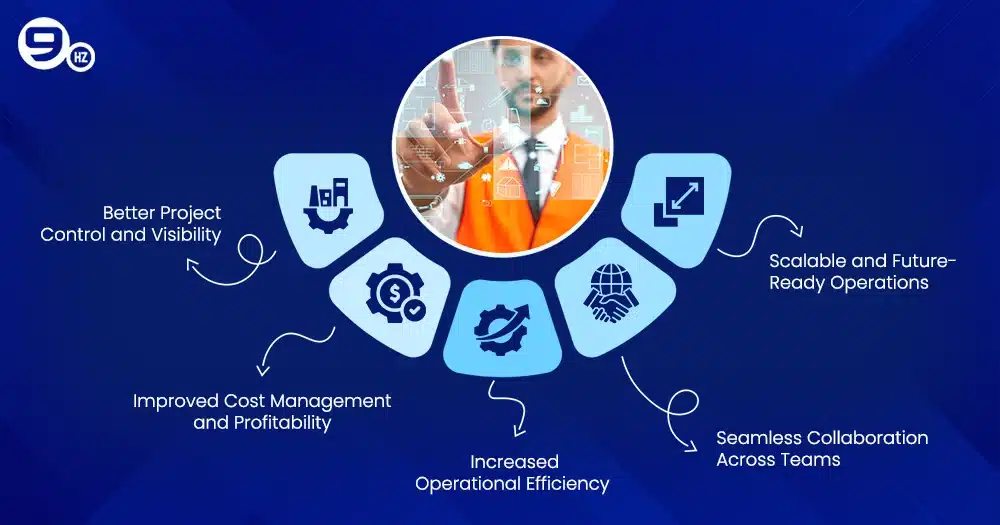
To recap, by 2026, the primary advantages of the development of ERP software in construction will be:
Construction ERP software centralizes all project data. Project managers can track timelines, budgets, labour, and materials in real time. The visibility provided allows teams to see where timelines and/or costs may be tracking off, and they can take steps to rectify them before those issues compound. Decisions can be faster and more certain when real-time data is available to those whose decisions are being affected.
The construction company Skanska implemented Viewpoint Vista ERP to consolidate all project and financial data into a single system. This single source of truth also minimised errors and increased reporting accuracy, making work teams more efficient at tracking their project performance.
Cost overruns are widely considered a problem within the construction industry. ERPs will reduce costs by centralizing budgets, purchase orders, invoices, and labour costs. It minimizes manual processing errors and guarantees more accurate financial forecasts. ERP systems from a trusted professional enable companies to defend their margins and increase overall profitability.
Hensel Phelps, one of the largest contractors in the country, leveraged Sage 300 Construction and Real Estate ERP to improve job costing and Budgeting. They were able to gain a much better grasp of cash flow, reduce costs, and enjoy a slew of other advantages from more sophisticated financial tools, and, as a result, achieved even higher profits.
Manual work creates bottlenecks in the building process, resulting in lower efficiency and accuracy. They provide automation for back-office functions such as billing, payroll, inventory control, and reporting/compliance through a conglomerate ERP system. This automation reduces time spent on paper processing, allowing more time for other, more valuable areas like planning and execution.
Yong Fong Engineering & Construction, based in Singapore, used the ERP solution from Synergix as a tool to help overall operations, “From project to finance”. Through that process, they achieved 60% productivity gains, reduced paper use, and made data more easily accessible.
Building projects involve several teams working in various locations. From a collaboration perspective, having a single version of the truth for all parties is the most crucial advantage of an ERP system. It also provides a weekly “living document” that on-site workers, office workers, contractors, and suppliers can all see and refer to, eliminating miscommunication across positions and inefficiencies.
Cloud ERP also enables construction firms to reduce project delays and material issues by providing real-time project-based collaboration between the office and the field. Companies that adopted ERP systems reduced project delays by more than 27% through improved synchronisation and information flow within projects, according to industry reports.
As the construction businesses expand, so must their systems, as there are only so many tasks they can outsource. A construction ERP software development can be flexible and will grow with new projects, users, and regulations. Whether a company is planning to expand into a new geography or adopt new core technologies, it should have the flexibility to grow in the long term, and ERP software will provide that flexibility. Aligning with a reputable partner means that the system will be maintained and developed as the business grows and changes.
Mid-sized construction firms that have utilized an ERP system achieve much higher levels of accuracy in project scheduling and lower cost overrun rates. After implementing a customized ERP system, BuildTech Infra Pvt. Ltd. experienced a 30% increase in schedule accuracy and a 25% reduction in operational losses.
Selecting the right ERP development model also becomes crucial for construction firms. Each model has a different degree of flexibility, cost management, and scalability. The characteristics of each model provide the company with the option to choose the one that best fits their project’s complexity, size, and desired growth.
| Development Model | Best Suited For | Advantages |
|---|---|---|
| Custom ERP Development | Large construction firms with complex requirements |
|
| Off-the-Shelf ERP with Customization | Mid-sized construction companies |
|
| Cloud-Based ERP Development | Companies managing multiple sites or remote teams |
|
| Modular ERP Development | Growing construction businesses |
|
| Hybrid ERP Development | Firms with strict data security or compliance needs |
|

Here are the key features that make construction ERP software development practical and worth the investment in 2026.
Construction ERP software manages project lifecycle scheduling. Managers assign tasks, track progress, and monitor all deadlines in real time. When someone encounters a difficulty during the task, the system notifies the manager immediately. This visibility helps the team to fix issues when they can, rather than when it’s too late.
Budget is always the core part of any construction project. ERP technology lets you see where you are spending related to the estimated costs as you work. It helps report cost overruns, labor availability, and material spending while ensuring the accuracy of financial information. It allows companies to protect their margins and avoid surprises at the end of a project.
Delays or late submissions turn into time and cost. Basically, it consolidates all processes for ordering, suppliers, delivery timing, inventory, and more into one system. This keeps the teams informed about what has been ordered, what is on-site, and what is coming next. It minimizes thrift store overstock and keeps projects in circulation.
ERPs specifically for the construction industry are also closely linked to accounting. Furthermore, invoices, payroll, taxes, and cash flow are updated in real time as work is completed. Companies don’t need to run around re-entering numbers into systems. As a result, the company receives clear, up-to-date financial statements.
It is hard to coordinate labour across sites. ERP software records attendance, work hours, payroll, and compliance requirements. Managers assign the right people to the right jobs and track productivity without manual reports or guesswork.
Machine downtime costs money. ERP systems also track equipment usage, availability, and maintenance schedules. Teams know what assets are, when service is due, and how often equipment is used. It ultimately helps with better planning and a longer equipment lifespan.
Construction also produces a large volume of paperwork, including contracts, drawings, permits, and safety records. It is stored in a single location in the ERP software. It is necessary to have an easy ERP software solution to eliminate confusion and bring visibility into the compliance process.
Building ERP systems provides clear dashboards linked to real-world project data, rather than generic reports. The senior management team can easily track costs, risks, and progress. These insights help you make better decisions and plan for the future.
Construction projects are never executed at the table; they are not done behind a desk. ERP software is also available in mobile versions, allowing site workers to track progress, share images, and access documents from the field. This ensures that the office and site teams are always on the same page.
Building-related ERP applications are based on a modern, robust architecture that supports complex software, enables real-time data access, and offers flexibility. Here are the standard technologies to build stable, future-ready ERP systems for the construction industry.
| Technology Category | Common Technologies Used |
|---|---|
| Frontend Development | React, Angular, Vue.js |
| Backend Development | Java, .NET, Node.js, Python |
| Database Management | PostgreSQL, MySQL, MongoDB, Oracle |
| Cloud Infrastructure | AWS, Microsoft Azure, Google Cloud |
| Mobile Technologies | Flutter, React Native, Swift, Kotlin |
| Integration & APIs | REST APIs, GraphQL, SOAP |
| Security Technologies | Role-based access, Encryption, Multi-factor Authentication |
It is observed that good use of construction ERP software development delivers tangible results. There are a few real-life examples of different construction companies choosing ERP for their needs.

Construction ERP software always faces challenges as technology evolves in the planning, execution, and monitoring of projects. ERP systems will be smarter, connected, and more secure by 2026 and beyond. Several key trends shaping the future of construction ERP software development are mentioned below.
Modern construction firms are adopting cloud-based ERP systems. These systems allow teams to access project data from anywhere, whether at work or at home. Cloud computing also reduces infrastructure costs and makes software updates easier to understand. Cloud ERP can help teams stay connected and work from a single source of truth as projects become more distributed.
Mobile access has never been an option in construction. Smartphone and tablet ERP apps allow site teams to see progress, report, and access documents in real-time. Mobile ERP provides tools for communication between field and office teams, reducing errors and improving decision-making on active job sites.
IoT devices are becoming increasingly common for tracking equipment, site condition monitoring, and collecting operational data. It also adds further equipment use, safety and productivity information to the ERP. Sophisticated analytics converted the original survey data into usable information that supports better planning and risk reduction.
Automation is replacing some of the functions of Construction ERP systems. Similarly, there is an assumption that artificial intelligence would be more effective at predicting project delays, stress-testing projects, and allocating resources. Such systems can leverage historical project data to inform more effective pre-planning decisions.
These systems can draw on previously collected project data to help make better planning decisions. The AI-driven ERP software minimizes uncertainty and enhances project success.
Cybersecurity is becoming a significant concern for all ERP systems that process a company’s financial data. Modern construction ERP systems improve access control, data encryption, and increased security monitoring. Furthermore, regular updates and compliance-driven security practices protect systems from cyber threats and data loss.

It may be hard to produce ERP software for the construction industry. Each project involves multiple stakeholders, changing needs, and tight deadlines. Without the right approach, ERP initiatives cannot deliver value. Below are some of the most common challenges encountered while developing construction ERP software.
One of the biggest causes of problems in ERP projects is poor planning. It is often a common misconception that when teams take the lead in ERP software development, they overlook essential business needs. In construction, variations between projects introduce room for error; poor planning can cause rework, delays, and overruns.
In the case of these ERP systems being used for a construction project, it is possible that multiple clients, contractors or subcontractors would access the same system. Every client has unique processes, reporting types, and levels of compliance. Dealing with all this complexity is not easy when designing a system.
The construction ERP software development requires constant interaction among developers, project managers, finance, and site staff. Communication breakdowns lead to misunderstood requirements and features that are not compatible with real-world processes. This is a gap that many users fail to adopt after deployment.
Sometimes, construction companies expect ERP software to solve all their problems in seconds. But the fact that cost and time estimations during development can also make the process frustrating. In the short run, technical problems are too far off to predict, leading to missed deadlines and project delays.
Real-time data is not a feature of ERP systems. Without appropriate input or approval in the development process, decision-makers lose focus, and progress slows. But not enough features, integrations, or technology choices will slow down performance and scale over time.
Choosing the right partner for your construction ERP software is more important than the software itself. The NineHertz, a trusted Construction Software Development Company, builds systems that fit your business, not someone else’s. We focus on your goals, your challenges, and your unique workflow so you get a solution that works from the start.
We begin by listening to your team and understanding how your projects run. Our next move is to create an ERP software that combines estimating, scheduling, accounting, inventory, field reporting, and client communication all into one simple-to-use system. We are not just a software provider, but problem solvers to eliminate bottlenecks in your projects.
Our construction ERP software developers employ existing methodologies, intelligent technology, and consistent feedback to ensure your project is on time and on budget. We keep them updated, tell them the cost from beginning to end, and walk them through the process. Thus making your ERP implementation process completely stress-free.
The NineHertz also provides scalable solutions that can be adjusted as your business grows. We adjust features to your size, whether you are a small contractor shop, a mature business, or planning to be one. We will help personally train your team and provide quick support and support for you to be successful.
By 2026, construction ERP software will become an essential tool for managing complex projects, controlling costs, and improving collaboration. A well-planned ERP system is valuable to identify the right development model, adopt modern technologies, and plan for the future.
Though challenges exist, the right strategy and execution make a clear difference. The NineHertz provides a scalable, secure, and practical ERP solution that boosts productivity and improves decision-making for construction businesses.
The basic functionalities include project management, budgeting, accounting, requisitions, inventory, personnel, and real-time field reports via mobile devices.
The cost is based on feature, complexity, and customization. A simple ERP system may be cheaper than a customised system with extras. The final cost also depends on the development time, technology, and future support needs.
Look for a firm with a proven track record in the construction industry, strong technical abilities, effective communication, and concrete work experience. The best software development firm understands real construction workflows and provides long-term support, not just software delivery.

Key Takeaways India's tech sector is set to cross $300 billion in FY2026, growing 5.1% from $282.6 billion the year…

It’s shocking that one malformed payload could have leaked customer data through an API edge case. It happens when there…

Any enterprise managing 500+ operations at times across the globe to cover supply chain, production lines, customer service centres, and…