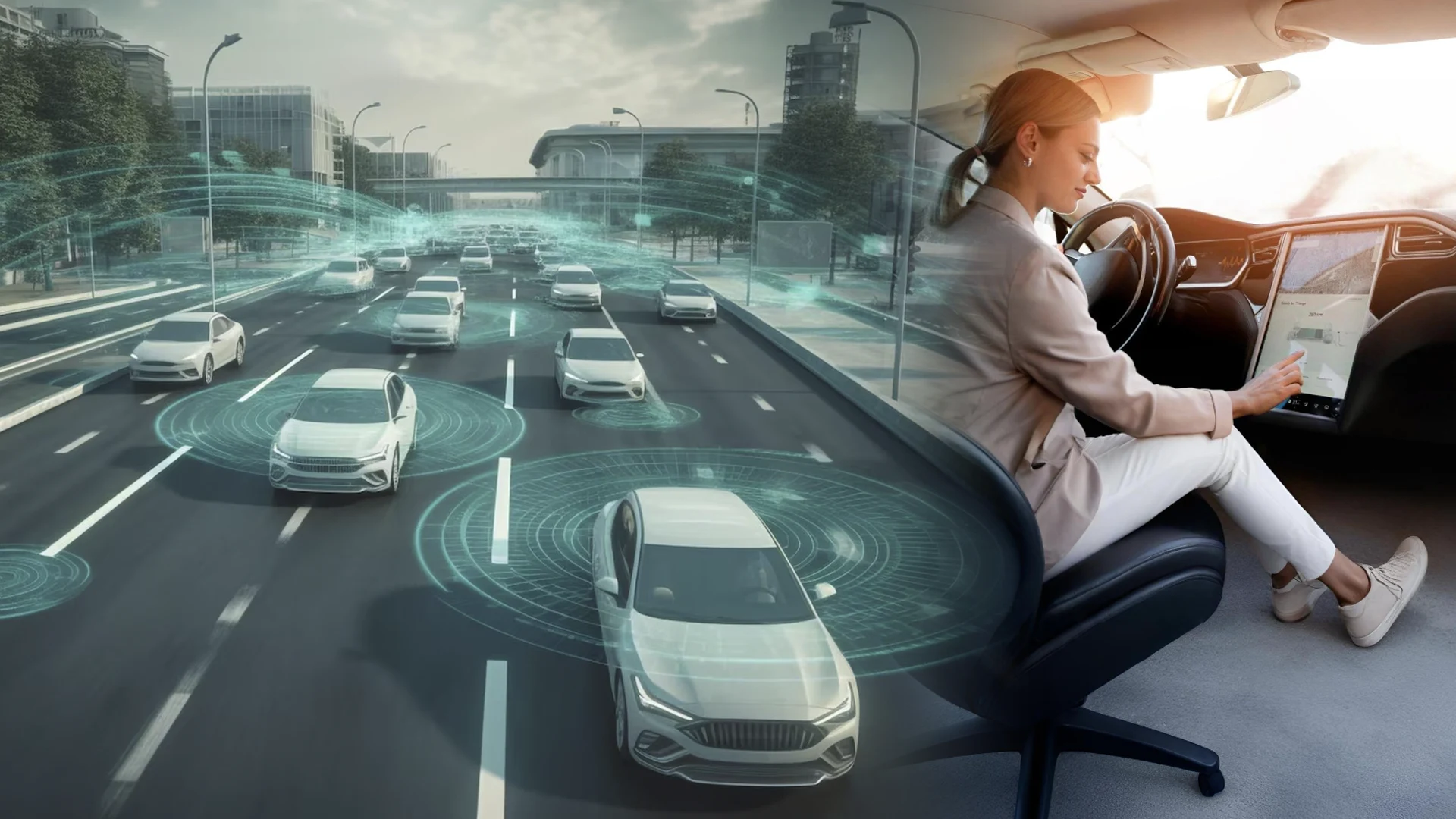
Ever wondered if self-driving cars make quick decisions in less than 10 seconds on busy roads?
Now it may! It is possible to use edge computing in autonomous vehicles to integrate AI processing into the vehicle, rather than being hosted on a cloud server.
Edge computing connects real-time sensors and helps in instant perception, planning, and control, reducing latency to milliseconds and improving safety.
Did you know?
The edge computing market for autonomous vehicles is projected to surge to around US$ 42.2 billion by 2034 at a CAGR of 21.76 %.
This shift is reflecting convergence in AI, edge intelligence, and autonomous driving. Locally running AI models help cars process vast amounts of sensory data in real time, make autonomous decisions, and deal with unpredictable road situations without the need for cloud latency.
As the technology matures, edge computing will become the backbone of safer, smarter, and more reliable autonomous mobility.
In this blog post, we talk about the key technologies, from neural networks to 5G-enabled sensors, that make edge-powered autonomous driving a reality.
In simple terms, edge computing in autonomous vehicles processes data on the vehicle and not via a cloud server. Every second, autonomous cars release huge quantities of data from LiDAR, cameras, radar, and other sensors. Edge computing stores data locally to make in-the-moment decisions, which reduces latency and increases safety. The advantages of edge computing over traditional cloud applications are that vehicles can do whatever they want, from breaking an obstacle to turning in or out, to observing the weather.
Automotive cloud computing is also balancing out with edge computing. While the cloud stores long-term data, model training, and fleet analytics, edge computing ensures there is no delay for the vehicle. The combination is critical to edge computing in the automotive market, where low-latency AI inference and high reliability are essential for autonomous mobility.
| Feature / Metric | Edge Computing | Cloud Computing |
|---|---|---|
| Data Processing Location | On the vehicle (local) | Remote data centers |
| Latency | Very low (milliseconds) | Higher latency due to network delays |
| Real-Time Decision Making | Excellent | Limited |
| Data Storage | Limited | Virtually unlimited |
| AI Model Updates | Periodic updates from the cloud | Continuous updates from the cloud |
| Reliability | High, independent of network | Depends on connectivity |
| Cost Efficiency | Higher upfront, lower ongoing | Lower upfront, higher ongoing |
The self-driving cars make thousands of decisions every second, but they can’t afford to wait for the cloud to respond. Edge computing for autonomous vehicles enables processing to occur directly on the vehicle, enabling quick, safe, intelligent driving. This technology is becoming the backbone of edge computing in the automotive market.

Real-time pipeline: sensors → perception → planning → control
All autonomous vehicles collect large volumes of data from sensors such as LiDAR, radar, cameras, GPS, and ultrasonic sensors. It goes back to this data in a pipeline of real-time data:
1. Sensors: Detects vehicles, pedestrians, markings of the lanes, traffic lights, and obstacles.
2. Emphasis: AI machines running on the car recognize and classify objects, and predict how they will move.
3. Planning: The system calculates the safest path, adjusts speed, and plans maneuvers.
4. Navigation: The car performs steering, braking, and acceleration commands automatically.
This local processing also reduces latency to milliseconds. Automotive edge computing systems run in real-time while automotive cloud computing stores data for long periods of time, reports on fleet health, and updates the model. They combine this strategy of speed and intelligence.
Autonomous vehicles split tasks between the edge and cloud, trying to balance speed and intelligence.
1. Edge (on the vehicle):
2. Cloud (remote servers):
This separation also gives the vehicles flexibility to respond immediately and to improve in the cloud. The integration of automotive edge computing with cloud computing is making modern self-driving cars faster, smarter, and safer, and is the cornerstone of the automotive edge computing market.
These autonomous vehicles require more than complex algorithms. In order to understand the road in real time, they rely on the tight integration of sensors and edge AI. In automotive edge computing, sensors collect raw data, and automotive edge computing processes it within the car. This collaboration allows for faster decisions, reduces risk, and improves driving safety, especially in difficult, unpredictable situations.

Each sensor is unique to automotive computing, and edge AI connects each of these sensors together:
Cameras: They give you detailed, high-resolution images. They tell cars where traffic lights, road signs, lane markings, and pedestrians are. Cameras are excellent at capturing sharp images, but not in low light or harsh weather.
LiDAR: It generates precise 3D maps of the world using distance-measuring laser pulses. It also helps vehicles see depth, shape, and object position, and is important for accurate navigation.
Radar: It detects objects and is reliable in rain, fog, or darkness. It is robust when the visual sensors are limited.
A vehicle equipped with edge computing software processes the data from all three sensors locally so that the vehicle remains aware in all driving conditions.
Sensor fusion combines camera, LiDAR, and radar inputs to produce one precise view of the environment. Performing this process via best AI inference edge computing for autonomous vehicles reduces the need to run on automotive cloud computing to analyze sensor data in milliseconds.
Edge-based sensor fusion reduces blind spots, increases object detection accuracy, and reduces false positives. If one sensor fails or falls short, others immediately compensate. This redundancy increases safety and reliability.
In contrast to traditional AI training and optimization in the cloud, car systems are edge-based and combine sensor data with inference in real time. This balance is of great importance for the future of edge computing in the automotive market, where autonomous driving is likely to be safer and smarter.
Automobile manufacturers are increasingly making use of edge computing architectures for automotive safety, speed, and scalability as autonomous driving becomes more common. All models describe the relationship between edge computing in autonomous vehicles and cloud systems, networks, and external infrastructure. Below are the main patterns found in edge computing in the automotive market of today.
In a fully onboard model, all safety-critical processing occurs inside the vehicle. Automotive systems with edge computing address perception, planning, and control at the local level without any external connection.
This approach concords with best AI inference edge computing for autonomous vehicles, in which it is necessary to brake or avoid a collision and control the road in milliseconds. In the unlikely event of a connectivity failure, the car drives quietly.
It is the most reliable, the least latency, and the most stringent safety regulation that manufacturers rely on for core driving functions. It is the most advanced form of edge computing in automotive design.
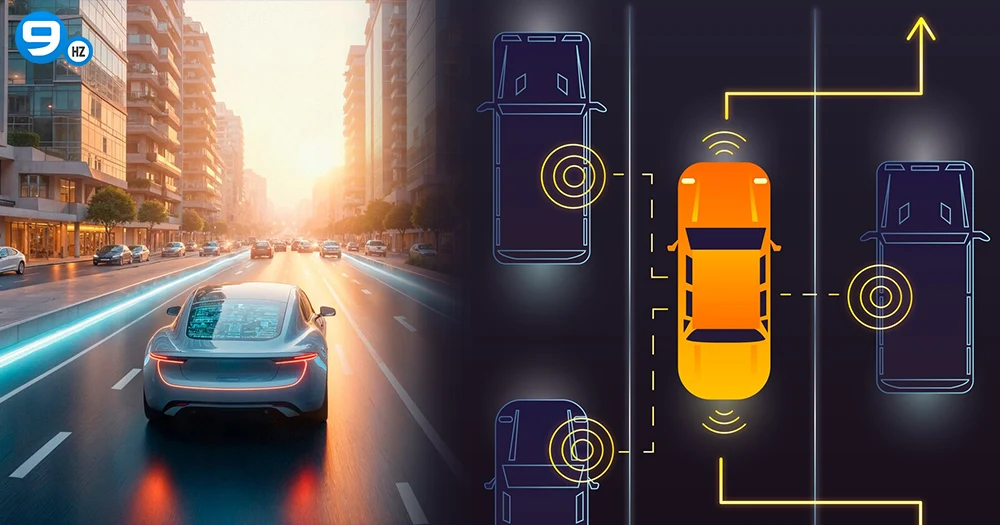
The hybrid system is a hybrid on-vehicle edge processing system with automotive cloud computing. The vehicles gather local information and send it to the cloud for analysis, training, and optimization.
Thus, the auto computing systems include fleet-wide learning. Cloud services build AI on combined driving data and add the required functionality to the cars through OTA updates.
This arrangement allows manufacturers flexibility in scaling intelligence across fleets while maintaining an edge in low-latency decision-making. The hybrid approach thus has become dominant in the edge computing automotive ecosystem.
It has a V2X communication and 5G Multi-access Edge Computing (MEC) for edge computing in autonomous vehicles. In this model, vehicles exchange real-time information with nearby cars, units on the road, and infrastructure.
This transfer of cooperative perception to the vehicles allows them to “see” around corners, detect risks earlier, and react collectively to traffic conditions. 5G MEC nodes process the shared data closer to the source, reducing the amount of latency and eliminating the need for distant cloud servers.
This architecture pushes the boundaries of edge computing in the automotive market, with better flow of traffic, safer vehicles, and better coordinated autonomous mobility.

Edge computing is entering the automotive systems, and it is changing the way vehicles think, respond, and drive safely. Automotive edge computing, processing data closer to where it’s generated, offers practical advantages just like those of cloud-only models. These advantages ensure that edge computing in automotive vehicles is still gaining ground in the industry.
Low latency is at the core of autonomous driving safety. Automotive platforms equipped with edge computing process sensor data in milliseconds, allowing for vehicle detection, decision making, and action to be instantaneous.
Best AI inference edge computing for autonomous vehicles ensures that braking and steering responses are instantaneous when a pedestrian steps into the road or traffic suddenly slows. Edge computing also eliminates round-trip to distant servers, thus reducing the accident risk in the first place and improving overall driving confidence.
No uninterrupted connections to the internet are required for autonomous vehicles. At any given moment, connectivity can be hampered by tunnels, rural roads, or city congestion.
In automotive, edge computing makes vehicles safe even when the cloud stops working. Critical perception and control systems operate locally, which ensures consistent performance regardless of network conditions. This reliability increases the resilience and trustworthiness of real-world automotive computing systems.
Motorized vehicles store huge quantities of data every second. Sending it all to the cloud would strain networks and increase the costs of operation. Automotive edge computing processes and filters data locally, and focuses only on valuable information for the automotive cloud computing platforms.
This is a much more compact method that saves bandwidth and allows for increased data security. Location data or raw sensor feeds remain in the vehicle and support regulatory compliance and user trust. Privacy-conscious design has thus become a driving force for edge computing in the automotive sector.
The technology of edge computing in autonomous vehicles combines speed and intelligence, but it also presents real-world engineering challenges. Vehicles are driven in rocky, dusty conditions. Engineers work to balance performance, safety, energy efficiency, and security in a moving machine, not a climate-controlled data center. This is a must to understand these constraints in order to safely and sustainably scale automotive edge computing.
Vehicles have very small power bills, unlike cloud servers. High-performance processors for best AI inference edge computing for autonomous vehicles consume considerable energy and generate heat.
Automotive makers should design lightweight computing devices that will not overheat when running real-time AI workloads. The excess heat can be fatal, a threat to hardware, or even a security risk.
Engineers do this by optimizing chip design, improving cooling systems, and improving software efficiency. But, power and thermal management remain important constraints in edge computing automotive systems, even as AI models become more complex.
Cybersecurity risk increases as vehicles become connected devices. Automotive cloud computing also facilitates over-the-air updates to manufacturers, so they can improve AI models and fix bugs remotely. But this convenience presents potential attack surfaces.
Hackers may attempt to hack through communication channels, hack into firmware, or attempt to hack into vehicle systems unsupervised. Any breach could have grave consequences, as automotive platforms control safety-critical functions using edge computing.
Manufacturers also need to have strong encryption, safe boot, hardware-based isolation, and constant monitoring to ensure safe operation for both vehicles and drivers. The growth of edge computing in the automotive market depends on security.
The safety of autonomous vehicles is paramount. All perception models, control algorithms, and decision-making systems are subject to rigorous testing and validation.
The validity of every possible scenario becomes extremely difficult when automotive edge computing systems process millions of real-time decisions. Engineers must consider edges, isolated road events, human behaviour, unpredictable sensor failures, and environmental extremes.
Unlike software, AI-driven systems change with each update and retraining. This dynamic nature adds another layer of complexity to certification and compliance.
Therefore, hardware and intelligent AI for scalable edge computing in automotive vehicles will need to be robust and agile but will also undergo disciplined validation processes, safety engineering, and regulatory alignment.
The automotive industry is undergoing a major digital transformation. Cars are not just mechanical machines, but intelligent, software-driven machines. As this shift becomes more intense, edge computing in the automotive market becomes a driving technology for safety, automation, and connectivity.
Now computer power is seen as the strategic measure of engine performance by automakers. They invest heavily in automotive edge computing, since real-time intelligence has a direct effect on vehicle safety and customer experience.

One of the main drivers of edge computing in automobile use is the rapid expansion of Advanced Driver Assistance Systems (ADAS). Real-time sensor processing provides adaptive cruise control, automatic emergency braking, lane-keeping assist, and blind-spot monitoring.
The latency of these systems is ultra-low. Camera, radar, and LiDAR data must be read out on the fly. And in the case of edge computing automotive platforms, that is possible because AI workloads are run directly inside the car rather than on remote servers.
Meanwhile, the emergence of SDVs is making computing even more demanding. In SDVs, software handles everything from infotainment to power management and autonomous functions. Today, manufacturers build their vehicles around centralized automotive computing architectures, where high-performance processors manage multiple vehicle domains.
This shift generates increased demand for secure, reliable edge computing in autonomous vehicles, especially as cars become smarter and more connected.
As the industry looks ahead, it is moving to centralized computing architectures. Automakers are now combining processing into fewer, more powerful domain controllers, rather than using dozens of small electronic control units (ECUs).
This has a beneficial effect on the ability of the automotive industry to use edge computing while minimizing system complexity. Centralized compute infrastructures enable better AI inference, faster updates, and better system integration.
And while this is happening, V2X communication is spreading. Cars will increasingly share data with other vehicles, traffic infrastructure, and smart city systems. This growth will extend to edge computing in the automotive market beyond the vehicle, enabling cooperative perception and smarter traffic ecosystems.
Edge computing transfers data locally rather than to the cloud. This enables greater efficiency and reduced bandwidth, storage, and infrastructure costs.
Yes. Edge computing, on the other hand, gives EVs the power to charge their batteries more efficiently, monitor their systems in real time and save energy without having to rely entirely on the cloud.
It analyzes component data in real time, flags early faults, and warns drivers about failures, increasing safety and reducing downtime.
Edge computing in autonomous vehicles is no longer a concept; it is the cornerstone of next-generation mobility. Automotive edge computing enables faster decisions, safer roads, and smarter vehicles from real-time sensor fusion and AI inference to hybrid cloud integration and V2X communication.
The development of edge computing in the automotive market will continue to take hold as the automotive industry looks toward software-defined architectures and centralized compute platforms. It reduces latency, increases reliability, protects data privacy, and helps to keep evolving through cloud collaboration. Simply put, without intelligent edge infrastructure, autonomous driving cannot scale safely.
Yet, an expert in AI, embedded systems, cloud integration, cybersecurity, and functional safety is necessary to build robust edge computing automotive systems. In that respect, the right technology partner is the key.
The NineHertz has vast expertise in AI, IoT, automotive software solutions, and scalable cloud-edge architectures. From developing ultra-fast automotive computing platforms to delivering secure OTA updates and intelligent mobility solutions, The NineHertz helps businesses transform their creative ideas into production-ready systems.

Imagine a city where you can see everything happening on the streets in real-time. In this city, you can find…

The Internet of Things (IoT) is changing industries by connecting everyday devices to the Internet, enabling real-time data collection, monitoring,…

Merging Artificial Intelligence (AI) with IoT is one of the groundbreaking approaches in the technology domain. On one side, IoT…