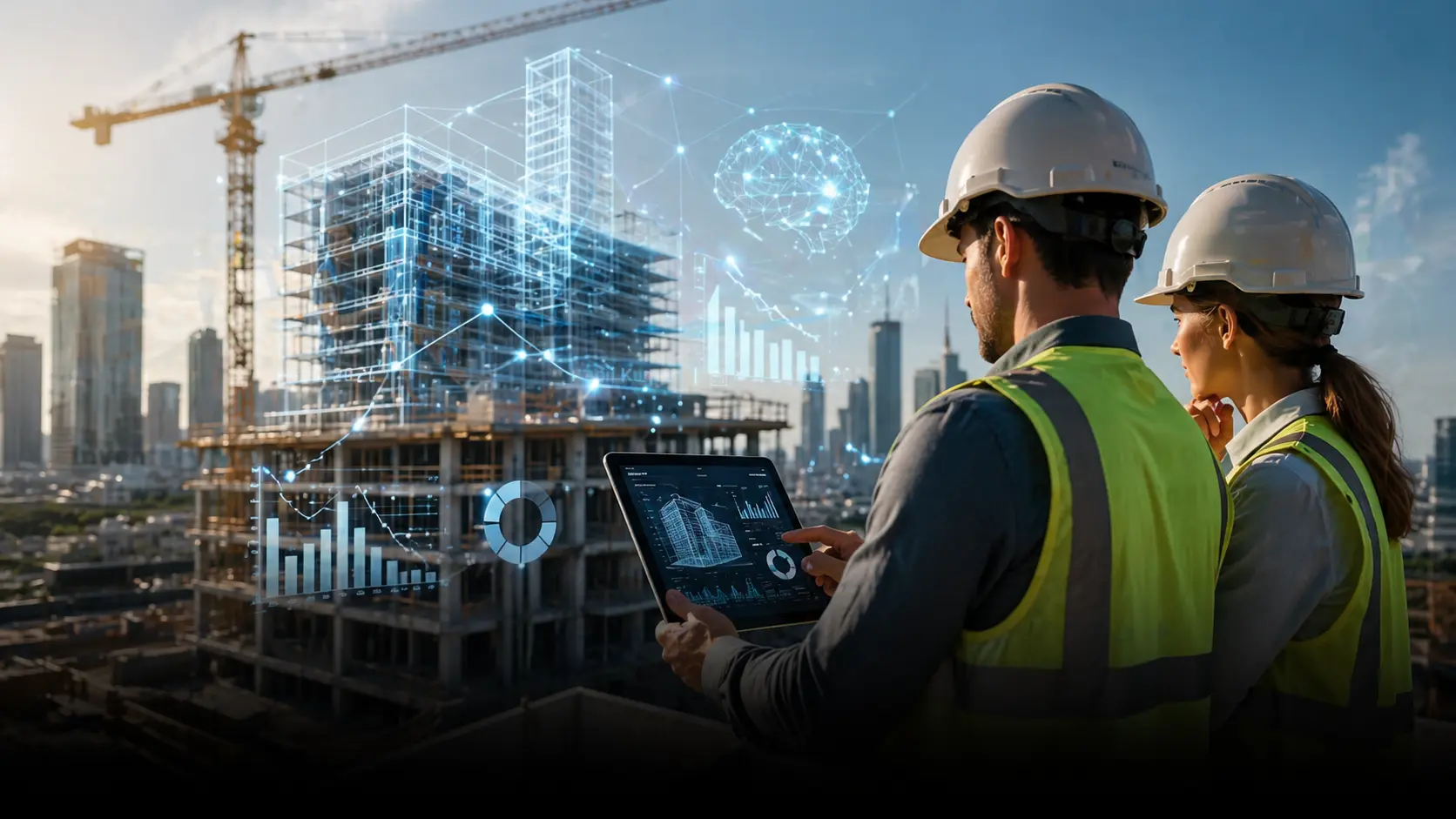
Think of architecture, engineering, and construction projects, where designing, cost optimization, and risk forecasting do not require extensive manual effort and also generate the desired outputs. Well, this has become possible with the inclusion of AI in AEC industry, which amplifies planning and decision-making like never before. The growing significance of artificial intelligence in the industry is justified by its usage in AEC firms.
AI AEC, as the name suggests, implies the application of machine learning, NLP, and predictive analytics features to enhance various processes within the designing and construction industry. Artificial intelligence and automation on every level streamline the industry activities, routine tasks, and performance overall. AEC companies implement AI tools for the following:
If you are also an architect, engineer, or constructor, or a firm, engaged in the industry, and want to boost your project performance, then it is high time to embrace AI and leverage its benefits.
AI in the AEC industry refers to the implementation of intelligent tools, such as computer vision, machine learning, generative design, NLP, and deep learning, into the BIM systems of Architecture, Engineering & Construction workflows. The technology is transforming the operations of the AEC sector by redefining designing, budgeting, and safety parameters according to the changing demands of the market.
Modern AI technologies encompass human-like intelligence and capabilities; for instance, they can learn, adapt, and reason before generating solutions. These features surpass the traditional methods of recording and monitoring AEC workflow, along with boosting its functional areas.
A construction software development company can put AEC AI solutions to work according to its unique preferences and merge them with its running BIM system for better project management. This integration enables the firms to get relief from manual documentation and enhance their proactive approach towards project risks and costs. Data-centric processes and predictive analytics source real-time decision-making at various stages of the construction lifecycle, streamlining execution timelines. Let us explore the role of AI for AEC industry:
Applications of AI in AEC industry are dominating multiple functional domains of architecture, engineering, and construction undertakings and enhancing the efficiency of its operations. Let us discuss the major AI use cases for AEC industry in 2026:
Generative AI produces innovative architectural designs while keeping the restrictions of budget and space in account.
By distributing AEC AI solutions to the BIM (Building Information Modeling), it is possible to identify the design conflicts between the plumbing, electrical layout, and ventilation structures in the early stages.
Machine Learning and predictive analytics are major applications of AI for AEC to estimate the time and cost of a project on the basis of past data.
In the present day, AEC AI solutions, such as drones, sensors, and computer vision technology, are used to continuously watch the construction site.
AI in AEC industry provides IoT sensors attached to the machinery and equipment that proactively monitor asset health and notify about the required maintenance in time.
The AEC examples of AI applications depict the significance of artificial intelligence in the contemporary world of architecture, engineering, and construction.
However, it is wise to use the technology early in different stages of the project lifecycle to avoid extra costs in trial and error. Reports suggest that 68% of early adopters of AI for AEC have saved approximately fifty thousand dollars.
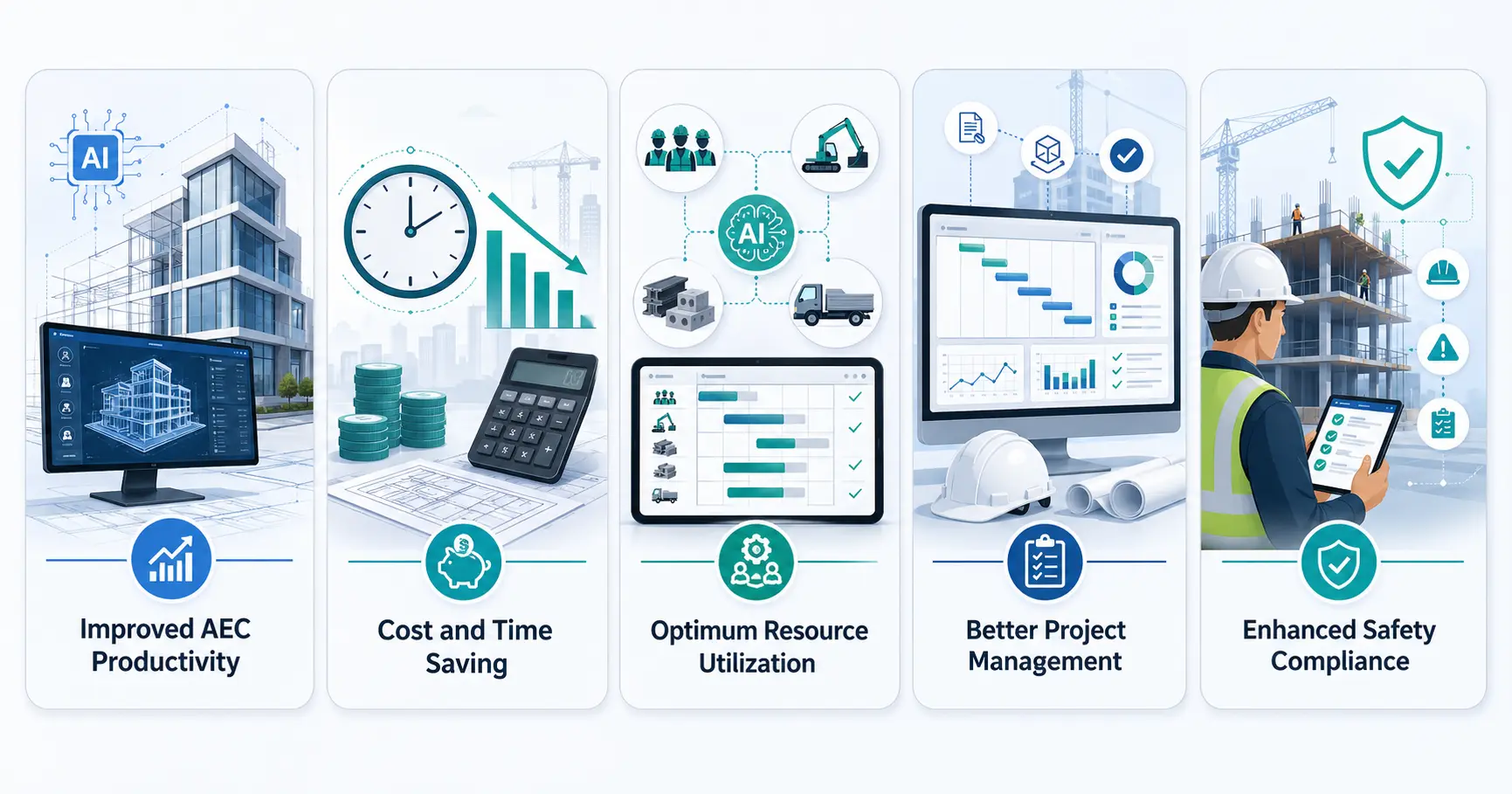
AI in AEC industry automates the routine as well as complex tasks throughout the lifespan of a project, delivering quality results in designing, engineering, and construction processes. Let us dive into the major advantages of adopting AI for AEC:
The above benefits of AI in AEC industry promote the instant necessity of leveraging its capabilities in the sector. But the companies that are seeking to do so must start with small steps and implement AI in only crucial areas, instead of deploying at a large scale in one go.
Integrating AI into the existing system of AEC firms must follow a phased process with step-wise implementation. Following is the general guide to the roadmap for AI in AEC industry:
Time period: 1 week – 4 weeks
Run data audits to understand and know your existing data infrastructure. This first step aims to transfer manual data handling to the digital platforms for AI usage. Audits will help in refining data and removing silos, as algorithms and analytics require quality data for an accurate outcome.
Time period: 4 weeks – 8 weeks
Find the areas where you face the most struggle or are heavily time-consuming, lowering the operational efficiency. These can include inaccurate cost estimations, project delays, design errors, and many more. Identification of pain points will guide you in implementing AEC AI solutions in targeted points.
Time period: 8 weeks – 12 weeks
Knowledge of major issues in the current workflow further leads towards strategically deciding the sections to upgrade with AI. However, instead of employing the technology in all the problematic parts in one go, select some highly impactful AI use cases for AEC. For instance, you can start with AI-powered project scheduling or safety monitoring.
According to the business goals, set clear and measurable ROIs after applying AI in the workflow, such as a 10% -15% reduction in cost per project, increased productivity, and improved safety compliance.
Time period: 12 weeks – 18 weeks
Running a robust AI system will need expertise and knowledge of how to use the modern tools in routine tasks. Therefore, prepare your staff for the upgrade with efficient training programs and workshops, and collaborate with AI AEC consultant teams for a better understanding of the technology and its benefits.
Time period: 18 weeks – 24 weeks
Finally, execute the AI tools and pilots aligning with your business’s unique needs and preferences. It is important to select the AEC AI solutions that can blend with the existing routine and BIM model, rather than replacing them.
Time period: 24 weeks – 30 weeks
Test AI performance on practical ground and evaluate its success by comparing results with predefined goals and ROIs. In case of negative deviations, identify the cracks and improve models and pilots. After achieving desired outcomes, expand the technology to a greater level.
This structured system ensures ethical implementation of AI in AEC industry with a lower risk rate, maximum performance, and ROI.
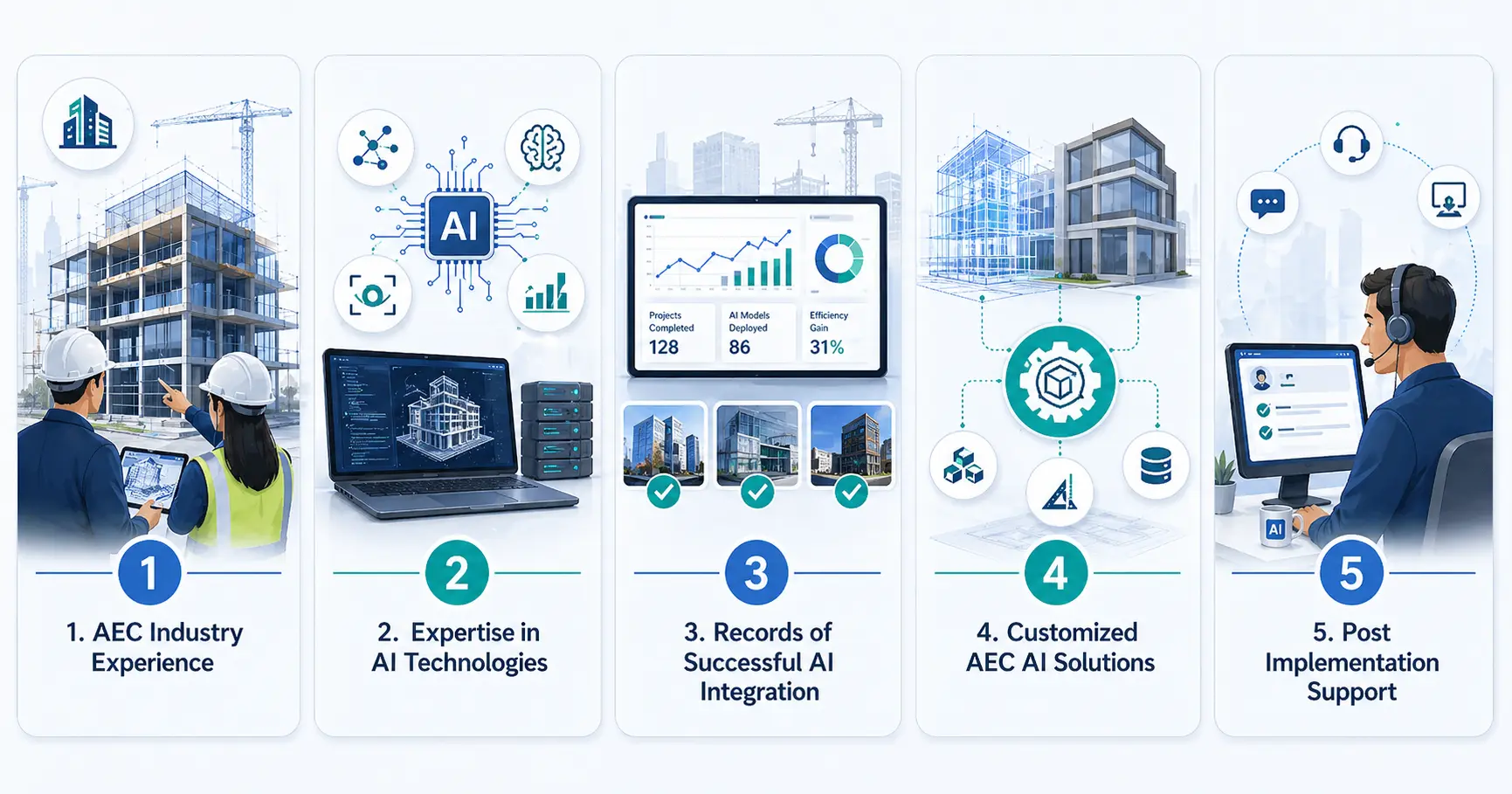
Choosing the right AI partner is equally essential as the technology itself. Here are some of the hints to guide you in this selection and list you as an early adopter:
The service provider must be acquainted with the AEC industry and the projects to develop AI software fit for day-to-day working. Look for a partner who has hands-on experience with BIM and project management tools to deliver you domain-specific services.
Proficiency in AI technologies works as a spine in cultivating the digital infrastructure. Make sure that the partner you are selecting has strong technical capabilities across multiple tools, including Machine Learning, computer vision, and data engineering.
Dig into the past track records and feedback of clients worked with that AI company, to determine the potential of successful AI deployment. Additionally, ensure that the partner is strictly following data security regulations and standards to avoid compliance issues in the future.
Your partner must develop customized AI tools, as each project requirement differs, and only tailored models will generate profitable results. One-size-fits-all is no longer applicable, and thus, adaptive systems are a must when going for upgrades.
Choose one that offers strong continuous support after the implementation of AI in AEC industry. AI AEC Consultant company, which provides ongoing technical assistance and employee training programs, is highly recommended.
Do not select a vendor; instead, search for a long-term partner who can stay connected and available when needed.
The NineHertz holds the qualities to tick all your boxes in the AI partner search list, as we carry 15+ years of experience in the field of AI development. We offer tailored AI in AEC industry, which can fulfill the unique requirements of each architecture, engineer, and construction project. Here are many more reasons to choose NineHertz for your AI deployment needs:
Lastly, we understand that our work does not end after the deployment; instead, we aim to deliver continuous technical support to our client for a long-term, effective AI infrastructure in their AEC business.
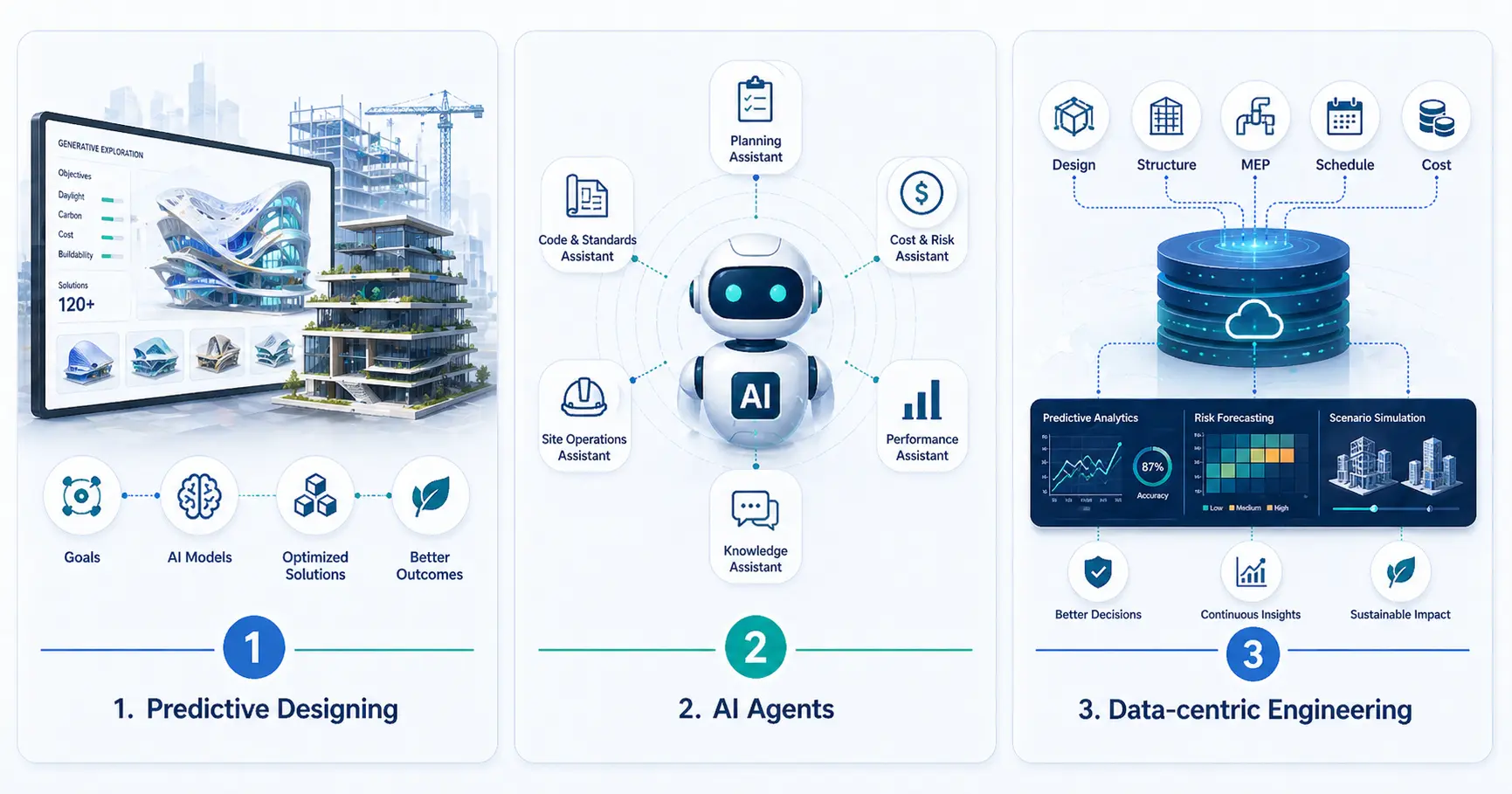
Emerging trends in AI that seem to reshape the AEC industry in the next some yeras includes predictive designing, AI agents, and data-centric engineering. The following is the detailed description of these trends:
Unlike traditional designing or AI-supported generative tools, this concept of predictive designing refers to the forecasting of the performance of AI-produced drawing options. To elaborate, this new technology will be able to explore the functionality of a design from different perspectives, such as environmental, financial, regulatory, and structural.
AI agents, on the other hand, will flourish in predictive designing by automatically generating multiple tools for countering design problems. These human-like technologies will first understand the context of the drawing, evaluate the software capabilities, and then deploy them in the design planning phase, replacing manual setup and repetitive modeling.
The new phase of engineering revolves around data that is structured, high-quality, and reliable. consistent input, human-in-loop, and real-time feedback boarding in the system will allow predictive asset maintenance and clean BIM models.
AI in AEC industry is transforming the functioning of architectural, engineering, and construction projects. Early adopters of the technology gain a competitive advantage, complete their project within the stipulated timeline, and incur lower costs. However, the implementation of AI tools is not a smooth path and consists of several challenges, but dedicated training programs, a strong data foundation, and partnering with an expert AI developer can minimize those obstacles to a significant level.
The upcoming time is projected to witness a boom in AI technologies, amplifying AEC automation and predictive decision-making.
AI in AEC industry is used to automate designing, planning, engineering, and construction phases. The technology is replacing manual efforts, reducing human errors, lowering rework costs, and producing high ROIs in construction projects.
The most notable uses are generative design, BIM automation, cost estimation, safety monitoring, and predictive maintenance.
AI is used to analyze the data to make predictions about risks, optimize design, and give the correct timeline, which enhances project planning.
Artificial intelligence boosts efficiency, saves money, improves safety, and guarantees improved decision-making.
AI, surely, reduces errors, delays, and enhances safety adherence, along with removing risks and costs substantially.
Some of the challenges are excessive cost, data problems, lack of skills, and resistance to the adoption of new technologies.
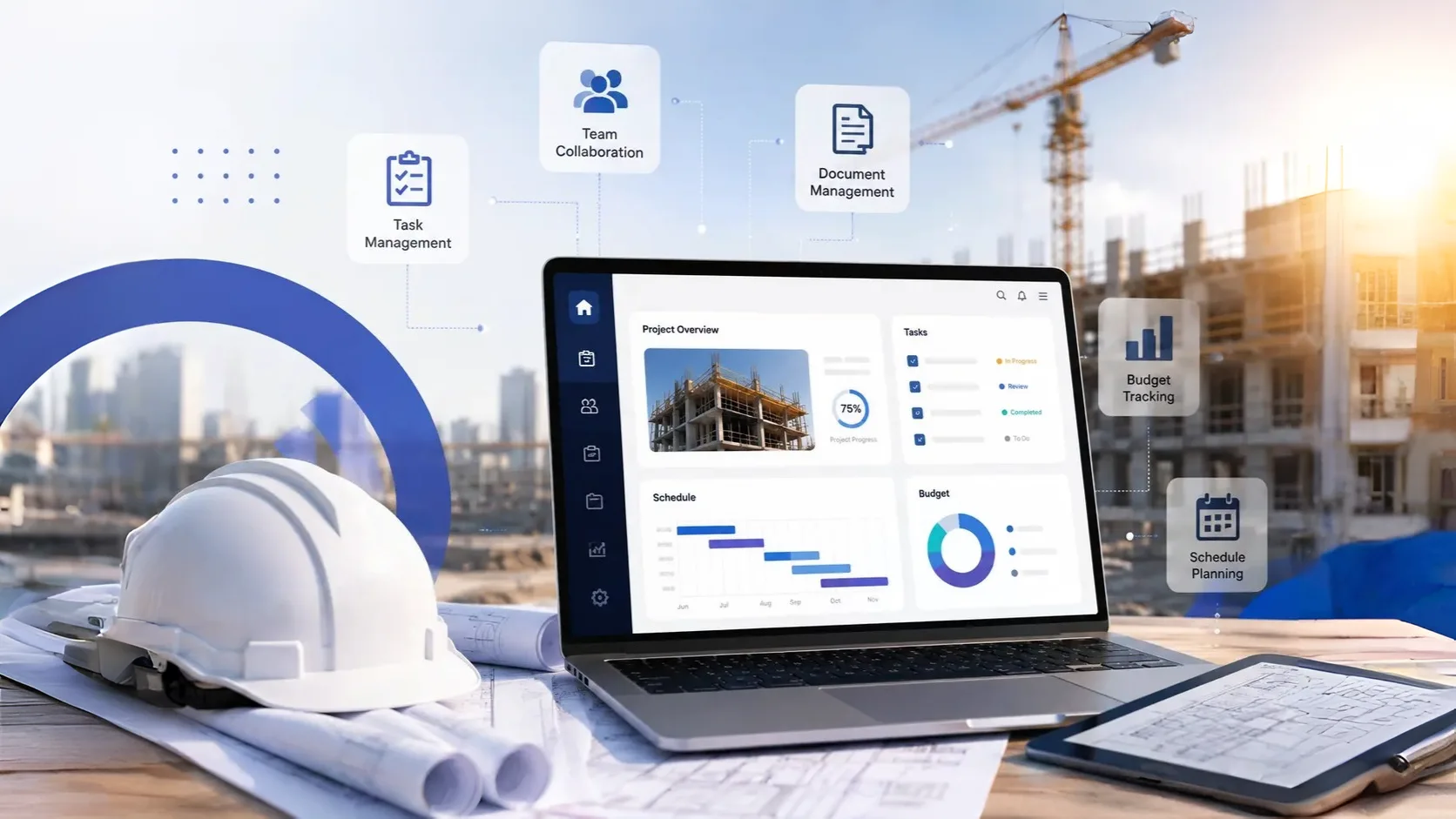
Key Takeaways Many construction companies are still running projects without a centralized system, which creates workflow problems and makes them…

Key Takeaways Construction companies are rapidly adopting digital tools to improve the efficiency of their operations and reduce risks. Custom…

Key Takeaways The construction industry is expected to rise to over $15 trillion by 2030; however, the issue of procurement…