
Have you ever imagined you could manage various aspects of a construction project on a single dashboard, like planning your budget, managing your timelines, and communicating with your stakeholders about the project details? The construction software lets you do all this and even more.
The construction software industry is expected to reach $24.72 billion in 2034, with an annual growth rate of 9.7%. As construction companies are moving away from paper-based approaches, integrating all these processes into a single platform is challenging. That’s why it is important to choose a solution that fits your requirements.
In this blog, we will discuss various elements you need to look for in construction software, what are the various types of software available today, and how to select and implement one that helps you make informed decisions.
Mistakes are bound to happen when a construction project still relies on spreadsheets, paper reports, email threads, and disconnected apps. In the modern world, where there are tight deadlines, higher costs, and increasing client expectations, your business cannot survive with fragmented systems and data silos.
That’s where construction software can help you streamline the process, saving time on repetitive tasks and improving efficiency. Let us see the negative impacts that occur while following traditional construction management methods.
People think that spreadsheets are cheap and familiar. Excel sheets are indeed easy to maintain schedules, budgets, and to measure progress. However, the construction industry is becoming more complex day by day. If your organization is still using manual processes and spreadsheets, then you are likely to make fewer profits.
Using spreadsheets for construction project management can lead to human errors and data duplication.
When project managers do not have real-time visibility, they cannot make the right decisions. Where there is no live data, their decisions might just become guesswork.
When reports are compiled manually, the data already become outdated, and you may overrun your budget without knowing.
For a project to be successful, you need coordination from all stakeholders, such as architects, project managers, suppliers, and contractors, who work from various locations. Traditional practices like using phone calls, emails, spreadsheets, or paper-based documentation lack real-time visibility and lead to misunderstandings between teams and expensive mistakes.
Are you still using static spreadsheets to forecast your budgets? In traditional construction project management, there are no live updates on your budget, schedule of your workers, or site data. So, even a small mistake can become a big budget issue. That’s why disconnected systems and static spreadsheets lead to wrong forecasting and profit leakage.
Teams generally use separate systems to track their work, and they may not talk to each other every day regarding progress. For example, finance teams track costs and operations teams track schedules. They use different apps to do this. On the other hand, the field team uses a different system to track site progress. Now none of them know what’s happening in other teams and make decisions independently.
If data is not being updated in real-time, leadership cannot understand why a project is getting delayed or why the budget is increasing. Team managers can make decisions based on outdated information.
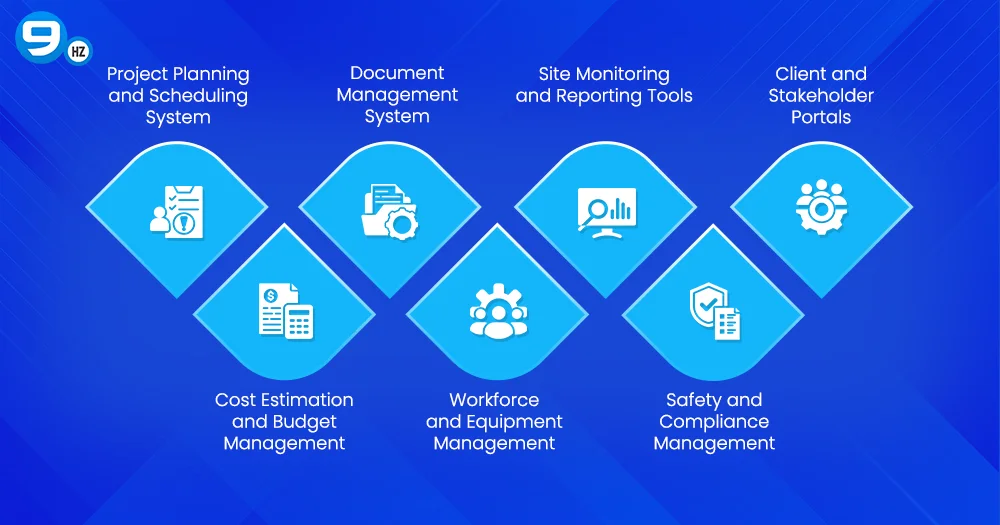
Whether you’re a contractor, builder, or real estate developer, a construction software development company can help you transform your everyday operations with digital tools and systems. Here are some of the features your modern construction software should have and the benefits they offer.
The project planning and scheduling module will help your organization to monitor the progress of your project against deadlines. This module will reduce miscommunication and project delays with better visibility.
The right development partner can help you build a module that allows you to have control over your finances. The cost estimation and budget management module will offer insights about where you are spending your money in real time.
A construction project involves a lot of drawings, contracts, and 3D models. If they are not documented properly, teams may end up using outdated drawings. This module lets you store and manage files in various formats, like PDF and DWG.
Labor costs, which are one of the major expenses of a construction project, need optimization. Equipment is one of the important investments and needs maximum utilization.
Management won’t know the ground reality if there are no site monitoring and reporting tools. You can get real-time updates on project progress with the help of a development partner. Photo or video documentation helps improve accountability and proof-based reporting. An issue tracking tool helps you log or track any delays or defects at the project site.
You can detect issues in the early stage when you have safety audits and compliance alerts. The safety and compliance management tool allows you set schedules for audits and inspections. Through a centralized system, this module allows workers to report injuries or safety hazards and initiate corrective actions through mobile apps. The software also tracks if all site activities meet industry standards.
The client and stakeholder portals reduce manual tracking and unnecessary followups allowing them to have real-time visibility of a project. Through this dashboard, clients can log in and check the status through shared documents.
The reporting dashboard has live charts and graphs to understand the performance of a project, improving clarity and trust.
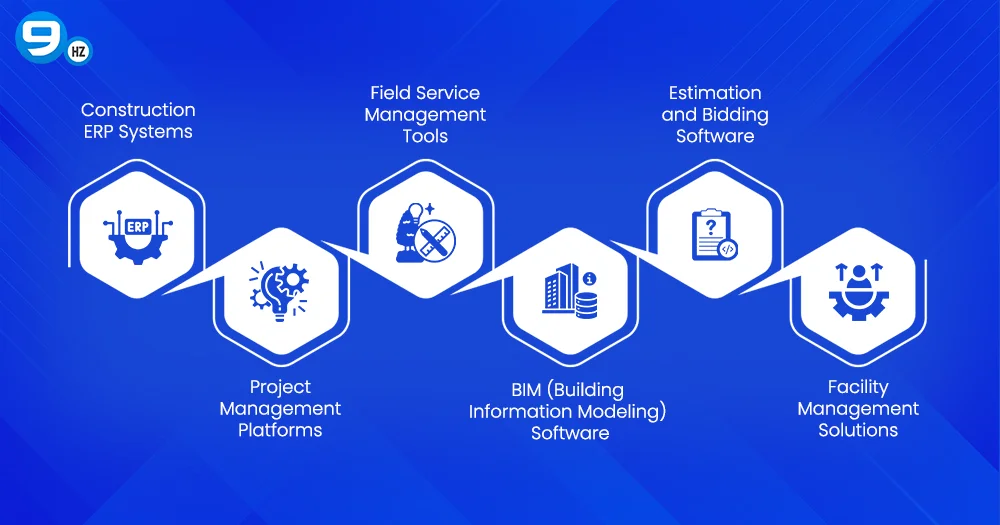
The market is flooded with various types of construction software, which means that you would often get confused about which one is the most suitable for you. Don’t worry. In this section, you can get an idea about a few types of construction software available. This will help you decide which one will be suitable for your needs.
When we are discussing construction software development, it is impossible to ignore construction ERP solution. This type of software is very useful for companies that work on large-scale projects.
A construction software development firm can customize this software based on your requirements, like budgeting, payroll, and resource allocation. It helps you connect with various tools like finance software and CRM platforms. In simple words, ERP software creates a centralized platform, increasing transparency.
We all know that construction projects are complex, and people from many departments, like the electricians, designers, and engineers, work together. Apart from assigning tasks to every team, you need a platform to know what they’re doing, or to track if they are following a timeline to finish the task or not. That’s where a project management platform comes in.
This platform gives you a complete picture of every stage of your project from planning to execution. If something goes wrong, you can go to the project management platform to find the root cause of a problem. It improves collaboration between teams and overall workflow.
If you ask your construction software consultant to build a tool that connects the field and office, a field service management tool will be their go-to suggestion.
This tool will connect your field service team and on-desk team. A lot of confusion will arise if both teams are not in sync. A FSM tool will allow them to access all documents in one place. It also enables the office team to create tasks and lets field teams update on the status of a task on a single dashboard. The FSM tool should be mobile-friendly as it’s difficult for people working in the fields to access their laptops.
BIM is a technology used to create a virtual model of a building before its construction. It contains details about geometry, materials required for construction, and thermal characteristics that provide a 3D representation of a building.
A BIM software provides valuable data throughout the project lifecycle and helps construction managers to execute a complex project easily. BIM helps to identify issues in the design in the initial phase itself. Thus, this feature, when integrated with construction software, helps you avoid rework and reduce delays.
Have you ever imagined what would happen if your expenses exceeded your budget limit? Accurate budgeting is very important for your business. Maintaining your budget as planned depends on many factors, such as material costs, equipment costs, labor compensation, supplier expenses, and more.
Estimation and bidding software gives you clarity as you set a budget based on previous databases. Contractors can avoid underbidding or overpricing, thereby increasing profits and win rates. Faster estimating means more opportunities and less workload.
Lack of proper communication and collaboration leads to nearly 48% of rework in construction projects in the US.
Facility management software helps you get rid of these challenges by ensuring that all teams are working with the same updated data. It also allows teams to focus on executing the work by freeing up their time on repetitive administrative tasks. This software helps reduce delays and improve the lifecycle management of equipment.
| Component | Estimated Cost Range | Estimated Development Time Duration |
|---|---|---|
| Basic System | $40,000 – $80,000 | 4 to 10 months |
| Mid-Level Platform | $20,000 – $50,000 | 3 to 6 months |
| Enterprise Solution | $1,80,000 – $4,00,000 | 3 to 8 months |
| Mobile Apps | $70,000 – $1,50,000 | 3 to 6 months |
| AI & Analytics Modules | $1,50,000 – $3,00,000 | 3 to 8 months |
| Integration & Compliance | $50,000 – $1,00,000 | 2 to 6 months |
The cost of construction software varies depending on its features. Advanced features such as advanced scheduling and BIM models need unique logic and data. That’s why the construction software with advanced features is on the expensive side.
Enterprise systems with multiple projects need a scalable infrastructure. Software for enterprises should enable them to have a role based access and is costlier when compared to mid-sized organizations.
The software requires real-time synchronization and API development when you plan to integrate it with IoT sensors or other existing software.
Construction software development becomes costlier when it has to provide mobile or offline-capable apps. You may need these features when you want to support your field team through an additional synchronization function.
If you are dealing with sensitive data, then you need construction software with standards like SOC2. These features will add additional expenses to provide another layer of security.
The price of construction software may vary according to the development team size and where they are located. For examples you can hire developers who charge $20 to $45 per hour from South Asia. And developers from North America may charge $100 to $200 based on their skills and experience.
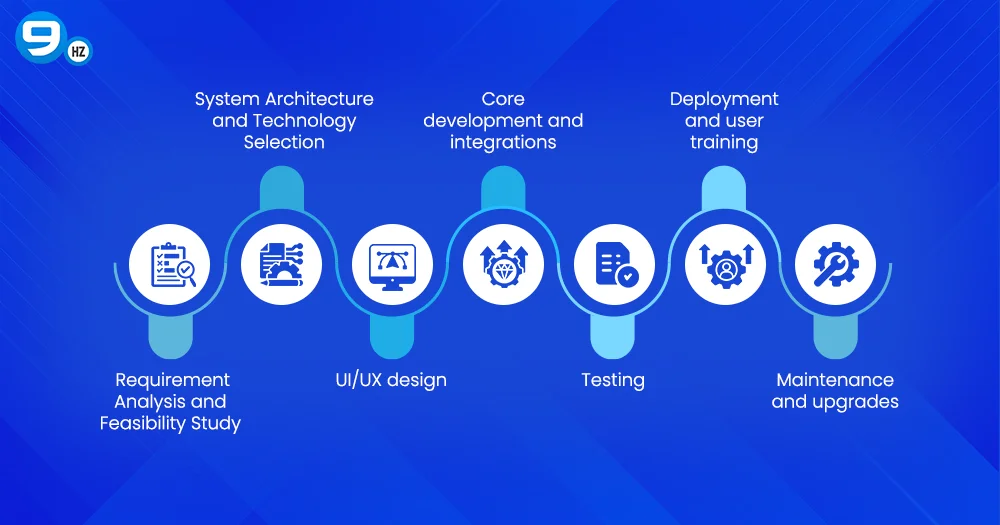
Developing construction software is a complex process and requires a combined effort from stakeholders and the development team. Here are the seven essential steps in the construction software development process for a successful project.
In the first stage, the development team has to establish the goals and milestones of the project after discussing with stakeholders. Analyse the software development cost against the ROI that the construction software may bring to the organization.
You have to choose a technology stack that aligns with your performance needs. Prioritize technology that will allow integration with ERP systems or accounting tools.
The next phase is to design an interface that feels similar to a real-world construction workflow. Create an interface according to the roles of users. For example, the user should be able to do a high-frequency task with fewer clicks. If a field worker is going to use the app, then the team has to ensure that the app works in low connectivity area.
This is an important phase in the construction software development, as the real process begins here. Developers build modules such as project management, budgeting, and scheduling based on your requirements. They have to ensure that the software integrates with other software and APIs for the smooth flow of data between departments.
After the development phase, you have to test the software for bugs or inconsistencies across various devices or platforms and fix them. This will help improve the software’s dependability and functionality.
Once the software is tested, you can deploy it in the real-world environment. User training sessions will help them to understand the features of the software and how to use it properly.
Construction software development is a continuous process. You have to monitor and maintain the software for it to work as expected.
This includes addressing and improving according to feedback given by users, and making sure it is compatible with other systems. You can upgrade the software with features such as accurate forecasting with AI and improved dashboards
There are two types of construction software available in the market. One is off-the-shelf solutions or pre-built software. It is built to serve a wide range of customers. The off-the-shelf software has standard features, and it is not suitable for complex projects. The other one is custom construction software, which is built explicitly to meet the demands of your organization.
Let us see how your organization can benefit from customized software built by a construction software development service company.
Custom construction software development service companies will understand your organization’s needs and goals before building the software. So, you will get a tool that was built to meet your requirements. Generic software cannot provide the flexibility and customization.
Off-the-shelf software limits migration and interrupts existing business systems during integration. Custom construction software solutions, on the other hand, allow for easy integration with APIs to ensure smooth workflows with fewer adjustments.
One of the major challenges of using off-the-shelf software is that you cannot customize it once your business grows.
A custom construction software, which is built with a scalable architecture, allows your organization to adapt to changes.
Investing in custom construction software development might look expensive in the beginning. You get a higher return on investments with custom software as it prevents technical debt and builds scalable features in the long run.
Do you know Netflix owns Open Connect as its own specific content delivery network? Similarly, custom construction software allows you to have unique features that set you apart from your competitors.
Construction software improves project management by ensuring the work progresses as you want it to, and the platform leverages data to help you make informed decisions.
Many tools and technologies are redefining how the construction industry operates, and without these technologies, it is not possible to achieve the results we are aiming for.
Using AI and ML in construction software development is beneficial in monitoring equipment condition and enabling predictive maintenance. Machine learning analyzes past data about asset usage and construction materials, leading to better inventory management.
Another technology that is driving the advancement of construction software is the use of IoT sensors. Employing IoT sensors can help you takecare of environmental conditions at the project site and monitor pollution levels. They can send you prompts when they detect anyone accessing the site without authorization.
Design collaboration is very important to reduce delays and rework in construction management. That’s why BIM integration in the construction software enables architects and contractors to work in real-time by creating a 3D model using BIM.
If you want your teams to access files from multiple locations and expand your storage dynamically, cloud computing technology is a must. It allows your software to scale when needed without investing in hardware.
: Augmented reality can overlay digital models on a physical site to reduce rework and errors in construction. Virtual reality enables you to provide better safety to your workers by offering immersive walkthroughs of a project.
Choosing the right partner for construction software development goes beyond just comparing prices offered by them. You need to have a good idea of their experience, trustworthiness, and the results they will bring to the table.
The company should have proven experience in working with organizations similar to yours. This will help them have a keen understanding of the complexities of the construction industry.
Before partnering with a software development company, check the feedback given by their past clients. The company’s portfolio and case studies will give you a glimpse of their expertise, punctuality, and support after the launch.
Custom construction software should efficiently manage complex workflows and integrate with other existing systems. Therefore, choose a company that has strong expertise in tech stacks like Python, Java, React, AI, ML, and cloud development.
Choose a software provider who can carefully manage your transition during and after deploying the construction software. The team should ensure smooth integration so that there is no disturbance to your business operations.
Post-launch support is very important for proper functioning of the software. You have to select a team that’s available to fix software bugs and that constantly updates security protocols. They should also offer strict SLAs and scale the system as your company grows.
The NineHertz is a premier leading IT firm with proven experience of 15+ years in custom software development. We assist businesses in developing new mobile apps and establishing digital infrastructure. We design scalable and secure solutions that work together and platforms that can grow with organizations over time.
With The NineHertz, you can centralize all of your operations, finance, procurement, fieldwork, analytics, and reporting in one digital place. Our solutions bring all the project data together, automate workflows, and allow you to understand what’s going on with operations, budgets, schedules, and resources in real time.
We build construction software solutions that incorporate enterprise-class technology, artificial intelligence, and a secure architecture. With a decade of experience, we can promptly address RFIs, submissions, compliance processes, and BIM. After the launch of a construction platform, The NineHertz will continue to support you, ensuring the platform is reliable and assisting your organization with future system development.
Construction businesses need real-world solutions to on-site problems and not cheap tools that look good on paper but fail in practice. Construction software development services fix problems by including different construction systems on digital platforms and enabling you to make smart decisions.
1The software should help your organization grow without changing your entire workflow. For this, you need a proven technology partner who makes your investment worthy. The NineHertz, established in 2013, has years of hands-on experience and a 92% client success rate. We help you choose from different types of software solutions that meet your needs and deliver measurable value.
The construction software should have features such as real-time tracking to get live updates on the project. It should also have a document management system to securely store your documents, AI-powered analytics to analyze project performance, and BIM integration to enhance 3D modeling.
The approximate time to develop construction software can take anywhere between 2 and 8 months. The duration may increase if we have to develop software for large-scale projects. Time taken to complete a project depends on various factors like the complexity of the systems, features, the size of the project, and how it integrates with other systems.
Yes, construction software can be integrated with existing systems. Construction companies use systems such as ERP systems, BIM tools, and other financial applications.
Yes. AI can be integrated into construction software. AI integration will improve decision-making and improves efficiency of operations.
Key Takeaways Many construction companies are still running projects without a centralized system, which creates workflow problems and makes them…
Key Takeaways AI in AEC industry refers to the application of artificial intelligence in the architecture, engineering, and construction industry.…

Key Takeaways The construction industry is expected to rise to over $15 trillion by 2030; however, the issue of procurement…