Is your marketing and sales team also busy, putting in all the effort, getting hundreds of leads, but only a small proportion is getting turned into actual business? According to statistics, the average MQL to SQL conversion rate is only 16%, with the fact that 79% of the leads never convert into sales. The reason is wasting time on the lead with the least chances of conversion. That’s where the best AI lead scoring tools help businesses to identify the best leads through a list of thousands and enable the sales teams to put their efforts where the chances of a successful deal are maximum.
According to Research Nester, the lead scoring software market size is growing at a CAGR of 16.5%, expected to reach a valuation of $25.5 billion by 2035. The manual lead qualification process is highly efficient, as the human workforce can only use a certain amount of eligibility criteria to declare the value of a potential client. On the other hand, AI lead scoring software is trained to analyze the lead on a wider eligibility scale to give a score that is more reliable and accurate. That’s why businesses are consistently exploring predictive lead scoring tools to ensure that they invest time in the high-value leads, lower workload, and increase ROI.
However, in the presence of hundreds of lead scoring tools, it can be highly challenging to find the right one. That’s why we have enlisted the 10 best AI lead scoring tools that you can rely on for your business. Give this blog a read, and you will have answers to all your questions around AI lead scoring software.
AI lead scoring tools are the software integrated with technologies like machine learning and predictive analytics that help in the automated analysis, ranking, and prioritization of potential customers on the basis of their likelihood to convert into a successful customer. For the same, they fetch data like historical partnerships, engagement signals, online behavior, budget, query, and much more to offer an accurate predictive lead scoring.
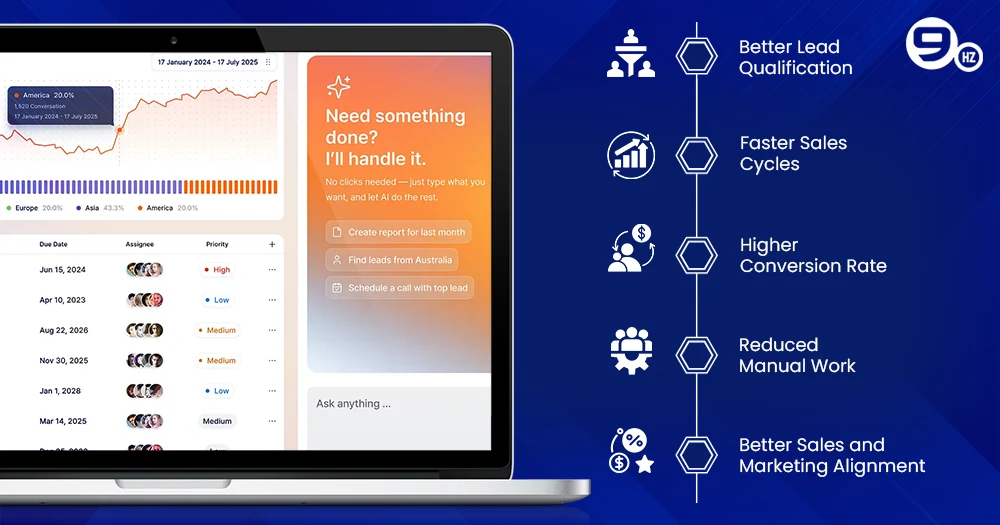
Traditional lead scoring methods rely heavily on manual rules, limited datasets, and static qualification criteria. As buyer journeys become more complex, businesses are shifting toward AI-powered lead scoring to improve accuracy, speed, and conversions. Here’s how AI lead scoring software helps modern sales teams:
The core competency of automated lead scoring working principle is that it goes far beyond the point-based system by combining the different layers of data intelligence to evaluate and rank the leads. It analyzes the leads on complex and reliable criteria to offer a security that can be trusted by the sales professional and marketers to make informed decisions. Here is the working mechanism of AI lead qualification tools-
The AI lead scoring system begins with fetching the data from your CRM and combining it with the behavioral signals, such as email opens, website visits, demo requests, or content downloads. Thus, by analysing both the data, AI makes a comprehensive profile that showcases the buying intent of the customer.
After the data is collected by the AI model, the machine learning model gets involved. ML models are nothing but algorithms that are trained on a huge amount of business-centered data. Thus, it matches the attributes of a new lead to those that were previously closed by the time. Therefore, the prediction made by machine learning models becomes reliable.
Lead scoring automation doesn’t provide the weekly reports, but it works in real time to ensure that the high-value leads can be entertained within minutes, not days. As soon as a lead performs a meaningful action like visiting the pricing page, submitting a query, or shifting from the relevant content, your team is informed about the same.
The AI lead scoring systems can be integrated into the sales automation stack. High-scoring leads get the personalized mail sequence, CRM records are updated, tasks are assigned to specific reps, and even the follow-up calls are scheduled automatically without requiring human intervention.
We build custom AI solutions for startups and businesses.
Now that we have an idea about the benefits and working mechanism of these software, let’s have a brief comparison of the best AI lead scoring tools.
| Tool | Best For | AI Features | Integrations | Starting Price |
|---|---|---|---|---|
| HubSpot Predictive Lead Scoring | SMB & mid-market teams already using the HubSpot ecosystem | Breeze AI for predictive scoring, “Likelihood to Close” scoring (0–100%), engagement & fit scoring, AI-assisted score recommendations | HubSpot CRM, Salesforce, Mailchimp, Google Ads, Zapier | $800/month (Marketing Hub Professional); Predictive scoring on Enterprise |
| Salesforce Einstein | Mid-market to enterprise Salesforce users | ML-based lead & opportunity scoring, Einstein Copilot, behavior scoring, predictive insights with score explainability | Salesforce Sales Cloud, Marketing Cloud, Pardot, Slack, Microsoft Dynamics | Included in Sales Cloud Enterprise+; add-on from ~$50/user/month |
| 6sense | Enterprise B2B teams running account-based marketing (ABM) | Predictive account scoring, anonymous intent detection, buying committee identification, Revenue AI orchestration, 500B+ monthly intent signals | Salesforce, HubSpot, Marketo, Eloqua, LinkedIn Ads | Custom; avg. contract ~$60,000–$124,000/year |
| MadKudu | PLG (product-led growth) SaaS companies with high inbound volume | Transparent “glass box” AI scoring, dual fit + intent models, product usage data scoring, Segment/Mixpanel integration for behavioral signals | Salesforce, HubSpot, Marketo, Segment, Outreach, Gong | From ~$999/month; avg. annual contract ~$32,000 |
| Apollo.io | Startups & SMBs needing an all-in-one prospecting + scoring platform | AI-powered lead scoring with firmographic & intent filters, 275M+ contact database, AI email personalization, engagement signal weighting | Salesforce, HubSpot, Outreach, Salesloft, LinkedIn, Gmail | Free plan available; paid from $49/user/month |
| Clay | RevOps & GTM teams building custom enrichment scoring workflows | Claygent AI research agent, waterfall enrichment from 75+ data sources, custom AI scoring formulas, AI-powered prospect research | Salesforce, HubSpot, Slack, Notion, Webhooks, 75+ data providers (ZoomInfo, Clearbit, Apollo) | Free plan (100 credits/month); paid from $149/month |
| Gong | Enterprise sales teams need conversation intelligence-driven scoring | Deal Likelihood Scoring (300+ signals), AI Ask Anything, call sentiment analysis, AI Data Extractor, Deep Researcher agent, real-time pipeline intelligence | Salesforce, HubSpot, Zendesk, Outreach, Salesloft, MS Teams, Slack | From ~$1,600/user/year + mandatory platform fee ($5,000–$50,000/year) |
| Drift | SaaS & tech companies with high inbound website traffic | Bionic Chatbots for real-time AI qualification, Site Concierge, intent-based visitor scoring, automated meeting booking, and AI-driven lead routing | Salesforce, HubSpot, Marketo, Pardot, Salesloft, Google Calendar | From ~$2,500/month (Premium); Advanced & Enterprise on custom quote |
| ZoomInfo | Large enterprise outbound sales teams needing data + scoring in one platform | ZoomInfo Copilot AI (account summaries, outreach recommendations), real-time intent scoring, buyer signal alerts, 500M+ verified contact database | Salesforce, HubSpot, Microsoft Dynamics, Marketo, Slack, MS Teams, Gong | Custom pricing; typically $15,000–$50,000+/year |
| Leadspace | Enterprise B2B teams running complex ABM & data unification programs | AI scoring across 3 dimensions (company fit, intent, persona), predictive account scoring, look-alike modeling, ICP analysis, 30+ data sources unification | Salesforce, Microsoft Dynamics 365, Marketo, Eloqua, HubSpot, Pardot | Custom; starts at ~$50,000+/year |

Choosing the right AI lead scoring tools is one of the most important but challenging tasks as the working mechanism is complex to understand. However, you can rely on the following AI lead scoring tools for your business-
HubSpot Predictive Lead Scoring is an advanced solution built into the Hubspot ecosystem. Thus, it becomes easier to use for the teams that are already using Hubspot CRM. The tool analyzes the lead and provides a score called “Likelihood to Close” between 0-100%. Thus, it eliminates the manual guesswork.
AI Capabilities- It uses Breeze AI to power predictive scoring using behavioral signals, engagement patterns, and historical deal data. It even adjusts the scores as soon as new conversion data is updated.
Best Use Case- The tool is best for small and medium businesses, along with the marketing and sales teams that work on HubSpot, and are looking for AI-powered solutions for automated and accurate scoring.
Integration- HubSpot Predictive Lead Scoring solution can be integrated with Salesforce, HubSpot CRM, Google Ads, Zapier, Mailchimp, and 1000+ other apps.
Pricing- The manual scoring begins at $800/month. Enterprise plans are customized according to the company’s needs.
| Pros | Cons |
|---|---|
| Native CRM integration without any setup friction | Predictive analytics comes with only the expensive Enterprise tier |
| Transparent scoring with complete justification | Comparatively less powerful for teamwork outside the HubSpot ecosystem |
| Consistent self-improvement |
Salesforce Einstein is basically the AI layer integrated into Salesforce’s Sales Cloud that scores leads by fetching the data from CRM and analyzing it to predict conversion likelihood. Salesforce Einstein is highly preferred by businesses that already rely on Salesforce CRM for their operations.
AI Capabilities– Einstein Copilot for conversational AI, ML-based lead scoring, predictive insights, and behavior scoring.
Best Use Case– Mid-market enterprise who existively use Salesforce CRM and wants an integrated scoring tool.
Integration– Salesforce Sales Cloud, Marketing Cloud, Pardot, Slack, Microsoft Dynamics, and the full Salesforce AppExchange ecosystem
Pricing– Standalone- $50/user/month.
| Pros | Cons |
|---|---|
| Deep Native Salesforce Integration | Complex setup |
| Score explainability | Expensive for small teams |
| Trained on CRM data |
6sense is mostly used by enterprises that rely on account-based marketing. The software helps to identify in-market buying commitments using the anonymous intent data as soon as a prospect fills out a form. The tool comes with a Revenue AI platform that has significantly upgraded in the previous year.
AI Capabilities– Buying commitment identification, predictive account scoring, AI-driven multi-channel orchestration.
Best Use Case– For enterprise B2B teams relying on account-based marketing and high investment capability.
Integration– LinkedIn Ads, Eloquo, HubSpot, Salesforce, Marketo
Pricing– Custom Annual Contract- $60,000-$124,000/year
| Pros | Cons |
|---|---|
| Anonymous intent detection | Expensive for small and medium businesses |
| Strong ABM orchestration capabilities | Complex and time-consuming implementation |
| Powerful buying committee identification |
MadKudu uses a glass box AI model that helps the sales professionals to understand how the score was assigned to each lead. The tool is dedicatedly built for PLG SaaS companies and works based on product usage data.
AI capabilities– Product usage signal integration via Mixpanel, dual fit + intent scoring model, automated prospect prioritization
Best Use Case– Bes for series B+ SaaS companies with PLG motion
Integration– Hubspot, Salesforce, Segment, Marketo, Gong, LinkedIn
Pricing– From ~$999/month; average annual contract ~$32,000/year based on Vendor data
| Pros | Cons |
|---|---|
| Complete transparency into scoring logic | Steep entry price |
| High predictive accuracy | Requires a huge volume of historical data |
| Strong PLG and product usage signal integration |
Apollo.io is one of the best AI lead scoring tools that combines a 275M+ contract B2B database with intent filter, outreach sequencing, and a built-in CRM layer. This core competency makes it one of the best tools for starting a sales team to identify high priority prospects.
AI Capabilities– Engagement signals, AI-powered lead scoring using firmographic fit, AI email personalization, contact enrichment
Best Use Case– Highly preferable for SMBs looking for all-in-one scoring and prospecting.
Integration– Gmail, Outreach, HubSpot, Salesforce, Gmail, Outlook
Pricing– Free plan available; paid plans from $49/user/month (Basic) to $119/user/month (Organization).
| Pros | Cons |
|---|---|
| Available free tier | Less sophisticated scoring as compared to platforms like Madkudu |
| Affordable for small teams | Certain bounce rate issues |
| Scoring+database+sequencing in one platform |
Clay is a spreadsheet-style data workspace that uses waterfall enrichment to connect to more than 75 enrichment providers. It analyzes each source in sequence to maximize the data fill rate.
AI Capabilities– Waterfall enrichment from 75+ sources, Claygent AI research agent, AI-powered prospect research, custom AI scoring formulas.
Best Use Case– Idea for RevOps teams looking for custom enrichment and scoring workflows through multiple data providers.
Integration– Webhooks, Notion, Salesforce, Clearbit, Apollo, ZoomInfo
Pricing– Free plan (100 credits/month); paid from $149/month (Starter) to $800/month (Pro); custom Enterprise pricing available.
| Pros | Cons |
|---|---|
| Excellent enrichment flexibility | Steep learning curve |
| Customizable scoring models | Quickly escalating credit costs |
| No need for engineering resources |
Gong is a leading software in the list of best lead scoring platforms that helps with revenue intelligence, analyzes sales conversion, provides coaching insight, and identifies pipeline risk indicators. The platform has build new AI agents for CRM automation.
AI Capabilities– AI Ask Anything, Call Spotlight summaries, Deal Likelihood Scoring, AI Data Extractor, sentiment and objection analysis, AI Deep Researcher.
Best Use Case– Ideal for an enterprise sales team that needs deep conversation intelligence and deal-level scoring.
Integration– Salesforce, Salesloft, Outreach, Microsoft Teams, Slack, Zoom, HubSpot.
Pricing– $1,600/user/year (Foundations) + mandatory platform fee of $5,000–$50,000/year. Onboarding fee $7,500+.
| Pros | Cons |
|---|---|
| Best in-class conversion intelligence | Expensive to set |
| Strong CRM synchronization | Doesn’t generate new pipelines. |
| Real-time pipeline scoring |
Drift is a part of Salesforce that qualifies website visitors in real time with the help of its AI-powered Bionic Chatbots and Site Concierge. The tools engage the high-value buyers as soon as they show any buying signals, like filling out a form, going to the payment page, etc. At the same time, this AI-led scoring platform also helps to book and schedule meetings automatically.
AI Capabilities– Real-time visitor intent scoring, Bionic Chatbots, instant lead routing, automated budget and authority confirmation.
Best Use Case– Preferred by the tech and SaaS companies with good website traffic and planning to turn it into qualifying leads.
Integration– HubSpot, Salesloft, Salesforce, Google Calendar, Amplitude, Mixpanel.
Pricing– $2,500/month (Premium plan); Advanced and Enterprise tiers require custom quotes. Per-seat fees of ~$80/month apply additionally.
| Pros | Cons |
|---|---|
| Real-time conversational qualification | Expensive entry point |
| Deep Salesloft integration | Limited to website channels only |
| Automatic meeting scheduling and booking |
The next name in the list of best AI lead scoring tools is ZoomInfo, which combines a large B2B contact database, consisting of 500M+ contacts, with intent intelligence, AI-powered scoring, and its generative AI layer named ZoomInfo Copilot. It helps to know who to contact, along with the best timing and message.
AI Capabilities– outreach recommendations, buyer signal alerts, Copilot AI for account summaries, technographic + firmographic + behavioral signal fusion
Best Use Case– Ideal for large enterprises that need a single platform for contact data, AI-guided prioritization, and intent signals.
Integrations– Microsoft Dynamics, Salesforce, Microsoft Teams, Marketo, and Gong.
Pricing– Custom pricing; typically $15,000–$50,000+/year. Available on Professional, Advanced, and Enterprise plans.
| Pros | Cons |
|---|---|
| Largest and verified B2B contact database | Enterprise-centric pricing |
| Real-time buying signal alerts | Variation in data accuracy |
| AI Copilot to blend data |
Leadspace is a complete B2B Customer Data Platform (CDP) that can centralize data from 30+ sources and build rich contact profiles. The tool powers ABM programs with different global enterprises like SAP, RingCentral, and Microsoft.
AI Capabilities– AI scoring in three different dimensions- intent, company fit, and persona, ICP analysis. On-demand data enrichment.
Best Use Case– Best for B2B large organizations with critical ABM programs requiring a full CDP for account-level segmentation.
Integrations– Eloquo, Microsoft Dynamics 365, Salesforce, HubSpot, digital ad platforms.
Pricing– Custom; starts at ~$50,000+/year. Subscription-based, with professional services required for implementation.
| Pros | Cons |
|---|---|
| Multi-dimensional AI scoring | Exclusively enterprise-priced |
| 30+ unified data sources | Long implementation process |
| Strong ABM activation capabilities |
While you can choose the right AI lead scoring platform from the names given above, it is also important to have an idea about how to analyze a lead scoring platform according to your particular business needs. Here are the key techniques that you can use for the same.
First of all, you should ensure that the AI lead scoring tool integrates well with your existing CRM software and is not just limited to a Zapier workaround. The tools like HubSpot Predictive Scoring and Salesforce Einstein only work best when they are connected to the CRM and able to fetch the data. A delayed synchronization can lead to high priority deals sitting idle.
Most of the AI lead scoring platforms nowadays offer AI features. However, the more important part is accuracy, as inaccurate results might hinder the entire sales funnel. Therefore, you must ensure that the software is trained on a huge volume of historical deals, sales data, and customer behavior patterns. You should also have an understanding of the mechanism used by software to provide scoring.
When investing in a lead scoring software, looking for automation capabilities is also necessary. The best AI lead scoring tools directly connect to the automated workflows, enrolling mid-score contacts in a nurture sequence, and alert the professionals when any user crosses the set threshold.
Every business has its unique workflow and requirements, which makes it important for AI lead scoring platforms to have customization capabilities. The software should let you weigh different signals like job title, product usage, pricing page visits, company size, etc.
Reporting and analytics are the backbone of any successful sales and marketing workflow. So, choose a platform that provides insights into the score distribution, model accuracy trends, and conversion rates by tier.
Many predictive lead scoring tools are cost-efficient to begin with, but the cost increases gradually with use. Therefore, you should choose the automated lead scoring software with pricing stability.
You should understand that even the best AI lead scoring tools can underperform if the fundamental rules are not clear. Have a look at these common mistakes that people make with lead scoring platforms and avoid them.
The performance of an AI product is entirely defined by the quality and quantity of data that is fed. Therefore, duplicate records, inconsistent job titles, missing fields, and outdated contact information must be avoided when you are training your AI model. Ensure data hygiene for accurate prediction and reports.
Scoring models should never be built on gut instinct. Assigning high points to action which might feel important for conversion sometimes don’t correlate with the closed deals. So, always remember to anchor your scoring model to historical conversion patterns.
Automation is good and productive, but over-automation might ruin your well-settled processes. There should be room for human judgment in the process. At the same time, the end customers must have a window to talk to human experts if the AI model is not able to understand and resolve their query. Ensure that you consult with your CRM software development service provider when automating things.
Changes are constant in the business, market, customer behavior, data, and workflows. Thus, if you don’t retrain the model after a certain period, it will continue to use the outdated data, and there is a high chance of inefficient results. Ensure that you retrain your model on new data and trends after 18-24 months.
Many businesses don’t have alignment between their sales and marketing departments, which leads to inaccuracy in lead scoring tools. For instance, if the marketing team is considering a 70+ score “sales ready” and sales reps are ignoring anything that comes below 90, the pipeline becomes just a blame game. So, there should be a mutual goal and understanding between the departments.
Artificial intelligence is upgrading each day, which brings a lot of exploration in the future of lead scoring tools. The tool is consistently evolving into a system that engages, identifies, and advances the leads without requiring human intervention.
Not just a tool but the future lead scoring platforms are taking the shape of AI sales development representatives with the capabilities to send personalized messages, book meetings on the basis of a threshold, and handle objections without human intervention. The human representative only needs to enter when the lead is sales-ready.
At the same time, agentic AI is going to play a significant role by helping these tools make decisions independently, perform multi-step tasks, and plan and reason in the workflow on the basis of pre-defined, clear goals. For the same, there will be increased demand for agentic AI development service providers.
Autonomous sales workflow is also going to be part of the future of AI lead scoring, where the software will not only assign a score but will also connect to the potential client and make them sales-ready.
Conversational AI and predictive intent engines are going to be another key highlight of evolution that is going to increase the accuracy, efficiency, and reliability of this software.
There is no denying the statement that even the best AI lead scoring tools might underperform if not deployed or managed by the right team. The NineHertz is a burgeoning artificial intelligence development company that enables businesses worldwide to understand the key limitations of their sales funnel and choose the right automated lead scoring platform.
The NineHertz carries an experience of more than 13 years in building next-gen AI solutions. Our highly experienced staff of 250+ AI engineers evaluates the core competency of each tool, aligns it with the real business requirements, and integrates it into the existing CRM of the company for seamless data flow.
As a leading AI-native engineering partner, we offer a free consultation session to businesses that helps them understand their key challenges, along with the best mitigation roadmap. From beginning to post-deployment, we offer active maintenance and support to ensure long-term sustainability and scalability of digital solutions.
Answer- The best AI lead scoring tool is highly dependent on the specific business requirements, sales workflow, budget, and overall goals. However, some of the best AI lead scoring tools are HubSpot Predictive Lead Scoring, Salesforce Einstein, 6sense, and MadKudu.
Answer- The accuracy of AI lead scoring software is dependent on the quality and quantity of historical data. For instance, Salesforce Einstein and MadKudu offer an accuracy rate of 80-90%, while some cheaper tools often compromise on accuracy.
Answer- Most of the popular CRMs like Pipedrive, HubSpot, Salesforce, and Freshsales can connect to AI lead scoring platforms.
Answer- Yes, small businesses can use AI lead scoring software to connect to high-value clients and increase their revenue. Several tools like Freshsales AI, ActiveCampaign, and Apollo.io offer cost-efficient AI features for small businesses.
Businesses no longer prefer to waste equal time on all the queries on leads generated through the marketing campaigns. Thus, they use lead scoring automation platforms, which help to analyze the customer behavior, historical track records, nature of the query, and other data to give an accurate score to a particular lead. This score helps the sales professional to identify if a particular lead is worth putting effort into or not.
Choosing the right AI lead scoring tools can be complicated without prior experience. Thus, you can rely on the tools listed above to automate lead scoring tasks in your business. If you have any questions around how AI lead scoring works, how to implement them, or what would be the long term costs, feel free to sign up for a free consultation session with The NineHertz.

Are you looking for the top AI development company in the USA? Guess what, you’ve come to the right destination.…

Key Takeaways Multi-agent systems can improve task specialization, coordination, and scalability by distributing complex workflows to specialized AI agents. Sequential,…

Key Takeaways AI supply chain risk monitoring uses real-time data and predictive models to flag disruptions before they escalate into…