
What if your consumers could look for policies, compare premiums, buy coverage, file claims, keep track of approvals, and get help in just a few minutes, without having to wait in line or visit physically?
This is happening right now because of the emergence of mobile apps for insurance and the larger digital transformation that is happening in the insurance business. The insurance mobile app development market is expected to reach over $20.41 billion by 2031.
The insurance industry around the world is changing in a big way to focus on mobile-first interaction. Traditional insurers that don’t switch to digital quickly enough could lose market share to these quick-moving rivals. Mobile is no longer a choice; it is a must-have in today’s world. This full guide looks at every part of making an insurance mobile app.
You will learn about the most important features, best practices, new technologies, development methods, technical architecture, insurance mobile app development cost, and the measurable commercial value of mobile insurance apps. This guide will help you make smart choices and develop a successful mobile strategy, whether you work in insurance, are an entrepreneur, or head a digital company.
A successful insurance mobile app development is far more than a digital brochure. It is a complete-service platform that supports the entire insurance lifecycle, from customer onboarding to policy management and claims settlement.
There can be multiple users of insurance applications, such as policyholders, agents, brokers, claims adjusters, underwriters, and administrators, who hold different roles and responsibilities.
Through custom insurance mobile app development, insurance companies have the opportunity to create apps that perfectly meet their business models. It opens doors to individualized user experiences, adjustable underwriting criteria, tailor-made pricing engines, and seamless integration.
Security must be a non, compromisable feature in insurance apps. At no time should highly personal and financial data be leaked.
Majorty of people in the US would like to make use of online self-service facilities when interacting with insurance companies, and over 70% believe that having a mobile app influences their decision on which company to choose.
Millennials and Gen Z, in particular, are demanding digital services that are fast, easy, and tailored to their needs, just like the availability of banking or shopping on e-commerce platforms. At the same time, insurance companies are increasingly being forced to reduce their prices and improve their services.
Studies have shown that by embracing mobile technology, businesses can save as much as 35% on administrative and processing expenses and retain customers for an average of 25% longer. This will have a direct impact on the company’s profitability and ability to continue operating in the long run.
As a result, the cost of developing an insurance app should not be treated as a mere factor in a budget. It should be considered a sound investment that allows you to develop, automate, and differentiate yourself.
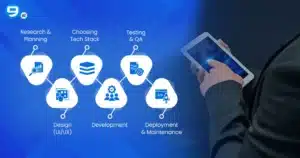
Here is a glance into the ideal insurance mobile app development process-
Select among frontend, backend, database, and cloud technologies.
Agile project management methodology for insurance app development, allowing companies to transition from slow, traditional, and rigid, product-centric models to faster, customer-centric, and value-driven approaches.
Functional, performance, security, and compatibility testing must be done.
Developing a robust insurance app requires a structured approach to development, App store submission, monitoring, and updates to manage sensitive user data and provide real-time services.
In line with insurance mobile app development, taking an Agile/Scrum approach is a way for the project to not only continue evolving but also through iterative releases being done instead of long and inflexible cycles.
Instead, the development is split into small sprints that are focused; the teams can work on deploying the most valuable modules, such as claims processing, underwriting workflows, and secure payment systems.
Thus, the process is continuously improved through stakeholder involvement, such as compliance officers, operations teams, and business leaders. Integration of their feedback is done early and efficiently. The risk is minimized, and the product quality is enhanced through regular sprint reviews and testing cycles, and the product is kept in line with regulatory standards. Agile goes hand in hand with releasing the MVP at a quicker pace, a feature validation with real users is done by the insurers, feedback is gathered, and the app is refined based on performance data. In the end, Agile contributes to insurance mobile app development becoming more flexible, transparent, and very focused on the results.
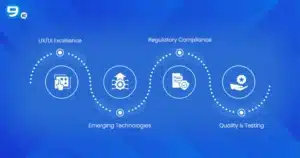
An app’s UX is really the main factor in how users will perceive the insurance app and how much they will get engaged. Providing users with easy navigation within the app, good use of negative space, and consistency in the visual aspects of the app will definitely help insurance companies get higher rates of app usage and increase customer retention. Thus, the UI/UX seamlessness is one of the core factors for the best insurance app development.
AI can be leveraged in insurance apps in various ways. AI in insurance help lines available 24/7 for immediate assistance through insurance chatbots, predictive analytics for getting better risk assessment, faster decision making by underwriters, and more personalized and efficient services delivery by IoT, based usage, based insurance models.
AI in insurance will decrease the chances of lawsuits, and at the same time, through higher security, it will enhance customers’ trust in digital insurance offerings.
A reliable insurance app development company emphasizes:
For a successful insurance mobile app, you must have a good technological foundation.
For insurance app development, technical aspects involve identifying the best tech stack and implementing security requirements.
When it comes to modern insurance apps, the decision between cross-platform and native development has a large influence on time, market, and performance. It’s important for the development of a mobile insurance app to get smooth performance and accurate data collection, which is a challenge for hybrid frameworks to handle efficiently.
In the insurance industry, APIs are what connect new front-end experiences with old back-office systems. Using RESTful APIs and GraphQL facilitates efficient data fetching that reduces latency for the end user. Besides the usual connections, insurance apps need third-party integrations of a different kind for live functionalities. Now, for instance, a link to government databases for instant KYC/AML, an integration with credit bureaus for smart premium calculation, and a connection with banking gateways for instant claim payouts. These integrations have to be done in a way that data consistency is maintained across CRM platforms and Enterprise Resource Planning (ERP) systems, without resulting in data silos.
Due to the business nature, insurance companies are required to maintain the confidentiality of Personal Identifiable Information (PII) and Protected Health Information (PHI), thereby necessitating security at the highest level. The stack needs to implement end-to-end encryption (E2EE) for all stored data because its current SSL/TLS encryption system fails to meet worldwide compliance requirements, which include GDPR and HIPAA standards. Access control should be enforced using OAuth 2.0 and rigorous Multi-Factor Authentication (MFA) to prevent unauthorized account takeovers.
The security architecture requires real-time threat detection systems together with continuous automated vulnerability scanning methods, which include DAST and SAST to find and fix security weaknesses before attackers can use them against the system.
Enterprise-grade cloud platforms such as AWS, Microsoft Azure, and Google Cloud provide essential deployment services that enable insurance services to maintain their high availability requirements. The platforms enable serverless architectures, which use AWS Lambda to enable automatic application scaling, which adjusts computing resources from full capacity to zero based on traffic spikes that occur during open enrollment periods and natural disasters.
The cloud infrastructure delivers geo-redundant backups together with automated disaster recovery systems. The system preserves essential policyholder information as it enables rapid service restoration after major data center failures, which take only minutes to complete,e thus maintaining business operations and preserving customer confidence.
| Insurance App Type | Type Estimated Cost | Best For | Key Features | Development Timeline | Team Size & Tech Stack |
|---|---|---|---|---|---|
| Basic Insurance App | $25,000 – $40,000 | Startups, small insurance agencies, and MVP development | Basic policy management, premium payments, simple claims submission, push notifications, email/password login | 2–4 Months | 3–5 developers, 1 UI/UX designer, 1 project manager, Firebase/Node.js, PostgreSQL/MySQL |
| Mid-Level Insurance App | $40,000 – $80,000 | Growing insurers, insurtech startups, and multi-product insurance providers | Advanced policy management, claims tracking, AI chatbot, secure document management, multiple payment integrations, biometric login | 4–8 Months | Cross-platform development with Flutter or React Native, scalable backend architecture |
| Advanced Insurance App | $80,000 – $150,000+ | Enterprise insurers, large carriers, and funded insurtech companies | AI-powered underwriting, automated claims processing, predictive analytics, IoT integration, blockchain support, white-label capabilities | 8–14+ Months | Enterprise-grade development team with AI/ML engineers, cloud-native infrastructure, advanced security & analytics systems |
| Annual Maintenance Cost | $10,000 – $25,000/year | Advanced enterprise platforms | Monitoring, updates, security patches, performance optimization, feature enhancements | Ongoing | Dedicated support and maintenance team |
Understanding the financial commitment required for insurance app development is crucial for making informed business decisions. The cost to develop an insurance app ranges significantly based on complexity, features, and business objectives, making it essential to understand what drives pricing at each level.
Budget Breakdown: What You Get at Each Level
Basic insurance apps are a good idea for startup companies, insurance agencies trying to go digital, or businesses that want to create minimal viable products (MVPs) before deciding on full-fledged solutions.
Among the features are simple policy management through which clients can access details of their coverage, policy papers, and basic information; premium payment linked to standard payment services such as Stripe or PayPal; easy claims submission that enables the uploading of documents and photos by the users; push notifications for renewal reminders and payment alerts; and basic user authentication with email/password login. The look of the app is typical, with basic customization, makeup of pre-built UI components rather than custom illustrations or animations.
Usually, the development of simple apps takes 2-4 months with a small team of 3-5 developers, one UI/UX designer, and a project manager. The backend is based on simpler architectures like Firebase or basic Node.js setups with PostgreSQL or MySQL databases. Third-party integrations are limited.
This investment results in a powerful and professional product that efficiently meets the company’s needs while providing a reasonable price. Besides, the combination of features totally improves the customer experience, and the law of the manageable development timelines is observed.
On this level, you can choose cross-platform development with Flutter or React Native, which gives you both iOS and Android platform releases from a single codebase, thus very much expanding your market base without doubling your development cost. The complexity of the features’ list drastically increases, from thorough policy management with coverage details, filing endorsement requests, updating beneficiaries to advanced claims processing with features such as photo capture, document scanning, claim status tracking, and automatic notification; AI chatbots available 24×7 to handle most of the customer queries; document management system users can upload, store and retrieve their insurance documents securely; multi, payment integrations via credit cards, digital wallets, and automatic bank transfers; and biometric authentication (fingerprint, Face ID) for an extra security layer and user, friendliness.
Mid-range applications are the right fit for long-time insurance service providers who look for digital solutions to their services, well-financed insurtech startups aiming to distinguish themselves in a highly competitive market, multi-product insurers who give health, auto, life, and property coverages, and companies that offer their services in several states or regions and need scalability. The expenditure results in professional, grade apps that can hold their own against the industry giants while still being budget-conscious resorts.
An advanced insurance application is at the forefront of insurtech innovation, integrating the latest technologies that not only make insurance a mere transaction but create a full-fledged digital ecosystem. This level is for industry leaders, heavily funded insurtech companies, and established carriers with a vision to dominate the market for insurance in the digital era.
Feature sets at this level include AI-powered underwriting that analyzes risk factors in real-time, providing instant policy quotes based on sophisticated algorithms; automated claims processing using computer vision to assess damage from photos, machine learning to detect fraudulent patterns, and natural language processing to extract information from documents; predictive analytics forecasting customer lifetime value, churn probability, and cross-sell opportunities; IoT integration connecting with smart home devices, wearable health trackers, or vehicle telematics for usage-based insurance; blockchain implementation for transparent; and white-label capabilities enabling insurance agents or partners to rebrand the platform.
The investment delivers transformative platforms that redefine customer expectations and operational efficiency, though the complexity requires substantial ongoing maintenance budgets of $10,000-$25,000 annually for monitoring, updates, and continuous improvement.
Comprehending what drives costs allows better strategic choices to be made about allocating funds and tightening operations. All factors influence each other, thus raising the challenge of predicting total expenses.
Feature complexity is the main reason for increased costs, and the prices go up more than double when the functionalities become wider. On one hand, elementary features like login authentication, viewing a policy, and making a payment through integration are standard factors that take relatively few development hours. On the other hand, with every single advanced feature, the whole application architecture gets affected; thus, consequent complexities arise.
Usage of computer vision for claims processing, which involves analyzing damage photos, requires model training, image processing pipelines, and integration with claims workflows, which can be up to 250-400 hours.
Telematics integration, connecting with vehicle or IoT devices, involves 200-350 hours. A fraud detection system that monitors patterns and flags suspicious activities needs 300-450 hours of work for anomaly detection algorithms, rule engines, case management interfaces, and investigator workflows.
Every feature influences architecture, security, testing, and documentation, thereby multiplying actual development time far beyond simple additive calculations.
A decision on the platform will deeply affect not only the initial development costs but also the maintenance costs in the long run. The insurance market reality shows users split fairly evenly between iOS and Android, with iOS users typically demonstrating higher policy values and engagement rates while Android dominates overall market share, particularly in emerging markets.
Modern insurance apps don’t operate in isolation. Integration complexity directly correlates with development costs, as each connection requires authentication, data mapping, error handling, and ongoing maintenance.
Regulatory Reporting Systems
Insurance applications process extremely sensitive information, such as social security numbers, financial details, medical records, and driver’s licenses. Therefore, security cannot be an optional feature but a critical requirement from the very start. Besides, the way security is implemented impacts the cost of development in terms of employing highly specialized experts, conducting extensive testing, and continuous monitoring.
Insurance firms are not allowed to cut corners in security. A data leak would mean a loss of customers’ trust and involves hefty regulatory penalties (GDPR fines can be as high as 4% of the global revenue), not to mention being vulnerable to class action lawsuits. Allocating 15-25% of the total development budget for security, therefore, is a wise move as it safeguards the clients and the business at the same time.
Developer hourly fees vary greatly depending on geographical location, which causes significant cost differences for producing the same functionality. Knowing the regional costs is a prerequisite to making well- informed decisions on strategic sourcing that will help achieve a balance between cost, quality, and communication.
Smart insurance firms reduce their development expenses without sacrificing their product quality by making:
One of the best things about insurance mobile app development is that it gets customers involved. A well-designed mobile app gives insurers and customers a direct digital link, which makes them more responsive and builds trust over time. Mobile apps help customers stay involved throughout their whole journey, from signing up and buying to renewing and filing claims.
One of the primary reasons for insurance mobile app development is to enhance operational efficiency.
To maximize the benefits of automation and prevent data silos, integrate the app with CRM and policy management systems. Mobile apps also facilitate upselling and cross-selling. To reduce the number of people who leave before they’re done, keep your checkout processes short.
Each time you roll out an insurance mobile app, it collects data that can be used.
Use real-time dashboards to monitor conversions, claims processing time, and user engagement.
Digital native companies are increasingly having a larger and larger impact on the insurance industry. A smart mobile app will make insurance companies appear cutting-edge and customer-focused.
This is a huge advantage in terms of retaining existing customers and acquiring new ones.
Insurance mobile apps that drive substantial revenue growth by transforming how customers discover, evaluate, and purchase policies. Apps eliminate traditional friction points through instant quote generation, one-tap payment integration, and biometric authentication, compressing sales cycles from 7-14 days to under one hour. This speed advantage reduces abandonment rates from 58% to 31%, capturing policies that would otherwise be lost. Mobile apps also excel at cross-selling and upselling, with app users purchasing additional coverage at 3.2 times the rate of non-app customers. Push notifications triggered by life events, home value increases, travel plans, and new mortgages, generate timely coverage recommendations that feel helpful rather than intrusive. Customer acquisition costs drop significantly compared to traditional agent networks, while viral referral features built into apps generate new customers at near-zero cost. The result: app-acquired customers deliver better lifetime value than traditionally sourced policyholders.
Establishing a proper development partnership is crucial. However, partnering with a company that has demonstrated domain expertise and technical profundity can be phenomenal. Among such companies, The NineHertz is a reputable technology partner that has gained a wealth of experience in developing scalable, secure, and high-performance digital solutions for world-class enterprises.
NineHertz truly provides insurance mobile app development services that cover all the bases from business consulting and UI/UX strategy to full-stack development, third-party integrations, testing, deployment, and post-launch optimization. Their agile methodology brings faster turnaround times, more transparent communication, and delivery outcomes that are more predictable.
They specialize in a few key areas, one of which is domain-focused development. They are so familiar with the standard practices of underwriting, claims automation, compliance mandates, and insurance data security standards that they can come up with the most fitting architectures. This not only results in fewer revisions but also helps to lower operational inefficiencies and optimize the cost of insurance app development in the long run.
Additionally, The NineHertz has a commendable technical prowess in modern tech stacks, AI integration, cloud, native architectures, API development, and enterprise-grade security frameworks. Their knowledge of CRM, ERP, and legacy system integration provides a smooth digital transformation journey without the need to overhaul existing processes.
Moreover, The NineHertz goes the extra mile in providing continuous support, performance monitoring, scalability planning, and security updates as part of their post-development services. Such a forward-looking strategy guarantees that your insurance mobile app will always be compliant, flexible, and ready for the future, increasing ROI while paving the way for sustainable digital growth.
Technical excellence combined with industry knowledge and a long-term partnership mindset, The NineHertz positions itself as a strategic ally, not just a service provider, in your insurance digital transformation journey!
Insurance companies that aim to survive and succeed in a digital-first economy must develop mobile apps for their customers today. Customers today want to access things right away, have seamless experiences, and services that are customized for them. If insurance companies do not keep up with these demands, they may find themselves losing customers to faster and more innovative competitors.
A properly developed insurance mobile app is more than just an innovation in technology; it is a tool to help your business grow by keeping customers loyal to you, making processes more efficient, and finding new ways to make mobile apps.
Insurance mobile app development is the creation of mobile apps that enable insurers, agents, and policyholders to handle their policies, make claims, and make payments through digital platforms.
The cost of insurance app development depends on the features, complexity, and platforms. The basic app development costs around $30,000, and the advanced app development costs more than $150,000.
The features that are required in insurance mobile app development include user registration, policy management, claim submission, document upload, payment, notification, customer support, dashboard, and security features for data protection.
Custom insurance mobile app development takes around 4 to 9 months, depending on the complexity of the app and the requirements of the development.
Custom insurance mobile app development provides more flexibility and scalability than ready-made solutions. The ready-made solutions are faster and less customizable.
The security standards for insurance mobile app development include ISO 27001, GDPR, PCI DSS, and OWASP.

Key Takeaways Insurance claims management software is a must rather than just a mere option in environments where the volume…

Key Takeaways With the end in sight of digital healthcare and InsurTech, insurers need to focus on developing mobile health…

Key Takeaways Insurance chatbots are AI tools that help insurers automate workflows such as queries, claims, policy services, and sales.…