
Do you know that 54% of OTT service providers lost revenue just because of piracy?
The businesses need to take some crucial steps in 2026. Piracy is not only the issue; threats like account takeover, phishing, illegal content distribution, and backend attacks are also key threats.
The global OTT market is set to reach over $262.08 billion by 2034 at a CAGR of 13.10% (2026-2034). The number of users is expected to be 5.11bn by 2030. With this increasing number of users and market segments, the biggest concern for content providers is security.
As user bases grow and multi-device streaming becomes normal, risk exposure increases. In 2026 and beyond, OTT app security must protect content, user accounts, payments, and backend systems together. Without structured protection, growth only increases risk.
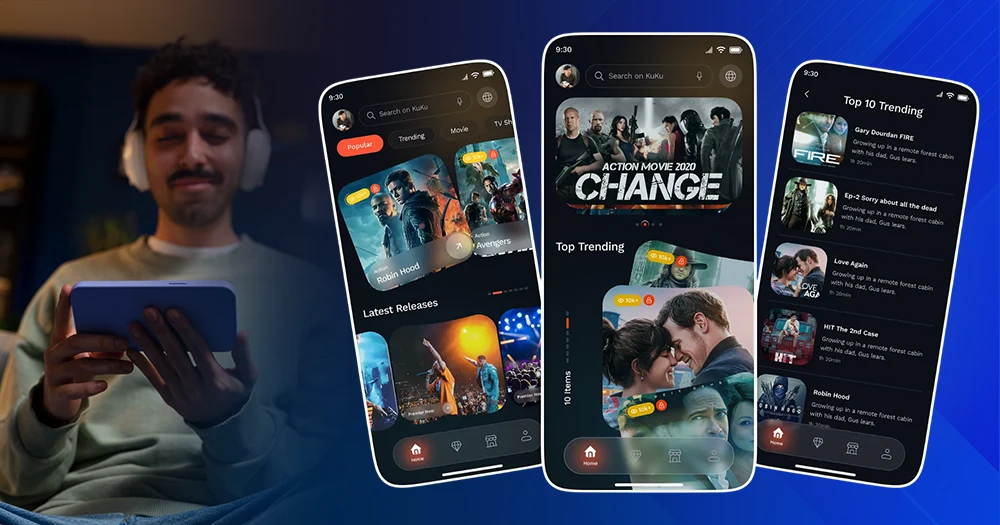
OTT app security is the process of protecting OTT apps and platforms from cyberattacks, content piracy, unauthorized access, and data breaches.
This involves methods like DRM, aka Digital Rights Management, encryption, code hardening, and forensic watermarking. The quest is to protect the users’ privacy and data and maintain the platform’s security.
To understand the OTT app security, you also need to understand the key components, such as:
Now, the question is –
OTT platforms attract attackers for one main reason: value. They provide premium content, manage millions of users, and process payments. This makes OTT platforms a soft target for stealing content, payment, and sensitive information for cyberbullying or fraud. If this happens, the platform loses business and credibility.
80% of streaming or OTT platforms witness a security breach. In 2026, if you are looking to launch your OTT app, it’s important to know the necessity of OTT app security.
The piracy methods have changed, and attackers are using AI tools. These tools detect weak points in OTT apps and make it easy to copy, modify, redistribute, bypass content locks, and remove watermarks. This makes manual protection methods weak. Once content is leaked, it spreads quickly across multiple platforms. In 2026, the use of AI-driven unauthorized tools will increase.
Now, users are not limited to a single device. By logging into one OTT account, users access content using smart TVs, tablets, phones, laptops, and gaming consoles. The point is, a secure system on one device may be weak on another. Some users also access the content from assembled devices. This all can open more entry paths for attackers.
It’s well understood that OTT apps and platforms collect users’ data. Due to the increasing attacks, data privacy regulations are also growing at the government level. If any leak happens or the app fails to protect user data, it can result in legal actions. That is not good for business.
In 2026, OTT app security is not just about protecting content. It is also about protecting user information and meeting legal standards.
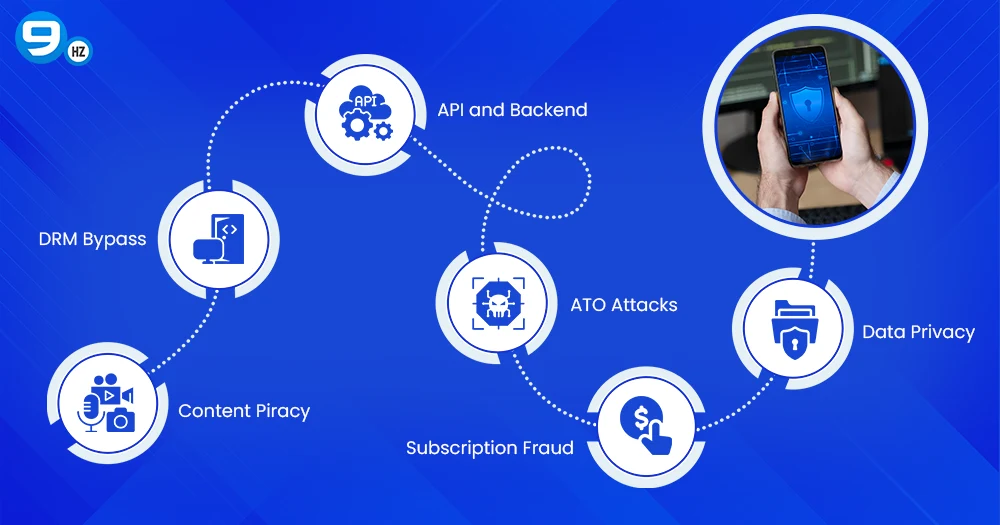
Now, OTT app security is no exception. To implement a robust security mechanism, you need to understand some major OTT security challenges.
Illegal copying of premium content remains one of the biggest problems. Once a stream is captured and shared, it spreads quickly across other platforms. This leads to revenue loss and weakens content licensing deals.
Attackers bypass digital rights management using techniques such as debugging, code disassembly, and API hooking to modify DRM rules. They find weak points, modify the code, and remove restrictions. When protection layers fail, content becomes easy to copy and misuse.
APIs and backends are the most important parts of OTT and other apps that help them manage users, payments, and content delivery. Hackers can easily get into the database and steal private data and information if security is weak.
ATO attacks are also one of the biggest challenges in 2026. Attackers are stealing usernames and passwords to sell them on the darknet. This is affecting privacy loss to the users and revenue loss to the OTT business.
Not only in fintech, but also in the media and entertainment industry, payment fraud is dynamically increasing. Fraudsters or cyberattackers are using fake cards or stolen payment details for subscription fraud.
OTT platforms store personal and payment information. Weak data protection can lead to leaks and legal penalties. In 2026, failing to meet privacy rules is a serious business risk.
Content piracy, DRM bypassing, credential stuffing, malware injection, and other cyber threats that target OTT platforms can hurt the platform’s security. These threats can hurt businesses and make customers lose faith in them.
Let’s look into the details!
MITM attacks are used for invisible intrusion, stealing credentials, and committing payment-related fraud. In this type of attack, a third party secretly intercepts communication between the user and the streaming server. The common target for MITM attacks is public or unsecured WiFi networks. The attackers remain undetected. They take over accounts, steal payment details, inject malware, and disrupt services.
The full form of DDoS is Distributed Denial-of-Service. These types of attack overwhelm streaming servers with fake traffic, consume bandwidth, slow down the services, and make content inaccessible. In a case of DDoS attacks, sluggish performance of OTT platforms affects the user experience, and downtime can lead to distractions among the users.
Malware-injected applications disguise themselves as popular apps, such as apps like Netflix, HULU, or Spotify. These apps may look real but contain hidden malicious code. When users download them, data can be stolen. Some of the top examples of these apps are SpinOK Trojan, iRecorder- screen recorder, Bigpanzi, and fake Netflix apps.
Rooted and jailbroken devices are modified devices that have no manufacturer restrictions. These devices are soft targets for attackers. On these devices, they can easily bypass digital rights management (DRM), steal content, and modify application behavior. The impact of Rooted and Jailbroken device exploits on OTT providers is revenue loss, reputation damage, and compliance violations.
Now, some readers may have a question: what are the advanced OTT app security solutions to tackle the challenges and threats? Let’s move to the next section of this blog to find the perfect answer.
The following are some advanced OTT app security solutions to eliminate security challenges:
Implementing a multi-DRM strategy protects the premium content on devices (smartphones, smart TVs), browsers, and operating systems, i.e., Android and iOS.
The point is, different devices support different content protection standards. A multi-DRM approach allows the platform to apply the right protection for each device. The key components include encrypted content packaging, licensing management systems, DRM-capable media players, and hardware security.
Use Cloud-Based Multi-DRM SaaS, forensic watermarking, concurrent stream limit implementation, geo-blocking, and regularly changing encryption keys.
End-to-End Encryption and Secure Streaming Protocols help in protecting OTT apps from piracy challenges and data breaches effectively. When you implement the encryption at source, the content remains safe, and using DRMs such as Widevine, PlayReady, etc., only authorized users can watch. This method also ensures data safety.
Secure streaming protocols like HLS/DASH with AES, RTMPS, and SRT reduce the risk of interception during playback and protect user information and video streams.
AI has applications across every domain, and using it for threat detection and fraud prevention is one of them. Just as a simple example, Netflix uses an AI system to prevent account sharing. AI helps in implementing proactive systems for behavioral analysis, countering threats like account takeovers, stream hijacking, and subscription fraud.
The core applications of AI in OTT app security are behavioral biometrics & user authentication that detect interaction patterns, account takeover prevention for analyzing login patterns, bot detection, and transaction fraud monitoring. AI forensic watermarking inserts unique identifiers and helps platforms trace pirated content.
APIs connect mobile apps, websites, and backend systems. If not secured properly, they can expose user data or subscription details. Strong access control and secure authentication reduce unauthorized access and misuse.
Secure API architecture and OAuth 2.0 implementation are crucial for OTT apps to protect user data, prevent content piracy, and eliminate threats like token theft and API abuse.
In simple terms, device fingerprinting stands for identifying the users’ devices to prevent account sharing, and dynamic watermarking is inserting unique identifiers to trace the source of content leakage.
Through the device fingerprinting technique, a unique identifier is created that fetches the details of the user’s hardware, software such as OS and browser, and IP address.
Dynamic watermarking invisibly modifies the video payload. Suppose that if a user leaks the content, the watermark can be extracted, and account details, device information, and the time of the leak can be detected.
A zero-trust framework means no user or device is trusted. It is important to always check and approve content to keep it safe. Checking the user’s identity (MFA/SSO), checking the device’s health (to see if it has been rooted or jailbroken), enforcing least-privilege access, and encrypting data to keep it safe are all important steps. Using a zero-trust framework is great because it stops piracy, keeps data safe, and makes security more flexible.
Ensuring the OTT app security is more vital than developing it. The practices you use to develop a secure OTT app matter a lot in 2026. The key component is using a multi-layered security approach. This can be combined with Digital Rights Management (DRM) like Widevine, FairPlay, etc., robust encryption such as Transport Layer Security, secure authentication, and others.
Thus, let’s have a look at some best practices for creating an OTT app.
A secure software development life cycle stands for integrating security into every stage of the development process. The focus should be on protecting user data, content rights, and streaming infrastructure.
In the planning phase, define compliance(GDPR, PCI-DSS for payments) needs, identify threats, and assess risks with third-party integrations. While designing the app, implement DRM, define access control, and plan for encryption. For secure development, follow OWASP guidelines, secure code analysis, and dependency management.
Once the app is developed, perform dynamic analysis(DAST), penetration testing, and content protection validation to find security issues and verify DRM controls. Deploy the app securely and continuously monitor it.
Integrating DevSecOps means weaving security tools, automation, and best practices directly into the software delivery pipeline. It treats security as a final and separate stage. This needs collaboration among developers, security, quality analysts, and operations teams. Through automation, consistent monitoring, and robust security practices, DevSecOps helps detect security issues as early as possible. Overall, it reduces data breaches, compliance failures, and operational disruptions.
Regular penetration and vulnerability assessments are the best practice for secure OTT app development. This requires ongoing vigilance to safeguard premium content, secure payment data, and block account takeovers. Using this practice, you need to test your app for API security issues, content piracy, DRM bypassing, user authentication, data protection, and auditing third-party components.
Code obfuscation is the process of converting app code into a format that becomes hard to understand by automated tools and humans. Consider it as a key, primary defense against reverse engineering that prevents the stealing of proprietary algorithms and finding weak points.
In addition to the code obfuscation, app shielding is a multi-layered strategy. App shielding enhances runtime protection and detects tampering attempts by attackers. Still, if someone modifies the app or tries to extract logic, the system can block or restrict usage. This reduces piracy risk and protects premium content.
Most OTT platforms depend on cloud servers to store content and manage users. A small configuration mistake can expose data or backend access. Permissions should be limited to only necessary roles. Storage buckets must not remain publicly open. Regular audits help detect weak settings early. When cloud access is controlled properly, data leaks and service disruption risks are reduced. Here is an ultimate guide on OTT app development cost.
OTT security will continue to change as streaming grows. Including the existing technologies, new technologies are about to add stronger security layers. Platforms that prepare early will reduce long-term risk and protect revenue more effectively.
Blockchain is decentralized and a perfect technology for security implementation. Using this technology, it’s easy to track ownership, secure IP rights, combat piracy, and prevent unauthorized distribution of digital content. The creators, platforms, and viewers can have secure transactions and fair contracts. The content creators are transparently compensated through smart contracts.
One of the significant benefits of biometric login into the apps is passwordless, instant login. From the OTT app security point of view, the biometric login credentials can’t be shared with someone else or with other users. For OTT platforms, this can reduce account takeover risks and unauthorized sharing. Biometric methods improve user convenience without adding complex steps, and users can log in to the app easily.
The traditional DRM systems work on the basis of a lock and key mechanism. Future DRM models will use AI to monitor how content is accessed and shared. If unusual behavior appears, protection levels can adjust automatically. This creates a more responsive defense system. Instead of static controls, platforms can react in real time to emerging threats.
In the near future, the conventional content delivery networks(CDNs) will be replaced by P2P architecture. Relying on technologies like Blockchain, IPFS(InterPlanetary File System), and edge-centric defenses, these models eliminate single points of failure and enhance data security and user privacy.
Selecting an experienced OTT platform development company is critical to eliminate existing and future security challenges. Here are some key things that you need to look for:
Including technology expertise, the company must possess some crucial security capabilities, and you need to look for:
Here, you also need to ask how they handle security challenges, whether they have specific processes or measures to minimize security risks as much as possible. Request real-world case studies demonstrating their security expertise in OTT app development.
Compliance and certifications are much needed for OTT app security. A reliable company must have expertise in local and international compliance requirements, data privacy regulations, secure payment processing standards, and content licensing. Ensure they follow secure development practices and maintain recognized security certifications.
The OTT app development companies you choose should enquire whether they provide consistent monitoring and maintenance support, and how they do so. It will help you keep your OTT platform secure from all threats.
In 2026, the OTT landscape is expanding dynamically. The threats are also increasing. For the OTT businesses, it is now crucial to implement a robust security mechanism to eliminate threats and challenges. The best approach is to bring in best practices for secure OTT app development, such as secure SDLC, DevSecOps integration, and others.
Platforms that ignore the advancements in security risk losing business and users’ trust. In 2026, the only thing that will work is prioritizing advanced OTT app security solutions for content and user protection.
Using secure streaming protocols, encryption, a multi-DRM strategy, AI-based fraud prevention, device fingerprinting, and a zero-trust security framework, you can prevent piracy and other threats.
Key security challenges in 2026 include:
For a secure OTT app development, implement the following:
Yes, AI helps detect unusual behavior, prevent fraud, and identify content leaks early.
DRM prevents unauthorized copying of content and ensures only authentic users can access content.

A react native app development company in India can help escalate your business to the next level via a high-performing…
Key Takeaways OTT platforms now face monthly subscriber churn rates of 5.5%, nearly triple the 2% recorded in 2019, and…

Key Takeaways AI is changing the landscape of fitness apps, providing more sophisticated personalized workouts from machine learning, computer vision,…