
Inventory management in multiple retail stores is perhaps the most operationally complex issue that today’s retailers face in the trading world. One small mistake that happens in one store can, in fact, cause a domino effect throughout the entire supply chain, leading to stockouts, broken customer satisfaction, and expensive emergency stocking. Inventory error, including overstock and stockouts, is costing retailers worldwide nearly $1.77 trillion a year, according to IHL Group research.
Problems in multi-site environments are amongst the toughest. Stock updates are not on time. Transfers between locations are not recorded. Letting seasonal demand spikes catch buyers is one of the most common demand forecasting mistakes in the supply chain process. Local counting procedures differ from location to location and staff, which makes consolidation almost impossible.
Retail supply chain management software for retail and consumer goods is the solution for these systemic failures. By bringing data together, automating processes, and using AI-based intelligence, it changes the inventory management process from a reactive scramble to a proactive, accurate operation at every site where a retailer does business.
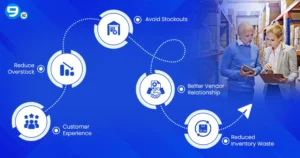
Inventory accuracy is more than just a number on a report. It is essentially the foundation of a joyous customer experience, making money, and having a good brand reputation. When inventory records are not in line with reality, this is a problem that will affect every subsequent process.
Imagine a scenario where a customer makes an online purchase and chooses store pickup. Even if the inventory data for that product is off by only one unit, this can lead to fulfillment failure, an annoyed customer, and a unit sale loss. Now, imagine the financial consequences if you multiply this by hundreds of SKUs and dozens of stores.
From a business standpoint, having too much inventory means that the money which could be put to work elsewhere is tied up, and you have to pay more for things like warehousing, insurance, and depreciation; that is, the inventory loses value.
On the other hand, when items are out of stock, you lose sales and customers who will most likely go to your competitors. According to the Harvard Business Review, out-of-stock situations cause retailers to lose, on average, 4% of their sales.
Moreover, inventory accuracy has a significant impact on a retailer’s relationships with vendors. When inventory is not accurate, purchase orders become unpredictable, supplier relationships are damaged, and the planning of logistics becomes inefficient.
Retailers using supply chain management software for retail and consumer goods report that just a 10% improvement in inventory accuracy can result in a drastic decrease in waste, both at the procurement stage and in logistics overhead.
Retail supply chain management software is a single tech platform that helps to coordinate, automate, and optimize the flow of goods, information, and resources across the entire retail supply chain, from supplier sourcing up to last-mile delivery and in-store replenishment.
Being designed for retail, the supply chain management software works differently and better compared to generic ERP systems. It can cope with the problems of high SKU environments, omnichannel fulfillment, seasonal variability, and multi-location inventory management. It collaborates with point of sale systems, warehouse management tools, supplier portals, and logistics platforms to form a unified operational ecosystem.
Top-tier supply chain management software for retail generally comes with modules for demand forecasting, purchase order management, inventory tracking, supplier collaboration, returns management, and analytics. More advanced platforms are equipped with machine learning models that help to enhance forecast accuracy, detect anomalies, and suggest the best stock rebalancing between locations.
When a supply chain software development company builds such platforms, it prioritizes scalability, API connectivity, and real-time data pipelines to make sure the system can grow with the retailer and adapt to the changing channel demands. As part of logistics software development services, they can be integrated to facilitate route optimization, carrier selection, and last-mile visibility all in one single platform.
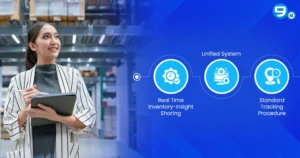
Retail supply chain management software is trained to share the real-time inventory insights across the operational workflow. Thus, the need for manual restocking is eliminated as the reorder requests are automatically placed once the stock level reaches a predefined level. It also helps to eliminate the use of disjointed, manual processes and replace them with integrated, automated workflows that update data online across all locations simultaneously.
The system generates one inventory record, which is accessed simultaneously by every stakeholder, store managers, buyers, warehouse teams, and executives. It removes the data lag and version conflicts, which are typical for manual systems. If a store in one city processes a return, the inventory count changes instantly for all users, thus making reordering decisions more intelligent at the other locations.
Moreover, supply chain management software for retail applies the same standardized receiving and picking processes at each location, and thus, it helps reduce shrinkage and miscounts resulting from human error. Barcode scanning, RFID integration, and automated reconciliation tools also contribute to increased accuracy at the point of interaction level.
| Criteria | Manual Inventory Management | Software-Driven Management |
|---|---|---|
| Data Update Frequency | Periodic (daily/weekly counts) | Real-time, automatic sync |
| Error Rate | High, prone to human error | Low, automated with validation |
| Cross-Location Visibility | Limited or delayed | Instant, centralized dashboard |
| Demand Forecasting | Based on intuition or simple history | AI-driven, multi-variable models |
| Anomaly Detection | Discovered during audits | Automated, continuous alerts |
| Scalability | Decreases as locations increase | Scales seamlessly with growth |
| Replenishment | Manual purchase orders | Automated triggers and approvals |
| Reporting | Time-consuming, static | On-demand, dynamic, role-specific |
AI-powered demand forecasting stands out as one of the most revolutionary tools in supply chain management software for retail businesses. AI forecasting engines that learn from historical sales data, seasonal patterns, promotional calendars, local events, and even macroeconomic signals can substantially reduce the inaccurate demand forecasting that has been a major issue in traditional retail supply chain processes.
For fashion retailers, AI forecasting can determine the colors and sizes that have the highest demand in particular locations by considering factors like local preferences, weather data, and social media trend signals. Thus, it gives an opportunity to send the inventory to the right stores before the season starts instead of having to deal with expensive markdowns or emergency transfers afterward.
Talk to our Experts
Schedule a Free Consultation Today
Retail supply chain management solutions are capable of accurately idetnifying the fast-selling product in a particular time and location by analyzing the vast amount of data like preferences of people in a region, weather conditions, and social media influence. Thus, the inventory can be sent to the right store before the demand spikes which ensure the seamless supply and maximum return.
Supermarket chains implement AI demand forecasting techniques to efficiently handle fresh produce. Based on demand forecasts for extremely short time intervals, these retailers can minimize food wastage and, at the same time, keep the shelves stocked with the products. Supermarket chains that have integrated supply chain management software for retail and consumer goods report a shrinkage reduction in perishable items of as much as 30%.
In electronics retail, where the product lifecycles are very short and prices drop quickly, AI models determine the right reorder point and quantity for every SKU at each location, thus helping to avoid overstocking of slow-moving products and at the same time ensuring the availability of fast-moving items.
It becomes much easier for the retailer to store and source the right volume of inventory according to the planned demand spike. The demand spike can be driven by promotions, marketing, or social media trends. Thus, the retailers can ensure that their shelves always have the right amount of particular SKUs which are currently in demand.
Multi-location retailers also use AI forecasting to execute inter-store stock balancing. When one location has excess inventory, and another is running low, the system automatically recommends transfers, calculates transfer costs versus potential stockout losses, and routes the movement efficiently, all without human intervention.

Automated inventory systems go a long way to reduce the discrepancies, but these can still take place. Shrinkage, receiving errors, mislabeling, and system glitches are part of retail operations. What separates advanced retail supply chain management software from others is its feature to detect, investigate, and resolve these discrepancies automatically, a feature called AI, driven inventory reconciliation.
In a traditional reconciliation, the employees need to physically check the inventory and then compare it with the computer records during a scheduled audit. This method is very inefficient, interrupts the business, and the infrequency of this can make it difficult to catch the discrepancies before they get worse and lead to bigger losses.
AI-driven reconciliation is a continuous process. It tracks the inventory movement and reports any statistical anomalies. For example, the stock suddenly falls without an explanation at one location, but this is not supported by the sales, transfers, or returns data. These anomalies set off an investigation process that signals the manager to look into certain SKUs or zones instead of conducting a full inventory audit.
Besides, machine learning algorithms that are trained with a history of shrinkage can determine the product categories, locations, and time periods that are more likely to be robbed. Hence, preventive measures can be taken in the first place through, for example, more security, more frequent targeted counts, and supplier quality audits.
The bottom line is a significant decrease in inventory losses that are not directly attributable to sales. Retailers that introduce AI reconciliation tools usually witness a significant improvement in inventory record accuracy, with some achieving accuracy rates exceeding 98% across all locations, a benchmark that was previously unattainable without prohibitively expensive manual auditing.
Retail supply chain management software platforms that are the most powerful in the market generally have a set of features in common, which are targeted at ensuring a high level of inventory accuracy across networks of locations.
Real-time inventory synchronization is an essential feature. Every stock movement, such as a sale, return, goods receipt, damaged goods write-off, or transfer between locations, is recorded instantly, and the corresponding information is broadcast to all systems and users. This effectively resolves the issue of phantom stock and double-selling in omnichannel scenarios caused by delayed updating of stocks.
These dashboards provide regional managers and executives with a consolidated view of various stores’ inventory levels at the same time. The users can also conduct a drill, which produces comprehensive data, thus going from a general overview of the network to viewing the store or SKU in a matter of seconds, which results in quick and well-informed decisions.
Auto-replenishment systems predict the inventory level at which the reordering should be done by taking into account the current stock levels, forecasted demand, lead times, and the safety stock thresholds. If a location’s stock is below the reorder point, the system triggers a purchase order or a transfer request automatically, thus breaking the reliance on manual intervention of the buyer.
Integration of barcode or RFID technology in the processes of receipt and sale indicates that the inventory movements would be recorded correctly and brought to the records immediately. Stores that are enabled for RFID can perform continuous item-level tracking without the need for manual scanning. Thus, it significantly increases the accuracy of the inventory of high-value or high-velocity SKUs.
Supplier portals are highly helpful in tracking shipments, managing invoices, and sharing accurate forecasts. They allow suppliers to access all relevant inventory information through a centralized dashboard, streamlining the supply chain process while strengthening vendor relationships. These portals support the supply chain risk management process by providing real-time visibility, reducing disruptions, and enabling proactive decision-making.
Talk to our Experts
Schedule a Free Consultation Today
Retailers who implement purpose-built supply chain management software for retail realize measurable benefits across financial performance, operational efficiency, and customer satisfaction.
Choosing the right supply chain management software for your business should be considered a strategic move that will determine the efficiency of your business operations for a long time. Making the wrong decision could be very costly and may cause your project to fail. However, if you choose the right software, your business will gain more and more advantages over your competitors.
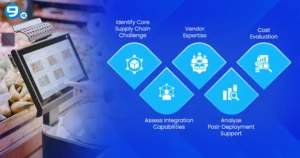
Start by identifying the issues you are currently facing. If your major challenge is inaccurate demand forecasting in supply chain processes, then choose a platform that has outstanding AI forecasting features. On the other hand, if a lack of visibility in different locations is the problem, go for systems that offer multi-site dashboards and real-time synchronization.
Integration capability is a must-have feature. An SCM platform should be able to integrate smoothly with your current POS system, ERP, e-commerce platform, and 3PL logistics partners. Hire a reputable supply chain software development company to evaluate the integration level and make sure that the selected platform comes with the APIs that your ecosystem needs.
Look into the vendor’s expertise in retail. Generic supply chain tools may fall short in areas such as SKU management, promotional planning, and omnichannel fulfillment, which are crucial in retail. For instance, SKU-Level Tracking Improves Inventory Accuracy and Profitability, making it a critical capability that generic tools often overlook. Find a vendor who has a track record of successful deployment across industries like fashion, grocery, electronics, or supply chain management software for retail and consumer goods.
Think about the quality of logistics software development services a vendor offers for the implementation process. Without professional configuration, data migration, and staff training, even the best platform will not perform well. Vendors who provide dedicated logistics software development services and post-go-live support significantly reduce the risk of implementation failure.
Evaluate the total cost of ownership, not just licensing fees, but implementation, training, integration, and ongoing support costs. Calculate projected ROI based on expected improvements in inventory accuracy, fulfillment rates, and carrying cost reductions before making your final decision.
Inventory accuracy offers multi-location retailers a great chance to increase their profits, improve customer satisfaction, and make the whole organization more resilient. Retail supply chain management software is the main driver of such accuracy as it abandons disjointed manual processes for integrated, AI-powered, and real-time inventory intelligence.
Supply chain management (SCM) platforms are a reflection of the modern world; they not only help retailers do away with inaccurate demand forecasting in supply chain operations but also enable automated reconciliation and cross-location stock balancing.
If you are also looking to build a retail supply chain management software, contact us for a free consultation from The NineHertz and make data-driven decisions.
Retail supply chain management software is a platform that focuses on the coordination of the complete flow of goods, data, and money transactions in a retail supply chain. Supplier procurement, warehouse management, store replenishment, and customer fulfillment are the major stages that the software runs through. It also connects with POS systems, ERP platforms, and logistics tools to form an integrated operational environment, which through better visibility, efficiency, and inventory accuracy, helps achieve higher profits at all locations.
It enhances inventory accuracy through the real-time synchronization of stock information among all locations and the automation of the receiving and replenishment procedures. Besides, it uses AI-powered anomaly detection to instantly highlight discrepancies and implements the standardization of inventory processes throughout stores and warehouses. Thus, the data lag and human error that lead to ghosts’ inventory, shrinkage miscounts, and stockout incidents in manual systems will be eliminated.
Each store or warehouse in a multi-location retailer represents a node in a supply network that is varied and interconnected. An error at one point will lead to faults all over the system. These will be in the form of reorder mistakes, failed deliveries and ultimately dissatisfied customers.
Accurate inventory helps to balance stocks efficiently among the different locations, ensures dependable omnichannel fulfillment, and opens up the possibility of tailor-made procurement decisions based on data analytics. High inventory accuracy enables efficient stock balancing between locations, reliable omnichannel fulfillment, and data-driven procurement, all of which are critical to profitability and customer loyalty at scale.
AI is a major factor in improving retail supply chain management software in multiple important aspects. For instance, AI running demand forecasting models is able to factor in hundreds of variables, past sales, weather, promotional activities, and regional trends, to come up with future demand predictions that are way more accurate than the ones made using traditional approaches; next, it perpetuates stock reconciliation at a very fine level by noticing irregularities right away; finally, it also makes possible stock rebalancing recommendation generation between different locations.
Combining these AI features, the supply chain operations and product availability at every point of sale are optimized to the extent that the losses due to bad demand forecasts are significantly minimized and the product availability and turnover of the stock at every location are maximized.
Key Takeaways AI supply chain risk monitoring uses real-time data and predictive models to flag disruptions before they escalate into…

The global supply chain covers a complex network of manufacturers, suppliers, distributors, wholesalers, retailers, and customers. So, how does a…

Maintaining a healthy relationship with suppliers is pivotal for businesses to ensure their long-term sustainability in a competitive market. For…