AI in Live Streaming Apps: How Artificial Intelligence is Reshaping Streaming Platforms?

- AI transforms traditional broadcasting platforms into intelligent, interactive environments by providing automated methods for engaging audiences with real-time content delivery.
- Current streaming platforms combine different types of AIs to improve discovery, forecast future behavior, and help reduce search tiredness when looking for content to watch.
- According to Grand View Research, the global live streaming market will grow to over $318 billion by 2031, driven primarily by AI innovation.
- AI also provides automated functions such as moderating chats, monitoring chats, detecting copyright violations, and managing safety through automated processes instead of relying heavily on human teams.
- Dynamic monetization systems utilize behavioral intelligence that enables revenue from advertisements, subscriptions, and virtual gifts, which is better than a standard pricing.
Video consumption online is a regular activity for 85% of American internet users. It is reported that approximately 19% of people abandon the viewing session because of the challenges associated with finding relevant content.
Content creators face an uphill battle trying to promote their content within the oversaturated ecosystem of content. Viewers give up on streams after only seconds of discovery latency. This growing gap between content volume and viewer attention forced streaming platforms to move toward real-time intelligence systems powered by AI.
AI in live streaming apps introduces multimodal intelligence, which combines conversation velocity, voice sentiment, and video frames into cohesive real-time embeddings that operate below the latency criteria of less than 200 ms. The NineHertz creates scalable WebRTC frameworks and edge-deployed transformers to power AI streaming platforms for large concurrent audiences.
The blog examines how advanced machine learning models, monetization, moderation, personalization, and the responsible adoption of AI have made it possible for artificial intelligence to power all aspects of modern live-streaming platforms.
Market Growth and Future Trends of AI in Live Streaming Apps
Despite rapid market expansion concealing several structural weaknesses within some streaming platforms’ business models, the live streaming market is projected to exceed 318.56 billion by 2031 with a CAGR of 26.74%.
Streaming platforms have lost over 47% of their audience during the peak phase due to problems relating to latency spikes and infrastructure limitations. This has resulted in an increasing number of platforms relying exclusively on AI-driven architectures for scaling their services.
TikTok Live has been able to exemplify this trend through the application of Edge AI technology. It reduces the end-to-end latency associated with billions of streaming experiences from 850 ms to 142 ms, resulting in higher levels of interaction and a longer period of time spent using these systems.
These trends indicate that streaming platforms are evolving away from “content delivery” systems and toward “intelligent engagement” platforms enabled by AI in live streaming apps.
Here are key trends in AI anticipated to shape the future of live streaming:
- Neural avatars will act as AI hosts for commerce-focused live streams in real time
- Emotion-aware recommendation systems that predict the moment a viewer will leave
- Automatic highlight generation that will identify viral content within a stream
The Impact of AI on Live Streaming Platforms in 2026
The estimated cost of search fatigue associated with these platforms is $4.7 billion annually, as consumers typically spend more time searching for content on the sites versus watching live streams. As competition has intensified, many of these platforms have moved away from manual content curation and toward automated, intelligence-driven business operations powered by AI in live streaming apps.
Multimodal recommendation systems that use CLIP embeddings combined with transformer-based analysis of user chat significantly decrease discovery time from approximately 22 seconds to just under 3 seconds, increasing user engagement. Automated techniques are replacing manual processes for moderation, curation, and monetizing content.
Key operational results:
- Hybrid recommendation system (RecSys) pipelines provide at least a 37% reduction in churn.
- Moderation costs are more than 80% less when scaled.
- Predictive monetization technologies increase average revenue per user.
AI Live Streaming Personalization: Enhancing User Experience

Modern customization goes far beyond traditional viewing patterns. AI live streaming personalization currently uses multimodal transformers that mix more than a dozen live signals to refine recommendations.
Advanced models combine computer vision outputs, natural language understanding, and reinforcement learning feedback loops into single embeddings that show what the viewer wants. AI live streaming personalization allows platforms to predict behavior instead of reacting to it.
TikTok Live added mood-adaptive feeds that change the intensity of material based on real-time audience sentiment patterns. This made people stay on the site for longer periods of time.
Measured outcomes show the effect:
- The length of sessions goes up, going over 120%.
- Better retention for users in the early stages of their lifetime.
- Creator earnings going up because of better audience matching.
Personalization is no longer about recommending content but predicting viewer attention in real time.
How AI Improves Content Discovery and Recommendations in Live Streaming Apps?
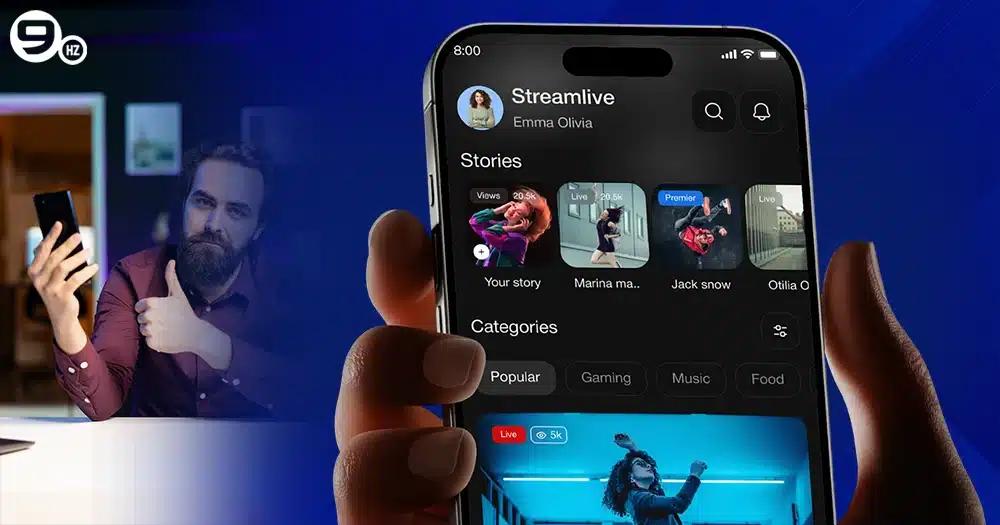
Creators now outnumber viewers due to the rapid increase in creator supply compared to viewer attention demand; therefore, AI content suggestion systems have shifted from traditional category-based browsing formats to multimodal discovery engines.
Modern live stream discovery AI uses vector search architectures that mix video, voice, and behavioral data. Every few milliseconds, computer vision samples frames, while automatic voice recognition makes transcripts in real time.
Neural matching engines can forecast virality minutes before peak engagement. This feature lets new creators reach more people faster without having to count their followers.
A normal suggestion pipeline looks like this:
Input stream → construction of multimodal embeddings → search for dense retrieval → cross-encoder re-ranking → tailored live ranking.
Results show up right away:
- Browse-to-watch time went down
- Viewer satisfaction numbers improve
- Discovery is moving from search behavior to predictive engagement
- This evolution allows emerging creators to compete based on engagement signals rather than follower size alone.
AI Content Moderation in Live Streaming: Ensuring Platform Safety
Toxicity, misinformation, and harmful visual content are some of the key challenges of the live streaming ecosystem. AI content moderation in live streaming uses a model known as a Vision-Language Transformer that interprets context beyond individual signals.
Modern moderation pipelines consolidate video frames, speech patterns, and conversation analysis to create a unified model for safety. With the ability to distinguish between gaming lingo and legitimate threats, Contextual AI provides a far more precise method of content moderation for live streaming.
Twitch’s new moderation tools are said to stop millions of violations before viewers see them. False positives have also gone down a lot since the company started using multimodal safety models. Edge-deployed AI lets moderation choices happen closer to the source of the stream, which stops bad content from propagating around the world.
Safety is just one of the operational benefits:
- Faster response when emotions are high
- Less need for big teams of people to moderate things
- More trust and readiness to follow the rules from advertisers
- Lower expenses for moderating operations at scale
Moderation has therefore evolved from a reactive safety function into a core infrastructure requirement for platform growth.
Real-Time Chat Monitoring Using AI in Live Streaming Apps

Live chat is the emotional core of streaming sites, but it also makes it hard to moderate on a broad scale. There are billions of messages sent every day; therefore, it’s hard to manually moderate them. This is why AI chat moderation systems within AI in live streaming apps are becoming more popular.
Transformer-based NLP models look at conversations all the time, looking at the context of messages over long periods of time instead of just a few phrases.
Real-time sentiment recognition finds rising antagonism before interactions get too toxic. When toxicity levels go too high, platforms automatically start interventions like slowing down conversation, muting people for a short time, or controlling bot traffic.
Modern chat monitoring workflows consist of
- Toxicity score that takes context into account
- Finding spam and planned attacks
- Analyzing patterns of behavior across discussions
Real-time chat intelligence now plays a critical role in maintaining healthy community ecosystems during live broadcasts.
Detecting Copyright Violations with AI in Live Streaming
As live streaming became more popular around the world, copyright protection evolved a lot. AI copyright detection currently uses perceptual hashing and neural audio fingerprinting to find media that has been changed or partially changed during live broadcasts.
Modern algorithms compare video frames to huge reference libraries. With continuous monitoring, you can find things in seconds instead of having to wait for review cycles after the incident.
YouTube has introduced an updated Content ID system that enables automated copyright detection as well as capabilities such as monetizing, muting, or blocking copyrighted content in real time. Many platforms have adopted automated licensing systems, which provide an opportunity for these platforms to turn boundary infringement into shared revenue contracts versus simply removing the videos.
Here are some of the primary benefits associated with this technology:
- Safeguarding the creator’s rights
- Minimizing or limiting the potential for legal problems
- Quickly and easily enforcing copyrights in real-time
Automated copyright enforcement also enables platforms to transform potential legal risk into monetization opportunities.
AI Monetization for Live Streaming Apps: Smarter Revenue Models

Live streaming has shifted from static pricing models to dynamic pricing systems for monetizing content. AI monetization for live streaming apps utilizes reinforcement learning algorithms to analyze and adjust revenue-related decisions on a continuous basis.
Currently, the majority of the artificial intelligence systems analyze multiple behavioral signals, such as engagement speed, historical sales data, and the type of device being used. Within AI monetization for live streaming apps, the reinforcement learning system modifies definitions of subscription pricing, virtual gift offerings, and pay-per-view options.
Data has shown that a small number of viewers drive a large majority of revenue for platforms that utilize lifetime value modeling. AI recognizes these types of viewers at an early stage after they join the platform, giving them different monetization opportunities without changing their experience of watching videos.
Offers to viewers are presented through the following mechanisms:
- Dynamic pricing adjustment based on hype cycles.
- Predictive upselling (based upon current viewer engagement) for products.
- Enhancing the ability to give virtual gifts by analyzing the viewer’s social connections.
- Automatically maximizing ad revenue through predictions based upon viewership patterns.
Revenue generated through live streaming is becoming increasingly dependent upon adaptive economic models, not just on static fixed pricing.
Dynamic Ad Targeting Powered by AI in Live Streaming Apps
Most contemporary streaming services analyze a combination of video frame content, chat emotion, and interaction speed to understand real-time analyses of viewer behavior using AI in live streaming apps.
Computer vision models enable the classification of live video scenes, while sentiment analysis allows estimation of audience response by observing changes in the levels of viewer engagement.
Algorithms track brief periods of decreased viewer engagement and insert advertising into points least likely to impede the viewer’s immersion. Campaigns that align with the emotional sentiments of their viewers tend to generate higher click rates than demographic-targeted campaigns.
Some of the other benefits of using these newer models include
- More relevance of advertising content as compared to the live content.
- Better ROI for advertisers.
- Less viewer frustration during live, extended streaming events.
AI-Based Subscription and Pay-Per-View Optimization Strategies
Price and subscription models have progressed from fixed-price models to more flexible-based pricing and subscription models with the help of AI-based subscription optimization technology. Streaming service providers now treat pricing as a dynamic system that uses historical data and behavioral patterns to anticipate future consumer behavior.
Predictive pipelines can proactively identify periods when subscribers are likely to cancel, allowing streaming platforms to deploy retention offers before churn occurs.
Companies using reinforcement learning (RL)–driven monetization strategies report significantly improved results by adjusting prices according to user behavior rather than relying on fixed segmentation models. Test results from Kick in 2026 indicate that dynamically priced offers achieved more than four times the success of traditional subscription bundles.
Among the key optimization outcomes are
- Reduced early subscription termination through predictive analytics
- Increased conversion from free viewers to paying subscribers
- Enhanced lifetime value across all user segments
AI Analytics and Audience Insights for Live Streaming Platforms
AI-powered analytics engines use predictive models to anticipate surges in audience engagement several minutes in advance, allowing platforms to scale infrastructure and adjust promotions during live broadcasts.
Advanced platforms conduct live A/B experimentation across multiple streams by analyzing variables such as thumbnail images, titles, pacing, and revenue-generating triggers. Causal inference techniques help identify actions that genuinely improve engagement rather than relying solely on correlation.
Through these insights, organizations realize:
- Programming decisions based on data
- Quicker optimization cycles when streaming live
- Better measurement of ROI and marketing capabilities
Machine Learning Models Behind AI in Live Streaming Apps
Live streaming applications depend on collaborative ecosystems of AI models instead of individual algorithms for analysis purposes. Machine Learning models are specifically engineered to deliver performance, precision, and real-time results within a live streaming context.
Visual senses and audio senses can be analyzed using visual ML models to determine and interpret visual images in video frame content and language and talk via conversational models in audio signals. EfficientNet-type networks process video frames faster and more accurately than traditional video processing methods.
Natural Language Processing (NLP) models evaluate chat message sentiment, speech transcripts, and contextual relationships within live video streams in real time. Edge deployment has a significant impact on AI performance. Models optimized for inference reduce processing time by executing AI workloads closer to the viewer, at the edge between the end user and cloud-based services.
AI streaming platforms deliver responsive, time-sensitive applications through integrated machine learning pipelines, ensuring consistent user experiences even during periods of high concurrent viewership.
Key Features to Integrate AI in Live Streaming App Development
Integrating AI in live streaming app development means developing excellent customer experience by incorporating the following features:
- Low-latency multimodal recommender systems.
- Algorithms for moderating video/photos using vision and language to create a safer experience for users on the platform.
- Algorithms for providing real-time analytics in chat with contextualizing NLP models.
- Algorithms for ad placement and prediction using AI/ML to better serve ads during live broadcasts.
- Advanced analytics dashboards that allow for experimentation.
- Algorithms to measure users’ emotion towards content being broadcasted and their level of engagement to personalize the experience for them.
Choosing the correct framework stack is also important because frameworks like TensorFlow or PyTorch allow for highly scalable workflows for training your models. In addition, deployment tools optimally support effective edge inference in a live streaming environment.
How to Implement AI in Live Streaming Apps Step-by-Step?
Implementing AI in live streaming apps is a step-by-step plan that is focused around what the leading streaming platforms currently offer:
1. Live Signal Instrumentation
In order to build a foundation for downstream models and decision-making for live broadcasts, record all signal data from the broadcast synchronously. Examples include frames of video, sentiment of audio, velocity of the chat, and user interaction. activity.
2. Develop Baseline Models
Begin with open-source architectures used for recommendation, moderation, and analytics workflows. The baseline models are then refined using platform-specific datasets so that predictions reflect actual viewer behavior rather than generic training data.
3. Edge Inference Deployment
Using GPU acceleration along with edge-deployment architecture optimizes the deployment of ML models. The inference running closer to the end user reduces latency, vital to live streaming environments.
4. Conduct Live Experimental Testing
Live stream experiments must be continuously monitored through A/B testing instead of only looking at engagement levels from a surface level.
5. Retrain Through Feedback Loops
Models developed with reinforcement learning must use user feedback continuously to retrain models on a constant basis. Behavioral change with respect to user engagement indicates direct evidence of measurable change.
Data Privacy and Ethical Considerations in AI Live Streaming Apps
The rapid rise of artificial intelligence creates new responsibilities regarding transparency and the responsible use of data. As ethical standards for AI streaming services mature, greater emphasis is being placed on balancing customized content delivery with user privacy concerns.
Federated learning models in business are becoming more prevalent. These models train algorithms on end-user devices rather than aggregating sensitive data in a single location. Differential privacy allows service providers to learn from grouped user activity without revealing the identity of any individual user.
Regulatory frameworks are still developing. Laws such as GDPR, CCPA, and emerging global AI regulations emphasize the need for service providers to explain their actions, undergo audits, and maintain clearly defined content moderation processes.
The following are best practices for implementing AI-based business applications:
- Provide explanations for moderation decisions
- Build systems with privacy as the highest priority
- Continuously test all models for bias
Cost of Integrating AI in Live Streaming App Development
When an organization evaluates the cost of AI-enabled solutions, it often overlooks optimization requirements within its streaming system. The overall costs affecting the final price extend beyond application development and are influenced by latency requirements, automation complexity, and the number of simultaneous viewers.
As of 2026, estimated price ranges associated with AI integration include:
- Recommendation Engine: $40K–$45K
- Vision and Language Moderation Systems: $60K–$70K
- Reinforcement Learning Pricing and Monetization Engines: $80K–$90K
- Full stack of AI-enabled streaming applications: $180K–$200K
When developing AI-enabled applications, most investment is directed toward training, deployment, and real-time analytics implementation. Modular AI architectures reduce financial risk by enabling businesses or streaming platforms to introduce intelligence features incrementally.
The NineHertz has built a scalable system design model for incorporating AI into streaming applications, allowing organizations to focus initially on the most impactful features and expand capabilities as user demand grows.
Final Thoughts
Artificial intelligence is changing the way people compete in digital streaming ecosystems. AI in OTT apps now decides whether platforms keep their viewers, keep their communities safe, and find ways to make money that last.
Industry experts increasingly expect generative co-hosts and AI-driven interactive experiences to dominate future streaming engagement. Organizations partnering with experienced development teams such as The NineHertz gain a strategic advantage by building intelligent streaming platforms prepared for the next decade of real-time digital interaction.
FAQs
1. What Role Does AI Play in Streaming Applications to Boost Viewer Retention?
Due to its ability to analyze multiple signals (viewing patterns, sentiment from social media platforms, and engagement speed), AI can recommend streams in real time, creating faster access to content. This decreases viewer abandonment and increases viewing time on the platform.
2. What Types of AI Tools Are the Most Effective for Moderation?
Modern platforms rely on several technologies to ensure accurate stream moderation, including vision-language transformer models, speech recognition systems, contextual NLP models, and automated safety pipelines capable of detecting harmful behavior across video, audio, and chat simultaneously.
3. What Methods Are Utilized by AI Algorithms to Find Inappropriate Content in Real Time?
AI continuously evaluates video and audio inputs along with conversational context. Edge inference enables moderators to make real-time decisions that prevent harmful or inappropriate content from reaching users and help protect audiences from risky or inappropriate behavior.
4. What are the cost and ROI benefits of implementing AI features?
AI reduces content moderation costs, improves the accuracy of advertising campaigns, and enhances the performance of revenue-producing operations, resulting in an overall increase in ROI across multiple platforms. An increasing number of companies report measurable improvements in user retention and audience growth after implementing these AI moderation solutions.
5. How Can a Small Streaming Startup Use AI Cost-Effectively to Increase Its Business?
Streaming startups typically adopt managed cloud-based AI APIs, open-source recommendation engines, and modular analytics platforms as part of a phased implementation approach, enabling cost-effective entry into AI adoption.
Great Together!
Latest Blogs

Challenges and Tricks for iBeacon App Development
In this current era, it is easier to locate a food court or a mall using GPS/location based services. But…
Subscriber Churn Intelligence Architecture for OTT Platforms: How Behavioral Telemetry and Predictive Scoring Enable 30-Day Early Intervention
Key Takeaways OTT platforms now face monthly subscriber churn rates of 5.5%, nearly triple the 2% recorded in 2019, and…

How Broken Media Supply Chain Architecture Costs OTT Platforms Millions in Launch Delays, Rights Violations, and Re-Encoding Waste
Key Takeaways OTT platforms bleed days - sometimes weeks - of subscriber revenue when fragmented media supply chains push content…