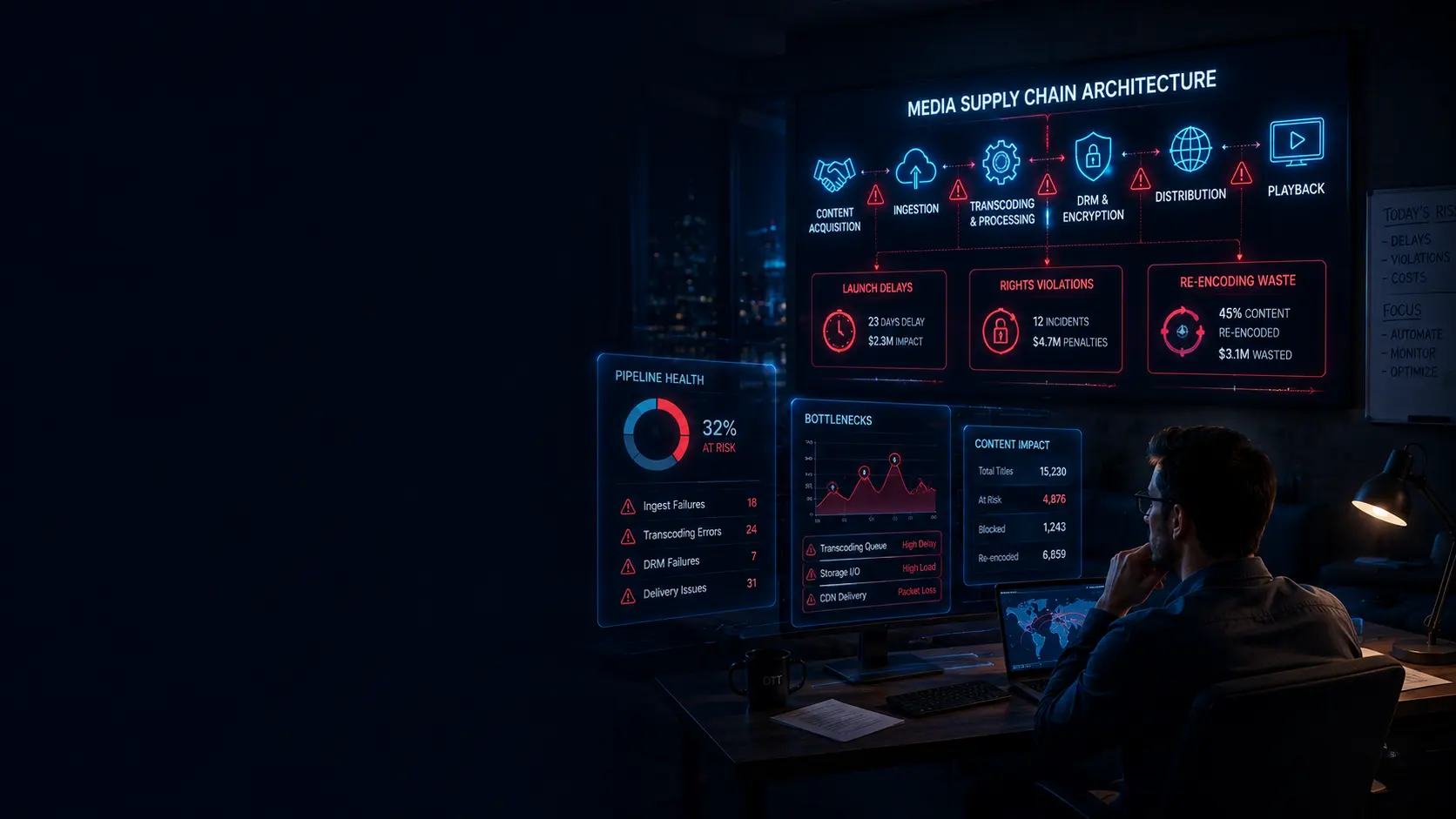
Every OTT platform has a content launch calendar. And almost every one of them has a quiet graveyard of titles that missed it.
Not because the content was bad. Not because the marketing team dropped the ball. The media supply chain – the technical and operational infrastructure that moves a raw asset from ingest to a paying subscriber’s screen – broke at a handoff nobody was watching.
A media supply chain is the end-to-end content operations pipeline governing how a video asset moves from acquisition through ingest, quality control, transcoding, rights packaging, and multi-CDN distribution to reach the viewer. Run that pipeline on siloed tools, manual handoffs, and sequential processing, and every step adds delay the next step has to absorb.
Worldwide OTT revenue hit an estimated $295 billion in 2024 and is on track to surpass $476 billion by 2027, per Electroiq’s market analysis. U.S. subscriber churn hit 40% in 2025 – driven largely by “subscription rotation,” where households sign up to catch a marquee release and cancel before the next billing cycle, per Mordor Intelligence. A two-week content launch delay does not just miss a window. It loses the subscriber who was waiting for it.
This post breaks down where media supply chains actually fracture, what those fractures cost, and what an orchestration architecture looks like when it is built to prevent them. If You are looking for top OTT app development companies, The NineHertz is one the best OTT platform development services provider.
Most OTT content operations teams picture their pipeline as three steps: transcoding, QC, delivery. That mental model is the starting point of most launch delays.
A production-grade media supply chain moves content through at least eight distinct transitions:
Each transition introduces a failure point. In most OTT operations, each one is also manual. An operator downloads a file, confirms a status in one system, and triggers the next step in a different one. When something breaks – wrong bitrate profile, missing subtitle track, expired rights window – the error usually surfaces at step seven. By then, fixing it means reprocessing everything from step four onward.
Mid-tier OTT platforms typically run a stack of best-of-breed tools that do not share state: a MAM, a separate transcoding vendor, a standalone DRM system, a CDN receiving content through batch jobs. They communicate through file transfers, internally written API glue, and manually configured schedules.
Telestream’s orchestration analysis puts it clearly: this fragmentation creates operational silos, redundant manual tasks, and brittle integrations – each one a fracture point waiting for the right moment to snap.
When there is no shared orchestration layer, a QC failure at 11 PM Friday does not trigger an automated re-route. It triggers an alert email that nobody reads until Monday morning.
Eliminate launch delays, prevent rights violations, and optimize your content delivery pipeline with a scalable media supply chain architecture.
Pro tip: Map your actual pipeline – not the diagram from the last all-hands – by asking your team to trace the last five launch delays back to their first failure point. The root cause is almost always at a handoff, not inside any individual system.
People tend to treat a launch delay as a scheduling inconvenience. It is actually three separate financial losses running at the same time.
The OTT subscription model runs on monthly billing cycles. A title released two weeks late misses the subscriber who signed up specifically to watch it during release week. That person cancels before the next charge if the title still is not there.
At a $12.18 average revenue per user (Statista, 2024), each individual cancellation looks small. Across the cohort of subscribers who rotation-cancel around marquee releases, it is a material line item – especially in a market with more than 377 independent OTT providers all competing for the same audience, per SymphonyAI. A subscriber who leaves because your title launched late has alternatives available before they finish canceling.
Launch campaigns run on fixed dates. The influencer deals, the paid digital spend, the PR push – it all executes whether the title is ready or not. When the launch slips two weeks, that budget drives viewers to a title that is not there yet. They arrive, find nothing, and leave. There is no clean way to pause a campaign mid-flight and replay it at full efficiency on a rescheduled date.
Streaming licenses cover specific time periods. They do not extend because your operations team was slow. A title delayed two weeks arrives with two weeks less exclusive visibility – which cuts directly into the return on acquisition cost. Global studios spent over $230 billion on content in 2024, per Mordor Intelligence. At that price point, two weeks of lost exclusivity per title adds up faster than most finance teams realize.
Pro tip: Calculate your content launch delay rate – the percentage of titles that miss their planned go-live date – and multiply it by your average content acquisition cost. That number shows what broken supply chain architecture actually costs.
Re-encoding waste is the most expensive symptom of a broken supply chain. The root cause is not the encoding stage. It is what happens before encoding starts.
Content arrives at OTT platforms from studios, distributors, and post-production houses. Each uses its own delivery specs, codec preferences, container formats, and metadata schemas. Without a pre-ingest compliance layer, assets walk into the encoding pipeline carrying problems:
None of these are visible to the transcoding system until it tries to process the file. At that point, encoding either fails outright or completes with errors. The asset gets flagged, sent back to the source, corrected, and resubmitted. Every cycle through that loop consumes compute, processing time, and operator hours that should never have been spent.
A single title requiring three passes to produce clean output costs three times as much to encode as a compliant asset. Scale that across hundreds or thousands of titles per quarter and the budget impact is significant – and largely invisible, because it never appears on a line item labeled “bad ingest.”
LCEVC research from SPIE Proceedings shows up to 75–85% encoding time savings through optimized parameter selection in modern codecs. That efficiency only materializes when assets arrive in a compliant state. Non-compliant assets burn through efficiency headroom before encoding even begins.
Pro tip: Build a pre-ingest compliance scorecard that grades every incoming asset against your encoding pipeline’s requirements. Assets below the minimum threshold should not enter the queue. They should trigger an automated correction request back to the vendor.
Fixing a broken media supply chain does not require replacing every system. It requires a unified orchestration layer that connects existing systems and removes the manual handoffs sitting between them.
The NineHertz has developed the Media Supply Chain Orchestration Model (MSCOM) – a six-stage framework for how content operations teams should structure their pipeline from ingest through global distribution, with automation driving every stage transition.
MSCOM: The 6 Stages
| Stage | Function | Key Automation Trigger |
|---|---|---|
| Stage 1: Compliance Ingest | Asset intake + pre-ingest validation | Technical spec check against encoding profile library |
| Stage 2: Metadata Enrichment | Rights, territory, and descriptive data binding | Rights database API call on asset registration |
| Stage 3: Parallel Encoding | Multi-format transcoding in simultaneous tracks | Job queue dispatch to codec-specific workers |
| Stage 4: Rights-Aware Packaging | DRM encryption + geo-license rule application | License server query at packaging time |
| Stage 5: Post-Encode QA | Automated integrity and compliance validation | Playback verification across device simulators |
| Stage 6: Orchestrated Distribution | CDN origin push + availability activation | Geographic availability rule enforcement at CDN edge |
The design principle holding all six stages together is event-driven state management: every stage completion triggers the next automatically, and every failure triggers a defined remediation path – not an email to a human operator who may or may not be at their desk.
Pulse-IT’s orchestration platform describes this architecture as a unified layer integrating PAMs, MAMs, QC engines, AI services, transcoding systems, and storage platforms under centralized control – letting teams automate safely without touching live production.
The MSCOM framework aligns with the Build-Run-Evolve methodology at the core of The NineHertz ContinuumAI framework: Build the compliant ingest and encoding foundation, Run it through automated orchestration, and Evolve it through rights intelligence and continuous KPI monitoring.
Sequential transcoding is the most common architectural decision that destroys OTT launch timelines. And it is almost never a deliberate choice. It is what happens when systems are assembled one at a time, without anyone connecting them at the architecture level.
A standard OTT delivery profile requires eight to twelve format variants: multiple resolutions for adaptive bitrate delivery, codec variants (H.264, HEVC, AV1), platform-specific packaging (HLS for Apple, DASH for Android and web), and HDR variants for premium content.
Sequential architecture processes each format after the last one finishes. A feature-length title with a twelve-variant profile can take eight to twelve hours to clear. Multiply that across a week’s content slate and the pipeline cannot clear its queue without overnight batch runs – and cannot absorb any upstream delay without pushing everything else back.
Parallel transcoding dispatches all format variants simultaneously to separate encoding workers. AWS Elemental MediaConvert processed over a billion minutes of video monthly in 2024 – enabling elastic scaling that cuts 40–60% off lifetime ownership cost compared to fixed appliances, per Mordor Intelligence.
A twelve-variant job dispatched in parallel finishes in roughly the time it takes to process a single variant. That is often a 70–80% reduction in total processing time – enough to make the difference between a pipeline that handles peak content volume and one that cannot.
Parallel architecture also allows priority-based queue management. A title flagged for imminent launch jumps ahead of catalog backfill work automatically, without a human re-sequencing anything manually.
Pro tip: Audit your transcoding pipeline to find out whether your output variants are dispatched in parallel or sequence. If you cannot answer that in thirty seconds, the answer is probably sequential – and your launch calendar is paying for it.
Reduce delays, cut processing costs, and deliver content faster.
Rights violations at OTT platforms are almost never about missing rights information. They happen because rights information exists in one place and the distribution system operates from a completely different set of rules – set manually, updated infrequently, and rarely synchronized in real time.
A content licensing agreement specifies territory restrictions, platform eligibility, output control requirements, and often explicit device or resolution limitations. That agreement lives in a rights management system. The distribution workflow lives in CDN configuration files and origin server access controls.
Most OTT operations do not connect these two systems at runtime. CDN geo-restrictions are configured manually at launch, based on rights data that was accurate on that day. When a rights window expires, a territory restriction changes, or a licensing amendment comes through, the CDN configuration does not update automatically. It updates when a human operator notices and manually propagates the change – which might happen the same day, the following week, or after the first violation complaint arrives.
The DRM market hit an estimated $5.53 billion in 2025, with projections to nearly double by 2030. Major studio licensing agreements now make demonstrable enforcement standards a precondition of content supply.
A properly integrated rights intelligence layer does three things without human involvement:
At packaging time: Queries the rights management system to determine which DRM profiles apply to each asset – applying Widevine, FairPlay, or PlayReady based on the device ecosystem being packaged for.
At availability activation: Reads geo-licensing rules from the rights system to configure CDN geographic availability at the territory level, before the title goes live.
At rights boundary events: Detects expiring windows, territory amendments, and licensing changes, then updates CDN configurations and playback license rules automatically – closing the gap where violations occur.
This is not about connecting a rights database to a distribution system. It is about making rights data a live input to every distribution decision – replacing a static rule set with something that actually reflects the current state of each licensing agreement.
Distribution is the failure mode closest to the viewer. Specifically, the gap between knowing content is ready and making it globally available – at the same moment, without a team manually configuring anything.
Most OTT platforms start on a primary CDN. That CDN has Points of Presence globally, but performance is not uniform across regions. Network congestion, infrastructure limitations, and routing inefficiencies create playback quality variations that viewers notice – even if operations teams do not.
A single CDN is also a single point of failure. When it degrades during a high-traffic event – a live premiere, a sports final, a breaking news moment – the platform has no automated path to route traffic elsewhere. The global CDN market hit $27.8 billion in 2025, with AI-driven routing engines that can cut egress charges by up to 30% during demand spikes. Those gains are only available to platforms running multi-CDN orchestration.
A multi-CDN distribution layer maintains live relationships with two or more CDN providers. At availability time, it pushes the origin asset to all CDN networks simultaneously. At each playback request, it routes the viewer to whichever CDN delivers the best quality-of-experience at that specific moment, based on real-time telemetry.
CDN selection decisions happen at sub-second speed – faster than any manual configuration. The result is simultaneous global availability at launch, without regional lag, and without anyone manually managing CDN failover during the worst possible moments.
Pro tip: Set a formal SLA for CDN failover time. If your current architecture cannot reroute traffic in under sixty seconds, you do not have a redundant distribution model – you have a backup that requires a human to activate it.
A supply chain that cannot be measured cannot be improved. Most OTT operations teams track the wrong things: titles published per month, encoding queue depth, CDN bandwidth. Those are operational metrics – they tell you what happened. What you need are outcome metrics that tell you what is about to happen.
The NineHertz MSCOM framework defines five outcome KPIs that indicate supply chain health before each release:
What it measures: Elapsed time from asset ingest completion to all-CDN availability activation.
Why it matters: TTP is the single indicator of whether your pipeline can honor launch commitments. A rising trend predicts delays before they land on the calendar.
What it measures: Percentage of encoding jobs producing compliant output on the first pass, without re-encode.
Why it matters: An FSR below 95% is a pre-ingest problem, not an encoding problem. It means assets are entering the queue in states the encoder was never built to handle.
What it measures: Percentage of titles where a rights violation or geo-licensing error surfaces during or after distribution.
Why it matters: Any RCR above zero tells you that your rights intelligence layer is not connected to your distribution workflow in real time.
What it measures: Time from CDN performance degradation detection to successful traffic rerouting.
Why it matters: CFT defines your worst-case viewer impact window during a CDN incident. It should be measured in seconds.
What it measures: Percentage of stage transitions that require manual intervention to complete.
Why it matters: PHER measures automation coverage directly. High PHER means high operational cost and high launch-delay risk – often in the same week.
Tracked continuously and trended over time, these five metrics give content operations leadership enough signal to fix problems before they reach the launch calendar, not after a missed date triggers a post-mortem.
A media supply chain is the full operational pipeline governing how a video asset moves from acquisition through ingest, quality control, transcoding, rights packaging, and CDN distribution to reach the subscriber. It matters because every broken handoff produces launch delays, rights violations, or encoding waste. In a subscription model where annual churn can hit 40%, a broken supply chain is a revenue problem, not just an operations problem.
Sequential transcoding finishes one output format before starting the next. Parallel transcoding dispatches all required format variants simultaneously to separate encoding workers. For a twelve-variant delivery profile, parallel architecture typically cuts total processing time by 70–80%.
Rights violations occur because rights data is disconnected from distribution decisions – not because it is missing. CDN geo-restrictions and platform access rules are typically set manually at launch and updated manually when terms change. Rights intelligence integration makes the rights management system a live input to packaging, availability activation, and CDN configuration, closing the manual-update gap where violations occur.
The five outcome KPIs that predict supply chain health are: Time-to-Publish (TTP), Format Success Rate (FSR), Rights Conflict Rate (RCR), CDN Failover Time (CFT), and Pipeline Handoff Error Rate (PHER). These measure outcomes that affect launch reliability and subscriber experience – not just operational activity.
Rebuild decisions make sense when Time-to-Publish consistently misses launch commitments; when Format Success Rate drops below 95%; when Rights Conflict Rate exceeds zero on a recurring basis; or when content volume is growing faster than the operations team can handle manually. Any one of these is enough to justify the conversation.
Every week a platform runs a fragmented media supply chain, it absorbs the same losses: delays that miss launch windows, violations that expose it to rights-holder penalties, and re-encode cycles that burn compute without producing viewer value.
The architecture exists to serve the content. When it fails, the content fails – and in a market heading toward $476 billion in OTT revenue by 2027, the platforms that capture a disproportionate share will be the ones that fixed their operational foundation before the competition outgrew them.
The NineHertz is an AI-native engineering firm that designs and builds media supply chain orchestration infrastructure for OTT platforms – from parallel transcoding architecture and rights intelligence integration to multi-CDN distribution orchestration and KPI-driven performance monitoring. Our ContinuumAI framework applies generative and agentic AI across the Build, Run, and Evolve stages of your content operations pipeline, replacing manual handoffs with automated orchestration and replacing guesswork with operational transparency.
If your content operations team spends more time fighting the pipeline than managing it, that is the signal. Connect with The NineHertz to scope a supply chain architecture assessment – and find out exactly what your current architecture is costing you.
You do not need to understand every component of a media supply chain to make a sound architectural decision. The pattern is simple:
Your launch delays are not a scheduling problem – they are a pipeline design problem. Your rights violations are not a legal oversight – they are a workflow failure. Your encoding costs are not a vendor pricing problem – they are a pre-ingest validation failure. Each has a known architectural fix, a measurable outcome, and a defined implementation path.
Platforms that treat content operations as engineering infrastructure – rather than a loose collection of vendor tools connected by manual effort – run faster, spend less, and retain more subscribers. The ones that keep the status quo will eventually rebuild anyway. The economics make it inevitable.
The only real question is how long to wait.

A react native app development company in India can help escalate your business to the next level via a high-performing…

Key Takeaways OTT platforms now face monthly subscriber churn rates of 5.5%, nearly triple the 2% recorded in 2019, and…

Key Takeaways AI is changing the landscape of fitness apps, providing more sophisticated personalized workouts from machine learning, computer vision,…