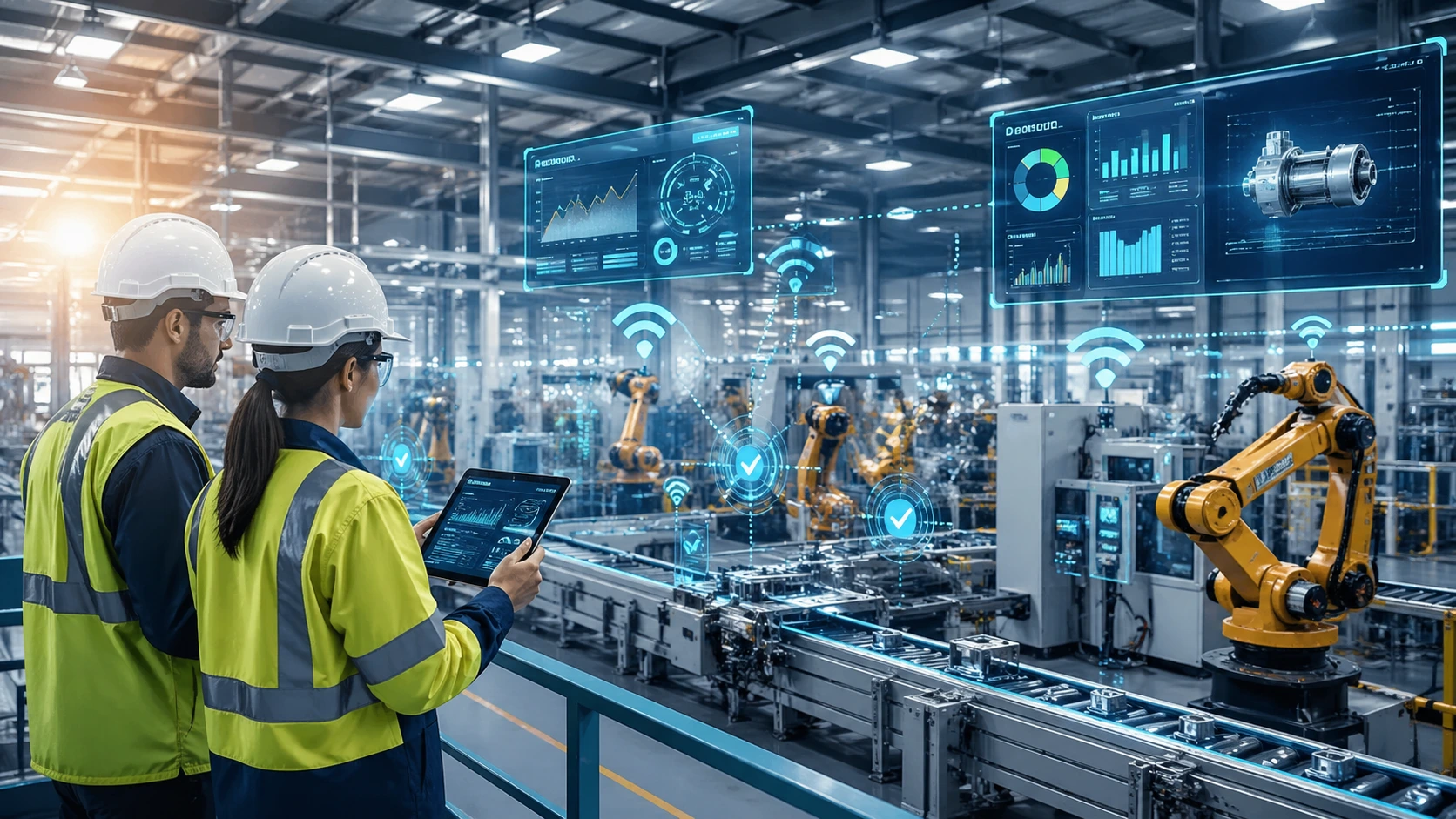
Downtime is one problem that everyone in the manufacturing industry understands, even though different industries calculate downtime in different ways. Today, many manufacturing companies are moving towards IoT technology to increase efficiency and boost their productivity.
The global market for IoT in the manufacturing industry is estimated to reach $286.3 billion by the year 2029, with a CAGR of 13%.
Every minute of downtime leads to revenue loss and affects the operational efficiency of your business. IoT sensors solve this problem by connecting multiple devices and sensors through the Internet under a unified platform.
According to Siemens, one hour of downtime at an automotive plant costs $2.3 million, and downtime at an FMCG plant costs up to $36,000. This is where the advancement of technology changed the manufacturing industry, and the revenue loss because of downtime can be reduced through the adoption of IoT technology.
In this article, we are going to discuss what causes downtime and how IoT devices can minimize downtime in a manufacturing plant.
Downtime in manufacturing plants is a period when all operations stop, affecting the efficiency and productivity of the plant. Sometimes the downtime is planned, and it happens for maintenance or changeovers. Planned downtime is manageable because everyone knows about it in advance.
But the downtime is unplanned, and it disrupts operations in the manufacturing plants. An unplanned downtime occurs due to failed equipment or supply chain issues that test the resilience of your business.
Unplanned downtime in most manufacturing plants doesn’t happen due to a single dramatic failure. But it happens due to a mix of things, and plant managers need to identify the reasons behind downtime. Only then will they be able to develop strategies to minimize downtime before they escalate into something bigger.
Here are the challenges that lead to downtime at the manufacturing plants:
These issues turn into expensive downtime when they compound together and lead to financial loss. This is where IoT solutions step in and help decrease downtime.
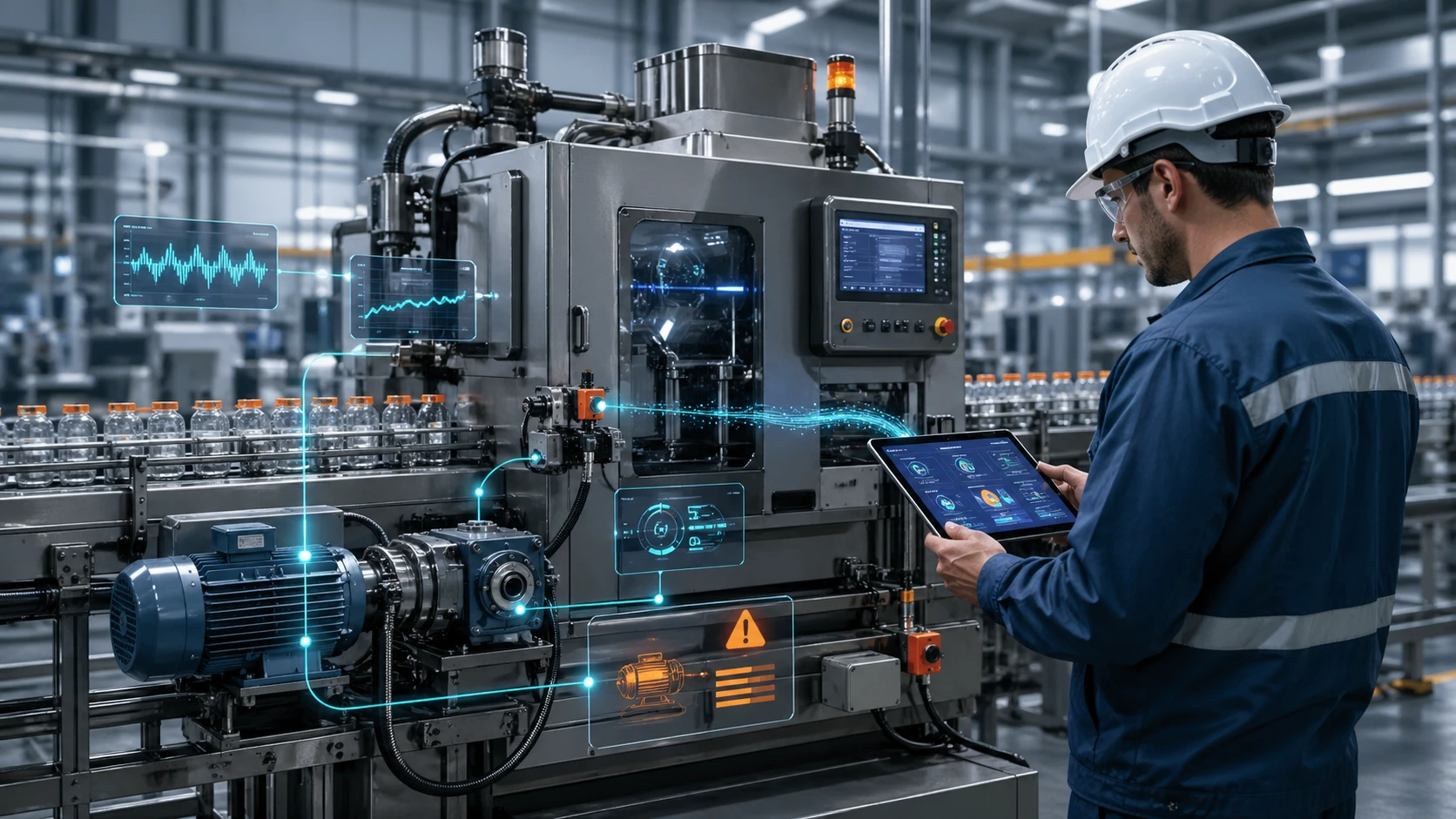
IoT devices work by integrating data management or IT systems with industrial operational systems. By merging these two systems, data flows between the physical and digital worlds. IoT devices integrate two technologies to work as a single system, reducing errors and increasing efficiency.
Here are four ways in which IoT can help reduce downtime in manufacturing plants.
IoT sensors work similarly to a health tracker, but for monitoring the health of machines. It runs 24×7 and measures every parameter that matters.
The sensors are attached to equipment and track its conditions, like temperature and energy consumption. All readings are sent to the central system in real time, and the moment values are outside the normal range, the system flags them immediately.
Without IoT sensors, you have to depend on scheduled maintenance or notice something is off only after it happens. With real-time monitoring, you will be able to monitor every machine in the plant, even in your absence, and track its health.
IoT devices become powerful due to their early fault detection capabilities. Expensive failures in a manufacturing plant, such as pump failures or gearbox collapses, don’t happen suddenly.
Most of these failures don’t happen in a single day but build up over a period of time. Human inspectors who monitor these machines on a weekly or monthly basis may not notice these early enough. But IoT sensors do that for you using multi-axis vibration sensors and thermal imaging with a level of detail impossible for human eyes to find.
Manufacturing plants that employed a combination of vibration sensors and temperature monitoring have reduced their equipment failures by a huge extent.
Most manufacturing plants use either a reactive maintenance model or scheduled preventive maintenance to maintain equipment health.
Predictive maintenance is possible because of IoT sensors that save more investment and time. IoT sensors continuously transfer data from machines into an analytics system. Machine learning models compare current readings with past data to calculate when a machine might collapse.
For example, the IoT solution sends you an alert saying that “the bearing in this particular machine is showing signs of wear, which is often seen in machines that are about to fail in 12 to 15 days. Schedule maintenance.”
One study by McKinsey says that predictive maintenance can reduce equipment downtime by up to 50% and reduce maintenance costs by 25%. These numbers show why predictive maintenance is one of the largest applications of IoT sensors.
Even when you have the best monitoring solution in place, how fast your team responds to a flagged event makes all the difference.
Your maintenance teams get remote visibility with the help of IoT devices. Visibility in the sense that you can track and monitor the health of every machine from a single dashboard or through a phone.
For example, when the system sends you an alert, you know the reason behind a failure even before you reach the location. This capability reduces the gap between detecting an issue and the time taken to fix it.
And for manufacturers who take care of multiple sites, remote visibility allows them to triage an issue without having to travel or wait to reach the location physically.
Alerts can be sent directly to operators through IoT wearable devices such as smartwatches. All these benefits contribute to minimising downtime in the manufacturing plants and taking corrective action immediately.
Most manufacturing plants have enormous amounts of data that are scattered and delayed. You need a central platform to convert the information into something useful and actionable. An IoT solution gathers all this data without any delay and turns it into insights teams can actually act upon.
Now you no longer have to wait a week to review the issue and fix it when the issue is still small and manageable. There are many applications of IoT in manufacturing, and let us discuss a few here.
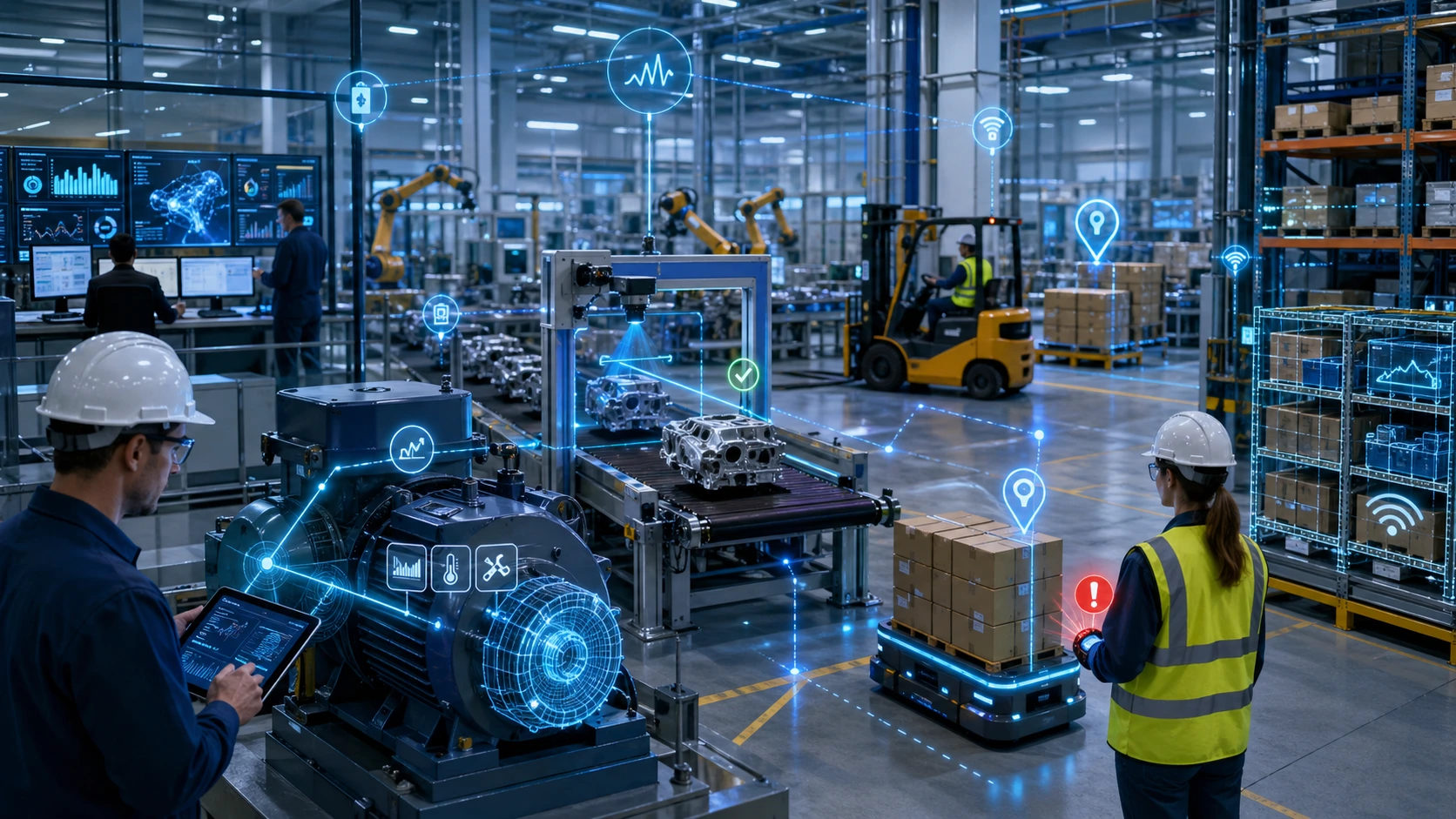
Do you remember the last time a machine suddenly stopped working, and you didn’t have spare parts on hand? You would have taken hours to figure out why the machine failed and how to fix the issue. In the meantime, you would have lost a significant amount of time and revenue.
But do you think the machine broke down all of a sudden? In most cases, the answer would be no. Because the machine would have shown signs for a few days and, in some cases, a few weeks. There could have been a subtle rise in temperature or a minute shift in vibration frequency.
The signals were always there. But nobody could catch them because there was no system in place to identify the changes. This is the gap that predictive maintenance closes in manufacturing plants.
IoT sensors installed in the equipment track the parameters continuously and feed the data into machine learning models that are trained to recognize what the normal values are for a specific machine. The system would send an alert the moment it identifies a deviation in the values before a machine breaks down.
Ford’s commercial vehicle division was able to do this by feeding the data from connected vehicles into machine learning models. Because of this, they could predict 22% of component failures in advance and saved 12200 hours of downtime.
If you’re a plant manager who manages multiple plants, then you would be aware of this situation. Something goes wrong during the night shift, creating an issue that goes unnoticed until the morning team arrives. This is where the remote monitoring capabilities of IoT devices become helpful.
IoT sensors attached to every machine in your plant create better visibility of the equipment through a single dashboard. Your team doesn’t have to be physically available to know what’s happening in real time. The IoT devices send alerts whenever something goes wrong to the concerned person without any delay.
A large automotive assembly plant installed IoT sensors on all the production machinery to monitor their condition continuously. Operators could identify and address issues in real time rather than discovering them hours later during an inspection. The impact of remote monitoring is directly seen on downtime, as the response time has reduced from hours to minutes.
A defective product that reaches the customer is costlier than the product itself. If a customer returns a product, you have to investigate and rework the product. And if this happens again and again, your reputation may be at stake, and no refund can fully repair it.
Most quality controls we have today are built to catch defects only after the products are already made. A batch gets inspected only at the last step, and you question yourself about how many units have been affected only after finding defects in one unit.
IoT solutions change this approach by continuously monitoring the conditions that could affect the quality of products. The system sends alerts once the parameters go out of range during production, when there’s still a chance to correct the mistake.
BMW uses AI-powered robotic arms with cameras to detect paint defects on the exterior of a vehicle that are invisible to the human eye. That level of precision is impossible to achieve through manual inspection, no matter how experienced your team is.
Most of the plant managers have a reasonable understanding of how much they’re spending each month. But they don’t have more clarity about where that energy is going.
They won’t know which machines are consuming the most and which ones are using full power when they are idle. If you don’t have access to real-time data, you wouldn’t have answers to these questions, and the wastage continues every month.
IoT sensors track the energy consumption of individual machines and HVAC systems. When you feed this data into a central analytics platform, you will identify patterns that you weren’t able to before.
Suppose there’s a machine that hasn’t been flagged for maintenance but is drawing 15% more power, which shows that there are signs of internal damage.
Supply chain disruptions are one of the most underestimated sources of downtime in manufacturing plants. A production line doesn’t always stop working because a machine fails. It could also stop working as the raw material didn’t arrive on time, or inventory ran out when no one expected it.
IoT devices bring extra visibility by tracking the location of goods in real time and monitoring product conditions during transportation. Managers will receive alerts when there’s a delayed shipment or when inventory levels cross a reorder threshold.
Before we get into what IoT solutions deliver for your business, let us understand what unplanned downtime is costing you right now. An unscheduled downtime in manufacturing plants costs about $260,000 per hour, and you know what’s worse than this.
Over 80% of companies can’t calculate the accurate cost of downtime. You see that there’s production loss and emergency bill repair. But you overlook hidden costs, such as the delivery penalty charged by a customer or losing a contract to your competitors due to a lack of efficiency.
So, let us know what happens to your business when there are fewer breakdowns.

When manufacturers implement IoT devices to monitor equipment, their impact on downtime is going to improve overall time.
For example, the US Department of Energy saw a 70% to 75% reduction in breakdowns among manufacturers who have advanced predictive maintenance programs.
Do you think IoT devices are going to save you money with less equipment breakdowns? Actually, you’re going to get back something even more valuable, which is the effectiveness of the equipment.
Overall Equipment Effectiveness increases by 20 to 25% for companies that optimize production with IoT solutions.
One of the most important financial benefits of IoT in manufacturing is that your maintenance expenses come down. The cost of an emergency repair is much more than that of a scheduled maintenance of the equipment.
Research by Deloitte shows that there is a 25 to 30% reduction in maintenance costs due to predictive maintenance programs powered by IoT devices. Most manufacturing plants achieve a positive ROI within 12 months of implementing IoT.

IoT in manufacturing is going to be beneficial for your company only when you have a solid plan to start with. When you implement IoT devices, you are going to spend more time and energy figuring out how they work, and at the same time, you have to be strategic in handling people and changes that are about to come.
Here are a few challenges you have to keep in mind before implementing IoT solutions in the manufacturing plant.
What is the role of IoT in reducing manufacturing downtime?
IoT devices work by integrating data management or IT systems with industrial operational systems. By merging these two systems, data flows between the physical and digital worlds. IoT sensors continuously transfer data from machines into an analytics system. Machine learning models compare current readings with past data to calculate when a machine might collapse.
Which IoT devices are most useful in factories?
IoT sensors, like vibration sensors, are useful to track parameters like temperature, pressure, and vibration. Motion sensors are used to analyze and process the data on the spot to speed up decision-making and send alerts. Industrial IoT devices like RFID tags and smart cameras make data sharing and communication easy between the equipment.
Can IoT work with existing plant systems?
This is one of the concerns that companies come across when they want to implement IoT in manufacturing. And the honest answer to that question is yes, it is possible.
IoT sensors are attached to machines to monitor the health of a machine, and these sensors connect to IoT gateways that act as a bridge between legacy machines and modern platforms.
Is predictive maintenance part of IoT downtime reduction?
Yes, and predictive maintenance is the most important process in reducing downtime using IoT technology. IoT sensors installed in the equipment track the parameters continuously and feed the data into machine learning models that are trained to recognize what the normal values are for a specific machine. The system would send an alert the moment it identifies a deviation in the values before a machine breaks down.
The impact of IoT in reducing the downtime of manufacturing plants is undeniable. Right from remote visibility to predictive maintenance, IoT is reshaping how manufacturing processes are managed. The potential for IoT to improve maintenance in the manufacturing industry is only going to increase with time.
However, in order to leverage all the benefits of IoT in manufacturing, you have to choose a partner who supports you right from the planning stage.
The NineHertz has enabled businesses from all over the world to implement IoT solutions and unlock the full potential of the technology and resources. Book a free consultation call with us to learn more about how you can use IoT devices to minimize downtime and increase productivity.

Imagine a city where you can see everything happening on the streets in real-time. In this city, you can find…

The Internet of Things (IoT) is changing industries by connecting everyday devices to the Internet, enabling real-time data collection, monitoring,…

Merging Artificial Intelligence (AI) with IoT is one of the groundbreaking approaches in the technology domain. On one side, IoT…