Imagine having the optimal amount of stock to satisfy customer demand without having to tie up cash in inventory. This is what an ideal supply chain inventory optimization looks like.
It enables the visualization and management of inventory levels across your entire supply chain network, enhancing your inventory planning and decision-making.
According to research, companies that implement advanced optimization techniques can reduce inventory costs by 15%. At the same time, they can also improve fill rates by 10%. As of now, only 23% of companies invested in AI-powered solutions, leaving a massive modernization opportunity.
This is because companies can’t get results with ready-made software. A supply chain software development company that understands the complexities in your inventory management can guide you in this process.
In this blog, let us have a closer look at inventory optimization and the common struggles across supply chains.
Supply chain inventory optimization management is a process that keeps track of your inventory levels and enables you to meet customer demand. It will weigh the costs of carrying inventory against the cost of insufficient stocks and lost sales.
Inventory optimization is possible only when you have a deeper level of understanding about customer demand, supply chain dynamics, and other factors.
Both Inventory optimization and inventory management are subsets of inventory control. Though they are closely related, they serve different purposes.
Inventory management is operational, tracking warehouse logistics and inventory levels. It handles day-to-day tasks like receiving shipments, storing, and fulfilling orders to maintain efficiency. It’s operational.
Talk to our Experts
Start Your Supply Chain Software Project
On the other hand, inventory optimization is strategic. It’s asking if we should stock an item or not. Most companies are good at inventory management. But they struggle when it comes to optimization.
Inventory management is a complex process, and if not managed properly, it can lead to revenue loss. Supply chain inventory optimization management can transform the challenges involved in inventory management into an advantage.
Here’s how inventory optimization solves common inventory management challenges:
A business without adequate inventory may lose revenue or have dissatisfied customers. Having too much inventory results in higher holding costs. In addition, if the overstocked inventory consists of perishable goods, they have the risk of being outdated or ineffective.
Sometimes seasonal trends determine a product’s demand. Without proper planning, a business can be either underprepared or overprepared.
Supply chain inventory optimization management solves this issue by using multiple forecasting algorithms and various data sources to improve forecast accuracy.
Natural disasters, strikes by workers, or worldwide events can prevent suppliers from delivering products. Without a contingency plan, disruptions can lead to failure in fulfilling orders.
Inventory optimization uses algorithms and data to decide the smartest way to split orders among suppliers.
Managing inventory becomes complex when a business offers the same product in different variants. For example, a model of shoes can come in different colours and different sizes. You’re now managing hundreds of SKUs, each with different lead times and suppliers.
Optimization techniques like attribute-based modelling help solve issues that arise because of product complexity.
What customers expect from you will grow and keep changing every day. E-commerce and D2C sales made inventory management fragmented.
These days, everyone wants personalized products, multiple varieties, and quick deliveries. So businesses need fresh approaches to manage stock and forecast inventory.
Supply chain inventory optimization management provides omnichannel visibility and service level segmentation to meet customer demands and expectations.
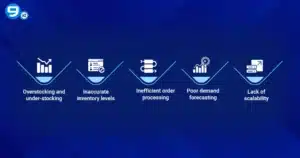
Inventory management is a universal struggle across businesses of all sizes. When things go wrong, they can lead to financial losses and unhappy customers. This is especially true for companies looking to scale or handling multiple sales channels.
Here are the key inventory challenges and how they affect your business operations:
According to IHL research, inventory distortion costs global retailers approximately $1.8 trillion all over the world every year.
Overstocking of inventory leads to tying up capital and an increase in storage costs. In contrast, under-stocking results in missed opportunities and dissatisfied customers turning to competitors.
This can lead to:
Balancing inventory levels requires accurate forecasting and inventory tracking systems.
Outdated systems and poor tracking methods can lead to inaccurate stock levels. This kind of inventory level error results in revenue leaks.
Wasp Barcode technologies report that 43% of small businesses use manual tracking or no inventory systems at all.
Here’s why most inaccuracies happen:
Due to this, customers receive the orders late or cancel them. Teams can waste their time handling stock disputes, which in turn affects customer satisfaction.
An effortless shopping experience doesn’t end when a customer places an order. It ends only when the customer receives the right product at the expected time. According to Shopify Plus, 45% of customers expect an order to arrive in 2 days or less.
An order fulfillment fails when the warehouse layouts are disorganized, and there is a lack of integration with shipping carriers. A supply chain software development company can help you address such challenges with inventory software.
Demand forecasting plays a crucial role in this process of optimization. You need to analyze and get an idea of future customer purchase decisions. This step will help you maintain sufficient inventory. Otherwise, it can lead to inadequate stock levels and poor order management, often caused by inaccurate demand forecasting in the supply chain.
The system you currently have may work well at 100 orders per month, but it may not work when you get 1000 orders. That’s why many companies outgrow their inventory processes. Most of the time, they don’t realize they have outgrown their current systems. Legacy systems are incapable of meeting growing needs, and scaling fails when such systems lag due to large transaction volumes.
The goal of supply chain inventory optimization management is to find a point where the inventory adds value instead of being a drain on resources. Even as technology gets better, businesses have a hard time managing their inventories.
According to research, errors in inventory tracking have an impact on 62% of business finances. Let’s have a look at the challenges that often stand in the way of optimization:
Inventory is managed across multiple sales channels such as e-commerce, physical stores, and third-party marketplaces. Due to this, difficulty arises in tracking stock levels. You will find it challenging to schedule replenishment and ensure on-time delivery.
Imagine what will happen if you have to face stock-outs in one location and overselling in certain locations. That’s why multi-channel fulfillment is an ongoing problem for supply chain management. You have to ensure that inventory is available at the right locations at the right time.
Consumer behaviour and market conditions are unstable. These factors make it difficult to crack demand forecasting. Even the most advanced forecasts may not work due to sudden changes in customer preferences or shifts in the economy.
Talk to our Experts
Start Your Supply Chain Software Project
Lack of historical data for new items and faulty POS data make forecasting even more challenging. These uncertainties may result in excess or shortage of inventory that impacts service quality.
Automation gaps lead to inefficiencies in inventory management and a higher chance of errors. Manual errors in record keeping make it challenging to respond to changes in demand or supply.
Inadequate automation results in:
This is what makes supply chain inventory optimization management difficult to manage.
A lack of resources or operational expertise does not cause inventory inefficiencies. There are more basic and deeper issues behind it.
You know what the first reason for inefficiency is? It’s the idea that having reduced stock equals increased efficiency.
Organizations under financial strain tend to drastically reduce their inventory. They do this without thinking about supply risk or demand fluctuation.
This strategy could free up working capital for a while. However, this condition leads to weak supply chains and less resilience to shocks. Inventory reduction that lacks control can lead to stockouts or service issues.
Inventory misalignment is one of the reasons for inefficiency. Poor placement between sites can decrease your service quality and increase your expenses. This happens even when overall supply levels seem adequate.
This happens when you make decisions about inventory without a holistic view. This situation results in blind spots, and you may not identify them easily. Due to this, some locations have too much inventory, while others are short. Eventually, they lead to needless transfers, increased wait times, and missed sales.
Instead of managing inventories strategically, many firms do so reactively. Instead of following a clear, enterprise-wide process, choices are made when pressing issues occur. The reactive environment promotes:
Inefficiencies will persist throughout the supply chain unless inventory is managed as a strategic capability rather than an expense to reduce or an issue to respond to.

Poor supply chain inventory optimization has a ripple effect throughout the supply chain. It makes operations less efficient and difficult for businesses to sustain.
Poor inventory optimization has a direct impact on financial resources in two ways. When there is too much stock, you have to pay for storage and handling. This capital could be used to fund expansion projects.
On the other hand, stockouts mean missed sales chances and less revenue. When your capital is tied up in inventory, you cannot invest in other areas of business. This acts as a disadvantage when you can’t leverage market possibilities.
Problems in the supply chain get worse when you have no control over your inventory. You cannot fulfill orders on time without proper tracking systems. This situation leads to delays in delivery that affect distribution.
When you cannot replenish stocks on time, bottlenecks will be created. These bottlenecks slow down the supply chain. Manual inventory systems cause operational problems that reduce productivity.
Poor supply chain inventory optimization management can worsen the relationship with your customers. Customers tend to post negative reviews about your service if they experience stockouts. This affects your brand reputation and reliability.
Customers lose trust in your company when product availability changes without warning. This affects the customer lifetime value that is necessary for the long-term success of your business.
When you can’t track your inventory well, then you’re not making decisions based on facts. Demand forecasting might look like a guess work than analysis, resulting in cycles of overstocking or understocking.
If the reports generated are Inaccurate, they hurt strategic planning. Due to this, supply chain managers can make incorrect insights for choices about pricing, manufacturing, and buying. This will make it challenging for your business to develop or adapt to changes in the market.
All of these factors combined put long-term viability at risk. Consistent inventory failures hurt a company’s reputation and make it harder for its brand to get new customers. When operational reliability drops, it’s difficult for firms to stand out, and they have the risk of going out of business.
So, inventory optimization became a strategic necessity that affects the long-term success of the business.
To tackle these deep-rooted issues, you need a holistic approach instead of temporary fixes.
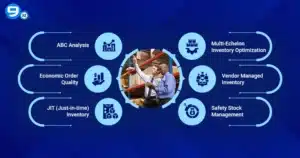
ABC analysis is a technique used to classify inventory items based on their worth and relevance. Items “A” hold high value and fast turnover. That’s why they need to be watched with careful observation.
B items have a moderate turnover rate and value. C items have low value and slow turnover rates. Businesses with huge inventories can benefit from this strategy by focusing on high-value items.
The EOQ concept is introduced to reduce overall inventory expenses. High costs can result from placing too many orders and having to store them. Costs can also rise due to placing too few orders too frequently.
You can calculate the most economical quantity with the help of EOQ. It is most helpful when you have a steady lead time and predictable demand.
This technique used in supply chain inventory optimization management can minimize carrying costs and in-process inventories. Materials are ordered and delivered in the production process only when they are required.
This process helps to lower waste and have only a few goods to store. JIT is useful for companies with perishable goods or those that have limited storage capacity.
Multi-echelon supply chains have several entities spread over various locations. They consider the relationship between multiple echelons, unlike other optimization techniques.
Companies with multi-tiered supply chains where decisions are taken at a single stage will find this method helpful.
In this method, the distributor’s inventory data is accessible to the supplier. Both parties are responsible for managing the inventory, while the client decides the inventory level.
Based on the agreed criteria, the supplier will decide how much inventory to send and when to restock. This technique used in supply chain inventory optimization management leverages suppliers’ forecasting skills and their understanding of market demand.
This helps organizations to reduce inventory management expenses and improve relationships with suppliers.
Safety stock is the amount of goods you save to protect yourself from stockouts. When you have the necessary stock on hand, you can meet your customer demands with ease. You need to find a balance between the costs of holding safety stock and the costs associated with stockouts or missed sales.
Advanced technology and Artificial Intelligence are transforming how companies are handling inventories. Reports say that AI has improved inventory management by 60%, and many companies are already planning to invest in AI.
Here are the essential tools and software required for inventory optimization:
Enterprise Resource Planning systems simplify operations within a company by integrating many business processes. They offer real-time visibility into inventory levels, sales, and deliveries.
Supply chain software development companies can help develop inventory management software that can be combined with an ERP system. This offers information on product performance and the inventory turnover ratio.
AI and ML can be used to find complex patterns in large datasets. They combine historical sales data, market trends, and economic data to provide accurate insights. This approach helps to predict shifts in demand and modify their inventory levels as required.
Internet of Things sensors can track inventory levels in real-time, such as smart shelves or RFID tags that help in inventory optimization. Supply chain managers and planners can notice possible stockouts or overstocking issues with the help of these devices.
Cloud platforms can enhance data sharing and real-time data collaboration throughout a company’s supply chain.

You need to stay up-to-date with the best practices to succeed in supply chain inventory optimization management. Here are five practices that will help you achieve peak performance during inventory optimization:
An effective inventory review system will streamline the inventory management process. There are two types of review systems: the continuous review system and the periodic review.
In the first method, you will replenish an item when it falls below a target level by continuously checking. In the second method, planners will replenish orders regularly along predetermined cycles.
Controlling the quality of inventory ensures that expectations of your customers are met and helps in your company’s growth. This is one of the best practices in supply chain inventory optimization management to prevent overstocking or understocking.
Companies are using AI-based analytics to forecast the future needs of customers. Use a combination of historical and predicted metrics to calculate inventory requirements.
As businesses evolve, inventory optimization practices have to evolve too.
Analyze key performance indicators like sales trends, customer feedback, and supply chain performance to identify areas of improvement.
Talk to our Experts
Start Your Supply Chain Software Project
Improving these areas will help you to limit overstocking and reallocate resources to other areas of the business.
The future of supply chain inventory optimization management is driven by advancements in AI, IoT, and Automation.
Companies adopting these technologies will outperform those using traditional methods. As a leading supply chain software development company, The NineHertz enables businesses across the world to be future-ready.
It is the process of maintaining the right level of inventory to meet customer needs. It reduces costs and maximizes profit.
Inventory optimization helps increase inventory turnover. It improves inventory forecasting to avoid urgent or bulk orders from suppliers.
Demand volatility, poor forecasting, and inaccurate data are the biggest challenges in inventory management today.
Companies can improve inventory optimization by using strategies like ABC analysis, JIT or Vendor-Based Inventory (VBI).
Industries like retail, e-commerce, manufacturing and distribution struggle the most with inventory optimization.
Key Takeaways AI supply chain risk monitoring uses real-time data and predictive models to flag disruptions before they escalate into…

The global supply chain covers a complex network of manufacturers, suppliers, distributors, wholesalers, retailers, and customers. So, how does a…

Maintaining a healthy relationship with suppliers is pivotal for businesses to ensure their long-term sustainability in a competitive market. For…