
The global construction industry is expected to reach an estimated of more than $15 trillion by the end of 2030. However, there are cases of delays and cost overruns that affect profitability.
Construction material ordering app development streamlines the procurement process for the construction industry. This has enabled contractors to order building materials in real time, check the availability of the same, and monitor prices.
On-demand ordering apps for the construction industry bring contractors, suppliers, and logistics providers together under a single umbrella, allowing for efficient execution.
Although the construction material ordering app development cost is a factor that needs careful consideration for any business, it has been realized that the same can be treated as an operational expense for the business.
This article aims to provide information regarding the development process, features, benefits, and costs for the construction industry.
Construction material ordering app development is a method of creating a software system to facilitate the ordering and delivery of construction materials in a more efficient manner. It eliminates the need to make phone calls, write orders, and manage the entire process of delivering materials to the construction site.
Its scope extends beyond the process of including features like supplier management, order management, delivery tracking, etc. Construction software development services helps building smart products that can be integrated with legacy software, including ERP, inventory, and accounting software.
The workflow of construction material ordering app development is a systematic approach to the entire process of ordering and delivering materials to a construction site. A contractor can order materials from a catalog, check prices, and order the materials, after which the supplier receives the order in real-time, and the delivery status is updated in real-time.
There are two major models: a single-vendor app, in which a contractor can order materials directly from a supplier, and a multi-vendor app, in which a contractor can order materials from multiple suppliers and compare prices, availability, and delivery time in a single app.
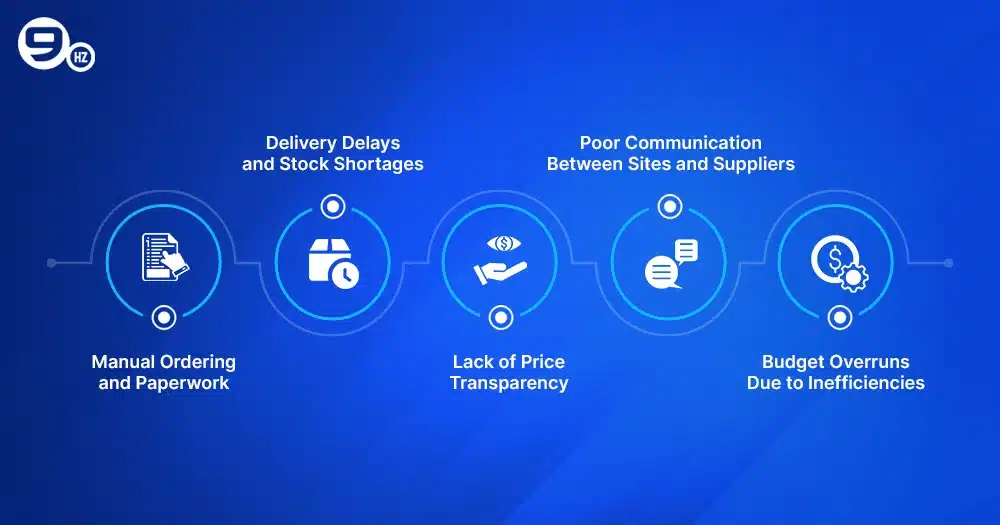
The conventional approach adopted for the procurement of materials in the construction industry has been fragmented and manual. Though much has been achieved in the development of the industry, the conventional approach adopted for procurement has remained the same, leading to operational gaps.
Manual procedures for ordering, paperwork, phone calls, and emails are time-consuming, and the chances of human error, duplicate ordering, and paperwork are high.
Due to the lack of real-time inventory monitoring, stock shortages are only identified after the order has been raised, leading to unexpected order delays.
There is a lack of real-time price transparency, and contractors are not aware of the prices and cannot compare them with other prices in real time. Hence, the lack of consistency in controlling prices results in the loss of business opportunities.
There is always a delay in getting information concerning the status of the order, which means there is a need for constant communication with the suppliers.
Delays, emergency procurements, reorders, and wastage of materials cause the overall budget of the project to increase, which results in low profits.
This is some of the problems that are being addressed by the need for the development of an application for the ordering of construction materials.
Construction companies are under pressure to improve the execution pace while ensuring costs are kept under control. Digital procurement is increasingly being considered a strategic priority.
As the complexity of procurement rises, the need for construction material ordering app development is not considered an option but an essential platform for an efficient and effective construction supply chain.
Construction material ordering app development is seen to yield operational benefits for contractors, suppliers, and construction enterprises.
The main areas of focus would be speed, visibility, and coordination.
The depth of the features has a direct impact on the efficiency and scalability of the app.
For a marketplace, backend management is critical in construction material ordering app development. Admin and vendor panels are critical in managing inventory, pricing, and order processing in a structured manner.
A good admin panel is an essential part, as it helps to bring transparency to the relationship between the contractors and suppliers.
Construction material ordering app development can be carried out in different ways, as per the business requirements, scope, and complexity of the supply chain.
This type is suitable for large suppliers or manufacturers who sell directly to contractors. This can be integrated with the internal procurement system and Construction ERP Software Development.
This model is capable of uniting different suppliers under the umbrella, where the contractors can see the prices, availability, and time of delivery of the products..
This model is designed for large construction companies with many sites. This model can be used for procurement, approval, budgeting, and reporting.
This model can be used for the rapid dispatch of products, especially for urgent requirements.
The model depends on the business needs, whether it is for supplier expansion, marketplace aggregation, or enterprise procurement optimization.
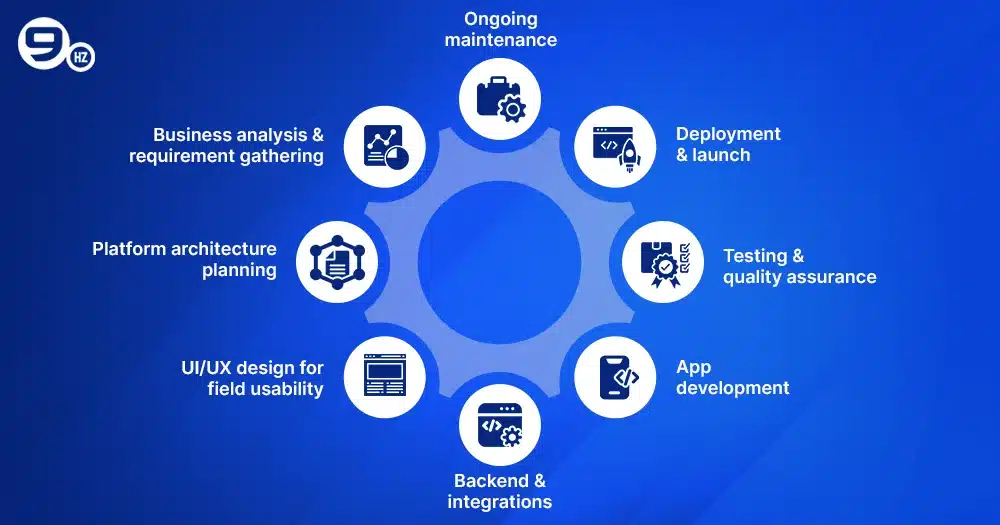
Construction material ordering mobile app development has several stages, which are discussed below.
This step helps in understanding the requirements for the project, which can be achieved through business analysis. In many cases, construction software development projects begin with the competitive analysis and operational gaps.
The architecture for the construction software development needs to be planned, which helps in the development of scalable systems.
The construction application design should be simple and very user-friendly, which makes it easier for the users to understand the design.
The fourth stage is dedicated to development and integration to bring all the required features into the mobile app.
The functional, performance, and security tests are conducted for the application before it is launched.
The application is ready for deployment with monitoring tools that track its performance and user behavior.
The application is updated and optimized for better and more stable systems.
Disciplined app development requires timely and efficient execution in all these areas.
The selection of a technology stack is a critical consideration in construction material ordering app development, and the aim is not only to deliver a high-performance system but to ensure it is a reliable and easy-to-manage system in the future as well.
There are a variety of options to develop apps, including cross-platform tools like Flutter or React Native, or native tools like Swift or Kotlin.
Cloud infrastructures can be used to securely store data and ensure the system can scale to meet increasing traffic as the business grows.
Having a payment gateway integrated can make transactions quicker and simpler between the contractor and the supplier.
These can be integrated to track the delivery and let the contractor know exactly when to expect delivery.
Being able to connect to inventory systems can ensure real-time updates to inventory levels.
Having analytics tools integrated can assist businesses in gaining a deeper understanding of ordering habits.
The technology stack chosen during development has a direct impact on the scalability and reliability of the system.
Construction material ordering mobile app development cost may differ depending on the complexity, features, and platforms on which the development is performed. Below is a general estimate.
| Component | Estimated Cost Range | Estimated Development Time Duration |
|---|---|---|
| Basic System | $25,000 – $45,000 | 3 – 4 months |
| Mid-Level Platform | $45,000 – $80,000 | 4 – 6 months |
| Enterprise Solution | $80,000 – $150,000+ | 6 – 9 months |
| Mobile Apps (iOS & Android) | $20,000 – $50,000 | 2 – 4 months |
| AI & Analytics Modules | $15,000 – $40,000 | 1 – 3 months |
| Integration & Compliance | $10,000 – $30,000 | 1 – 2 months |
The cost increases with the degree of customization, security, and integration.
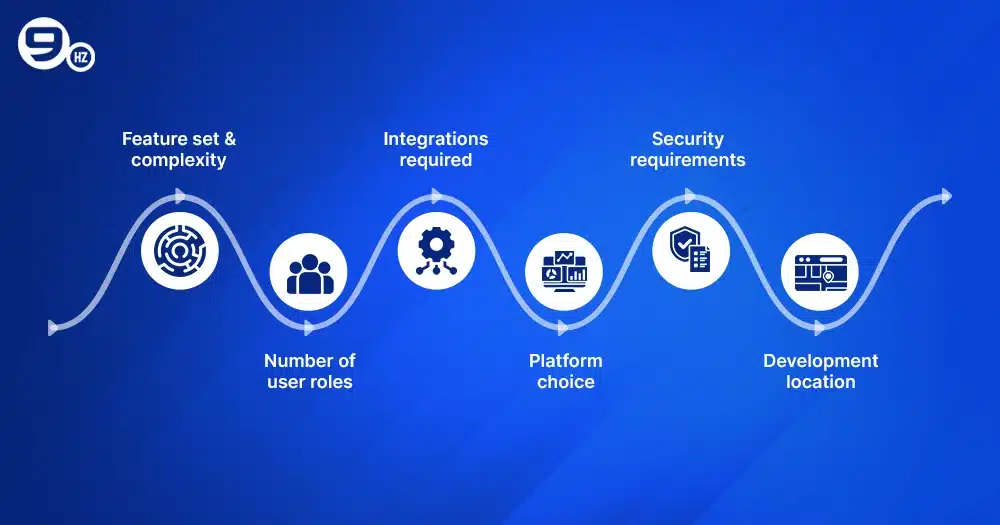
The cost of developing the construction material ordering app is not fixed. It changes based on the business needs, depth of the features, and the technical requirements. A small-scale app for a supplier would cost much less compared to a large-scale marketplace.
More sophisticated features require a higher budget than simpler ones. Simple ordering and tracking are affordable, but the cost increases with any integration, like AI-driven forecasting or any other automation.
Creating a construction app for contractors only is less complicated than creating one for contractors, suppliers, delivery teams, managers, and administrators.
Integration of ERP, accounting, inventory, or CRM systems is more complicated than a standalone app.
Creating a construction app for iOS and Android devices is more expensive than creating a construction app for a single platform.
Ensuring robust data security, payment security, and compliance can be costly.
Construction software development companies located far from each other can have a higher budget than local ones.
A clear plan can assist in managing the construction material ordering mobile app development cost without compromising scalability.
Construction projects face challenges related to coordination gaps and supply chain issues. With the construction material delivery app development process, these issues can be resolved in an organized manner.
This feature helps in the real-time update of construction materials that are out of stock.
With better coordination between suppliers and delivery personnel, there will be fewer chances of delays and confusion.
As connectivity is a major issue in construction sites, the app can function offline and sync data once the internet connection is available.
A streamlined onboarding process makes it easier for vendors to join the platform, manage catalogs, and fulfill orders efficiently.
Financial risks can be eliminated by making sure that all transactions are secure. With the proper approach towards the development of the construction material delivery application, businesses can have better control over the process, which can lead to reduced downtime.
Selecting the proper partner for the development of the construction material ordering application is as important as selecting the features. The success of the application depends on the proper selection of the development team.
If the company has experience in the construction industry, it can design the application according to the challenges faced during the construction process instead of the general application structure.
The company must have experience in the development of logistics applications, marketplace applications, or procurement applications.
The application developed must have the capability to support the growing needs of the businesses.
Maintenance, updates, and monitoring of performance are critical to the success of construction projects.
Working with the right construction software development partner is essential as it can lead to better construction and project execution, better project performance, and higher return on investment.
Thus, the selection of a suitable development partner is a crucial factor that makes a big difference in the outcomes of the project. NineHertz is a firm that uses its technical as well as industrial knowledge to provide businesses with reliable procurement systems.
NineHertz develops scalable mobile or web applications according to real-time business needs.
We ensure that the interface of their applications is suitable for real-world job site conditions.
The NineHertz ensures that the entire development process is organized and transparent.
Our team develops scalable applications that can handle a large supplier base.
Partnering with a development firm experienced in construction material ordering app development helps businesses achieve their goals.
Construction material ordering app development is not only a good idea, it is also a good strategic decision for the construction business. This is because, by developing a digital app, the contractors can immediately check the availability of the materials, order the products that are required from the different suppliers, and also order the products that are required for the project.
This can be helpful for the contractors, as they can avoid idle time on the project sites. This kind of digital app can also be helpful for businesses, as it can be easier for them to monitor the orders, the budget, and the requirements. By developing a digital app, businesses can also avoid unnecessary purchases, which can be helpful for them.
By developing a digital app, businesses can also avoid up to 30% of the time wasted due to delays. By developing a digital app, businesses can also be assured that they can be scaled up easily.
Construction material ordering apps are digital platforms that connect contractors, suppliers, and delivery teams, which help contractors order the required materials for the project with ease. This helps contractors complete the project without any unnecessary delays.
The cost for developing a construction material ordering app varies depending on the features, complexity, and size of the project. The minimum cost for developing a simple app would be around $25,000, while the cost for developing a sophisticated app with many vendors and analytics would be more than $150,000.
The basic features that would be required for the development of the app would be the product catalog with categories, real-time tracking of stock and price information, information on bulk ordering, scheduling, payment gateways, and order tracking.
Yes, the apps can integrate with other systems, such as ERP, inventory database, and any accounting systems, which ensures that the information flow is seamless.
Absolutely. Marketplace apps allow multiple suppliers to manage catalogs, process orders, and coordinate deliveries within one platform, giving contractors more options and competitive pricing.
By automating procurement processes, the apps can reduce delays, stockouts, and budgeting problems. According to studies, digital procurement platforms can reduce procurement-related delays by up to 30%.
Key Takeaways Many construction companies are still running projects without a centralized system, which creates workflow problems and makes them…

Key Takeaways AI in AEC industry refers to the application of artificial intelligence in the architecture, engineering, and construction industry.…

Key Takeaways Construction companies are rapidly adopting digital tools to improve the efficiency of their operations and reduce risks. Custom…