Now, AI has footprints across every industry. The businesses are using AI/ML for real-time benefits. But, do you really think that integrating AI is enough? No, as every business is now implementing AI in its own way. Here, you need something unique that creates a difference.
What about AI native applications, where you can utilize AI at every layer? Instead of integrating a chatbot or recommendation engine, using an AI-native approach is the best way to have a solution that can think, learn, and adapt from the core. All this will be without any human intervention.
From the growth perspective, the global AI market size is set to reach US$1.68tn by 2031, at a CAGR of 37.00%. Industries like healthcare, finance, retail, and manufacturing are rapidly adopting AI applications. A more interesting fact is 80% of early-stage SaaS businesses use AI tools, and 61% reported profitability.
The business is witnessing a high growth ratio with applications built around AI and having at its core, at every layer. This article explores all aspects, such as AI ML native applications use cases, benefits, key characteristics, and more.
AI native applications are software applications developed using AI from start to finish. In these apps, AI is at the core, not as added features or any upgrades. It acts as a “Central Nervous System” and decides how the system works, plans things, makes decisions, and improves over time, learning through data.
Core AI applications utilize an architecture that includes machine learning (ML) and AI models as fundamental components. In simple terms, instead of being layered, AI algorithms, data processing, and decision processing are embedded directly into the apps.
Some of the top key characteristics of AI native apps include:
The main function depends on models, not static rules.
The system improves by using new data instead of remaining fixed.
Data pipelines are built into the foundation.
Outputs change based on patterns, behavior, and context.
As usage grows, the intelligence layer scales with it.
There is a question for you. Could you find out the difference between adding features, system upgradation, and building a new AI app?
Quite interesting – Right?
Here, the surprise is that adding features refers to the AI-Enabled app, system upgradation means AI-powered, and developing a new app where AI exists at every layer is called AI-native app development.
Let’s differentiate: AI-Enabled vs AI-Native vs AI-Powered Apps!
| Aspect | AI-Native | AI-Enabled | AI-Powered |
|---|---|---|---|
| AI Integration | AI as core | AI features added | Software enhanced with AI |
| Depth | AI exists in every layer | AI features act as accessories | AI integration into a specific workflow |
| Architecture Design | Revolves around AI | Conventional | Traditional + AI Layer |
| Learning | Continuous | Limited | Partial |
| Can it work without AI? | No | Yes | Partial |
| Scalability | Highly adaptive | Limited by add-ons | Best for specific tasks |
| Maintenance | High | Low | Moderate |
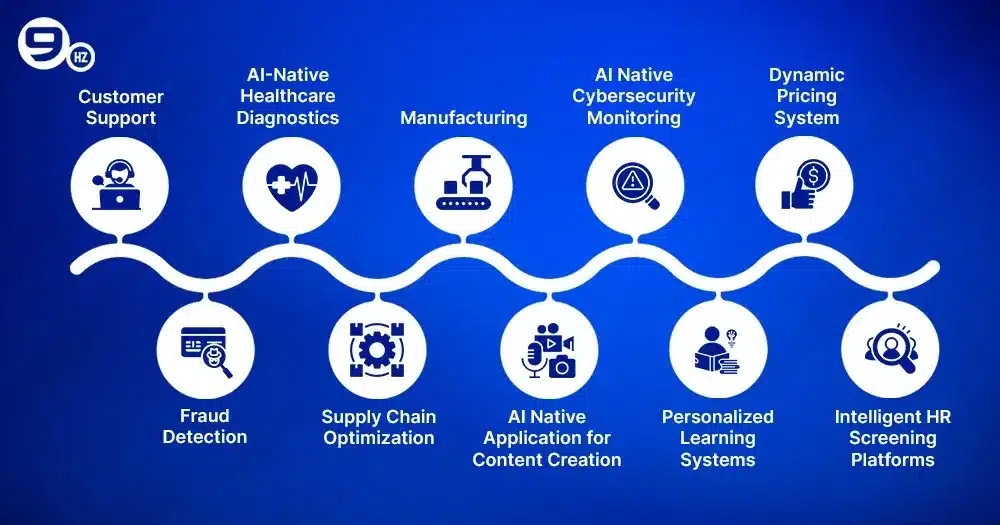
The AI technologies are mature now and offer state-of-the-art stability. So, here are some practical examples. These depict AI ML native applications use cases across industries, or how you can apply them to your business domain.
Instead of like chatbots, AI native customer support platforms understand context, past interactions, and intent. They can autonomously resolve tickets, solve complex issues, and improve responses through learning.
Financial fraud is a key challenge to the fintech industry. Thus, AI native applications in banking can help monitor transactions in real-time. These systems analyze the data and learn from it to identify the fraud in real-time. If the threat changes, the model identifies and learn it quickly to prevent any threat.
The simple chatbot in healthcare has limited functionality. But an AI native helps for diverse use cases such as diagnostics, drug discovery, patient personalization, and more. Having an intelligence layer, these systems improve with growing clinical data.
Supply chain businesses struggle with demand prediction, inventory adjustments, and route optimization. An AI-native application in supply chain management solves industry challenges efficiently. The AI system collects data from all sources, analyzes, learn, and makes decisions autonomously, reducing overheads and improving operations.
AI in manufacturing helps with predictive maintenance of equipment through collecting data from sensors, quality control through computer vision, optimizing energy consumption, and more. AI, at its core, analyzes a vast amount of data and adapts to the changes to reduce waste, downtime, and improve production.
A gen AI native application in marketing or media can generate, refine, and personalize content based on user behavior. It does not just suggest ideas. It produces structured outputs that adapt in real time.
Cyber threats are a significant challenge for all industries, where AI native applications help provide protection. AI native cybersecurity applications are built by using AI as the core engine. The key AI ML native use cases include autonomous threat detection, Agentic AI security analysis, predictive vulnerability management, deepfake & phishing detection, and others.
These platforms adjust course material based on student progress. Lessons change in real time. Difficulty levels adapt automatically. Without AI, the system would become static.
AI use cases in eCommerce, travel, and other industries too. Using AI systems, e-commerce and travel platforms can automatically adjust pricing based on demand and user behaviour. AI models continuously evaluate and analyze the data for dynamic pricing.
AI-native hiring systems can effectively analyze resumes, skill data, and performance patterns. They shortlist candidates based on predictive indicators, not keywords alone. With time, accuracy improves, and the system provides the best hiring outcomes.
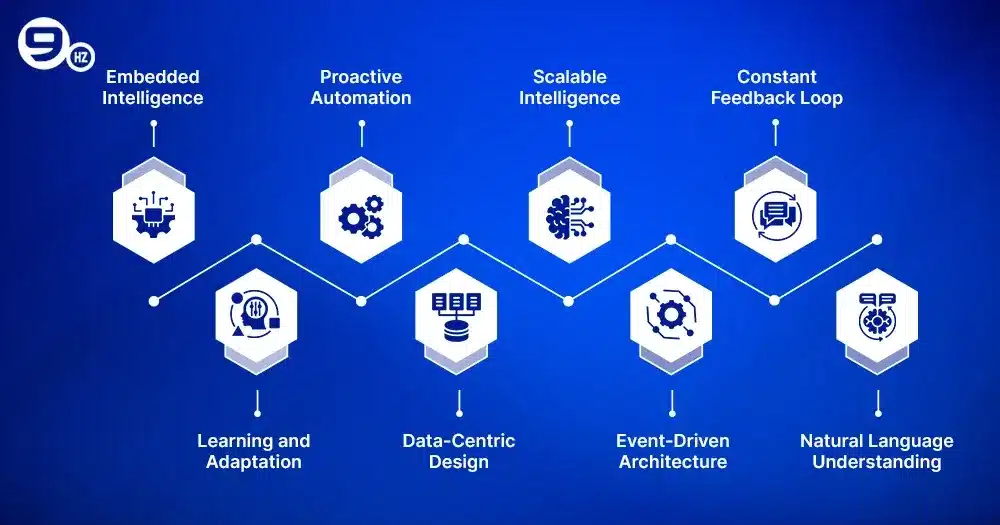
Now, you have gone through some of the top AI native applications examples in the above section. To fully understand the concept, it is best to go through the core characteristics.
From the data foundation to the user interface, AI is integrated into each layer of the application. In the AI-powered applications, AI is integrated as a separate module.
AI-native systems improve as they process more data. They do not rely only on fixed rules written during development.
These applications not only react to the user inputs, but also automate complex tasks, workflows, and self-manage processes. No human intervention is required.
AI-native apps are built around data, and they use real-time data streams, IoT devices, and transactional data to make decisions.
These applications easily handle large-scale data and operations. There is no need to redesign the product or an app.
The event-driven architecture responds to the changes in the source systems without a delay and uses change data capture (CDC), streaming transformations, and event streams.
The platform architecture supports real-time data ingestion, sharing, and learning at every layer consistently. This creates a constant feedback loop to power system intelligence.
The NLU capability of AI native apps or platforms allows users to interact with the system in natural language and receive context-aware responses.
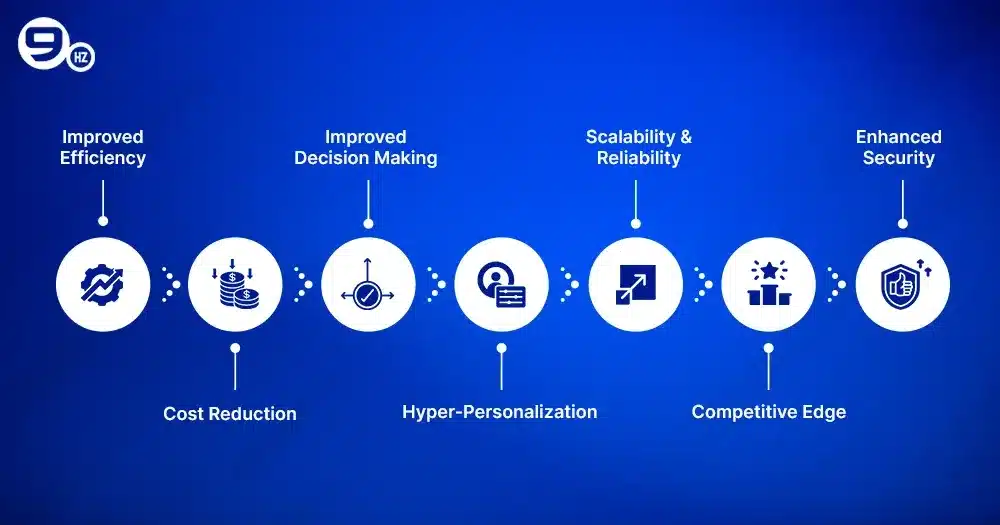
Key benefits of AI native applications include high business efficiency, improved decision-making, and hyper-personalization. Let’s read more in detail.
AI-native apps help automate repetitive tasks that, in turn, reduce errors, improve efficiency, and productivity.
In relation to the above, when efficiency improved through automation, the operating cost is less by a significant level.
AI-native platforms use analytics that are based on real-time data to give businesses predictive insights that they can utilize. This helps them make better and faster business decisions.
Context-awareness is one of the capabilities of AI native applications. These apps analyze user behaviour and deliver personalized responses.
These applications scale with the growing business needs, efficiently handle complex processes, and provide reliable responses. There is no need to expand the team.
A Gen AI native application is the best to adapt to the market trends faster. With customization, a business can innovate and create smarter solutions.
Utilizing machine learning(ML) algorithms, these apps detect threats and respond to attacks in real-time if any.
Building AI native applications is a step-by-step process and requires careful attention to each step. Here are the steps to build an AI native app strategically.
As a business leader, your first move is to identify and define business challenges that you want to address through an AI or Gen AI native application.
AI systems depend on data quality. Identify what data is available, what is missing, and how it will be collected. Clean data early. It saves costs later.
Not every use case needs a large model. Sometimes, a focused prediction model is enough. Match the model type to the business goal.
The system should allow data flow, retraining, and monitoring. AI should not sit as a side feature. It must be part of the core workflow.
User interactions and outcomes should feed back into the system. Without feedback, improvement stops.
Launch with clear performance metrics. Track how the system behaves. Adjust regularly. AI native applications improve through iteration, not one-time releases.
Pro Tip: The development process is complex and requires expertise. For better outcomes, it is better to collaborate with an experienced AI development company. The experts will help you develop the app flawlessly.
AI native applications offer real benefits as AI acts as a central system instead of being an additional feature. Here are some real-world examples of AI native applications and how businesses are using them for better results.
The Australian telecom company, Telstra, developed and introduced Gen AI tools for customer support after service activation, collaborating with Microsoft Azure OpenAI Service. These tools help for quickly accessing accounts, product details, summaries of past interactions, faster troubleshooting, and more personalized care. Their Gen AI system helped them reduce follow-up contacts by 20% and 10% load on the support team.
Uber is one of the AI-first companies that has integrated AI and Machine Learning at the core of their application. The company has achieved real-time results with its own developed ML platform- “Michelangelo”. Now, Uber optimizes all its operations, deploying 5,000 models that handle 10 million predictions per second.
How Uber uses an AI-native application? The company is using it for DeepETA, dynamic pricing, route optimization, fraud detection, and customer support, putting AI at the core of its applications.
The average cost to implement an AI-native application ranges from $50,000 to $250,000. This is just a ballpark estimate, and things depend on use cases, complexity, industry, size/type of business, and other factors.
Whenever a business plans to launch an AI-native application, they face the first question: How much does AI cost? Technically, the major cost components are development, integration, infrastructure, data preparation, deployment model, and customization.
Let’s break down the AI native cost stack in a simpler way!
| Component | Scope Included | Avg. Cost Range(in USD) |
|---|---|---|
| Workforce & Talent | AI engineers, data scientists, product roles, etc. | $50,000 – $3,000,000+ |
| Frontend & Backend Development | App logic, APIs, UI integration | $20,000 – $150,000+ |
| Data Collection & Preparation | Sourcing, cleaning, labeling data, pipelines | $5,000 – $50,000+ |
| Model Design & Development | Foundational models, custom training | $10,000 – $300,000+ |
| Cloud Infrastructure & Hosting | Compute, storage, and scaling costs | $5,000 – $200,000+ |
| Integration & Testing | QA, system integration, user testing | $10,000 – $80,000+ |
| Deployment & Release | Launch support, environment setup | $5,000 – $30,000+ |
| Security & Compliance | Data protection, audits, legal checks | $5,000 – $100,000+ |
| Maintenance & Support | Monitoring, feature upgrades, model retrainin,g etc. | ~20% of overall project cost |
Now, in a business-sized perspective initial setup cost could be like:
| Business Type | Initial Setup Cost |
|---|---|
| Small/ Startup | $50,000-$100,000 |
| Mid-Size Business | $100,000-$150,000+ |
| Enterprise-Scale | $150,000-$200,000+ |
Pro-Tip: The above-mentioned cost is just an estimated cost. If you need an exact estimate, it would be best to connect with a top AI consulting firm for a detailed estimate and a strategic development roadmap.
AI native applications are developed by integrating core architectural elements, foundational models such as GPT-4o, LLaMA, specialized stacks like LangChain, and LlamaIndex for model orchestration, and vector databases, for example, Pinecone, Chroma for context. This also includes frontend and backend elements. Therefore, the tech stack looks like:
React Native, Vue, TypeScript, Expo, Next.js, and TypeScript, including Vercel AI SDK, are some of the top choices of AI developers to build frontend components, i.e., responsive UIs and rapid prototyping.
Node.js, Python (FastAPI, Django), or similar tools manage logic, APIs, and data exchange. The backend connects models with business workflows.
You can call it an intelligence layer for AI-native apps. This includes OpenAI GPT models(4o, 5, etc.), Anthropic Claude (Haiku, Sonnet, Opus), and Meta LLaMA. These models help handle voice, image, and text.
AI orchestration frameworks act as a software layer that manages, coordinates, and automates multiple AI models, data sources, APIs, and workflows into a scalable system. These frameworks include LangChain, LlamaIndex, and LangGraph.
Vector databases act as specialized storage and help generate context-aware, real-time responses, enabling semantic search and retrieval-augmented generation(RAG). Its top examples are Pinecone, Weaviate, and Chroma.
Specialized AI tools offer specific functionalities. For example, FAISS(nearest neighbor search), Hugging Face(model hosting), DialogFlow(NLP), and MobileNet(on-device edge computing).
The future of AI native applications will be more interesting than our expectations. The autonomy will be on top. Applications are shifting from generative to Agentic AI. With the advancements, there will be new training techniques, new architecture, better model orchestration, Gen AI, and prediction AI will be combined creatively.
Let’s have a look at the key trends!
The global agentic AI market is set to grow to $139 Bn by 2034(CAGR 40%) with the dynamic enterprise adoption of autonomous, multi-agent systems. The LLM chatbots are being replaced by goal-oriented agents that plan, reason, and take actions. Partnering with a reliable agentic AI development company could help you move beyond chat interfaces and deploy autonomous agents that handle research, operations, and decision workflows across your enterprise systems.
Driven by the rapid expansion of IoT and connected devices, Edge AI is witnessing rapid expansion. The forecast is of $118.69 Bn by 2033. The focus is on enabling low-latency connectivity and improving operational efficiency. The beneficiaries will be industries like manufacturing, healthcare, and retail.
Future AI native applications will better understand user behavior, history, and environment. Systems would be able to adjust responses based on context. This creates more natural interactions and reduces manual input. Applications will feel less reactive and more intuitive.
With explosive growth, by 2030, enterprise AI will completely shifted to the production mode, where in 2026, the majority of organizations are actively deploying it.
The global AI-native SaaS market size will be USD 367.6 billion by 2034, at a CAGR of 36.59%. Its key future trends include Vertical AI-native SaaS(specialization of AI modes for specific industries), hyper-personalization, data platform integration, and Agentic AI & workflow automation.
The NineHertz, as a trusted custom AI development services provider, we develop reliable AI-native applications for SMBs and enterprises. Our team of experts will be with you every step of the way, from POC (Point of Concept) to production. We are experts at making AI ecosystems that follow the rules and help brands solve business problems and automate complicated tasks. Our AI solutions ensure seamless data management and high-end security features.
The NineHertz acts as an AI center of excellence for AI strategic consultancy, ML engineering, Data Science & Analytics, and Solution Architecting. Following a well-curated process, we produce solutions for worldwide businesses. Over years of experience, we are experts at developing cost-effective solutions, and there will be no compromise in the quality.
Our proven results across industries make us the right choice to build an AI native app to bring the best outcomes for your business.
The success of a business depends on how you think about the future and utilize futuristic technologies to address the challenges. Developing an AI native application is the right move in this competitive business landscape. This will help business leaders to enhance efficiency, adapt to innovation, and gain a competitive edge in the fierce competition. What you need to take care of is strategy, planning, and implementation aligned to the business needs.
AI native application development needs a vision and strategy, and then, for sustainability, you need consistent monitoring. The right approach will lead you to business success using an application built around AI.
As an experienced AI native app development company, The NineHertz is your go-to partner for developing an application with a strong ethical foundation.
An AI native application is software built around AI from the start. The system depends on AI to work and improve over time.
AI-powered apps add AI as a feature. AI native apps are built on AI at their core, and cannot function properly without it.
Common use cases include fraud detection, personalized learning, healthcare diagnostics, intelligent customer support, and predictive maintenance.

Are you looking for the top AI development company in the USA? Guess what, you’ve come to the right destination.…

Key Takeaways Multi-agent systems can improve task specialization, coordination, and scalability by distributing complex workflows to specialized AI agents. Sequential,…

Key Takeaways AI supply chain risk monitoring uses real-time data and predictive models to flag disruptions before they escalate into…