
Picture a clerk in a county office manually typing land record details into a system built in 2003 – while 400 permit applications sit in a shared inbox, waiting their turn. That’s not a hypothetical. That’s Tuesday in a lot of government offices.
The paper problem isn’t new. What’s changed is the gap between what citizens expect and what manual workflows can deliver. People now track packages in real time, get mortgage pre-approvals in minutes, and renew driving licenses from their phones. Then they file a public records request and wait six weeks for a form letter.
Automated document processing for government closes that gap. Not by hiring more clerks or buying faster scanners, but by using AI to read, classify, extract, validate, and route documents the way a highly trained reviewer would – just faster and without fatigue. According to Grand View Research, the global intelligent document processing market was $2.30 billion in 2024 and is on track to hit $12.35 billion by 2030. The government and public sector segment is one of the fastest-growing pieces of that market.
At its most basic level, it’s about getting information out of documents without a human having to read every page.
That sounds simple. It isn’t. Government agencies deal with documents that vary wildly in format, language, quality, and origin. A single workflow might pull in handwritten land survey forms, tax returns submitted as PDFs, insurance certificates scanned on someone’s phone, and XML records piped in from another agency’s system. Traditional OCR can read text off a clean printed page. It falls apart on everything else.
Modern automated document processing for government uses machine learning, NLP, robotic process automation, and deep OCR together. The system figures out what type of document it’s looking at, pulls the relevant fields, checks that data against existing records, and routes the result to wherever it needs to go – without anyone manually moving it along. For routine, clean documents, no human ever touches the process.
Pro tip: When evaluating automated document processing for government workflows, the right question isn’t “can it read documents?” It’s “can it understand them?” The difference is the gap between OCR and genuine document intelligence.
The scope is wider than most agencies initially expect. It’s not just intake and capture. It’s the full lifecycle – classification, extraction, validation against compliance rules and reference databases, exception flagging, and integration with whatever records or case management system already sits downstream. Vendors that pitch this as a scanning upgrade are missing the point. The actual value is in the workflow orchestration layer.
Honest answer: mostly because they’ve run out of other options.
Hiring has limits. Budget cycles are constrained. And the document volumes keep growing – more applications, more filings, more compliance documentation, all processed through systems that were designed for a very different era.
What’s also true is that the outcomes from early intelligent document processing government deployments have been hard to ignore. Covered California’s rollout of Google Document AI is a good example. Citizens upload a photo of a document and get a classification response in four to five seconds. The agency hit 65 to 70 percent document handling automation. During peak enrollment, that translated to tens of thousands fewer inbound calls per day. That’s not a marginal efficiency gain. That’s a different operating model.
A few things are pushing other agencies in the same direction:
The National Archives and Records Administration is worth mentioning here. NARA is working through 13 billion paper documents using IDP, including handwritten pension files from the Revolutionary War era. If it works at that scale and that level of document complexity, the argument for applying it to current permit applications and benefits filings gets a lot easier to make.
Before getting into solutions, it helps to be specific about what’s actually broken. The problems are structural, not accidental.
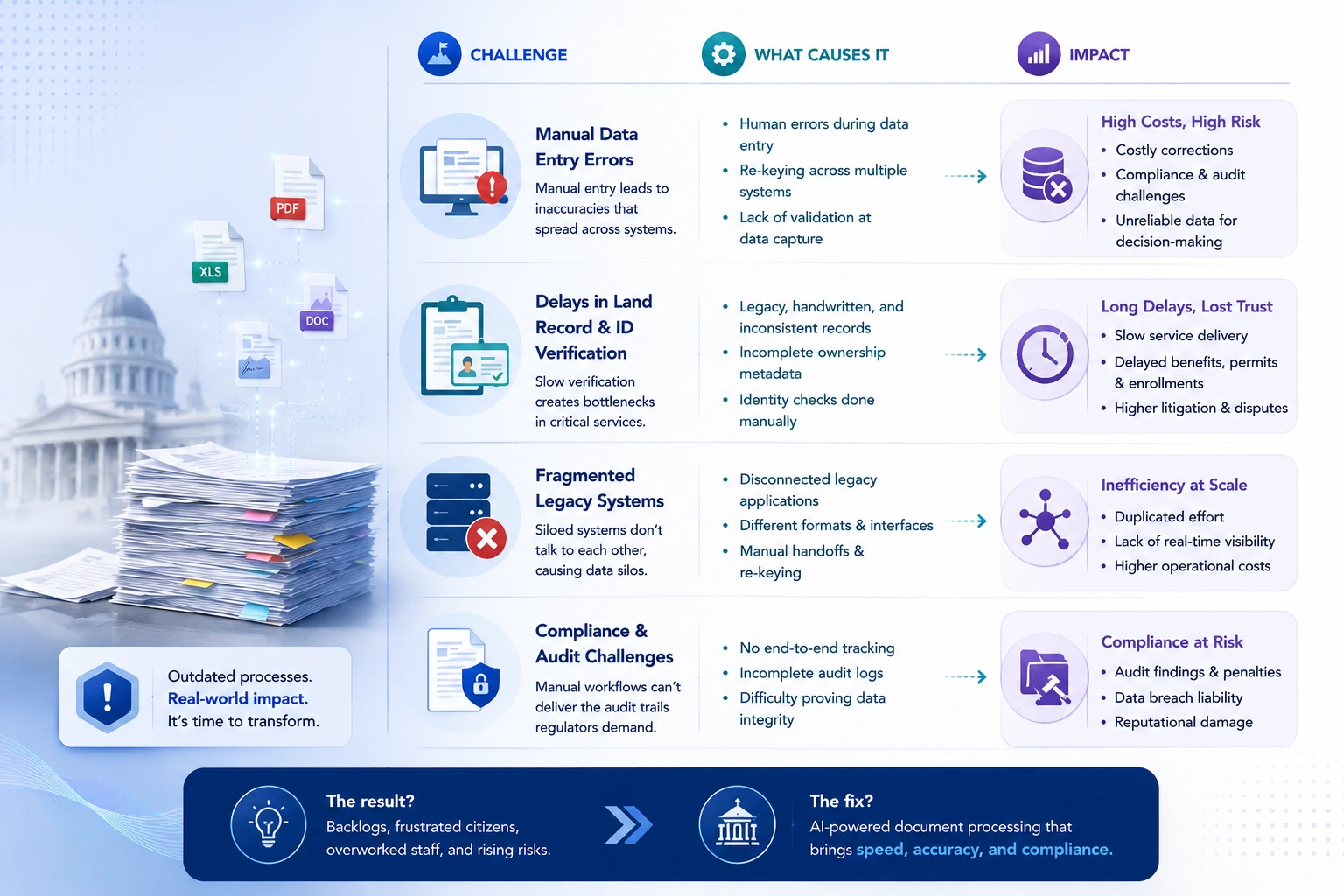
The issue with manual data entry isn’t just that people make mistakes. It’s that mistakes in document processing don’t stay local. A wrong field in a property tax record propagates through assessment systems, payment records, and dispute queues. By the time it’s caught, fixing it requires corrections in several places, each handled manually.
A 2025 study in the World Journal of Advanced Engineering Technology and Sciences found that AI-driven government document processing reduces processing time by over 70% while also improving regulatory compliance. Speed gets the headline, but accuracy is the actual ROI driver. Catching errors at the point of entry, rather than downstream, is where the real cost savings show up.
There’s also an audit dimension. FISMA and NIST frameworks require agencies to demonstrate that sensitive data was handled with documented integrity throughout its lifecycle. Manual processing produces an error trail that’s nearly impossible to reconstruct cleanly when auditors come asking.
These two document types cause more downstream problems than almost anything else in government document processing.
Land records are particularly messy. In India’s DILRMP digitization program, the blocking issue wasn’t getting records into digital format – it was validating them. Legacy entries often contain handwritten data, inconsistencies between records, and missing ownership metadata accumulated over decades. More than 60 percent of litigation in India involves land disputes, and a meaningful chunk of those trace back to record ambiguities that proper verification would have caught.
Identity verification failures are similarly costly. When someone’s identity proof can’t be confirmed, every downstream service – benefits, permits, enrollment – gets held up. AI-driven document validation that cross-checks submitted IDs against authoritative databases in real time is the fix. The cycle goes from days to seconds.
This is the one agencies don’t love talking about, but it’s usually the biggest actual obstacle.
Most government agencies have accumulated systems across multiple decades, none of which were designed to talk to each other. A benefits application that needs cross-verification against three separate agency databases? Each one lives in a silo, accessed through a different interface, managed by a different department. The manual workaround is phone calls, emailed requests, and re-keying data at every handoff.
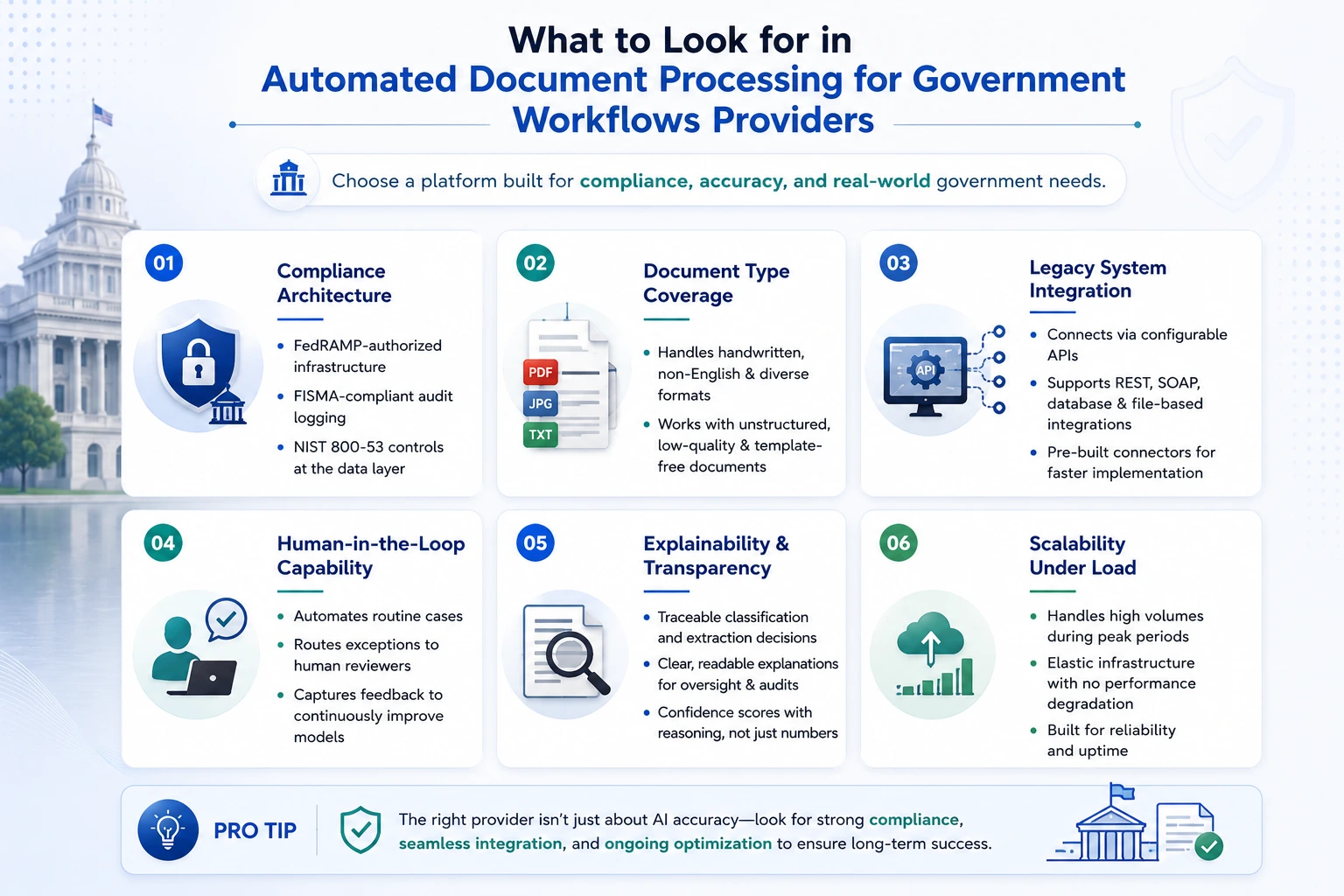
This is why government document processing services can’t just be evaluated on how well the AI reads documents. The integration architecture matters just as much. Can the platform connect to existing systems through configurable APIs without forcing a full system replacement? Does it operate within FISMA and FedRAMP security perimeters? That’s where the difficult conversations usually happen in procurement.
Understanding the mechanics helps when evaluating platforms and scoping implementations. The pipeline has three core stages.
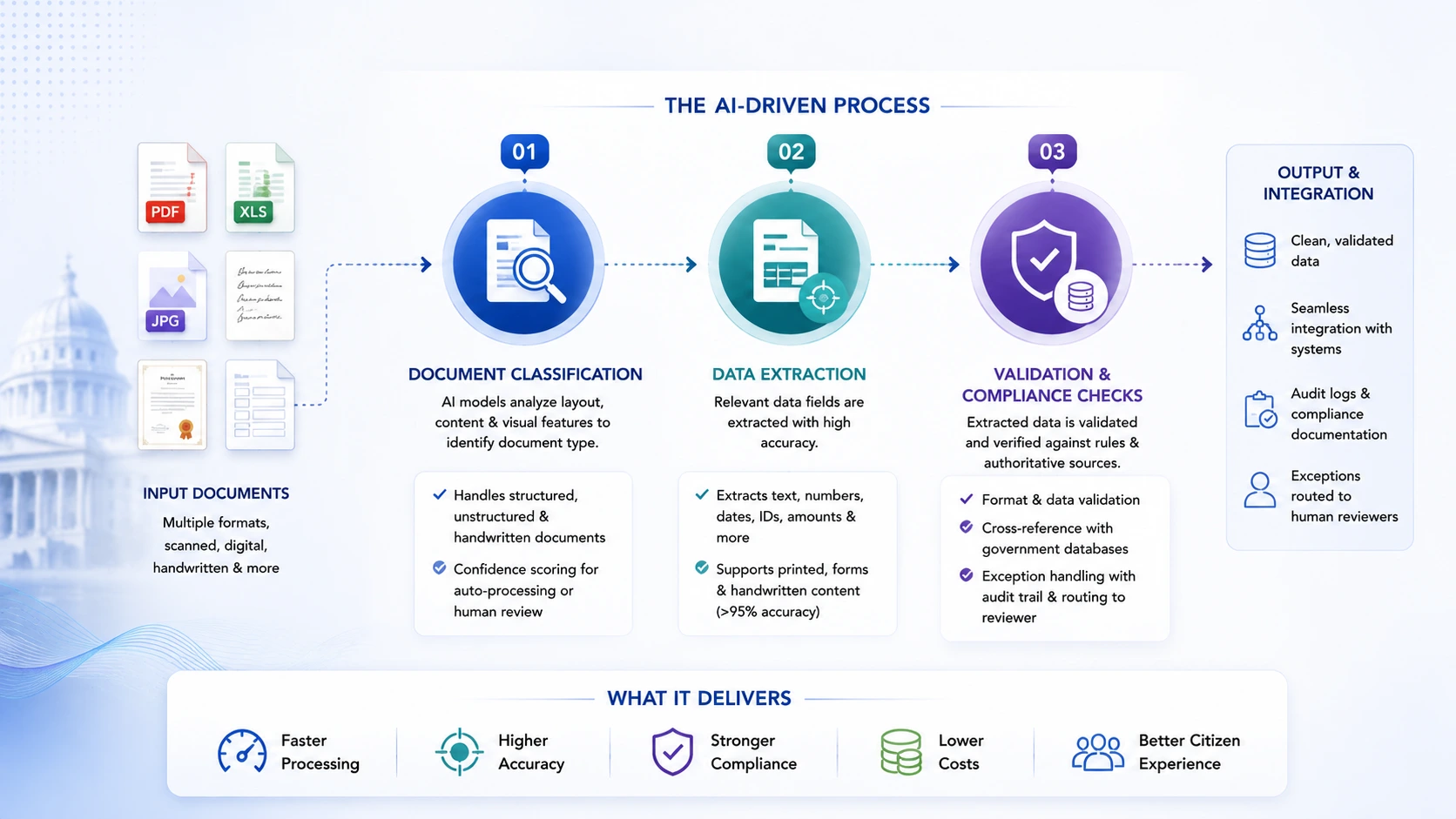
Before anything gets extracted, the system has to know what it’s looking at. A driver’s license is processed differently than a land survey, which is processed differently than a tax return.
Modern classification models use layout analysis, text content, and visual features to categorize documents – including handwritten ones, low-resolution scans, and formats that don’t follow any template. Once classified, a confidence score determines whether the document goes straight to automated extraction or gets routed to a human reviewer for a second look.
Government agencies receive documents from dozens of different issuing authorities across states and countries, each with its own format conventions. The classification layer has to handle that range without manual rule-writing for every new document type encountered.
Once a document is classified, the extraction layer pulls specific data fields – names, dates, addresses, ID numbers, dollar amounts – from both structured forms and unstructured narrative content.
V7 Labs reports that modern AI document processing systems regularly exceed 95% extraction accuracy for structured data. In government contexts, that accuracy matters because extracted data goes directly into decision systems: eligibility determinations, tax assessments, permit approvals. Extraction also handles handwritten content, which is non-negotiable for agencies processing older records or field-completed forms.
Pro tip: Human-in-the-loop (HITL) feedback loops are essential for maintaining extraction accuracy over time. Models that don’t incorporate correction data from human reviewers degrade as document formats evolve.
Extracted data still isn’t ready to act on until it’s been validated. Format validation checks that fields match expected patterns. Cross-reference validation matches extracted identity data against authoritative government databases. Compliance validation confirms that the document and its handling satisfy FISMA, NIST 800-53, and any sector-specific requirements.
When something fails validation – a missing field, a mismatch with reference records, a flagged inconsistency – the system generates a structured exception with a full audit trail, routes it to a human reviewer, and logs every decision in the chain. That exception-handling layer is actually what makes automated document processing for government workflows deployable in regulated environments. Getting documents read quickly is easy. Getting it done in a way that survives an audit is harder.
These aren’t conceptual. Each of the following represents an active deployment type with documented outcomes.
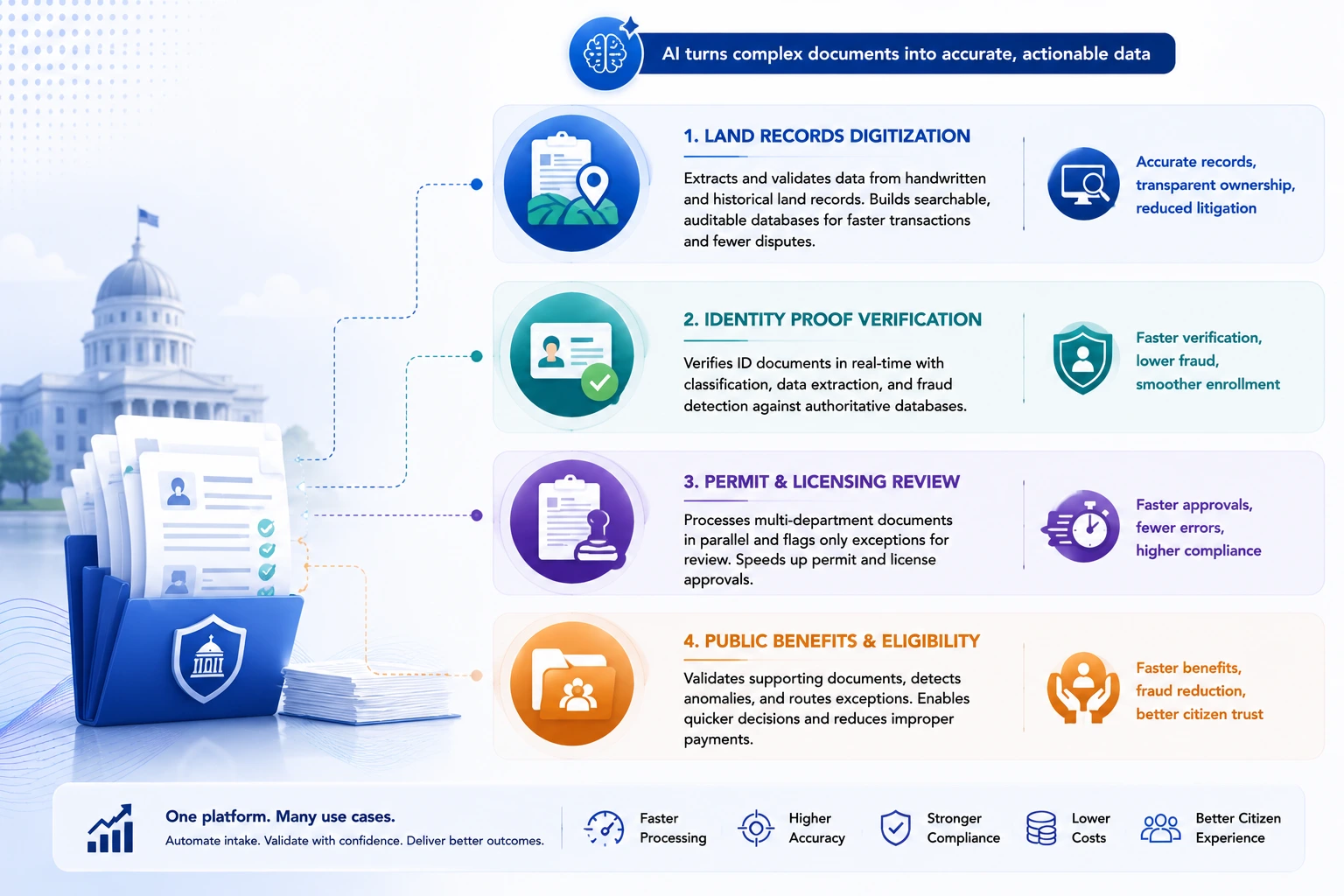
Land records combine almost every hard problem in document processing: handwritten historical entries, inconsistent formatting across decades, multiple issuing authorities, and serious legal consequences if a record is wrong.
AI-driven platforms treat this as a structured data transformation problem. Deep OCR and handwriting recognition models process the raw records. Extracted data gets validated against existing parcel and ownership databases. Anything that doesn’t reconcile cleanly gets flagged for legal review rather than auto-ingested and propagated. The result is a searchable, auditable land records database – the kind of system that makes property transactions faster, disputes less frequent, and tax assessments more accurate.
Covered California proved what real-time identity verification looks like at scale: upload a document, get a response in under five seconds, with classification and field extraction happening automatically. The enrollment experience changed. Call volume dropped. Processing throughput increased.
Behind that is a classification layer trained on the full range of acceptable identity document types – licenses, passports, state IDs, immigration documents – with parallel fraud detection running on every submission. Anomalous font patterns, metadata mismatches, and values that don’t match known issuing authority standards all get flagged before a record is accepted, not after.
A commercial construction permit can require documentation from half a dozen different agencies or departments. Zoning clearance, environmental sign-off, contractor licensing, insurance certificates – each is a different document type, validated against a different reference database.
Automated document processing for government workflows handles this in parallel rather than sequentially. Everything gets classified, extracted, and validated at the same time. Reviewers only see actual exceptions, with structured context pre-populated, instead of picking through a mixed stack of complete and incomplete applications. StateTech Magazine’s reporting on King County, Washington confirms that this pattern produces measurably faster response times and fewer downstream data errors.
Benefits applications – social security, unemployment, housing assistance – are document-intensive by design. Every claim requires verified income records, employment history, residency proof, and identity documentation. Under manual processing, the review chain creates backlogs. Some applicants wait months.
AI-driven IDP processes supporting documentation in parallel, validates it against reference databases, and pushes only genuine exceptions to human reviewers. Routine approvals that used to take weeks can be turned around in hours. The fraud angle is also meaningful: ML models trained on historical case data can spot patterns that suggest duplicate claims or fabricated documentation before a claim clears, not during a retrospective audit.
The case for automated document processing for government workflows isn’t hard to make when you look at what manual processing actually costs.
Not every IDP platform is actually built for government use. These are the questions worth asking before shortlisting:
Picking the right platform is half the job. The implementation partner is the other half, and in government document processing services engagements, it often matters more.
Government document workflows are not the same as commercial enterprise document workflows. A land records digitization project has different data governance requirements than a benefits processing automation project. The right partner understands those differences before the SOW is written, not after the first integration issue surfaces.
Things to look for:
The NineHertz is an AI-native engineering firm that brings its proprietary ContinuumAI framework to compliance-heavy, legacy-integrated environments – exactly the kind of operating context government document processing sits in.
The Build, Run, and Evolve model shapes how every engagement is structured:
The NineHertz has worked across healthcare, finance, and logistics – industries where compliance and data governance requirements are similarly unforgiving. That experience transfers. The same discipline that governs HIPAA-compliant health record extraction applies directly to FISMA-compliant benefits documentation processing.
For GovTech platform builders, The NineHertz works as a development partner to build the document intelligence layer that becomes part of your agency-facing offering. For agencies buying directly, the engagement runs from workflow assessment through production deployment and ongoing optimization.
Security comes from architecture, not from vendor assurances. The right baseline is FedRAMP-authorized cloud infrastructure, FISMA-compliant audit logging, and NIST 800-53 controls implemented at the data handling layer – not bolted on as an afterthought.
It depends on scope. A focused deployment – one document type, one well-documented system of record, clear validation rules – can reach production in eight to twelve weeks. Pre-trained models and template libraries have cut the cold-start time significantly for common document types.
Broader implementations covering multiple document types, multiple departmental systems, and complex cross-reference validation run six to twelve months, with phased workflow rollouts throughout that period.
Yes, but the integration layer needs to be built with government system constraints in mind.
Most legacy government systems predate REST APIs. They use SOAP-based web services, have data schemas that don’t map cleanly to modern document platforms, and sit inside network security boundaries that restrict external connectivity.
The outcomes from automated document processing for government deployments are real and documented. Covered California is confirming document types in under five seconds. The U.S. Treasury recovered over $4 billion in improper payments through AI-driven document validation in a single fiscal year. NARA is working through 13 billion paper documents with intelligent extraction. None of these are pilot programs anymore.
What separates agencies and GovTech platforms that actually get there from those that stay stuck in planning is usually one thing: architecture clarity. Not enthusiasm for AI, not a budget approval – a clear-eyed decision about what compliance requirements the platform needs to satisfy, which legacy systems need to connect, and what the first workflow to automate actually looks like.
The NineHertz builds that architecture through its ContinuumAI framework. Whether you’re a GovTech platform building document intelligence into your product, or an agency ready to move specific workflows from manual to automated, the starting point is a workflow assessment, not a sales pitch.
The backlog won’t clear itself. The question is whether you build the processing infrastructure to handle it – or keep adding to the queue.
Ready to map your document processing workflows to an AI-native architecture? Talk to the NineHertz team to start with a workflow assessment.

Key Takeaways Legacy grant management solutions have proved to be inefficient in handling ARPA, IRA, and BIL pressure as the…

Key Takeaways Government RFPs now score omnichannel service delivery as a single unified criterion – not channel-by-channel capability. Channel-by-channel development…