
Government RFPs are changing. And most GovTech ISVs are still submitting proposals built around an architecture that stopped winning three years ago.
The shift is not subtle. Procurement evaluators in 2025 and 2026 are no longer checking a box for digital channels. They are scoring proposals against structured omnichannel capability requirements – asking whether a platform can sustain a single, coherent citizen interaction across web portals, mobile apps, contact centers, and field offices simultaneously. If your platform stores a different version of the same citizen in each of those channels, you are not just losing points on the scorecard. You are losing the contract.
This is the omnichannel capability gap. It is not a UX problem or a design failure. It is an architectural one. At the center of that architecture sits the unified citizen record – a shared identity layer that persists across every channel, channel system, and data source in a government agency’s ecosystem.
This article explains what that architecture actually requires, why ISVs keep building around it instead of through it, what it costs when proposals lack it, and how GovTech platforms can add unified citizen record capability without tearing out the channel systems already in production.
Pro tip: If you are preparing a GovTech RFP response right now and your platform maintains per-channel data stores without a shared identity resolution layer, read the implementation section first. The gap is closeable in a single platform enhancement cycle – and the RFP timeline may not wait.
There is a reason omnichannel language now appears in the technical requirements section of government RFPs rather than the vision statement. Citizens are not tolerating channel silos the way they did a decade ago. They expect to start a benefits inquiry on a mobile portal, call a helpline to continue it, and visit an office to finalize it – all without repeating themselves. That expectation is not aspirational anymore. It is a procurement criterion.
The government AI market is growing from $22.41 billion in 2024 toward $98.13 billion by 2033 at a 17.8 percent compound annual growth rate, according to procurement intelligence tracked by Civic IQ. A significant portion of that growth runs through citizen engagement platforms – and agencies issuing those contracts have learned from early implementations that channel-by-channel investment does not produce omnichannel outcomes. They are now writing RFPs that say so explicitly.
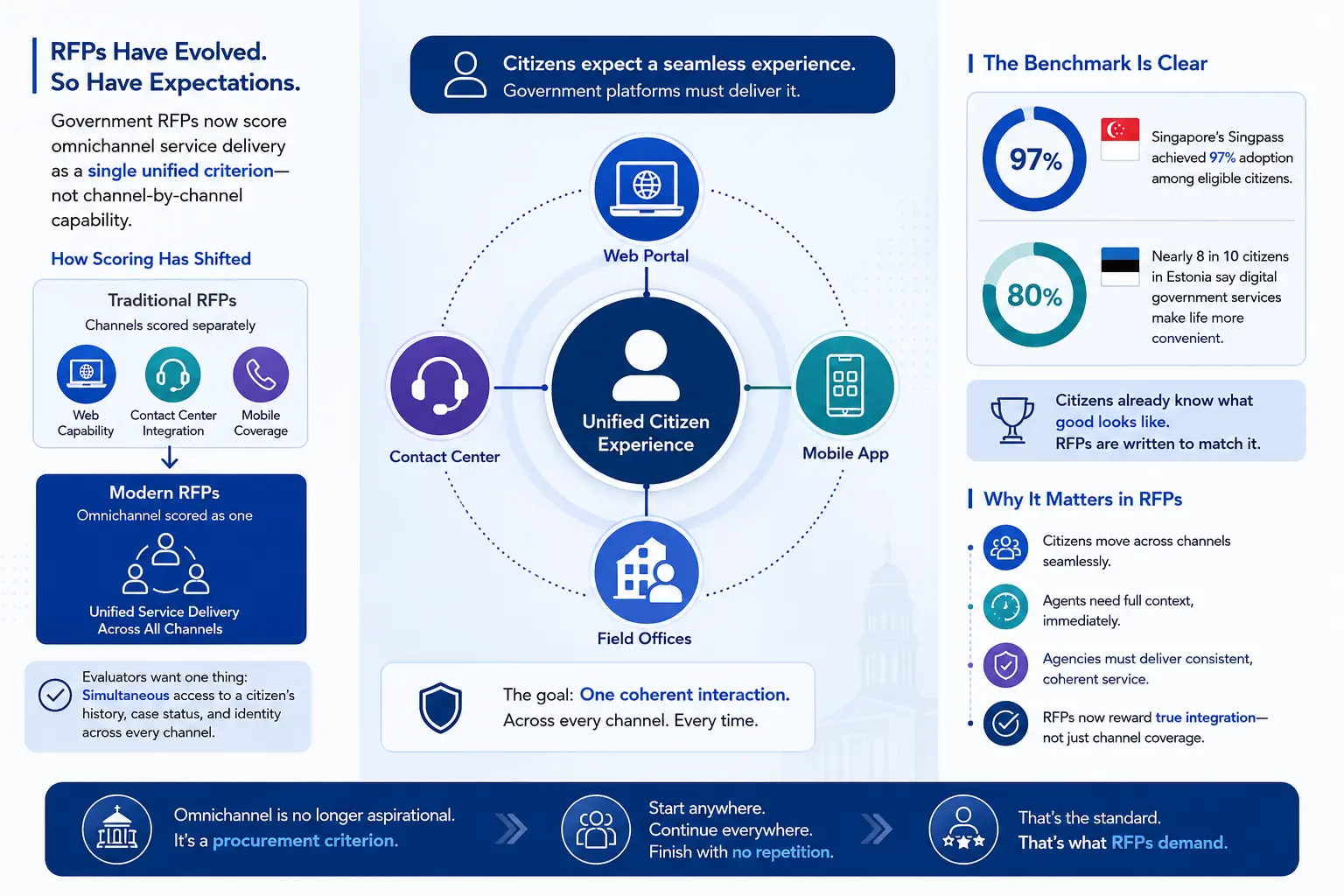
Traditional GovTech RFPs evaluated technical capability in parallel tracks: web self-service capability, contact center integration, mobile platform coverage. Each was scored separately, and a vendor that excelled in two of three channels could still win.
Modern RFPs score unified service delivery as a single criterion. Evaluators want to know whether a citizen’s interaction history, case status, and identity attributes are immediately available across every channel without data transfer, re-authentication, or caseworker lookup. The operational word is simultaneously. Not eventually – simultaneously.
This means the capability gap is not about which channels a platform supports. It is about whether those channels share a coherent identity layer underneath.
Singapore’s national digital identity platform, Singpass, reached 97 percent adoption among eligible citizens – setting a global benchmark for what integrated citizen identity can look like in practice. In Estonia, nearly eight in ten citizens say digital government services genuinely make life more convenient. These figures matter to procurement teams because they establish a standard. When citizens already know what good looks like, agencies cannot afford to procure platforms that do not match it.
That competitive context is now embedded in RFP requirements. The platforms that win are the ones that can show a shared citizen record – not a parallel set of channel-specific records that look unified from the front end but diverge the moment a caseworker touches the backend.
Most GovTech platforms did not set out to create fragmented citizen data. The fragmentation happened incrementally – one channel implementation at a time, each solving a real problem, each creating a new silo.
The pattern is consistent. A web self-service portal is built first, usually with its own user authentication and citizen profile store. A mobile application follows, often developed by a different team or vendor on a separate timeline, with its own database schema. A contact center integration comes next, connecting to neither the web nor mobile stores – instead reading from a legacy CRM or case management system that predates both. Field offices use a fourth system, usually a standalone case management or document management tool with its own citizen identifiers.
At the end of that development timeline, a single citizen who has interacted with the agency across all four channels has four records. Those records may share a name and a date of birth. They probably do not share an internal identifier. They almost certainly do not share an interaction history.
When that citizen calls a helpline about a web form they submitted last week, the contact center agent has no visibility into the web submission. When a field officer reviews the citizen’s case, they see a record that reflects the last field office visit – not the call or the web activity. Each channel is telling a different story about the same person.
This is not a hypothetical. It is the default architectural outcome when channel systems are built independently without a shared identity layer. And it is the condition that procurement evaluators are specifically designed to detect during technical evaluation.
Some platforms attempt to mask this fragmentation with a unified API layer – a facade that aggregates data from the four channel stores and presents a composite view on demand. The facade looks like a unified record on the surface. But beneath it, each channel system still maintains its own version of citizen truth. Updates in one channel do not propagate to others. Conflicts accumulate silently. The facade returns whichever version of the citizen each channel system happens to hold at query time.
Procurement evaluators who have seen this architecture before know what questions to ask. When they ask how updates to a citizen’s address in the mobile app propagate to the contact center system in real time, a facade-based architecture cannot give an honest answer.
The architectural gap is specific. It is not the absence of a unified front end. It is the absence of a shared identity resolution layer that sits below all channel systems and maintains a single authoritative citizen identity regardless of which channel a citizen uses to interact.
That layer has a formal name in enterprise data architecture: a Master Data Management (MDM) identity hub – or in the government context, a Unified Citizen Identity Graph. Its function is to resolve citizen identities across channel stores, deduplicate conflicting records, maintain a golden record for each citizen, and propagate updates to downstream systems in real time or near-real time.

Building a shared identity layer requires solving a genuinely hard problem: identity resolution across systems that were never designed to interoperate, using data that is inconsistently structured, variably complete, and often contradictory.
A citizen’s name might appear as ‘Robert Williams’ in the web portal, ‘Bob Williams’ in the contact center CRM, and ‘R. Williams’ in the field office system. Without identity resolution logic that can recognize these three strings as the same person – and that can do so at scale, across millions of records, with acceptable false positive and false negative rates – unification is not possible.
Most ISVs building GovTech platforms have not invested in that logic because it requires specialized capability that sits outside the core product roadmap. Web developers know how to build portals. Mobile engineers know how to build apps. Identity resolution at government scale requires a different skill set entirely.
Identity resolution across channel systems relies on two matching paradigms that serve fundamentally different purposes and should be used in combination.
Deterministic matching resolves citizen identity using trusted unique identifiers – national ID numbers, tax reference numbers, verified email addresses. When a trusted identifier appears in multiple channel systems with consistent values, deterministic matching joins those records with certainty. It is fast, auditable, and produces no ambiguity in the match decision. The limitation is that real-world government data frequently lacks consistent trusted identifiers across channels – citizens who created accounts before an identifier was required, records migrated from legacy systems without complete identifier fields, or channels that never collected a particular identifier at all.
Probabilistic matching addresses these gaps by calculating the statistical likelihood that two records represent the same citizen, based on a weighted combination of field similarities: name phonetics, address proximity, date of birth, and interaction pattern analysis. A citizen named ‘Bob Williams’ in one system and ‘Robert Williams’ in another may not have a shared national ID number across both records, but a well-tuned probabilistic model can flag them as a likely match for human review or automated consolidation based on the weight of combined evidence.
England’s Hospital Episode Statistics Identifier system illustrates what the right combination achieves. A purely deterministic approach left a missed match rate of 8.6 percent across millions of patient records in 1998. Adding a probabilistic matching pass brought that error rate down to 0.4 percent by 2015 – an order-of-magnitude improvement that directly affected service quality and administrative overhead. Government citizen identity resolution operates under the same constraints and benefits from the same solution.
Pro tip: The safest production architecture applies deterministic matching first for all records where trusted identifiers exist and are consistent, then runs a probabilistic pass over the remainder. This keeps the computationally expensive inference work focused on the records that actually need it, reducing both processing cost and false positive risk.
The business case for unified citizen record architecture has two components: procurement outcomes and operational efficiency. Both carry quantifiable costs when the architecture is absent.

RFP evaluations are structured around weighted criteria. When omnichannel service continuity is a scored criterion – which it increasingly is in modernization-focused government procurements – a platform that cannot demonstrate unified citizen identity is competing at a structural disadvantage. The gap does not reduce the score by a few points. It eliminates the ability to score on an entire criterion category.
For ISVs competing in GovTech markets where average contract values run from $25,000 per year for small agencies to $100,000 or more for mid-market implementations, a capability gap that consistently removes a platform from consideration in omnichannel-weighted RFPs represents a compounding revenue loss. Each missed contract is also a missed reference customer – and government procurement heavily weights past performance.
Inside agencies that have already deployed channel-siloed platforms, the operational cost of fragmented citizen records falls primarily on caseworkers. When a citizen’s record does not automatically carry interaction history across channels, caseworkers perform that reconciliation manually – searching multiple systems, comparing fields, resolving discrepancies, and then re-entering consolidated information.
Organizations using more than three identity verification or data management vendors experience a 20 percent higher rate of false positives and a 15 percent increase in operational costs compared to those using a unified platform, according to research by Forrester. In government service delivery, false positives in citizen identity translate directly to incorrect case decisions, duplicated benefit payments, and compliance failures.
Fragmented identity systems across organizations cost an average of $3.78 million annually in administrative overhead and system management inefficiency. That figure was measured across enterprise IAM environments generally – government agencies managing high-volume, multi-channel citizen interactions face comparable or higher costs depending on case complexity and caseload volume.
Pro tip: When building a business case for unified citizen record investment internally, the caseworker time calculation is often more compelling to agency leadership than the architectural argument. Quantify the average time a caseworker spends reconciling citizen records across systems per case, multiply by caseload volume, and translate to FTE cost. The result typically justifies the platform investment within a single budget cycle.
A unified citizen record is not a feature. It is an architectural outcome produced by four interconnected components that must work together to maintain a coherent citizen identity across a multi-channel government platform.

The identity graph is the foundational data structure. It stores citizen identities as nodes and channel-specific records as associated attributes. When the same citizen appears in multiple channel systems, the graph links those channel records to a single identity node rather than maintaining parallel identity objects. Updates to any attribute in any channel propagate through the graph to associated records.
The graph must persist across sessions and transactions, survive system updates and migrations, and scale to the full citizen population the agency serves. For state-level government platforms, that scale routinely means tens of millions of records with complex update patterns and strict data residency requirements.
The resolution engine processes new and updated records against the identity graph using a hybrid of deterministic and probabilistic matching logic. Deterministic rules handle records with consistent trusted identifiers. Probabilistic models handle the remainder, producing match probability scores and routing low-confidence matches to a human review queue rather than auto-merging.
The resolution engine must be configurable – different government agencies have different trusted identifier standards, different data quality baselines, and different risk tolerances for false positives. A benefits eligibility system cannot tolerate false positive identity merges that result in consolidated case histories for two different citizens. A contact center platform may accept a higher false positive rate in exchange for better first-call resolution. The engine configuration must reflect those tradeoffs explicitly.
The event synchronization layer guarantees that events occurring in any channel are captured in the citizen’s record in real time or near real time. If a citizen changes their address with the mobile app, the change should be synced to the contact center system before the next call comes through – not at the next overnight batch sync cycle.
This means the system must be integrated using an event-driven method, not through the batch ETL pipelines that most traditional channel integrations are based on. The synchronization layer varies based on the channel systems exposed, such as API gateway patterns, event streaming platforms, and change data capture mechanisms.
Unified citizen records concentrate PII in ways that channel-siloed architectures do not. A single record linking a citizen’s health, benefits, tax, and licensing interactions across multiple agencies carries significantly higher data sensitivity than any single channel record.
The governance layer must enforce attribute-level access controls – ensuring that a contact center agent can see interaction history relevant to their service function without accessing medical or financial records outside their authorization scope. It must maintain complete audit trails for every access and modification event. And it must support data subject access requests and right-to-erasure workflows, which become considerably more complex when a citizen’s record spans multiple agency systems through a shared identity graph.
The architectural path that works in practice – and that fits within the budget and risk tolerance of a platform enhancement rather than a platform replacement – is to add a shared identity layer on top of existing channel systems rather than replacing those systems.
This approach treats each channel system as an authoritative source for its own interaction data while the unified citizen record layer sits above them, resolving identities across sources and maintaining the golden record. Channel systems continue to function independently for their core use cases. The shared layer makes them interoperable without requiring changes to their internal data models.
The NineHertz applies the Unified Citizen Record Architecture (UCRA) framework to GovTech platform enhancement engagements. The framework sequences implementation across four phases, each delivering standalone operational value while building toward full omnichannel capability.
| Phase | Objective | Deliverable |
|---|---|---|
| 1: Identity Inventory | Map all citizen-bearing data stores across channel systems and identify existing identifier overlap | Channel data dictionary and identity surface area report |
| 2: Resolution Engine Build | Deploy hybrid deterministic/probabilistic matching engine with agency-configured thresholds and human review queues | Identity resolution pipeline processing existing record population |
| 3: Golden Record Establishment | Build unified citizen identity graph from resolved records, establishing master identity nodes and channel record associations | Production identity graph with conflict resolution audit trail |
| 4: Real-Time Synchronization | Implement event-driven update propagation from channel systems to identity graph and downstream consumer systems | Live unified citizen record accessible across all channel touchpoints |
The synchronization architecture differs depending on what each channel system exposes. Web portals built on modern frameworks typically support webhook or API-based event publishing. Mobile platforms may require SDK-level instrumentation. Legacy contact center CRMs often support only batch export or database-level change data capture. Field office systems range from modern case management APIs to file-based exports on a fixed schedule.
A production UCRA implementation must accommodate all of these integration patterns simultaneously. The identity graph layer acts as the normalization point – consuming updates from each channel in whatever format that channel supports and maintaining the unified record regardless of update latency differences between channels.
Pro tip: Start the identity inventory with whichever channel system has the cleanest and most complete citizen identifier data – usually the primary web self-service portal or the main case management system. Use that channel as the deterministic anchor for initial identity graph population, then layer in the other channels using probabilistic matching against the established nodes. This sequencing reduces the cold-start problem in identity resolution and produces a higher-quality initial graph.
Platform enhancement investments in government technology need to produce measurable outcomes that procurement teams, agency leadership, and finance offices can evaluate. A UCRA rollout generates metrics across three categories: record quality, service continuity, and operational efficiency.
| Metric | Target Benchmark |
|---|---|
| Duplicate citizen record rate | Below 2% of total population |
| Identity resolution confidence score (mean) | Above 0.85 |
| Manual review queue clearance time | Under 48 hours average |
| Cross-channel record consistency rate | Above 98% for core attributes |
| Golden record coverage | 95%+ of active citizens within 90 days |
Service continuity metrics measure whether the unified citizen record is actually improving the citizen experience across channels – the operational outcome that RFP evaluators are ultimately trying to procure.
The operational efficiency metrics translate the platform capability into agency budget and staffing terms – the language that influences renewal decisions and expansion contracts.
The NineHertz is an AI-native engineering firm that delivers platform modernization through its Build, Run, and Evolve framework – a structured engagement model that treats unified citizen record capability as a platform enhancement rather than a replacement initiative.
For GovTech ISVs competing on omnichannel-weighted RFPs, the challenge is not understanding the architecture. It is building the identity resolution and synchronization infrastructure fast enough to be competitive in the next procurement cycle, without disrupting the channel platform that existing agency clients depend on.
In the Build phase, The NineHertz engineering teams run the identity inventory and resolution engine deployment – the first two phases of the UCRA framework. ContinuumAI, the firm’s proprietary AI orchestration infrastructure, accelerates the matching model configuration and calibration work that typically takes GovTech teams multiple months to complete manually. The result is a production-ready identity resolution pipeline calibrated to the agency’s specific data quality baseline and false positive tolerance.
The Run phase covers the golden record establishment and initial synchronization deployment – bringing the unified citizen identity graph into production and connecting it to existing channel systems through the appropriate integration patterns. The NineHertz operates the synchronization infrastructure during this phase, providing the monitoring and incident response capability that in-house GovTech teams often cannot sustain alongside active product development.
The Evolve phase extends the unified record capability as the platform adds channels, agencies, or service domains. When an ISV client wins a new contract that requires integration with a previously unsupported channel system, the UCRA architecture absorbs the new channel without requiring changes to the identity graph structure or the existing synchronization layer.
For GovTech ISV teams actively preparing RFP responses, the practical outcome of a UCRA enhancement is a demonstrable capability answer to the questions procurement evaluators are now asking.
Can your platform maintain a consistent citizen record across the web portal, mobile app, and contact center simultaneously? Yes – through a unified identity graph that receives real-time updates from each channel.
How does an address update in the mobile app propagate to the contact center system? Through an event-driven synchronization layer that pushes the update within minutes of the originating transaction.
How do you handle citizen records that exist in multiple channels under different identifier schemes? Through a hybrid identity resolution engine that applies deterministic matching on shared identifiers and probabilistic matching on demographic attributes, with human review queues for low-confidence cases.
These are answerable questions. A platform without UCRA cannot answer them.
The gap between where most GovTech platforms are today and where omnichannel RFP requirements place the bar is real. But it is a specific, addressable gap – not a fundamental platform rebuild.
The decision point is whether to close that gap before the next RFP cycle or after it. Closing it before means investing in the identity inventory and resolution engine now, during a period when the enhancement can be completed without the deadline pressure of an active procurement. Closing it after means waiting for a lost contract to create the urgency, then attempting to build under pressure while competing against platforms that already have the capability.
The sequence that works is straightforward. Run the identity inventory across your existing channel systems. Quantify the duplicate record rate and the cross-channel inconsistency volume. Build the resolution engine against your actual data profile rather than a hypothetical one. Establish the golden record population using your highest-quality channel as the deterministic anchor. Then connect the synchronization layer to your channel systems in order of integration complexity – starting with the channel that supports the cleanest API surface.
That sequence produces a demonstrable unified citizen record capability. It produces the capability before the next RFP evaluation. And it produces the kind of architectural depth that procurement evaluators who understand the problem can distinguish from a facade.
Pro tip: The identity inventory is the highest-value first step because it often reveals the specific field and identifier gaps that are driving your current RFP scores down. Running it before starting the resolution engine build ensures the engine is configured against your actual data reality rather than an idealized model that will not perform on production data.
You do not need to rebuild your platform to win omnichannel RFPs. You need to add a shared identity layer that sits above your existing channel systems and maintains a coherent citizen record across all of them.
That layer has four components: an identity graph, a resolution engine, a synchronization layer, and a governance framework. Each is buildable as a platform enhancement on top of your current architecture. The UCRA framework sequences the build across four phases, each of which delivers standalone operational value to your existing agency clients while moving toward full omnichannel capability.
The investment pays back through two mechanisms: better RFP scores in omnichannel-weighted procurements, and reduced caseworker overhead at agencies that are already your clients. Both are quantifiable. Both are achievable within a single platform enhancement cycle.
The RFP evaluators writing the omnichannel requirements that are currently scoring your proposals down understand the problem. They know what a facade looks like. The platform that wins is the one that can show the real architecture underneath – and that architecture starts with the unified citizen record.
On a government RFP, omnichannel means a citizen’s interaction history, identity, and case context are immediately accessible to any service agent or system regardless of which channel the citizen used previously. It does not mean supporting multiple channels. It means those channels share a single, continuously updated citizen record – so a caseworker handling a phone call can see what the citizen submitted online that morning without switching systems or running a manual lookup.
Deterministic matching resolves citizen identity using trusted unique identifiers – national ID numbers, verified email addresses, tax reference numbers – where an exact match confirms two records represent the same citizen with certainty. Probabilistic matching applies weighted statistical models to estimate whether two records represent the same citizen when shared identifiers are absent or inconsistent, using combinations of name phonetics, address proximity, date of birth, and behavioral signals. Production-grade citizen identity resolution uses both: deterministic matching processes records with reliable shared identifiers, and probabilistic matching handles the remainder. Using only one approach leaves a portion of the record population either unresolved or incorrectly merged.
Yes. The UCRA framework adds a shared identity layer above existing channel systems rather than inside them. Each channel system continues to function independently for its core service function. The identity graph layer resolves identities across channel stores and maintains the unified record, consuming updates from channel systems through whatever integration pattern each system supports – API events, change data capture, or batch export. Channel systems do not need to be modified to support the unified record. They need to expose their update events to the synchronization layer, which most modern and semi-modern systems can do without significant re-engineering.
A unified citizen record concentrates PII across service domains in ways that channel-siloed records do not, which requires more granular access controls rather than looser ones. The governance layer of the UCRA architecture enforces attribute-level permissions – a contact center agent authorized to see service interaction history cannot access health or financial records from other agency systems through the same identity node. Every access and modification event is logged in a tamper-evident audit trail. Data subject access requests and right-to-erasure workflows operate against the identity graph directly, ensuring that all channel records associated with a citizen identity are included in the response or erasure scope – something that channel-siloed architectures typically cannot guarantee.
Omnichannel capability is no longer a differentiator in GovTech RFPs. It is a threshold requirement. Platforms that cannot demonstrate a unified citizen record architecture are not competing for a different tier of contract – they are being disqualified from the contracts that drive long-term GovTech revenue.
The unified citizen record is a buildable, demonstrable, measurable platform capability. The architecture is understood. The implementation sequence is proven. The measurement framework is ready. What separates platforms that win omnichannel RFPs from those that do not is whether the shared identity layer exists in production – not in the proposal, not in the roadmap, but running against real citizen data.
The NineHertz works with GovTech ISVs to build that capability through the UCRA framework – using the Build, Run, and Evolve model and ContinuumAI infrastructure to accelerate identity resolution deployment and platform integration without disrupting existing agency clients.
The next procurement cycle will not wait for your roadmap. The unified citizen record needs to be in production before the RFP lands.
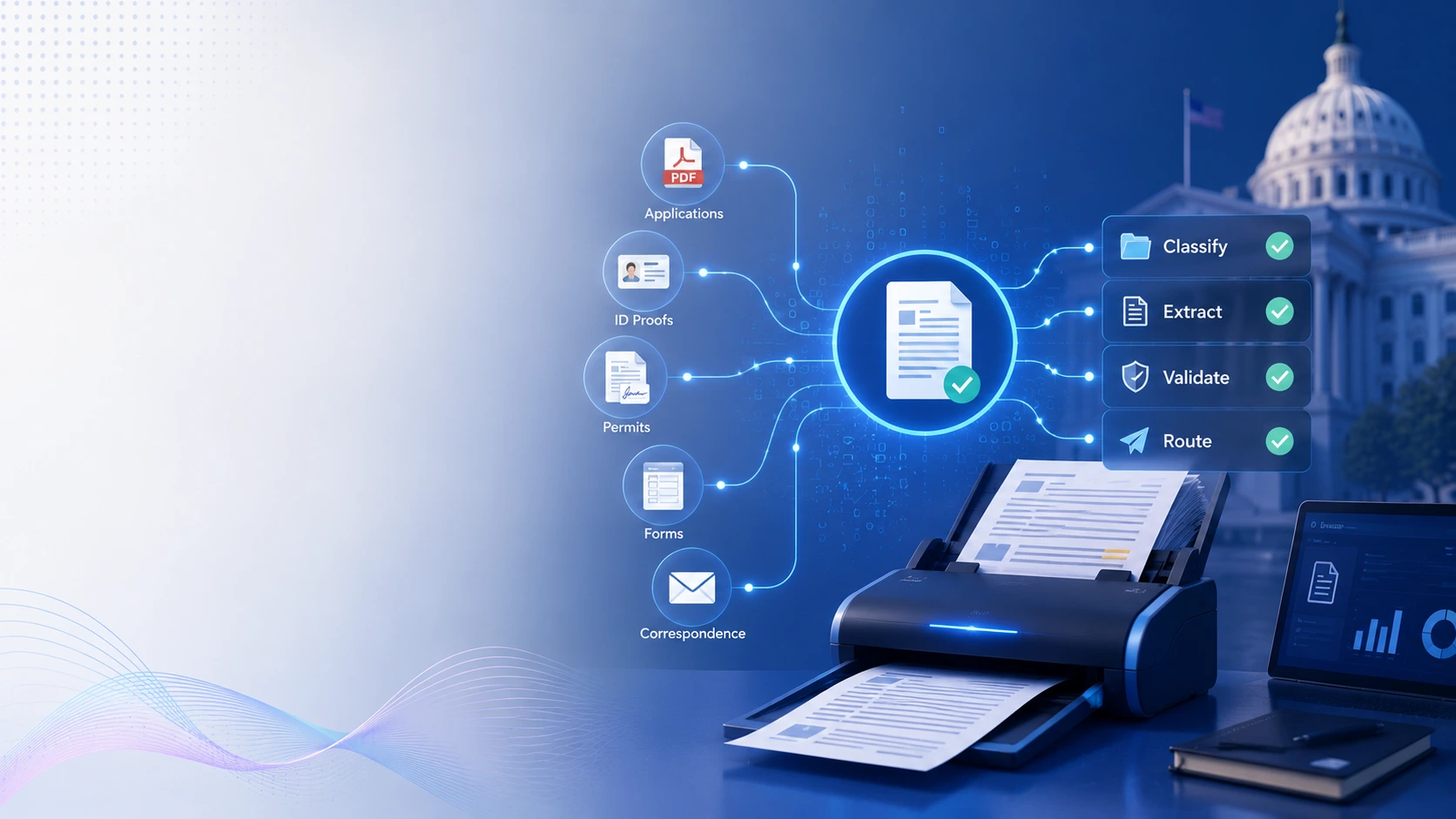
Key Takeaways Automated document processing for government refers to the use of AI, NLP, and ML to classify, route, and…

Key Takeaways Legacy grant management solutions have proved to be inefficient in handling ARPA, IRA, and BIL pressure as the…