An offshore team can work very efficiently or inefficiently depending on whether the engagement model matches the actual need. If you choose the wrong model at the beginning, problems show up later as missed deadlines, unclear ownership, or deliverables that don’t match expectations. The cost of that mistake is going to compound with every quarter as long as the wrong model stays in place.
Most enterprises fail at offshoring not because of bad talent but because they pick the wrong engagement model for the problem they actually have.
A CTO hiring for a 6-month sprint and a CTO building a 200-person captive center are solving different problems. But many companies apply the same model to both. The result shows up later as budget overruns or delivery delays.
Staff augmentation vs. dedicated ODC vs. BOT is the decision enterprises get wrong most often. This happens because they choose the model based on cost alone, without weighing control or scalability needs.
So, we’re going to show you a decision-making framework called the Offshore Engagement Model Selection Matrix that makes this decision more measurable than instinctive. OEMSM is a 5-dimensional framework that scores your business against factors that actually determine the right fit.
In this article, we’re going to break down all three engagement models, what they are, and where each one wins. You’ll also have a glimpse of the real cost of choosing the wrong model and a side-by-side comparison of all the models along with the OEMSM framework. By the end, you will get an idea about how to match the model that aligns with your budget and scaling target.
Each offshore engagement model is built for a different level of ownership and long-term intent. The right choice for your business depends less on “Do I need developers?” and more on “What kind of relationship do I want with the offshore setup over time?”
Staff augmentation vs. dedicated ODC vs. BOT each serve different businesses, and choosing the right one among them requires understanding what these models are structurally designed for.
If you want fast capacity without building a new organizational layer, staff augmentation is the right fit for you. But if you want a stable offshore engineering hub, ODC fulfills your requirements.
Here’s a detailed breakdown of all three models before we go deeper into each one of them.
The right offshore engagement model depends on control and ownership rather than just cost savings.
| Dimension | Staff Augmentation | ODC | BOT |
|---|---|---|---|
| Operating Model Maturity | Low to medium; works as an extension of your existing team | Medium to high; a more structured offshore delivery setup | Designed to evolve from partner-led to client-owned operations |
| Knowledge retention | Mostly stays with individuals | Better shared across a dedicated team | Strongest, because processes are designed to transfer into your organization |
| Vendor dependency | High for people availability, low for delivery model | Medium, as you rely on the partner for team management | Starts high, then decreases after transfer |
| Strategic fit | Tactical resourcing gaps | Product engineering and ongoing delivery | Market expansion, capability building, and eventually insourcing |
Staff augmentation allows enterprises to extend their existing teams with external developers or engineers on demand without the need for full-time hiring.
The staff augmentation services helps you handle project surges or teams that need a capability without long-term headcount commitment. Contracts are hourly or monthly, with no infrastructure or setup costs.
A dedicated ODC is a long-term offshore team built exclusively for one client and operates under the client’s processes and delivery standards. But the setup is housed and managed by the vendor.
Unlike staff augmentation, a dedicated ODC functions as an integrated extension of the client’s in-house team, with shared goals and defined governance. It is designed for ongoing product development and not for short-term project leverage.
If you want a permanent product team in an offshore location, an ODC gives better control and steadier economics over time.
The Build-Operate-Transfer model is a three-phase structure in which a vendor sets up and runs an offshore team on the client’s behalf, then transfers full ownership to the client at an agreed-upon milestone.
The BOT model is designed for enterprises that want eventual control of a captive center without absorbing the upfront setup risk. This works best for companies that want eventual ownership, so it trades early simplicity for long-term control and asset transfer.
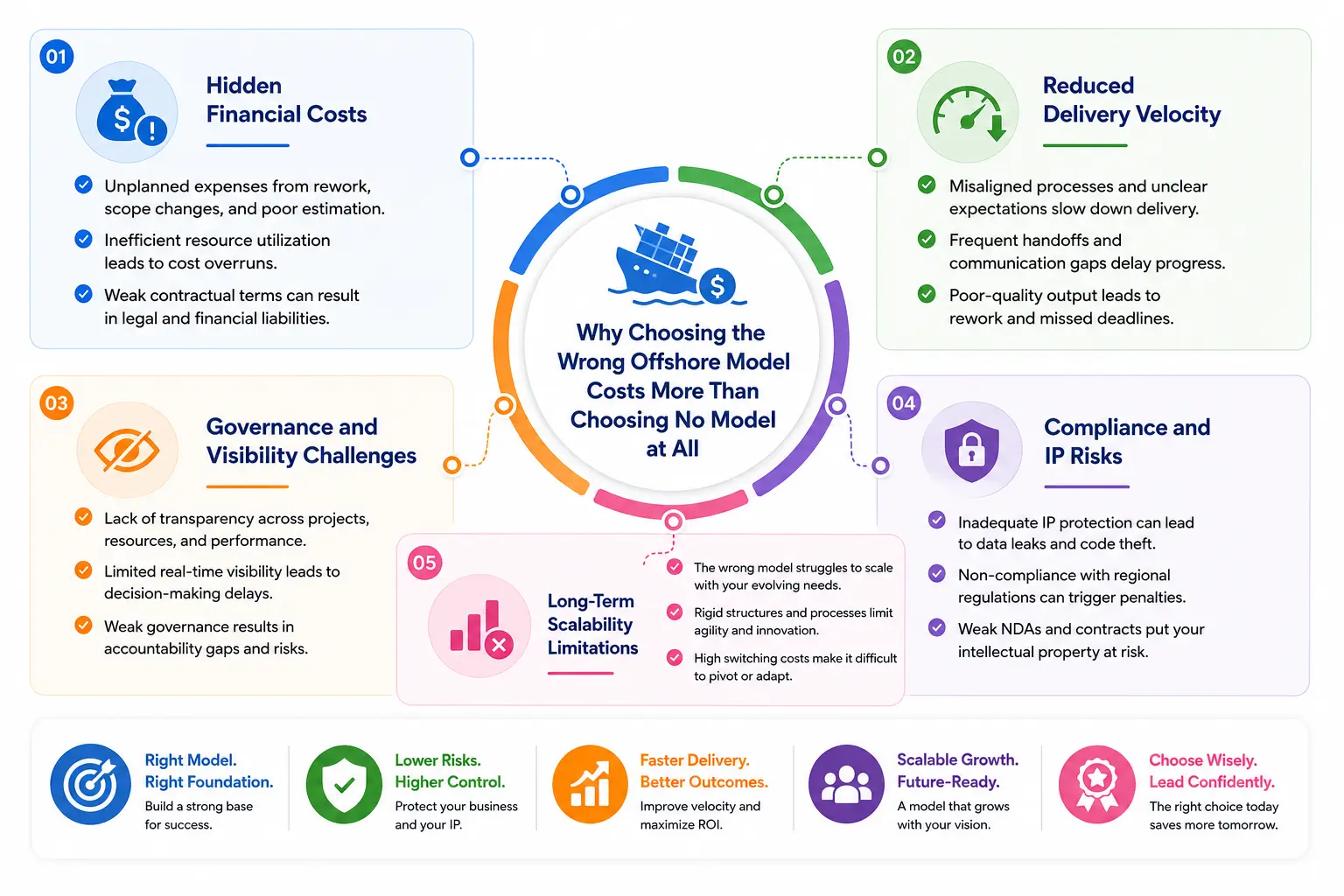
A mismatched engagement model not only under-delivers but also actively creates costs that wouldn’t exist if the work had stayed in-house. Here’s where enterprises feel it most.
Deloitte’s 2024 outsourcing survey shows cost reduction remains an important reason to choose offshore development besides talent and agility. When you make wrong decisions about the offshore engagement model, the financial damage shows up as extra spending around the project, and not just in the contract price. These costs include redundant vendor fees, rework, delays, extra management effort, and the cost of changing course after the work has already started.
A model misaligned with how a team actually operates slows everything down. When you choose a staff augmentation model for long-term product development, it creates constant onboarding cycles.
A BOT structure works best when you are building a long-term offshore capability. But if you apply it to a short sprint, you spend too much time on setup and transfer planning for work that ends quickly. In both cases, the model itself becomes part of the problem because the process overhead does not match the duration or complexity of the work.
When an offshore setup is not built with the right oversight, the reporting structures become clumsy, and accountability falls between the cracks. Due to this, the client can’t easily see what the offshore team is working on and how much progress has been made. This is especially true in staff augmentation arrangements that scale beyond their original scope without a governance layer to match.
Engagement models carry different levels of IP protection. Different outsourcing setups can expose you to various types of ownership risks around the project.
The risk gets worse when multiple vendors contribute to the same codebase, because it becomes harder for you to prove who created what and under which agreement. If ownership is ambiguous, a company can run into problems when it wants to audit the codebase or enforce confidentiality.
A model chosen for today’s team size rarely scales to tomorrow’s requirements. Companies that start with staff augmentation and delay transitioning to a Dedicated ODC, the model stops working well beyond a certain size or complexity.
If the business expects the team to expand and stay important over time, it needs a more structured operating model earlier.
When evaluating staff augmentation vs. Dedicated ODC vs. BOT, Staff augmentation is the most widely adopted offshore engagement model. It is also the most frequently misapplied one. Understanding how staff augmentation is structured helps enterprises deploy it where it actually delivers value.
The client defines the role and skill requirements, and the vendor takes up the responsibility to source, vet, and contract the talent. Once onboarded, augmented staff work directly under the client’s project management and delivery structure. The vendor remains the legal employer and handles everything from payroll to compliance. The client owns day-to-day direction and output accountability.
Nearly 74% of enterprises around the world are utilizing staff augmentation to overcome skill gaps. Staff augmentation delivers speed and flexibility that no other model matches at the entry level.
The model’s flexibility is also its structural weakness. Augmented teams are not permanently tied to your company, so when a contract ends, the people and context may leave too. If there is no strong onboarding, documentation, and management layer, the company keeps paying the “learning tax” every time people change or projects shift. That makes delivery less efficient, and the model starts to break down eventually.
Staff augmentation works best when the requirement is specific and time-bound. A few scenarios where the staff augmentation model fits well:
Staff augmentation usually has a variable and people-based cost structure. You pay by hour or day per resource, and the total cost depends on role seniority, location, or their tech stack. Hourly rates range from $25 to $200 per hour, while monthly resource pricing can range from about $3,500 to $15,000 per developer.
Staff augmentation is one of the fastest models to launch because the vendor is supplying pre-vetted people rather than building a whole operating center. Onboarding usually takes a few days to a few weeks. But the model may become inefficient if it is stretched beyond temporary support.
If your company is thinking about long-term product development, the decision is no longer about filling immediate staffing gaps. You have to choose a model that gives you stable team ownership and stronger process control. A dedicated offshore development center is usually more suitable in such cases, as it preserves knowledge and standardizes delivery.
A dedicated ODC operates as a fully integrated offshore unit and is structured around the client’s tech stack and delivery methodology. The vendor provides the infrastructure, HR, and compliance framework, but the client directs the product team and delivery outcome. Teams follow the client’s way of working and coordinate through weekly syncs and shared tools.
The dedicated ODC model builds institutional knowledge that staff augmentation cannot. The same team works on the same product over months and years, compounding context with every sprint. Enterprises also benefit from lower costs for long-term resources compared to the augmentation model.
A Dedicated ODC requires more upfront investment in onboarding and governance design than most enterprises anticipate. The model also demands consistent management attention from the client side so that teams have outcome ownership instead of just executing tasks. Companies without internal bandwidth to manage a distributed team will struggle here.
Do you know who benefits most from a Dedicated ODC model? It is suitable for organizations that have an extended product roadmap. But if a company only needs a few extra developers for one release, this model would be too heavy.
SaaS companies scaling engineering capacity, FinTech firms building regulated platforms, and digital-native enterprises managing multiple product lines are among the strongest fits for this model.
Dedicated ODC pricing is structured as a fixed monthly team cost that covers salaries and vendor management fees along with infrastructure costs. ODC pricing is more predictable than many other outsourcing setups, as you are paying for actual team compensation and operational fees rather than defined hours.
This model takes longer to launch than staff augmentation because you are setting up a real operating unit.
Enterprises that have worked through the Staff Augmentation vs. Dedicated ODC vs. BOT decision and landed on BOT are making a long-term bet. They are not just looking for offshore delivery, but for full ownership of an offshore entity. It is the most structurally complex of the three models, and also the one with the highest long-term ceiling.
Build-Operate-Transfer model is a step-by-step way of creating an offshore center that the client eventually owns. The “Build” in the BOT model indicates that the vendor sets everything up from scratch, including the team, office or remote infrastructure, and legal processes. The vendor runs the center for a set period while the client gradually gets more involved in the operation phase.
BOT eliminates the two biggest barriers to captive center ownership: upfront setup risk and operational learning curve. The vendor absorbs both during the Build and Operate phases, giving the client time to build internal capability and governance confidence before taking ownership. BOT model provides the lowest-risk path to a fully controlled offshore entity.
BOT commitments are long, and that is the primary risk. If business priorities shift mid-engagement, unwinding a BOT structure is more complex than dissolving a staff augmentation or ODC contract. Vendor dependency during the operating phase also means clients must negotiate clear SLAs and transfer conditions upfront, before the contract is signed.
BOT works best for large enterprises and Fortune 500 organizations planning to establish a permanent offshore presence in markets like India, Eastern Europe, or Southeast Asia. It is particularly well-suited for companies with long product horizons and high compliance requirements.
The BOT model needs the highest upfront investment of the three models. In many commercial BOT engagements, the operating period is around 18 to 36 months. The ownership transition happens at the end of the agreed period. This is why the BOT model is used when a company wants long-term offshore capability but prefers not to take the risk at the initial stages.
Each model has a different structural logic, and the right choice depends on where your business is today versus where it needs to be in three years. Here’s how they differ across the dimensions that matter most.
| Criteria | Staff Augmentation | Dedicated ODC | BOT |
|---|---|---|---|
| Control | Managed by Client | Shared | Managed by both the vendor and the client |
| Team Ownership | Vendor | Vendor | Owned by the client after the transfer |
| Cost Structure | Variable or hourly rate | Fixed monthly costs | Higher upfront and lower long-term expenses |
| Scalability | High, but only in the short term | High and long-term scalability | It is very structured and phased |
| IP Protection | Moderate protection | Strong level | Strongest |
| Time Taken to Launch the Model | 1 to 2 weeks | 6 to 10 weeks | 6 to 18 months |
| Governance Requirements | Lightweight | Structured | Full enterprise-grade |
| Best Suited for | To fill skill gaps and sprints | Ongoing product teams | Captive center ownership |
Staff augmentation gives clients operational controls without ownership. A Dedicated ODC shares both, whereas BOT is the only model where legal and operational ownership ultimately transfers to the client.
The cost of the staff augmentation model flexes with headcount. A Dedicated ODC comes with a recurring monthly bill. But the Build-Operate-Transfer model requires the highest upfront investment, and the expenses reduce once you own the entity.
Instead of going through a full-time hiring cycle, staff augmentation lets you hire external professionals for a specific need and keeps control of the work. This is not the case with the other two models. BOT is launched in phases: build, operate, and then transfer of ownership. Dedicated teams expand over time as your needs change.
New people can start contributing in days if the work is well defined in the staff augmentation model. In the ODC model, the team needs a bit more ramp-up until the rhythm is established. BOT is a long-term setup, and the benefits show up later.
Organizations with strict compliance requirements need more than the capacity to deliver. While staff augmentation leaves the governance responsibility with the client, unlike Dedicated ODCs or BOT.
Comparing BOT vs. Dedicated ODC vs. Staff Augmentation, BOT is the best when your goal is to own a strategic offshore asset. But Dedicated ODC is better for building a delivery engine than staff augmentation.
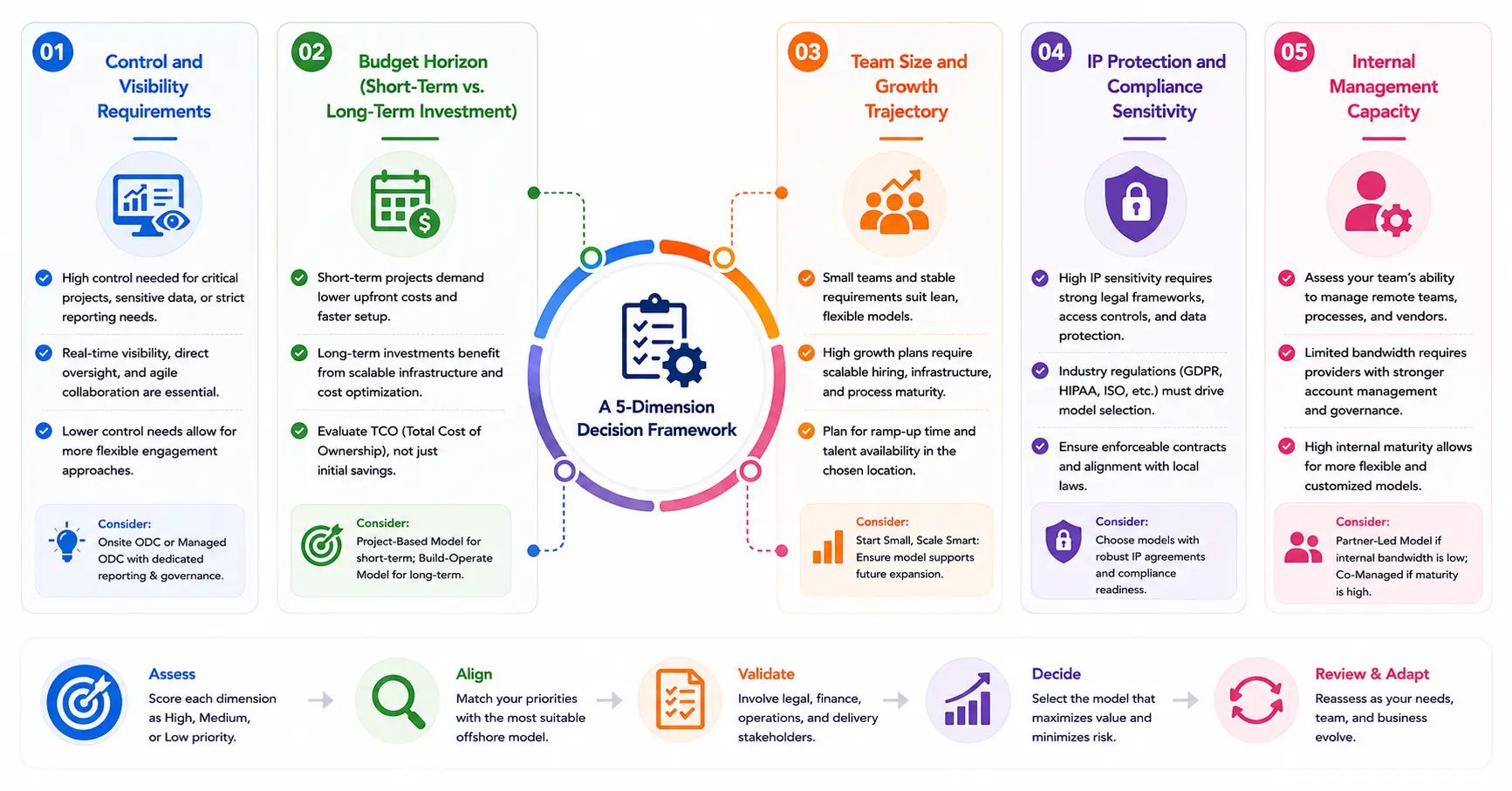
Most offshore model decisions are made on instinct or cost alone, which is why they fail. The Offshore Engagement Model Selection Matrix (OEMSM) replaces guesswork with a structured approach. In this decision-making framework, you will evaluate your business across five dimensions that determine the model fit. You have to score each dimension from 1 to 3, add your points, and match the result to a model recommendation.
How much direct control does your organization need over day-to-day operations?
Mark the score as 1 if your team can manage individual contributors within your existing project structure. Give yourself a score of 2 if you need a dedicated team aligned to your delivery process. But can tolerate vendor-managed operations. When you require full operational and legal control and are prepared to own the offshore entity, the score is 3.
Let us look at your offshore investment. You get a score of 1 if your budget is project-bound and reviewed quarterly. If you can commit to a fixed monthly team cost over a period of 12 to 24 months, then the score is 2. You score 3 if your organization is prepared to front-load investment over 2 to 4 years in exchange for full ownership.
For a long horizon, Dedicated ODC can be better as its fixed setup cost gets spread across time and scale.
What is your offshore team size today, and where do you want it to be in 24 months? Give yourself a score of 1 if you need fewer than 5 resources for a defined project scope. But if you’re planning a team of 5 to 39 engineers with a stable product roadmap for years, then give yourself a score of 2. If your offshore headcount trajectory exceeds 30 and you’re building toward a standalone delivery entity, the score is 3.
The dedicated team model becomes more cost-effective than augmentation once you need 5 or more people working on the same product.
Now it is time to evaluate your IP risk and compliance obligations. Score 1 if your product handles non-sensitive data with no cross-border regulatory exposure. You get a score of 2 if you operate under frameworks such as SOC2, ISO, or HIPAA. Give yourself a score of 3 if your product handles data related to GDPR or CCPA.
Does your organization have the internal bandwidth to manage an offshore team directly? You get a score of 1 if you have a strong engineering leadership layer. If you can dedicate a part-time offshore program manager but need the vendor to handle governance, then you get a score of 2. Is your internal capacity limited, and do you need the vendor to own operations entirely before a structured handover? Then your score is 3.
Add scores across all 5 dimensions, and your total will fall somewhere between 5 and 15. If the total score is between 5 and 7, staff augmentation is the best choice for you. When you score 8 to 11, go ahead with the Dedicated Offshore Development Center, and the BOT model is the best fit if your score is between 12 and 15.
A low OEMSM score doesn’t mean a less sophisticated mode. It means your current business stage calls for flexibility over structure. A high score signals that your organization has the scale and investment horizon.
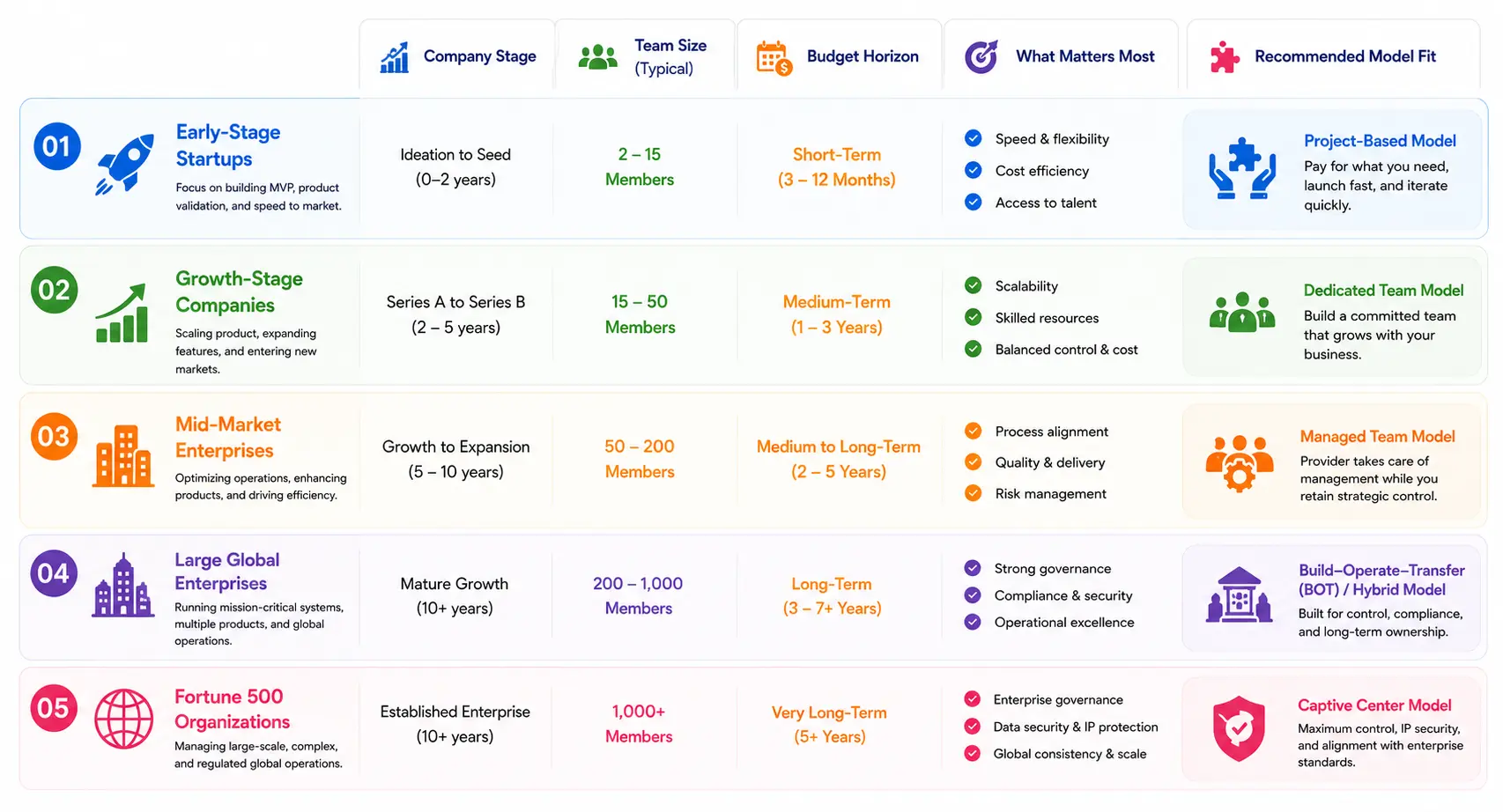
When you’re evaluating BOT vs. Staff Augmentation vs. Dedicated ODC models, you need to understand that the right offshore engagement model isn’t just a function of budget.
Startups have limited budgets and fast-changing requirements. That’s why Staff augmentation is the best fit for them, as it lets them hire specialized talent without committing to a large operating structure.
Once a company hits consistent revenue and a stable product roadmap, the direction shifts. A Dedicated ODC starts making sense with predictable monthly costs and a team that compounds knowledge retention.
Mid-market companies need more than just extra people, as they usually have several product lines and higher compliance needs. That’s where a Dedicated ODC gives you more advantage with a stable team.
At this scale, offshore teams are strategic assets and not cost lines. Large enterprises with 50+ offshore headcount requirements and multi-year delivery horizons should begin with an ODC and later convert it into a BOT-style owned entity.
For Fortune 500 companies, the main concern is not whether to build an offshore presence, but how to do it with minimal risk. BOT is preferred because the vendor handles the difficult early phase, and the client gets time to prepare before taking ownership.
The right choice among Staff Augmentation vs. Dedicated ODC vs. BOT depends on your industry.
SaaS companies need fast iteration cycles and scalable engineering capacity. A Dedicated ODC is the strongest fit as it supports continuous product development without onboarding overhead. Staff augmentation works well for short-term feature sprints or filling a senior architecture gap.
FinTech operates under some of the most demanding compliance frameworks globally. Legal risk moves with the data and not with the engineer or a company’s location. So, a Dedicated ODC with embedded compliance protocols is the baseline recommendation. BOT is better when a company is building a permanent offshore operation.
Any offshore engineer handling protected health information has the same compliance requirements as an in-house employee. Dedicated ODCs with contractually enforced privacy and security controls are the least complex offshore option that is acceptable for the healthcare industry. The BOT model works well for long-term healthcare infrastructure.
Insurance platforms handle sensitive policyholder data, and there is a need for access control and governance. A Dedicated ODC with defined data governance protocols and audit rights is the right choice for them.
Construction technology companies building project management or ERP platforms benefit the most from a Dedicated ODC model. It supports long development cycles without knowledge loss between releases.
Manufacturing tech projects are complex, full of domain-specific details. So, they benefit from a team that stays together, and that’s where a Dedicated ODC becomes the best fit.
Retail and ecommerce companies face seasonal demand spikes that make staff augmentation attractive for short-term scaling. A Dedicated ODC delivers better continuity and lower long-term per-resource cost.
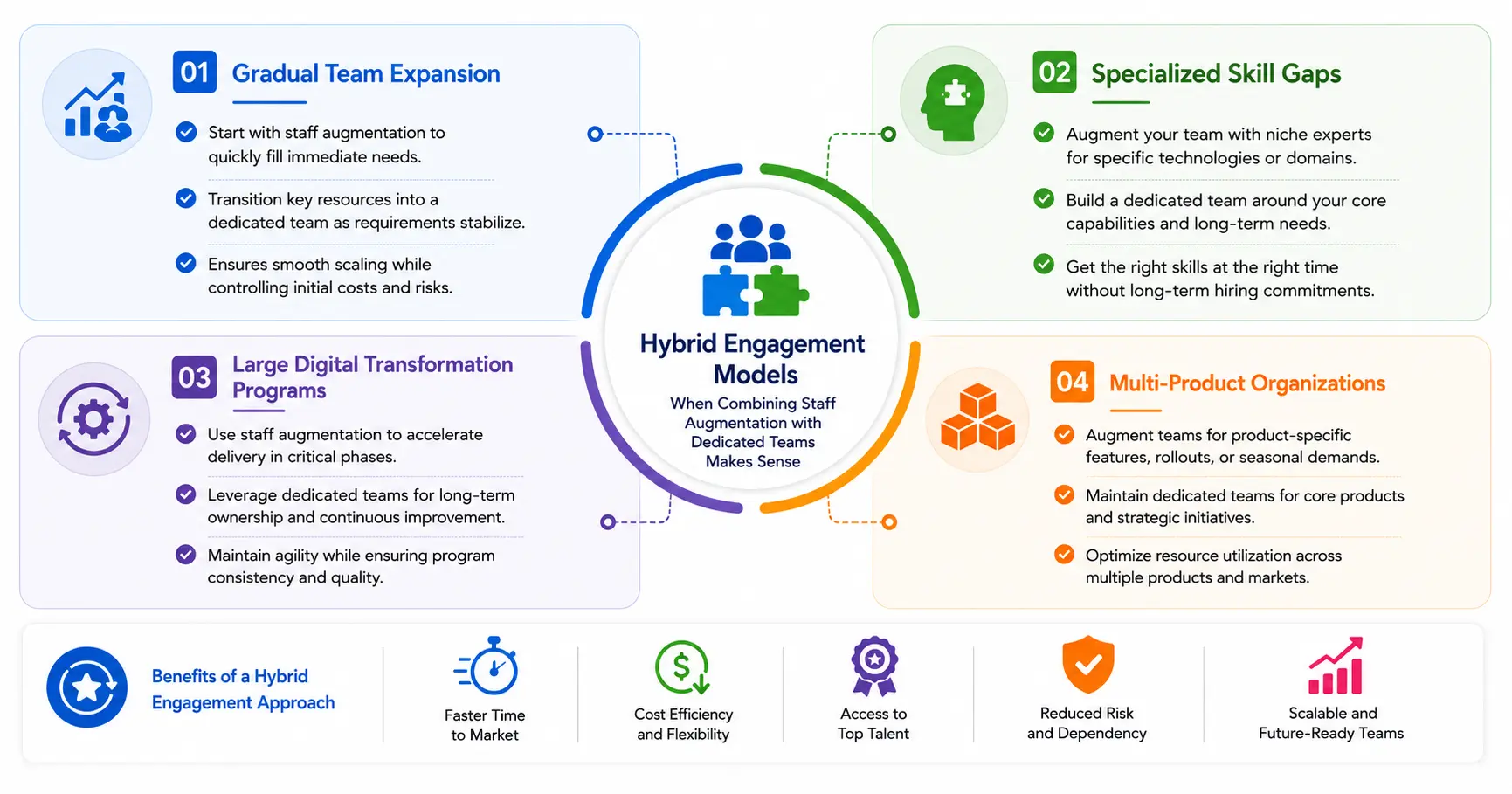
Not every offshore engagement fits into a single model. A hybrid structure allows you to explore staff augmentation alongside a Dedicated ODC and is now becoming common among enterprises managing complex delivery programs.
Enterprises that aren’t ready to commit to a full Dedicated ODC use staff augmentation as a low-risk entry point. This hybrid model validates offshore collaboration and builds internal management confidence.
Even at Dedicated ODCs with good staffing, there are skill areas that are outside the core skill set of the DODC. Staff augmentation addresses these gaps as and when required, without the need to restructure the ODC contract, or permanently add more staff.
There are multiple workstreams in parallel within enterprise-wide transformation programs, and some of these workstreams may be left with long-term dedicated delivery teams, some without. The model adopted for a hybrid approach allows each workstream to have its own structure, not compelling a common engagement model for programs that have varying timelines and skill needs.
Companies managing multiple product lines can run a dedicated ODC for their core platform while using staff augmentation to support new products that are still in early development.
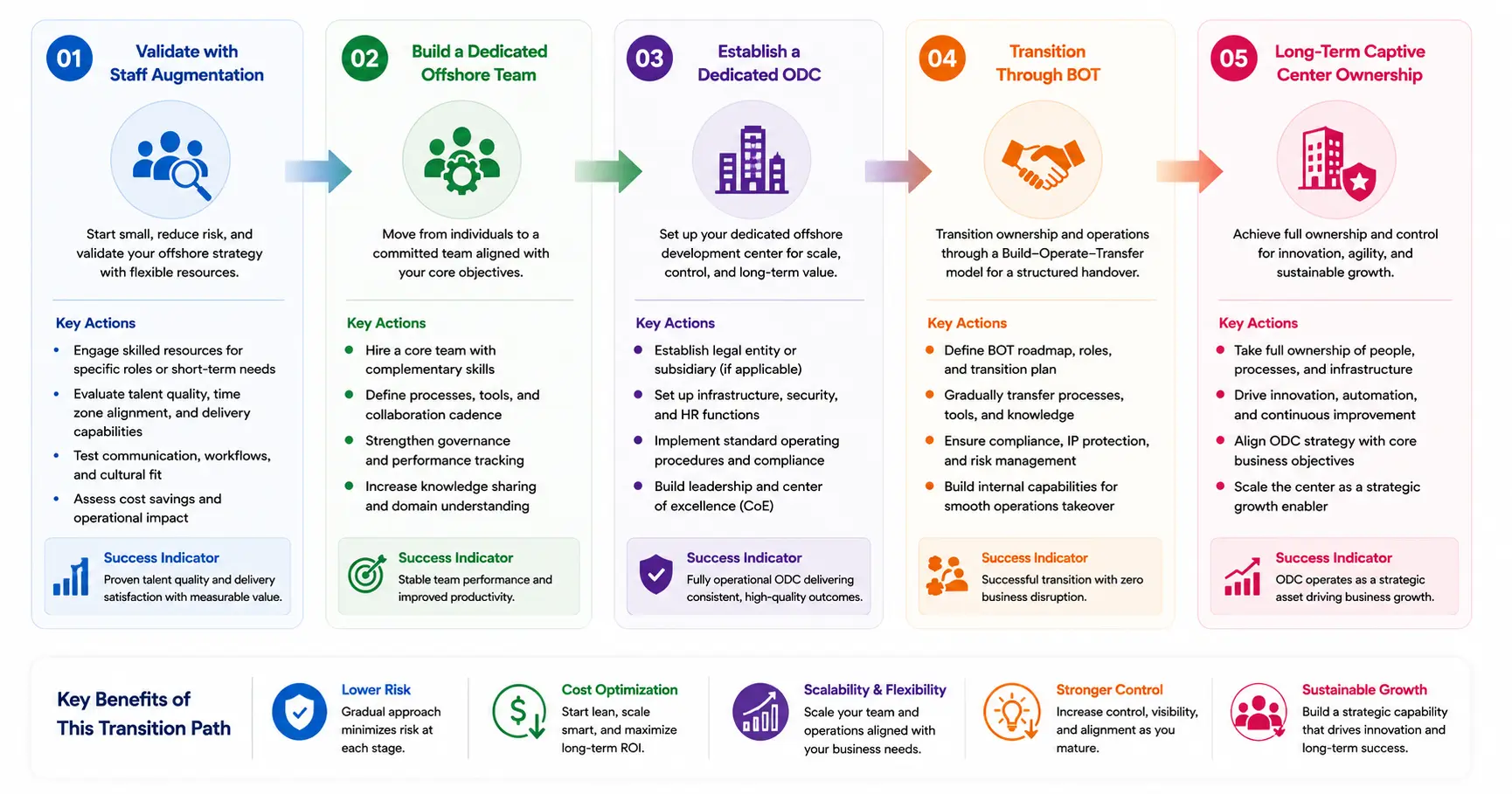
Few enterprises start offshore with the model that serves them best at that moment. The more common and lower-risk path is a phased progression where each stage validates the next before the organization commits to greater complexity and investment.
The first one is to test collaboration at scale, before it becomes a formal commitment. Begin with a few offshore personnel (1 to 3) on the team. The question is: can distributed work really work for your organization with reduced risk?
If the trial is successful, the next step will be to make the individual contributors a more organized offshore team. This involves them beginning to collaborate over processes and regular sprint cycles. If the way is still flexible, it’s now more predictable and reproducible.
This point, the offshore team is no longer a team of people but rather an official offshore delivery center. That translates to having defined governance and service level expectations.
For the transition phase the company is now in a position to own the offshore operation and is pursuing a Build-Operate-Transfer model. The legal and operational complexity is managed by the vendor initially and then gradually transferred to the company.
This is the final destination, as the offshore operation becomes a fully owned internal business unit. The company now controls HR and delivery governance directly. The phased approach is usually chosen when offshore capability is so important that the company wants it as part of its own organization, not a vendor service.
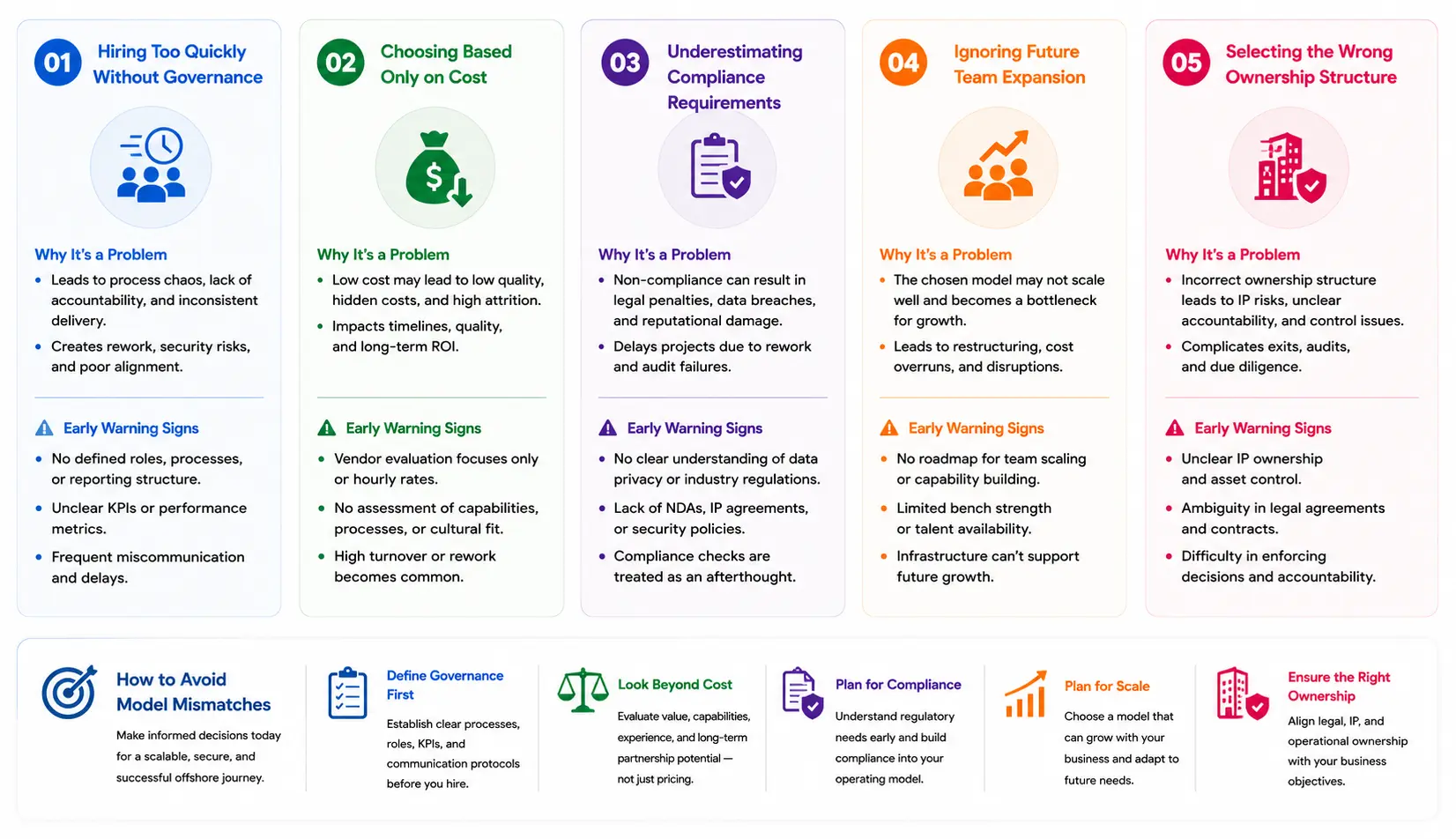
Choosing the wrong offshore engagement model never looks like an obvious mistake at the time. Most mismatches follow recognizable patterns, and the earlier they’re identified, the lower the cost of correcting them.
Hiring more external or remote sources without clear ownership and escalation paths creates problems faster than it creates value. Without proper structure, growth turns speed into chaos.
Low hourly rates make staff augmentation attractive on paper. But the cost per resource is only one input, whereas the management overhead and knowledge loss between contracts eliminate those savings.
Companies in regulated industries underestimate how far compliance obligations follow their data across borders. Selecting staff augmentation without robust IP assignment clauses and data handling protocols creates regulatory exposure that a Dedicated ODC or BOT model would have addressed.
A model chosen for a team of five doesn’t scale itself to thirty. Companies that delay transitioning from staff augmentation to a Dedicated ODC struggle with inconsistent delivery standards and fragmented teams.
When you are evaluating Dedicated ODC vs. Staff Augmentation vs. BOT, choosing the wrong starting model forces costly offshore rebuilds later.
Hourly rates and monthly team costs are the numbers most enterprises lead with, and the reason most offshore TCO calculations come back wrong. Here’s how the three models actually compare.
Staff augmentation carries the lowest entry cost at $50 – $100 per hour per developer with no setup or infrastructure fees. BOT engagements require upfront setup fees of $50,000 to $200,000, covering entity establishment and recruitment infrastructure. Dedicated ODC sits between the two with no legal entity cost.
The monthly retainer costs range from $3,500 to $15,000 per developer, depending on geography and seniority. For the Dedicated ODC, the price includes not just developers but also team management and reporting. BOT is more like a staged ownership model where you first pay for vendor-run operations and then move toward direct ownership later.
In the staff augmentation model, the vendor only bills for the developer but creates 25% to 40% management overhead not captured by vendor invoices. More of the coordination work is built into the vendor’s service in the Dedicated ODC. So, your team spends less time managing individuals and more time bringing results. Once the BOT model moves into the operating phase, the vendor handles most of the day-to-day coordination.
Dedicated teams become cheaper than rotating augmented staff. Because of this, there is less rework and more accumulated knowledge. For BOT, the company gets very strong cost savings compared with onshore teams.
| Cost Dimension | Staff Augmentation | Dedicated ODC | BOT |
|---|---|---|---|
| Setup cost | No setup cost needed | Cost is low to medium | $50K to $200K |
| Monthly cost for developers | $3,500 to $15,000 | Lower blended rate | Between $4,000 and $8,000 |
| Management overhead | 25 to 40% of the project cost | Included in vendor bills | Managed by the vendor before transfer |
| Knowledge retention cost | High as it resets with each rotation | Cost is low as knowledge compounds over time | Lower after stabilization |
| IP or Compliance risk cost | Cost is moderate to high | Low | Lowest among the three models |
| 24-month TCO vs. Augmentation | Only baseline expenses | 40 to 55% lower | Higher upfront but lower post-transfer |
| Best financial profile | Short-term and variable budgets | Stable with a 12- to 24-month horizon | 3+ year capital commitment |
Timeline is the deciding factor when enterprises are choosing between Staff Augmentation vs. Dedicated ODC vs. BOT under delivery pressure.
| Phase | Staff Augmentation | Dedicated ODC | BOT |
|---|---|---|---|
| Initial setup | Not needed | 2 to 4 weeks | Takes 3 to 6 months |
| Recruitment and onboarding | 1 to 2 weeks | 4 to 6 weeks | It is included in the Build phase |
| Time to first delivery | Days after onboarding | At the end of the first sprint cycle | After the build phase |
| Full productivity | 2 to 4 weeks | Two to three months | 12 to 18 months |
| Governance setup | Immediate to lightweight | 4 to 8 weeks | Built into the Operate phase |
| Ownership transfer | Not applicable | Not applicable | Takes 18 to 36 months |
| Engagement length | 3 to 6 months | 1 to 2 years | More than 3 years |
Staff augmentation is the fastest offshore engagement model to deploy, as vendors have pre-vetted benches. Specialist roles take 3 to 5 weeks, depending on availability and screening depth.
A Dedicated ODC requires six to ten weeks from initial scoping to sprint delivery. It takes two to three months to get into full productivity once the team is assembled.
The BOT lifecycle runs from 18 to 36 months in total. The Build phase takes 3 to 6 months, during which the entity is set up and hiring is done. In the Operate phase of the BOT model, the team takes 12 to 24 months to mature and deliver. Handover takes 3 to 6 months in the Transfer phase.
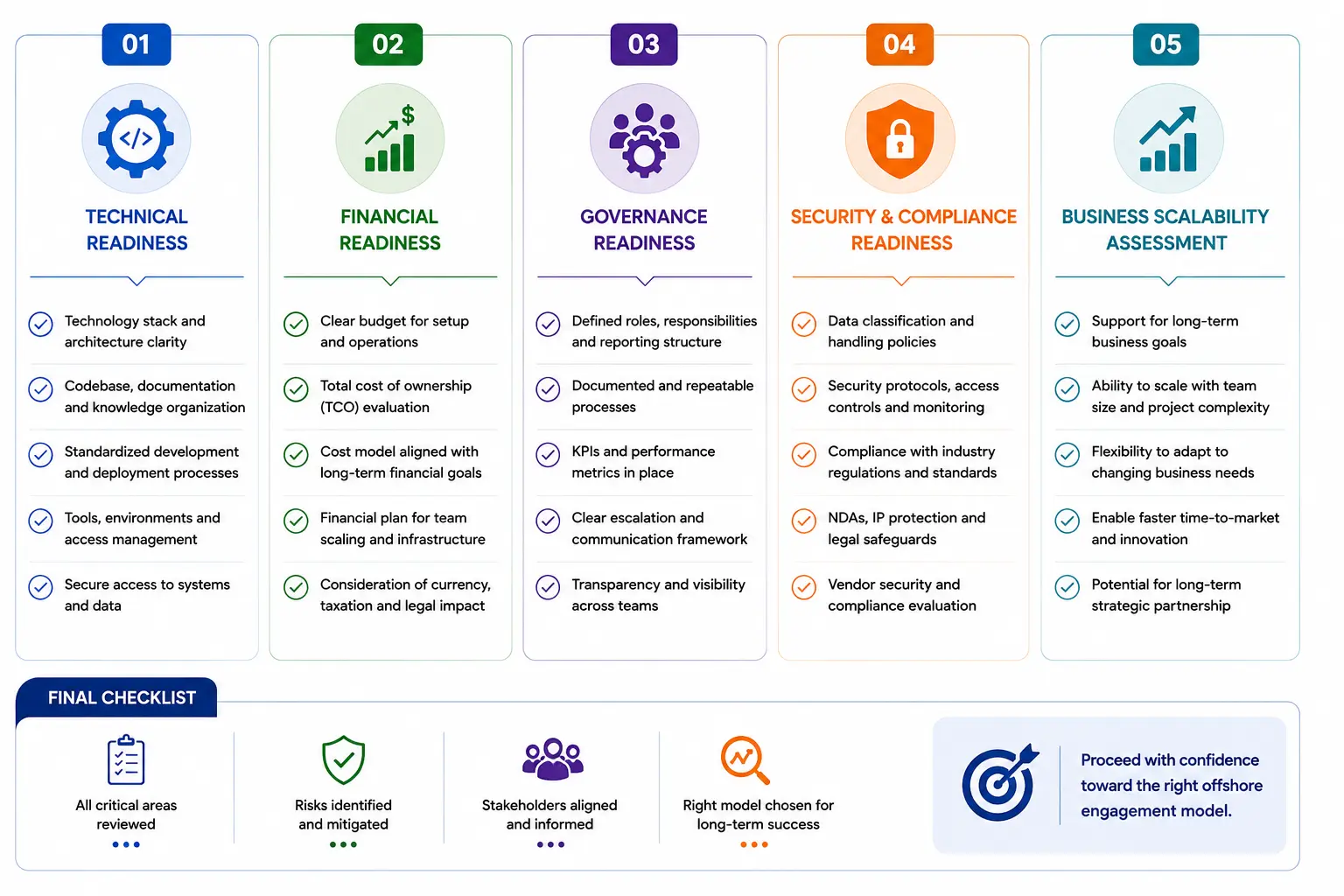
Before committing to any offshore engagement model, enterprises need to test their readiness across five dimensions.
You have to check whether your engineering environment is organized enough for outsiders to join smoothly. If your stack and deployment steps are not clear, an offshore team will waste time figuring out such things instead of delivering work.
Is your budget set up for a short-term hire model or a longer-term operating model? The real cost of the model includes more than the vendor quote, such as onboarding time and management efforts. So you need a structure that supports investment and eventual ownership.
You should know if your company can manage a distributed team or whether the vendor needs to handle most of the governance. Having an idea about how you will track work and judge performance ensures that you own the offshore outcomes.
If the team is going to operate across different countries, you need to know how data is handled in each place. The contracts should also mention who owns the IP and whether audits are allowed.
It is worth analyzing whether your offshore demand is small and temporary or whether you want it to grow into a larger long-term setup. If you expect headcount to increase over time, then you need a more structured model.
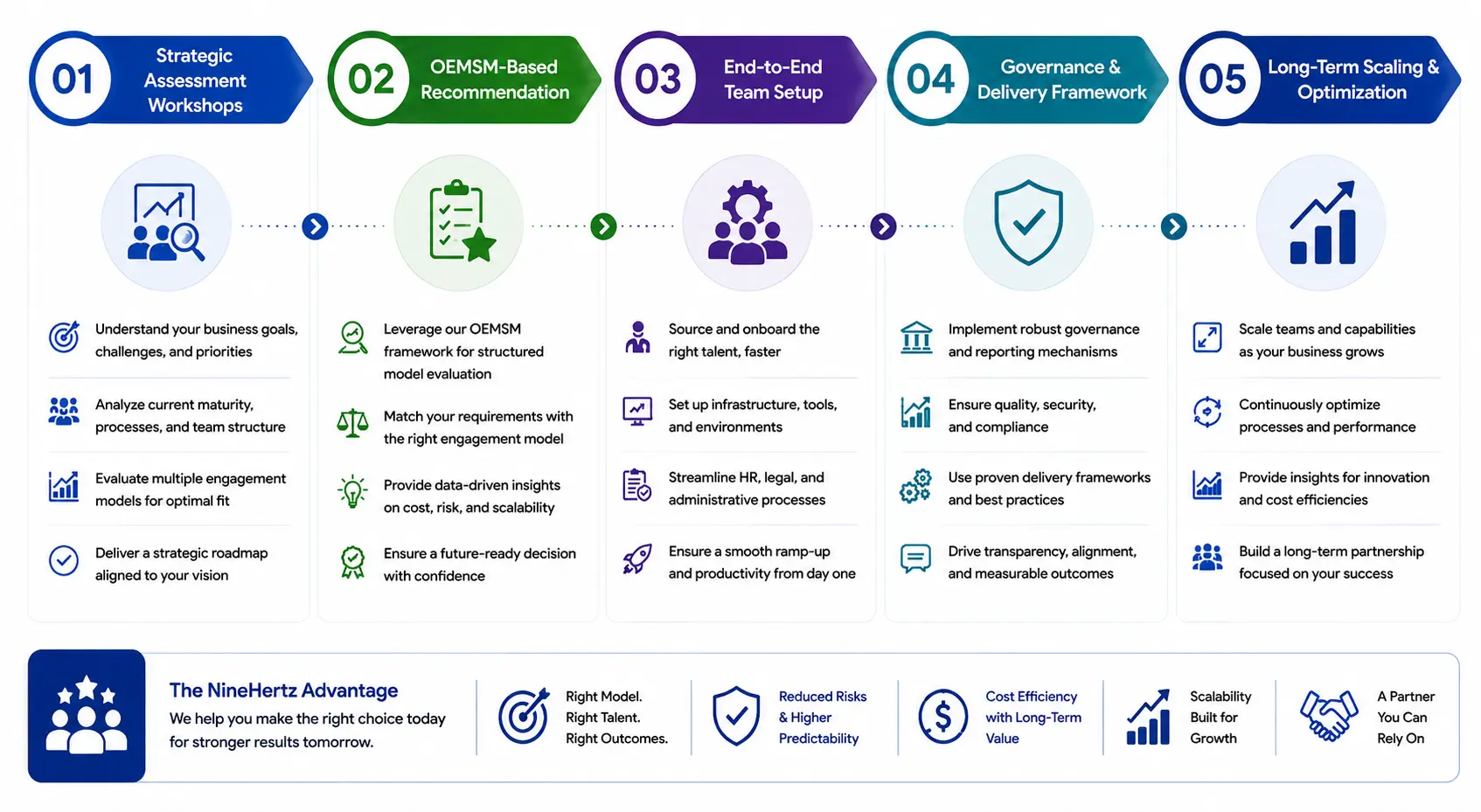
Selecting the right offshore engagement model is only half the decision. The other half is determined by how well the model delivers on its promise. Here’s how The NineHertz supports enterprises across the selection and implementation lifecycle.
The NineHertz begins every enterprise engagement with a discovery workshop to map current gaps and compliance requirements before any model recommendation is made. We ensure that engagement starts with evidence and not assumptions.
Using the Offshore Engagement Model Selection Matrix, The NineHertz scores each client across all five dimensions, such as control requirements, budget horizon, team growth trajectory, IP sensitivity, and internal management capacity. We recommend a model based on a documented rationale and not a sales pitch.
From role definition to onboarding, The NineHertz manages the full team setup process. Our team makes the offshore team launch faster by managing hiring and setup.
Every NineHertz engagement is built on a defined governance layer covering performance benchmarks and quarterly business reviews. Clients have full visibility into offshore delivery without management overhead.
As business requirements evolve, The NineHertz supports structured transitions from staff augmentation to Dedicated ODC, or from ODC to BOT.
The difference between Staff Augmentation vs. Dedicated ODC vs. BOT isn’t a question of which model is better – it’s a question of which model fits where your business is today and where it needs to be in three years.
Staff augmentation gives you speed, but a Dedicated ODC ensures continuity and knowledge retention. The BOT model gives you ownership and a phased approach to full entity ownership. Each model delivers its value, but only when it’s matched to the right business stage and internal management capacity.
The OEMSM decision-making framework in this guide lets you make that match deliberate rather than instinctive. Score your business across the five dimensions and not just your immediate cost target.
The enterprises that get offshore right don’t just find cheaper talent. They build offshore structures that compound in value with every quarter, and that starts with choosing the right engagement model.
Staff augmentation adds individual contractors to your existing team for short-term skill gaps. A Dedicated ODC builds a long-term offshore team exclusively for your product. If you want to go further, choose BOT, where the vendor sets up and runs the offshore operation before transferring full legal and operational ownership to you.
While evaluating Dedicated ODC vs. Staff Augmentation vs. BOT, go with Staff Augmentation for early-stage startups due to its low setup cost and quick deployment. Startups with stable funding and a roadmap for more than 12 months should evaluate a Dedicated ODC as the next step.
A Dedicated ODC makes sense when you have a stable product map and consistent delivery requirements for 12 months or more. It’s the right model when your team size warrants continuity over flexibility and knowledge retention matters more than short-term headcount.
You can choose the right engagement model for your business by analyzing the real-time project needs. Staff augmentation is ideal when you just need to extend your team for a specific project. ODC works best to integrate an extension of your team at a better or cost-efficient destination to increase the project volume. BOT model is mostly preferred when you want an expert team to build your product and then get the entire ownership and resources transferred.
OEMSM is a 5-dimension decision framework that helps to identify the best outsourcing model for your project. The dimensions and weights of the selection are-

This is technology’s tipping point! The smart and future-forward organizations are not only slashing costs, but they are also building…

Key Takeaways IP architecture is not a legal formality bolted onto an India ODC after launch; it is a strategic…

Key Takeaways India’s dominance in offshore engineering is strengthening as 1580 GCCs are already operating in India, generating $50 billion…