The risk for modern supply chains is more than just tariffs. Businesses are dealing with geopolitical uncertainty, instability of suppliers, internal risks, and concerns with cybersecurity. Traditional Supplier Risk Management (SCRM) is not good at monitoring for point-in-time visibility into sub-tiers and fragmented data.
Here, an agentic AI supplier risk management platform changes the approach. Instead of waiting for a supplier to fail, the system keeps reading weak signals across internal and external data. Supplier failure detection AI mechanisms can help procurement teams understand how agentic AI detects supplier collapse early and what action should come next. The risk for modern supply chains is more than just tariffs; businesses are dealing with geopolitical uncertainty, instability of suppliers, internal risks, and cybersecurity concerns.
This blog explains how agentic AI detects supplier collapse early, which signals matter, and what architecture, AI agents, governance, and roadmap are needed for a supplier risk intelligence platform build.
Traditional SCRM may look fine on paper, but it misses risk while it is still forming. Annual audits, Tier-1-only visibility, and outdated assessment models are not enough when risks can come from geopolitics, cyberattacks, factory shutdowns, or sub-tier supplier issues.
Traditional SCRM relies heavily on static, once-a-year assessments, and it creates an inaccurate sense of security because everything may look perfect, but it leaves massive blind spots regarding what happens during the other 364 days of the year.
Static scorecards are not suitable for proactive decisions. They fail to capture real-time drifts in suppliers’ operational and financial health. This is why a supplier risk intelligence platform matters. It not only stores supplier ratings, but it also keeps checking the signals behind those ratings.
Supplier collapse is usually gradual. First, delivery timelines stretch, then quality issues arise. Payment terms change. Key people leave, and a compliance warning appears. A supplier risk intelligence platform matters because it reads changing signals before the disruption reaches operations.
When the real question becomes, “Why is this supplier becoming risky? How serious is the risk, and what should we do before it affects operations?” the situation needs more than a basic approach. Unlike traditional tools, an Agentic AI platform keeps checking supplier health, connects early warning signs, and suggests the next step for procurement.
Traditional platforms send static alerts after the problem has already started. An agentic platform works earlier. It connects supplier signals, checks supplier health, and reads how the risk is changing before it affects operations.
Rule-based risk systems are rigid and work on “everything predefined”; one logic miss nuance and multiple risks involve immediately. These systems only focus on predictive analytics or just summarizing the data. On the other hand, Agentic AI operates autonomously, executes workflows, investigates anomalies, and adapts strategy without any manual intervention.
| System Type | How It Works | Main Limitation |
|---|---|---|
| Rule-based system | Follows fixed rules with little room for any customization | High chances of missing hidden or changing risks |
| Traditional AI | Only analyzes static data | Still needs manual intervention |
| Agentic AI | Works autonomously, learns through actions, and makes proactive decisions | Needs clean data and strong governance |
Autonomous agents spot hidden dangers like operational drift, changes in supplier behaviour, or early financial stress before they impact operations. Together, they create an always-on procurement intelligence layer. The system can flag supplier failure detection AI signals, suggest alternate suppliers, raise alerts, start an RFQ, or send the issue to the right team.
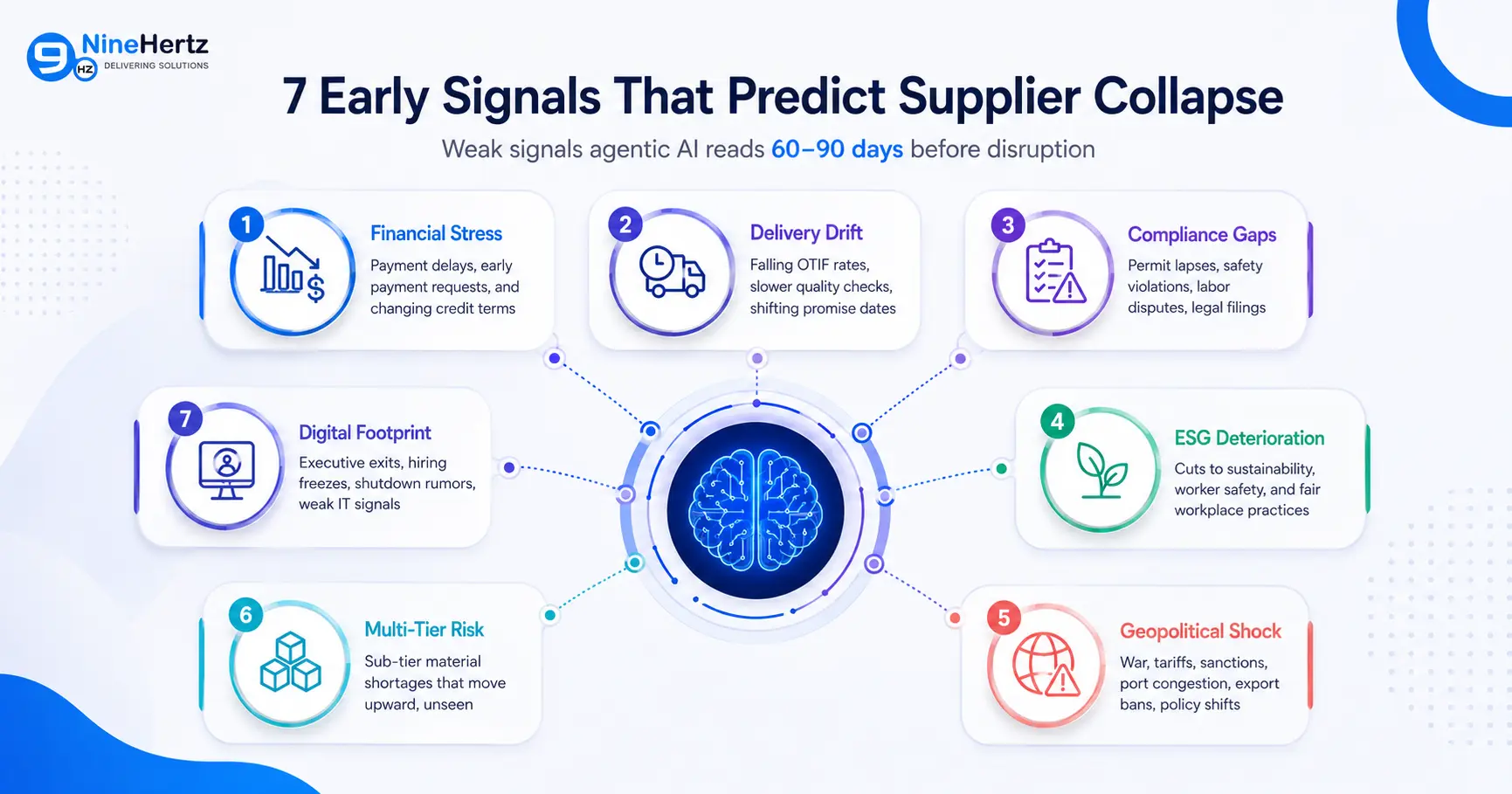
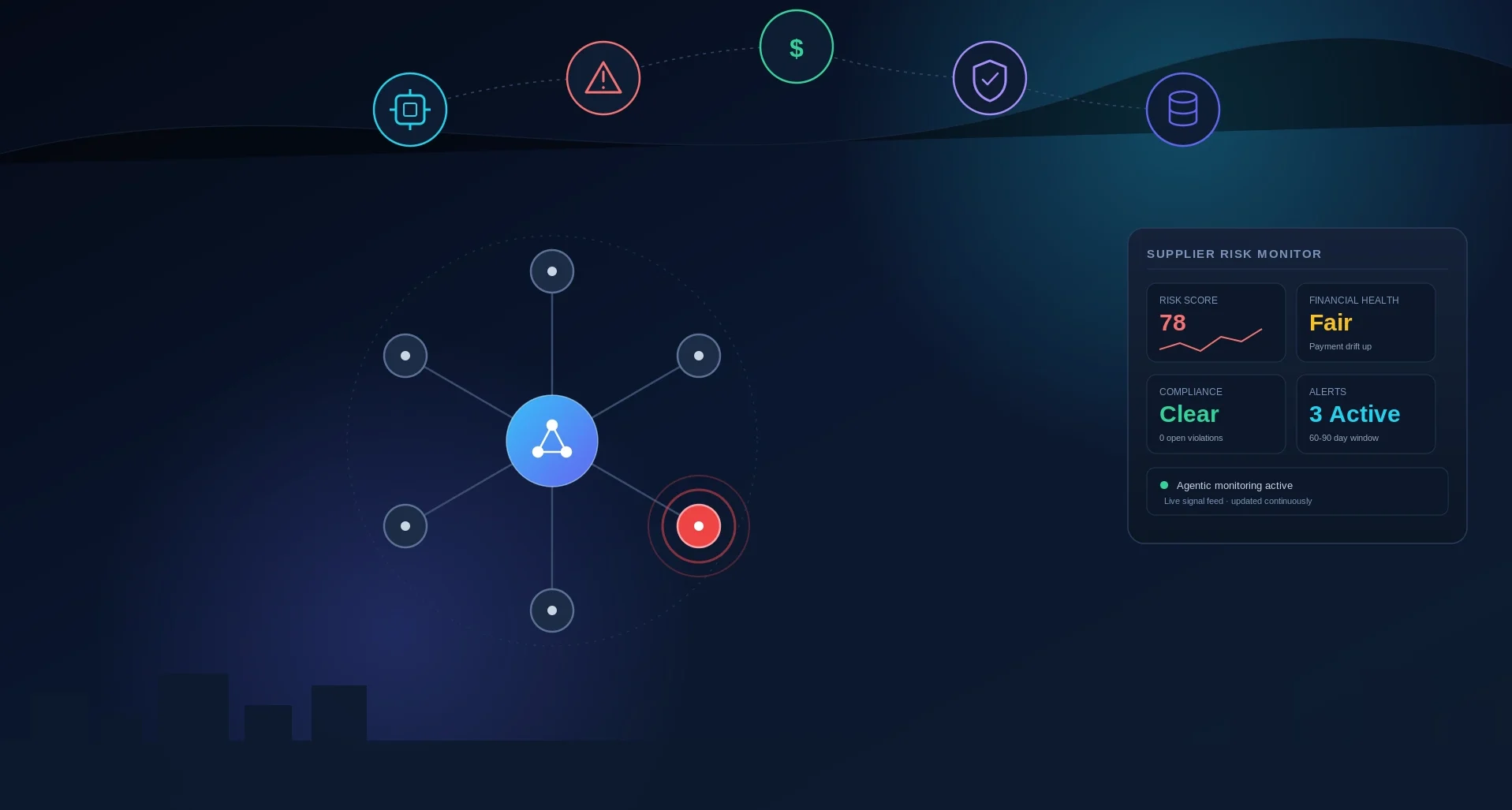
Supplier collapse rarely starts with one big shock. It usually begins with weak signals that audits, credit scores, and manual reviews miss. With an Agentic AI supplier risk intelligence platform, teams can move from manual checks to always-on risk monitoring. Here is how agentic AI detects supplier collapse early, often 60–90 days before it affects operations.
Payment behavior is often the first warning. A supplier may delay vendor payments, ask for early payment, or change credit terms. This leaves a trail of behavioral anomalies, and AI models track these micro-behaviors to flag the crisis before something happens.
Delivery performance does not degrade in a day; it starts slowly, and then rapid delays start. Consistent drops in On-Time, In-Full (OTIF) delivery rates, quality checks take longer, and delivery promises keep shifting. When this continues for weeks, the platform treats it as a risk pattern.
An Agentic AI multi-tier supplier visibility platform can scan structured and unstructured sources for permit lapses, safety violations, labor disputes, or legal filings. If the risk is serious, it can trigger pre-set risk playbooks.
When a supplier is in financial stress, they enter “survival mode” and stop spending on long-term initiatives like sustainability, worker safety, or fair workplace practices just to save a dollar today. When an AI notices a supplier’s ESG scores dropping, it is a massive red flag that the company is running out of cash and cutting corners to survive.
War, tariffs, sanctions, port congestion, export bans, and policy changes can hit supplier reliability fast. Risk platforms map these events against supplier locations and operating footprints.
Many companies know direct suppliers, but not the suppliers behind them. If a sub-tier supplier faces material shortages, the impact moves upward. Supplier failure detection AI exposes these weak links early.
Supplier health also appears in public signals: executive exits, hiring freezes, shutdown rumors, weak online activity, or poor IT maintenance. With a supplier risk monitoring architecture, teams can detect collapse risk much earlier.
An agentic AI supplier risk management platform cannot work like a simple reporting tool. It needs a connected supplier risk monitoring architecture where data, supplier identity, AI agents, risk scores, and workflows work together. Otherwise, procurement teams only get alerts and still have to guess the next step. A strong supplier risk intelligence platform build usually has six layers.
The platform collects supplier data from ERP, SCM, accounts payable systems, supplier portals, contract tools, shipment systems, external news, credit databases, ESG sources, regulatory feeds, and IoT devices. The goal is to bring scattered supplier signals into one place, and payment behavior, delivery delays, and compliance issues stay disconnected without a data ingestion layer.
Many enterprises have the same supplier listed in different ways across plants, regions, and business units. The supplier entity resolution engine creates one supplier identity and maps Tier 1, Tier 2, and Tier 3 relationships. This layer is also important for a multi-tier supplier visibility platform because hidden dependency risk often sits below direct suppliers.
This is the working layer of the platform. Different AI agents handle different risk areas, such as risk Detection Agents that watch delay pattern supplier Intelligence agents that track supplier behavior. An ESG Agent checks labor, safety, and environmental issues. A Financial Health Agent reads payment drift and credit signals, and the compliance agents track licenses, sanctions, and regulations. Overall, the multi-agent orchestration layer makes the platform active using diverse agents.
After collecting signals, the system needs to understand what they mean. This is where LLMs, Graph RAG, knowledge graphs, ML models, and vector databases work together. For example, the system may connect a delivery delay with a payment issue and a factory shutdown notice. One signal may look small. Together, they may point to supplier failure.
The predictive risk scoring engine converts signals into a composite supplier risk score, confidence score, risk trajectory, and business impact estimate. This helps teams know how risky the supplier is, how fast the risk is growing, and which plants, products, or customer orders may be affected.
The final layer turns intelligence into action. The platform may recommend an alternate supplier, launch an RFQ, notify procurement, create a Jira ticket, raise an SAP workflow, or escalate the issue to executives. This is where AI procurement risk platform development becomes useful. The system does not stop at “risk detected.” It helps teams act before the supplier issue becomes a business disruption.
An agentic AI supplier risk management platform works through specialist agents, not one large system doing everything. Each agent has a clear job.
The agent reads supplier signals from news, court records, customs data, local forums, shipments, quality checks, and supplier communication. If small misses keep repeating, it flags the pattern before it turns into a production problem.
Financial stress often appears in payment and credit changes first. This agent checks invoice delays, payment behavior, credit movement, and cash stress signals as part of the supplier failure detection AI layer.
A single missed compliance step should not delay procurement or shipment; compliance agents must ensure this. They track regulatory drift, workplace safety violations, and corporate governance.
This agent maps supplier relationships across Tier 1, Tier 2, and Tier 3 suppliers. It helps the Agentic AI supplier risk intelligence platform find hidden dependency risks behind direct suppliers.
Procurement decision agents score risks related to the suppliers and make decisions autonomously. If a supplier’s risk score crosses a critical threshold, this agent evaluates the platform’s internal databases to find pre-vetted alternative vendors.
This agent prepares simple risk summaries for leaders. It explains which supplier is at risk, why the risk is rising, what business area may be affected, and what action is recommended.
| Agent | Core Functions | Output |
|---|---|---|
| Supplier Monitoring Agent | Scan global news, legal filings, and data to spot early warning signs | Early behavior risk alerts |
| Financial Intelligence Agent | Track cash flow, payment delays, and credit health | Financial stress signals |
| Compliance Agent | The agent monitors safety violations, staff turnover, and rule-breaking | Compliance risk warnings |
| Supply Chain Graph Agent | Map how a problem with a sub-supplier impacts the whole chain | Hidden exposure mapping |
| Procurement Decision Agent | Score procurement risks and find alternative vendors | Recommended next action |
| Executive Reporting Agent | Prepare risk summaries for business leaders and provide explanations | Leadership-ready view |
The real value is how fast the system connects weak signals before people notice the pattern. An Agentic AI supplier risk management platform does this by reading supplier behavior over time, not only checking one alert.
A minor delay or one bad review does not mean supplier failure. The concern starts when quality, payments, compliance, and shipments all begin to drift. That is where supplier failure detection AI helps teams spot the signals before the problem becomes visible.
Every supplier has a normal working pattern. The platform builds a baseline for that behavior and flags unusual changes like missed updates, partial shipments, or sudden order rejections.
Supplier risk changes over time. Temporal reasoning helps the system see whether the risk is improving, stable, or getting worse. For example, three small delays across 60 days may matter more than one big delay that gets fixed quickly.
Traditional systems depend on static data. An Agentic AI risk management platform can run predictive checks and show where supplier risk may move next.
Even when the supplier risk intelligence platform works autonomously, human validation still matters. Procurement leaders can review the evidence before switching suppliers, starting an RFQ, or waiting.
Implementing an autonomous supply chain demands enterprise-grade security, transparency, and compliance. An Agentic AI supplier risk management platform cannot run without controls, as risk decisions affect contracts, pricing, production, and business continuity. Thus, automation with clear approvals, evidence, security, and oversight is the best approach.
Every unearthed future risk and its score must show the reason behind it. If a system flags a risky supplier, then there must be signals behind the score, such as payment drift, delayed shipments, compliance issues, or multi-tier dependency risk. It makes the supplier risk monitoring architecture easier to trust.
AI can recommend action, but people should approve major decisions. Switching suppliers, launching an RFQ, or escalating to leadership should pass through procurement, finance, or operations teams before action is taken.
Procurement and compliance teams need an audit trail to check who made a decision, when they made it, and what data supported it. Log every alert, score change, recommendation, approval, and workflow action with a timestamp.
Not every user needs access to every supplier detail. Thus, it should be strictly managed through a granular, enterprise-grade Role-Based Access Control (RBAC) framework to keep sensitive data safe.
For enterprises asking how to build an AI supplier risk intelligence platform, governance should be part of the build from day one. ContinuumAI™, as a precisely created AI-native framework and charter, adds an effective layer of AI governance. It ensures that AI initiatives are ethical, effective, secure, and built to deliver measurable business value from the ground up.
The framework empowers enterprises to support their AI initiative for supplier risk management intelligence through three core stages (Build, Run, Evolve) and seven core principles to solve the common pitfalls businesses face while implementing AI governance. By putting “human-in-the-loop validation,” the supply chain enterprises achieve long-term, sustainable business outcomes.
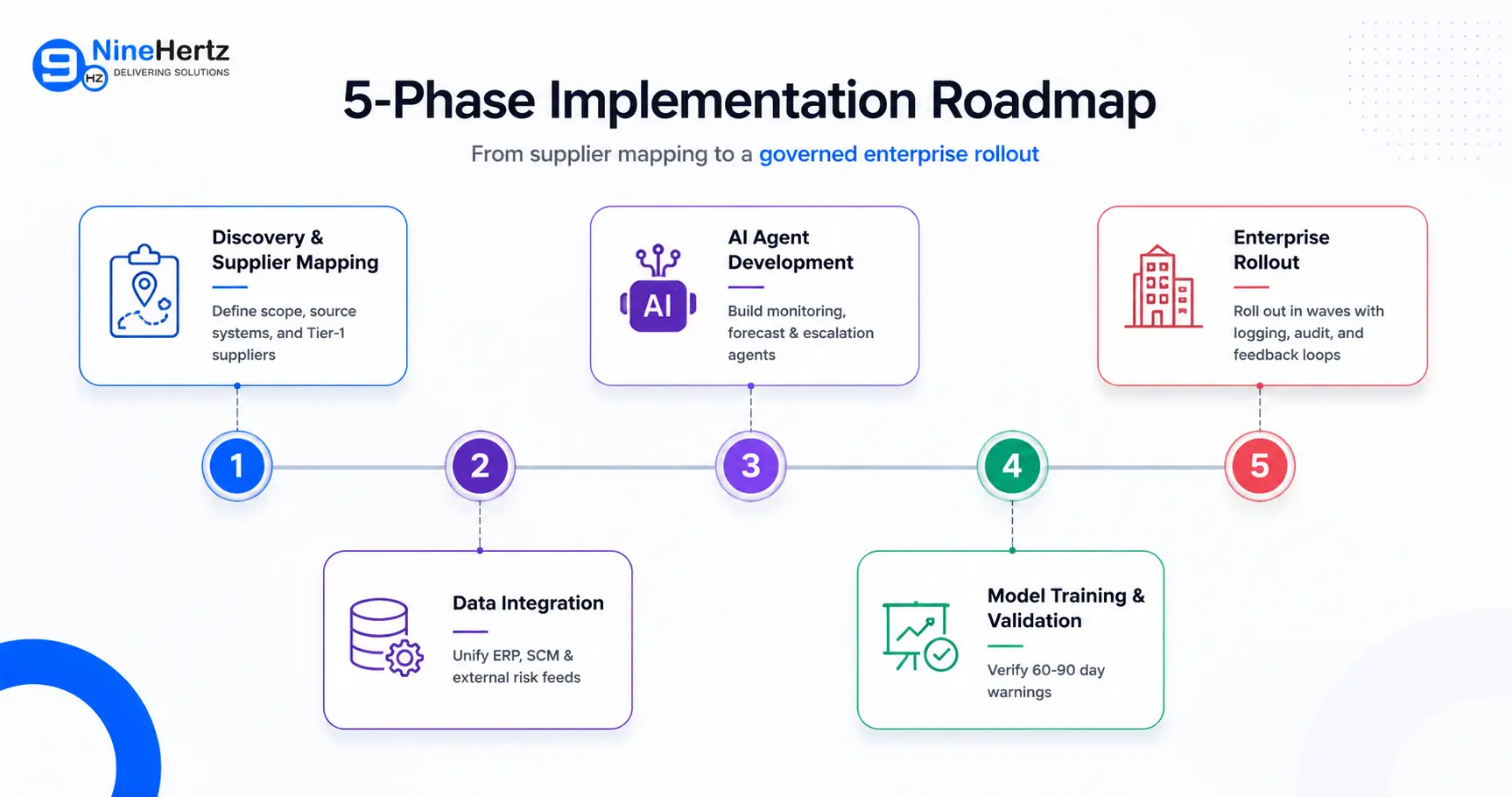
Building a supplier risk intelligence platform is not just implementing an AI agent and starting to use it the next day. It is a sophisticated process and needs effective orchestration. Here is the five-step process for enterprises asking how to build an AI supplier risk intelligence platform.
The foundation step is to define architectural boundaries and map the initial procurement ecosystem. Based on spend volume, source dependency, and operations impact, identify Tier-1 suppliers. Conduct internal discovery sessions to identify critical risk factors. Catalog all internal enterprise data structures to create a data baseline.
The next step is data engineering and foundation. Unify data sources, establishing secure API pipelines connecting internal systems (SAP, Oracle, or proprietary ERPs). Also, add external third-party feeds (credit bureaus, geopolitical risk APIs). Then clean and consolidate the data to create a base for a clean supplier risk monitoring architecture.
Build agents for supplier monitoring, financial health, compliance, supply chain graph analysis, procurement decisions, and executive reporting. This is where AI procurement risk platform development starts becoming practical, not just a dashboard idea.
Now, train the model on historical multi-tier supply chain data to map dependency paths and trace cascading impacts. Test the model against historical supplier bankruptcy, payment patterns, delivery history, and compliance events to verify that the platform successfully generates 60–90 day warning windows.
As the final stage, set role-based access to protect the sensitive data from unauthorized use and launch the platform in a “human-in-the-loop” pilot phase. The better approach is to start small, continuously updating behavioral baselines, reducing alert noise, and then expanding.
Building an Agentic AI risk management platform provides a massive strategic advantage. However, enterprise-scale deployments encounter some distinct operational and technical hurdles, such as:
Enterprises typically store supplier data across multiple ERPs, procurement databases, and region-specific tracking systems. This creates redundancy and acts as an initial technical barrier. Due to unclean data, the supplier risk monitoring architecture produces weak signals.
Most of the businesses are still using legacy ERP systems. Connecting a modern agentic AI platform to these legacy systems needs complex API orchestration, where syncing real-time transactional data without disrupting core business operations is a real challenge.
Mapping a Tier-1 vendor is straightforward. But when it comes to mapping Tier 2, Tier 3, and sub-tier material suppliers, things are complex and need high data transparency. Overcoming sub-tier opacity is a prominent roadblock for enterprises during AI procurement risk platform development.
In the absence of fine-tuning of threshold parameters, the system generates too many alerts or an overwhelming volume of minor notifications. This makes procurement teams suffer from alert fatigue.
Macroeconomic environments, compliance laws, and geopolitical boundaries shift rapidly. Without governance such as ContinuumAI™, the models can drift over time, and automated reasoning fails to align with the ethical mandates and corporate guidelines.
It requires extreme training efforts when professionals are working with traditional supply chain systems to make them switch to work on an Agentic AI supplier risk management platform. Human resources may oppose it due to fear of job loss.
The NineHertz thinks beyond the traditional SCRM as an AI-native engineering firm. We orchestrate Agentic AI supplier risk management solutions and provide services based on the pivotal “Build, Run, and Evolve” framework. We build agentic AI systems that procurement, finance, operations, and compliance teams can actually use.
For companies exploring procurement risk platform development, our team builds supplier risk monitoring architecture through fine engineering. Then connect it to ERP, SCM, AP, supplier portals, and external intelligence to create a strong base for a supplier risk intelligence platform build.
Once the platform is live, we provide support for workflows and governance controls that help teams to use the system effectively in procurement decisions. As the platform matures, more AI agents, prediction models, supplier graphs, and autonomous workflows can be added. This is where an agentic AI supplier risk management platform becomes more useful over time.
Thus, if you are planning how to build an AI supplier risk intelligence platform, The NineHertz can help you move from idea to controlled enterprise rollout.
Traditional risk intelligence systems (built on the illusion of safety) rely on static data and annual audits, and that is no longer effective. These systems create blind spots, and teams only get to know once the disaster has happened. Comparatively, Supplier failure detection AI helps read these weak signals before they affect operations.
AI procurement risk platform development helps handle modern supply chain volatility. However, transitioning to a resilient supply chain requires more than just deploying an autonomous AI failure detection layer. While agentic AI excels at capturing weak early-warning signals 60–90 days before a disruption, this intelligence is only valuable if paired with enterprise data readiness and operational agility.
This is where the smarter approach is to “Build, Run, and Evolve.” The outcome is a more sustainable supply chain operation with reduced risks and stronger long-term success.
An agentic AI supplier risk management platform checks supplier signals, reasons for risk, and suggests actions before disruption reaches operations.
AI for Supplier failure detection analyzes the preliminary signals (financial, operational and behavioural) and warns of supplier collapse beforehand, rather than relying on static data.
Supplier risk prediction is very accurate, given that it is correlated with several signals and reasons over time.
Yes, it can be integrated with major ERP and procurement systems such as SAP, Oracle, and more.
Most platforms use a mix of machine learning, LLMs, knowledge graphs, forecasting models, anomaly detection, and vector search. The mix depends on the use case.
A basic supplier risk intelligence platform build can take 3 to 6 months. Timelines change with data quality, integrations, and rollout size.
A robust supplier risk monitoring system typically requires ERP, SCM, AP, contracts, supplier portals, shipment data, compliance feeds, and external intelligence.
Yes, if the agentic AI supplier risk management platform has role-based access, audit trails, workflows, and explanations.

Are you looking for the top AI development company in the USA? Guess what, you’ve come to the right destination.…
Key Takeaways Multi-agent systems can improve task specialization, coordination, and scalability by distributing complex workflows to specialized AI agents. Sequential,…
Key Takeaways AI supply chain risk monitoring uses real-time data and predictive models to flag disruptions before they escalate into…