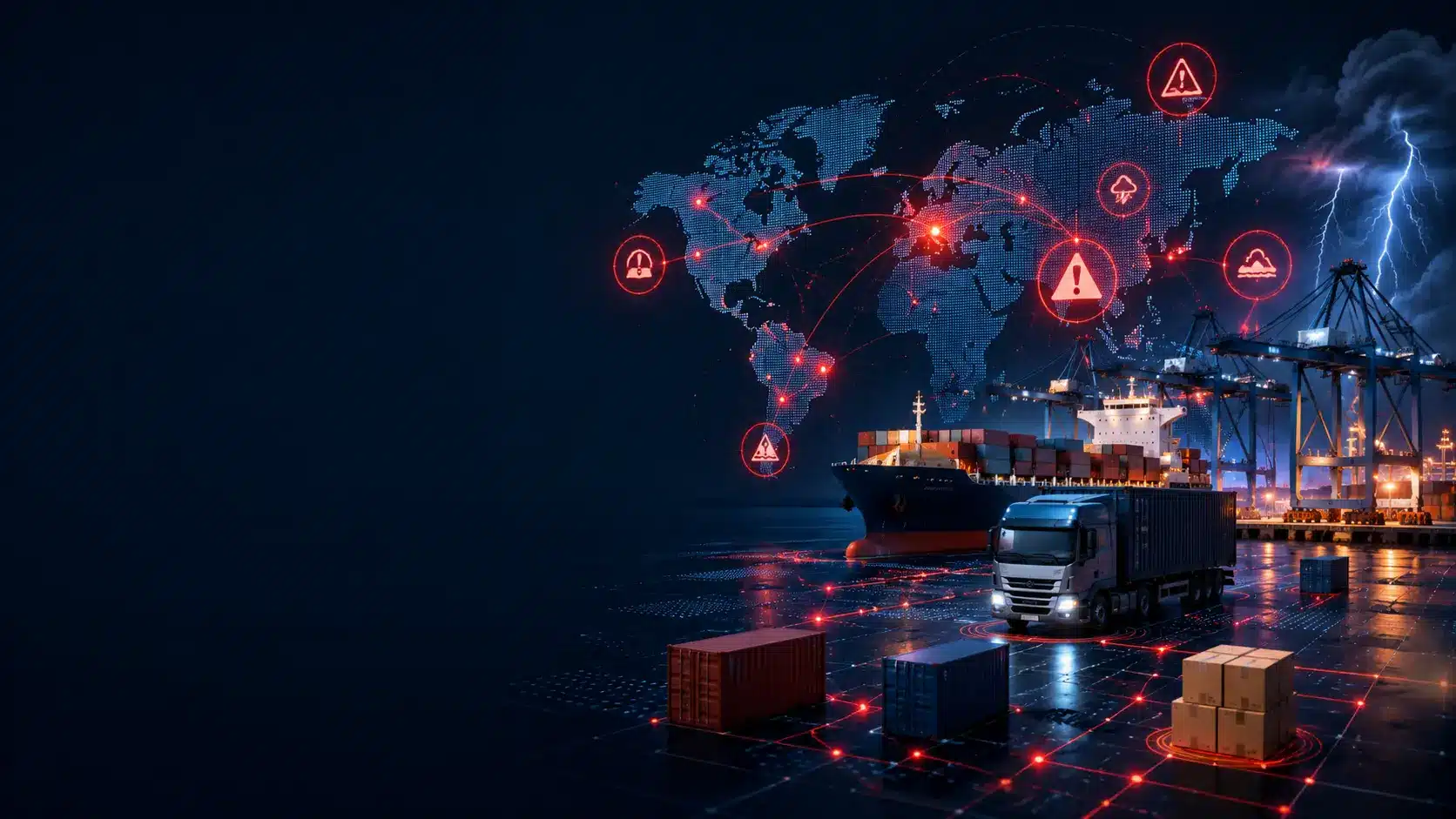
Geopolitical tensions, volatile demand, climate-related disruptions, and supplier instability are no longer isolated events. They’ve become recurring operational risks that organizations now face simultaneously, which is why supply chain resilience has shifted from an operational concern to a strategic priority. Meanwhile, third-party involvement in breaches has risen from 15% to 30% year-over-year, a sign that supplier risk now stretches well beyond logistics into cybersecurity and compliance.
The problem is that most supply chain risk management systems were built for a slower operating environment. Periodic supplier reviews, manual assessments, spreadsheets, and reactive reporting all assume there’s time to catch up later. In practice, the financial and operational damage is often already underway by the time a disruption gets flagged.
AI-powered supply chain risk monitoring closes that gap. Rather than waiting for a disruption to surface, it continuously analyzes supplier performance, logistics data, market signals, weather events, geopolitical developments, and operational metrics in real time, catching emerging risks early enough to act on them. McKinsey has found that AI-enabled disruption detection can reduce risk impact by up to 40%, translating into roughly $500 billion in avoided losses across global supply chains.
What organizations can monitor is expanding too. Machine learning models predict supplier failures before they hit production schedules. Computer vision catches quality defects during manufacturing and warehousing. Generative AI summarizes risk reports, recommends mitigation strategies, and helps procurement teams move faster as conditions shift. That momentum is reflected in the market itself: the global AI supply chain sector is projected to reach USD 16.93 billion by 2034, growing at a 14.21% CAGR from 2026.
Adopting AI-driven risk monitoring isn’t just about better visibility. It’s what lets a supply chain absorb a disruption instead of buckling under it.
Uncertainty is now the norm in the supply chain industry. Businesses are operating under sudden trade restrictions, unstable weather conditions, resource shortages, and geopolitical unrest. Real-time supply chain monitoring eliminates these bottlenecks. It offers clear visibility and identifies risks in advance.
In global supply chains, complexity is rapidly growing. The industry operates through multi-vendor ecosystems. Managing multiple supplier activities is time-consuming, and third-party cyber threats are a potential risk. Port congestion delays delivery and impacts customer satisfaction.
Therefore, supply chain companies need real-time visibility and must have an effective risk-handling mechanism to prevent any disturbance by geopolitical instability, transportation dependencies, and global sourcing complexity.
Traditional supply chain monitoring systems show limited capabilities that don’t suit current industry requirements. It relies heavily on manual tasks, offer limited visibility, and have a slow reactive response time to disruptions.
Due to the lack of predictive capabilities, conventional systems fail to analyze a large volume of data and predict risks such as shipment delays, supplier failure, inventory shortage, or overstocking.
Manual analysis takes too much time and results in delayed reporting, which is useless after a risky event occurs.
Where the traditional system fails, AI supply chain risk monitoring brings innovation into the processes.
AI (by deep-tier visibility and network mapping) assesses the supplier network to uncover hidden risks. The tools continuously monitor logistics activities, inventory movements, warehouse operations, and market conditions.
Machine Learning and Predictive Analytics process data from global news, weather patterns, port congestion reports, and financial data for pattern identification that can create risks.
The system creates automated supply chain alerts that help teams make proactive decisions. Overall, AI tools for risk monitoring in supply chains enhance visibility, support asset utilization, reduce manual errors, and increase efficiency.
Get real-time risk visibility before it costs you a shipment.
AI in supply chain risk monitoring leverages key AI technologies to monitor and analyze data from various sources to predict disruptions and risks. Here is how it works.
Machine learning (ML) analyzes historical and real-time data to identify hidden patterns and predict risks in supply chain operations, such as risks within the supplier network, logistics routes, and other operational areas.
NLP makes communication easier for teams and extracts data from sources such as supplier emails, invoices, contracts, global news, and more.
Computer vision helps process images and video feeds to monitor the production line, ensure quality products, and eliminate safety issues.
Predictive Analytics creates “What-if” scenarios and analyzes them to identify risks in supply chain management and suggest proactive measures.
AI risk management tools monitor diverse data from sources such as:
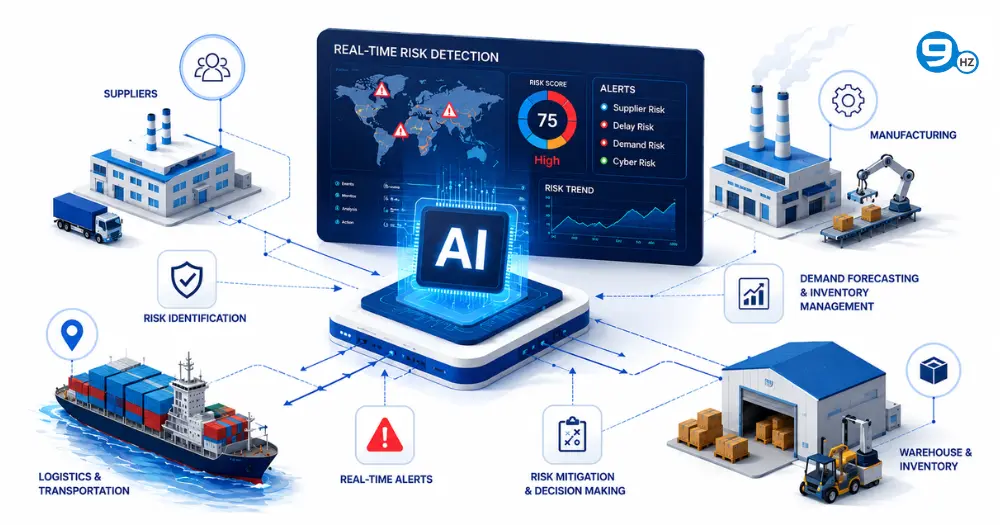 Here are some top use cases for how AI helps with supply chain risk detection in real time. This will help you to understand the concept practically.
Instead of finding low-cost suppliers, businesses are now focusing on suppliers who are not only cost-effective but also reliable, scalable, and compliant with industry standards. This is where AI in supply chain management helps businesses improve supplier risk analysis.
AI enhances the overall process of supplier risk detection. For financial instability monitoring, these systems analyze supplier data, financial reports, news updates, social media activity, and ESG (Environmental, Social, and Governance) disclosures.
Machine learning also helps identify unusual patterns, operational issues, and early signs of supply chain disruptions. By combining AI, ML, predictive analytics, and real-time data processing, businesses can create an early warning system to detect compliance violations, score vendors (via dynamic risk scoring) and delivery performance, segment high-risk suppliers, and more.
AI supply chain risk monitoring follows a data-driven approach for risk management. This increases resilience, adherence to compliance, suggests a mitigation strategy, and sources alternatives to protect business continuity.
When a cargo ship gets stuck in a global conflict (for example, Red Sea shipping disruption), or a major highway is closed due to a regional conflict, or due to any natural calamity, it directly impacts distribution and delivery. AI appears here as a savior and helps in logistics risk monitoring. AI-powered logistics monitoring systems track route data, weather conditions, fuel prices, traffic congestion, and live shipment movement. When the system detects any unusual delay, it creates instant alerts.
For example, if port congestion is detected, route-optimization-software analyzes available alternatives and recommends more efficient routes before shipments experience significant delays.
For the transportation and logistics disruption monitoring, businesses are now using machine learning models to analyze real-time and historical data. These models help in identifying patterns linked to delay.
Another example is AI, machine learning, and predictive analytics, which help with fuel and weather impact analysis. Based on the data, the system predicts the weather conditions, analyzes routes, and calculates fuel consumption on all the routes. This helps logistics and transportation make swift decisions.
Another top use case of AI supply chain risk monitoring is demand forecasting and inventory risk management. Companies can accurately forecast demand for their products by applying AI to internal and external data. It helps in budget management, inventory planning, shipping priorities, and manufacturing schedules.
When there is no risk monitoring and management, there is a high risk of stock shortages or overstocking. Both conditions result in delayed delivery, wastage, storage costs, and lost sales opportunities. The best solution is AI-based demand forecasting that uses machine learning and predictive analytics. It accurately estimates future demand and helps businesses predict stock shortages and prevent overstock.
The system analyzes a scale of data covering historical sales, demographics, consumer behavior, seasonal trends, competitor activities, and economic conditions. Apart from this, advanced systems also analyze website traffic and social media data. Based on it, the AI demand-sensing system forecasts inventory risks in real time.
The most shocking truth is that supply chain breaches have impacted 31% of organizations. In 2026, cyber attacks are one of the biggest global threats.
The solution?
AI plays a critical role in strengthening organizations to prevent cyber risks in supply chains, including third-party risks, ransomware, and others. It helps businesses detect and eliminate cyber threats in several ways.
An AI anomaly detection system consistently monitors the network and detects anomalies in real-time. It uses a large volume of data to identify patterns that can create issues with digital security. If the system detects suspicious login attempts, abnormal data transfers, or malware behavior, it can trigger real-time threat alerts.
Many businesses are also using AI to monitor third-party vendor systems because attackers sometimes try to breach them to gain access to larger systems.
As ransomware and data theft cases continue to grow, AI-driven cyber threat detection helps companies respond to threats immediately.
The global economy is volatile. Old trade treaties are broken, and new ones are formed. Political instability is also an issue. A sudden change in tariffs can reduce the margin and profit. For this scenario, predictive risk analytics is a lifeline for global supply chain businesses. These systems can process international news, regulatory updates, and market conditions.
AI models can easily assess political instability and sudden economic risks that could affect material costs, fuel prices, and tariffs. Based on it, the companies can make the right decision before any geopolitical risk affects their business.
How does it work? AI performs graph-based risk mapping, tracing vulnerabilities from Tier-1 suppliers to Tier-3. Machine learning performs sentiment analysis and identifies patterns through the data, such as global news feeds, corporate reports, and government announcements, to detect geopolitical threats.
For predictive scenario modeling, AI creates digital twins of the supply chain to simulate how market trends or political unrest can affect operations, cost, and inventory.
Quality matters always and everywhere, from production to delivery. The manufacturing sector is now fiercely competitive, and maintaining product quality is a necessity. A small defect can get the entire lot rejected by the clients and also result in material waste and re-shipping costs.
The conventional methods are ineffective and offer a limited approach for quality control. Now, AI in supply chain management and Machine Learning are helping manufacturers with quality control and product defect detection. Industries such as automotive, electronics manufacturing, food and beverage, pharmaceuticals, and textiles are using AI for real-time predictive defect detection, reducing waste and costs.
Computer-vision-powered high-resolution cameras can continuously monitor assembly lines and process automated quality scoring. The AI models process images and video feeds to find surface scratches, incorrect labeling, microfractures, and other defects. This makes manufacturing anomaly detection easy.
Some businesses also use AI supply chain risk monitoring to track defect trends across factories and suppliers. This helps teams with recall prevention, identify issues faster, and improve production quality.
Natural disasters (such as hurricanes, tsunamis, earthquakes, and wildfires), extreme weather events, and pandemics all cause production shutdowns and disrupt supply chains. All of these cause impacts such as infrastructure damage, delivery delays, and slowed delivery of raw materials. AI and machine learning help in supply chain disruption detection.
AI-powered systems analyze meteorological data, satellite imagery, historical weather data, and ocean temperature readings to forecast weather conditions. Using these insights, logistics and transportation teams can decide whether to reroute shipments or put sourcing on hold until conditions are favorable.
Storm-tracking tools can predict when a storm is likely to affect a shipping route or a warehouse location. It creates an instant alert to reroute cargo or adjust delivery schedules.
Machine learning algorithms are capable of predicting flood/fire disruptions by identifying patterns in the data. For example, by detecting equipment malfunctions such as an overheating transformer or a downed power line, the system sends alerts to maintenance teams and can shut down the power supply to prevent any disaster in the production lines.
Real-time compliance and regulatory monitoring is one of the crucial use cases for AI supply chain risk monitoring and detection. The supply chain is a compliance-sensitive industry. It must follow different regulations/mandates related to customs, environmental policies, safety standards, and ESG requirements. Manually, it is a complicated task when a business operates in offshore locations.
AI simplifies it through automated supply chain alerts, custom regulatory tracking, automated document checks, and risk-scoring dashboards. The systems use natural language processing and graph-based mapping to scan global data to predict operational, financial, and geopolitical risks in supplier networks.
The system performs consistent, automated compliance audits by bypassing the manual audit process. They cross-reference the supplier activities according to the global import & export regulations, such as
If a supplier fails to meet the compliance requirements and environmental standards, the system creates automated supply chain alerts to the teams. Some advanced AI supply chain monitoring tools also automate document verification and risk scoring, and reduce manual workload.
We’ll build your AI risk-monitoring roadmap for you.
Key benefits of using AI for supply chain risk management and monitoring include:
AI supply chain risk monitoring helps businesses make decisions faster. AI and machine learning-powered data analysis and automated predictive risk analytics allow teams to act faster, such as during shipment rerouting, weather disruptions, or supplier failures.
Whether it is risk mitigation, vendor selection, or compliance tracking, AI provides live supply chain insights. It gives businesses better visibility into a tiered supplier network, logistics movements, supplier performance, and compliance monitoring. This helps businesses respond faster to supply chain disruptions and operational delays.
When the risks are mitigated before they disrupt the supply chain operations, it results in reduced downtime and costs. AI automates complex data analysis, optimizes inventory, and helps detect supply chain disruptions. Thus, there are fewer shipment delays, fewer production stoppages, and no understocking or overstocking.
In the supply chain market, competition is fierce, and the focus is on customer satisfaction and personalization. Using AI, businesses can maintain service levels, streamline workflows, and manage inventory and warehouse operations to ensure product availability. The teams can provide faster responses during disruptions and reduce delays by detecting transportation risks.
AI supply chain risk monitoring improves the way businesses assess and manage risks. Real-time data analysis, pattern recognition, predictive risk analytics, and automated supply chain alerts help businesses build resilient supply chains.
Before reaching this section, we have covered the brighter part of AI supply chain risk monitoring. But reality is something different from what we think. There are certain challenges associated with implementing real-time supply chain monitoring.
Let’s have a closer look!
AI is data-driven. High data accuracy and quality are a must for AI effectiveness. The AI processes data to drive insights, and machine learning systems learn from data. If AI models consume inconsistent or inaccurate input data, they produce output accordingly. The supply chain industry is data-heavy; therefore, businesses must ensure their data is clean and accurate.
Outdated systems remain ineffective and add complexity to AI integration. Legacy ERPs and WMS lack modern capabilities. This forces organizations to invest in new systems or costly, fragile middleware. In 2026, supply chain businesses need a system modernization before they implement AI successfully.
AI tools, cloud infrastructure, data storage systems, and skilled professionals are required to implement an AI system for supply chain resilience, but it is a costly affair. Employee training and post-launch maintenance are some additional costs. This becomes a major challenge during the early adoption stage.
AI in the supply chain requires the right skills, knowledge, and capabilities. The technical team members must be well-trained or specialized in Machine Learning, Natural Language Processing, Deep Learning, and Predictive Analytics. Meanwhile, the operations team must have practical knowledge of using AI risk management tools. However, a lack of professionals restricts AI adoption in supply chain and logistics.
Partner with The NineHertz to build your custom AI risk system.
Traditional supply chain practices are no longer sufficient. Integrating AI into practices is creating a major shift, i.e., from reactive to predictive and autonomous systems. The future lies in predictive optimization and real-time automation. Apart from this, AI brings decision intelligence that helps business leaders move forward.
Here are some future trends that will reshape AI supply chain risk monitoring.
Modern supply chains face shifting demands, port slowdowns, weather challenges, and geopolitical disturbances. Traditional systems make it complex to handle all these challenges. GenAI helps to solve all these challenges, acting as an intelligent layer. It processes massive data and filters it to predict critical risks. Provides a unified view and recommends next-based actions. Conversational AI dashboards help the team to act fast.
Conventional systems rely on historical data and require manual intervention, which is time-consuming. An autonomous supply chain solves these challenges through AI, predictive analytics, and automation. The system makes dynamic decisions without any intervention, considering factors such as consumer behavior patterns, economic indicators, weather trends, and market signals.
In the near future, it will help supply chain businesses with real-time decision-making, autonomous inventory and warehouse automation, dynamic route optimization, and improved agility.
In the supply chain, digital twins replicate the network, including logistics routes, inventory levels, and warehouses. With the help of virtual models, companies can simulate all conditions, study, and analyze the impacts of scenarios. By combining predictive data analysis with digital twins, companies can accurately forecast demand, automate routine tasks, and enhance operational visibility.
Hyperautomation combines AI, RPA (Robotic Process Automation), and IoT to handle complex operations that require effort and cost. It helps businesses with autonomous warehousing, such as AI robots for high-speed picking, packaging, and sorting. Self-driving vehicles like autonomous trucks and delivery drones will reduce logistics costs and ensure 24/7 delivery. Natural Language Processing, Gen AI, and OCR will reduce documentation costs and automate the flow.
AI supply chain risk monitoring helps businesses with better risk management. The risks are identified earlier, monitoring processes are automated, and companies are responding faster during disruptions. AI offers diverse use cases from supplier risk analysis and logistics risk monitoring to demand forecasting, cybersecurity, and compliance tracking. All use cases help to improve visibility and reduce risk.
Technologies, i.e., Machine learning, NLP, predictive analytics, and computer vision, enable companies to plan more strategically and make faster decisions. Now teams can detect unusual activity and respond more quickly, instead of having to check everything manually.
There are more suppliers, more routes, more warehouses, and more changing customer demands. All of this makes managing supply chains more complicated. That’s why many companies are now installing AI monitoring systems to reduce delays, halt operational problems, and keep supply chain activities flowing smoothly.
The NineHertz is an award-winning artificial intelligence development company specializing in custom AI supply chain software and automation solutions. Our AI-driven solutions help businesses optimize operations, minimize disruptions, improve supply chain visibility, and make data-driven decisions.
AI supply chain risk monitoring is the process of using technologies such as machine learning, predictive analytics, and real-time monitoring tools to identify and manage supply chain risks.
An AI system consistently analyzes data from diverse sources, including supplier data, contracts, IoT sensors, ERP systems, and weather forecasts. It identifies unusual patterns, delays, and operational issues and then creates automated supply chain alerts.
Industries with complex supply chain operations benefit the most from AI risk monitoring. This includes manufacturing, retail, e-commerce, logistics, healthcare, automotive, food & beverage, and consumer electronics.
Yes, AI can predict supply chain failures by analyzing historical data, supplier performance, weather conditions, market trends, and operational activities.
The best AI tools for supply chain monitoring are SAP Integrated Business Planning, Oracle Supply Chain Management, and IBM Watson Supply Chain. If you need a custom AI tool, The NineHertz can assist you as we have good experience in it.

Are you looking for the top AI development company in the USA? Guess what, you’ve come to the right destination.…
Key Takeaways Multi-agent systems can improve task specialization, coordination, and scalability by distributing complex workflows to specialized AI agents. Sequential,…

Key Takeaways India is becoming a global hub for AI-native product engineering, not just support work. The city you choose…