
Insurance companies are no longer using chatbots only for basic support. Based on Tidio’s study, 60% of business owners consider AI Insurance Chatbots improve customer experience through automation. Today, an insurance chatbot can help with claims, policy queries, payments, renewals, and even lead generation. That is why businesses are now exploring real insurance chatbot examples, practical insurance chatbot use cases, and the right approach to insurance chatbot development.
In this blog, you’ll see how these chatbots work and where they fit across the insurance journey, including examples and use cases.
An insurance chatbot is a chat-based tool that helps insurance companies talk to customers and solve common queries. It uses NLP, AI, and machine learning to understand what the user is asking and reply based on that.
In regular support systems, customers usually wait for an agent, follow fixed steps, or deal with limited support hours. Insurance chatbots make this easier. They can answer policy questions, share claim updates, help with billing, and support customers at any time. For insurers, this matters because customers now expect quick help.
Conversational AI is becoming important in the insurance sector. The way customers interact with businesses has changed. Customers need an instant response. They expect quick help, easy communication, and support when they need it.
Now, insurers are under pressure to improve service without increasing operational load and costs. This is one of the main reasons chatbot adoption is growing across the insurance industry. From policy questions to claim updates and renewals, conversational AI helps insurers efficiently manage large volumes of queries.
It is also a part of the larger digital shift in insurance. As more services move online, customer engagement is also becoming digital. Here, conversational AI improves the customer experience, saves time, and helps support professionals do their jobs better.
Here are some interesting real-world insurance chatbot examples.
Lemonade’s “AI Maya,” Allianz’s “Olivia,” and State Farm’s “Ask Jake” are the top examples of AI chatbots for claims filing. You can submit claims just by chatting, available on WhatsApp, 24/7. NLP helps these bots settle claims by automating verification and payments.
GEICO’s Kate uses NLP to answer questions about policies, coverage, and the usual details customers ask about. Over at Allstate, ABIE does something similar for small businesses—handling questions about coverage and claims.
Lemonade Maya, GEICO Kate, Zurich Insurance, and DKV Nauta support customers for premium payments, claims processing, document submission, and policy management.
LAQO Insurance “Pavle”, Bajaj Allianz Haptik, and an AI assistant by The AA (Automobile Association) are lead generation and sales support chatbots. They handle the tasks, such as generating quotes on the spot, qualifying leads, and pulling together the documents you need.
The top examples of customer retention & renewal reminder bots are Progressive’s Flo Chatbot, Sobot’s Insurance Chatbot, and AA Ireland. All these chatbots have the capability of self-improving responses, providing tailored answers.
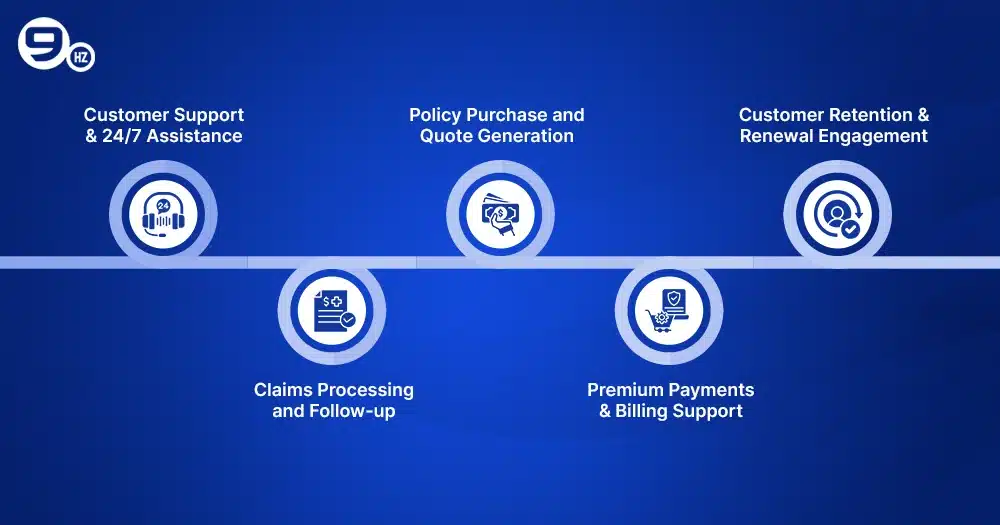
Insurance chatbots have diverse use cases across the entire policy lifecycle. From answering the questions like- “What insurance policy do you provide?”, “What does my policy cover?” to “how do I file a claim?” Chatbots provide straight answers right away.
Insurance Chatbot Use Cases Involve:
The biggest win for insurance chatbots? Automating customer support. They give customers a solid self-service option plus round-the-clock help when they need it. If issues are beyond the chatbot’s competence, it escalates them to human experts.
Insurance chatbots accompany customers every step of the way, from filling in details to uploading documents. Even after processing, the chatbots help individuals to track the claim processing in real-time.
Insurance chatbots make the customer journey smooth. By asking simple questions, using AI/ML algorithms, they analyze what a customer needs, which policy they need, and the purpose. They guide customers to the policy aligned with their needs. As a result, insurers capture quality leads and improve conversion.
Many customers contact insurers with payment-related questions. These usually involve premium due dates, billing details, payment status, or available payment options. An insurance chatbot can answer quickly, which saves time for both customers and support teams.
Insurance businesses struggle with customer retention due to the competitive market. An AI chatbot sends personalized alerts to customers about offers, sends policy reminders, and provides additional information related to the queries. This enhances engagement and retention.
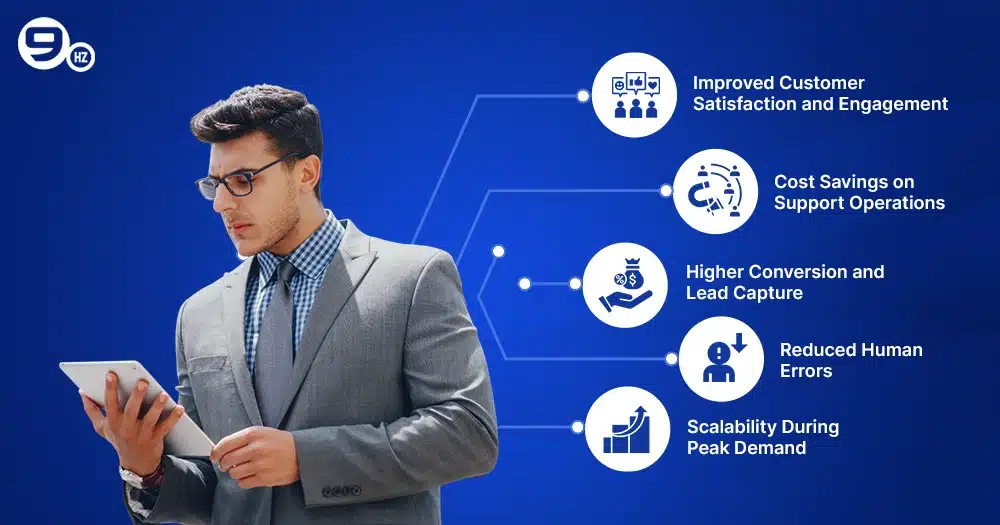
Insurance chatbots can improve customer support, speed up claim-related processes, and reduce response time. Here are some of the main benefits.
Through a single chatbot, you can provide omnichannel support to your customers. This enhances engagement and satisfaction when customers have answers or a resolution in less time.
Customer support operations are expensive when you are dealing on a large scale. You need a large team to answer the queries. Even sometimes handling common queries creates a big load. Through AI chatbot development, you can save on high operational costs as these will handle the queries autonomously, and there is no need for large human staffing.
Insurance chatbots guide individuals from start to finish, from enquiring about and purchasing a policy to filing a claim. Customers can access support anytime through multiple channels and receive personal assistance. Using the data from the first-time interaction, the sales team can generate better leads.
Every day, insurance companies handle massive, sensitive data. One manual mistake can lead to a disaster. Chatbots can access the data and information, guide customers step-by-step, following a set workflow. That means fewer mistakes and info that actually stays consistent.
When disasters strike or claims pile up, support teams can get overwhelmed. Insurance chatbots can manage a high volume of conversations simultaneously.
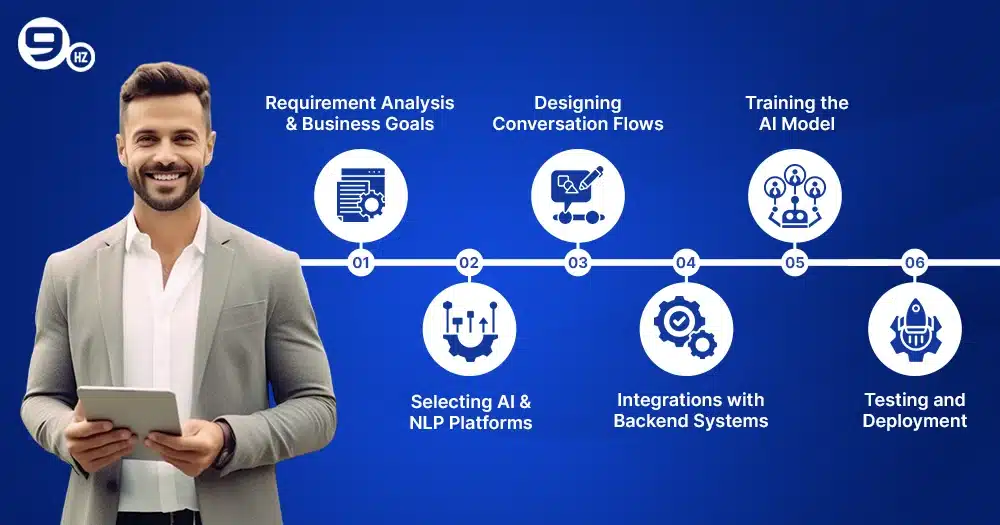
For business leaders, it is essential to understand the process of insurance chatbot development. This will help implement the bot in the right and desired way.
Start by defining the goals and analyzing the requirements. Be clear about what the chatbot is meant to handle, whether that is common questions, claim support, policy-related queries, renewals, or lead generation. It will clearly help you document all your chatbot development needs.
Pick an AI and NLP platform for your chatbot. It will help you shape the chatbot to understand customers’ queries, intent, and context for providing natural responses. A few solid options worth looking at: Ema, Kore AI, Cognigy, Botpress, or Strada. Insurance app development company will help you to select best platform for insurance chatbots development.
Conversation flow matters as much as the frontend and backend of a chatbot. Critically, the process how customers will engage with the bot and how it guides the interaction. Here, your goal is to make the communication feel natural. Each response must navigate customers to the next step.
The chatbot must be able to pull the information and details from the backend. This is where backend integration plays its role. Connect your chatbot to the backend. Ensure it fetches policy details, claim status, payment history, interaction history, and more.
At this step, you need to train the AI model. Train your chatbot on real insurance-related queries, customer intents, and support scenarios. This allows chatbots to work seamlessly and provide relevant responses.
The last step of insurance chatbot development is testing and deployment. Rigorous testing leads to a fine product. Thus, businesses need to test the chatbot on a real-world or actual scenario basis, including bug testing and removing vulnerabilities.
Besides the frontend and backend tech stack, there are some crucial technologies that are required to build a fully functional AI chatbot for insurance and banking businesses. The role of AI is critical, but its subsets are also needed.
NLP helps chatbots understand, interpret, and generate human language. The technology allows chatbots to communicate with customers with intent, context, and sentiment. In simple terms, using NLP chatbots responds naturally rather than with fixed replies.
AI and Machine Learning make chatbots self-efficient. Using AI & ML, chatbots understand the patterns and learn to analyze conversations with the customers and provide personalized replies related to the policy number, claim, and queries.
Modern virtual assistants or chatbots support voice-enabled communication. Through using speech recognition technology, the chatbot listens and understands the voice queries of customers using NLP and provides answers.
Although from the business benefits POV and the best practices, implementing chatbots for multi-channel support is the best. Web and mobile chatbots function the same, but they are slightly different. Web chatbots are useful for quick support and lead generation. Mobile chatbots help with user convenience, and customers can access them anytime, anywhere.
Insurance chatbots deal with sensitive information of customers, such as name, contact, address, and financial data. Thus, it is necessary to ensure the security and comply with the regulations such as HIPAA, GDPR, and others. For security, implementing End-to-End Encryption (E2EE), Data Masking, Multi-Factor Authentication (MFA), Role-Based Access Control (RBAC), Prompt Injection Filters, and others is the best practice.
The cycle doesn’t end with just developing an insurance chatbot and using it for handling customers. There are some practices that you should follow for better customer satisfaction and chatbot success.
The customers can interact with your team through any medium, i.e., website, insurance app, or through social media, as preferences are diverse. Make sure that your insurance chatbot supports multi-channel availability and stays accessible.
Similar to the other key industries, the fintech and insurance sectors are also focusing on personalization. The companies are providing personalized responses based on the customers’ profiles. Your chatbot must be capable of fetching the details from profiles, policy, and past interactions, and provide relevant responses to the customers.
An insurance chatbot should not stay fixed after launch. The better approach is to track the queries customers ask, failed conversations, and well-performing responses. Based on it, train your chatbot so it can provide relevant responses. This helps improve the chatbot, making it more useful in real customer situations.
Some questions need a human touch. Some cases are too complex, sensitive, or urgent. In such situations, the chatbot should smoothly transfer the conversation to a live agent. There must be no need to repeat the query for the customer.
On the brighter side, insurance chatbot development brings potential benefits to the business. But on the darker side, you should not forget that there are certain challenges also associated with developing a chatbot for the insurance business. Some common challenges include a complex regulatory environment, legacy systems, integration issues, and more.
Customers do not always ask questions in a fixed format. Some customers may ask simple questions, but some may ask in confusing language or put incomplete queries. This may create issues while addressing the query if the chatbot is not capable of understanding.
Insurance chatbots deal with personal, financial, and policy-related data. As a result, following industry regulations and complying with local and international regulations is a must.
Still, some insurers are using legacy systems for processing claims, issuing policies, and handling customer records. If the system is not compatible with modern technologies, it may create issues while using the insurance chatbot from both ends, i.e., the business and the customer’s end.
Although AI chatbots are efficient at handling queries, they miss the human touch. When a customer switches to the questions and returns to the earlier executives, they still understand, but the insurance chatbot may fail to maintain the contextual understanding and can make communication entangled.
The better approach to overcome all these challenges is to train your insurance chatbot on real scenarios, while development ensures compliance with the help of a chatbot development company, assess your system before chatbot integration, and combine human and AI expertise to handle the queries.
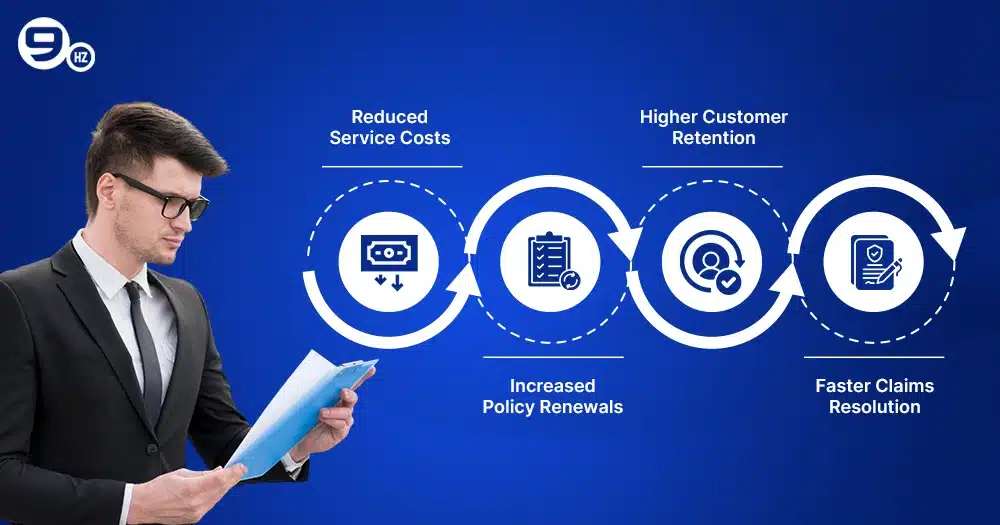
Insurance chatbots provide high ROI, such as reduced operational cost, increased revenue, improved customer retention, conversion, and more. The common use cases that impact ROI are claim processing, policy servicing, lead generation, and sales.
Let’s have a closer look at what you’ll get once you invest in insurance chatbot development.
The customer support team is required to answer customer queries, so the hiring cost is also associated. The insurance chatbots can handle ~60-80% routine queries autonomously, such as FAQs, policy status, claim status, and others. That reduces the dependency on manual resources, reduces hiring cost, and service cost too.
Policy renewals are one of the key challenges for insurers as customers forget to renew or move to another company. Here, chatbots can help you send personalized reminders, offers, and help customers with the renewal at their own convenience.
Fast and easy support improves the customer experience. When policyholders get help on time, they are more likely to stay with the insurer instead of looking elsewhere.
Chatbots can collect claim details, guide users with the next steps, and share status updates. This makes the process fast and provides a seamless customer experience while filing for the claim.
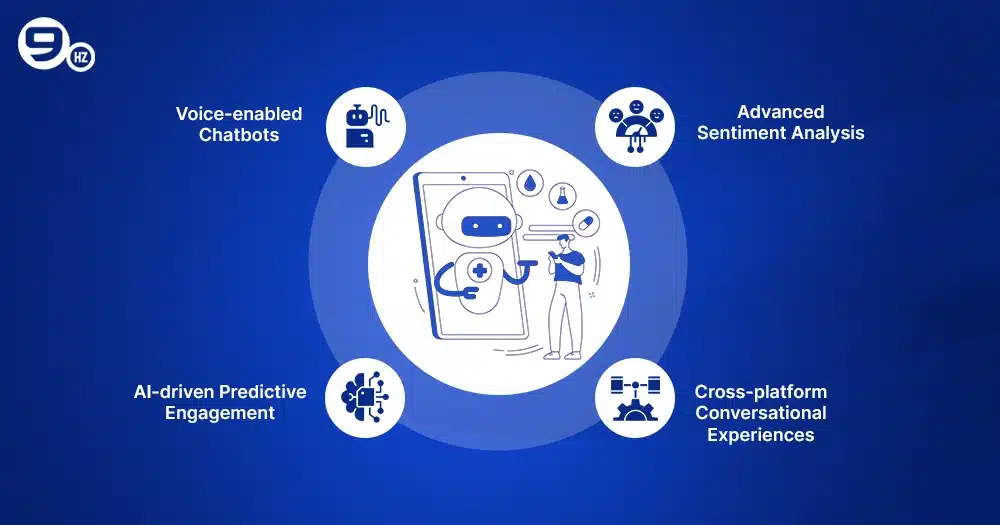
Insurance chatbot development is witnessing dynamic growth, and in the future, we’ll experience more than what we have today.
Customers are tired of typing. In the near future, you will talk to your insurance bot just like a person. This makes filing a claim or checking a policy much faster, especially when you are on the go.
Bots won’t just wait for you to ask a question. They will use data to eliminate problems before they happen. For example, if a storm is coming, a bot might message you first with safety tips or a quick link to start a claim.
Bots are getting better at reading emotions. If a customer sounds angry or upset, the system detects it immediately. It can then change its tone to be more helpful or pass the call to a human expert to save the relationship.
The customers would be able to initiate the communication on one platform and continue on another. For example, starting a chat on an insurer’s website and finishing it in a mobile app without losing any information.
The needs of the insurance sector have changed, and customers demand immediate response regarding their policy, claim filing, and premium payment queries. Instead of traditional methods, using insurance chatbots is the best approach. These chatbots support diverse use cases from policy purchasing to claim filing. Consider this a strategic move.
The market competition is fierce, and using a chatbot, you can have an extra edge. A well-built chatbot can improve service, reduce workload, and help insurers stay ready for changing customer expectations.
This is the right time to integrate a chatbot into your customer-related workflows. For strategic development, it would be a better idea to consult with an experienced chatbot development company.
The key insurance chatbot use cases involve Customer Support, Claims Processing, Quote Generation, Premium Payments, and Customer Retention & Renewal.
Some real insurance chatbot examples are: Lemonade (AI Maya & AI Jim), Geico (Virtual Assistant), and Progressive (Flo).
That depends on needs. It may take a few weeks to develop a basic chatbot, but an advanced one requires 8-10 months initially.
The best technologies to build an insurance chatbot are AI, ML, NLP, and secure backend integrations.
Yes, if developed genuinely and with the help of a reputed chatbot development company.
The ballpark estimate is $20,000-$100,000. The rest of the things depend on complexity and features.
Yes, but sometimes it requires human intervention if the case is sensitive and needs expertise. Combining human expertise and AI is a better approach.
Insurance chatbots improve customer experience by providing instant responses and 24/7 support for all types of queries, from policy details to claim filing.

Key Takeaways Insurance mobile apps are the digital interface designed for policyholders where they can track, manage, and file a…

Key Takeaways Insurance claims management software is a must rather than just a mere option in environments where the volume…

Key Takeaways With the end in sight of digital healthcare and InsurTech, insurers need to focus on developing mobile health…