
The insurance industry has witnessed significant evolution, with technologies like customized software and artificial intelligence playing a core role. The insurance platform market around the world had a valuation of $116.16 billion in 2025. The market is expected to grow with a CAGR of 12.3% to achieve the valuation of $207.52 billion by the end of 2030. The key challenges, such as slow claim processing, manual analysis of incident reports, and a lack of customer satisfaction, have been the core motivating factors for businesses to opt for insurance software development.
However, the cost associated with insurance software development services still shapes the decisions of most of the FinTech companies. While the average cost ranges between $40,000 to $300,000, it can be highly optimized using certain cost-saving practices. In this blog, we will be talking all about custom insurance software development, the cost, the development process, and more.
Insurance has evolved from a traditional product to a digital service, portraying itself as a life and finance savior in case of any incident. However, no one has time to visit the insurance offices and banks to register their case and get the claim. Thus, the traditional vehicle insurance system is no longer efficient to cater to changed customer expectations. Here are some of the reasons to upgrade from the traditional vehicle insurance systems-
The traditional vehicle insurance relies on static factors like car model, age, and personal details of the driver. Thus, it eventually misses the more important factors like driver behavior, which has the most impact on the insurance claim chances.
The traditional insurance software development solutions don’t cater to the modern usage patterns like shared mobility, part-time driving, and carpooling. Thus, it requires a pay-as-you-drive model.
It can never be denied that the traditional insurance workflow included a lot of manual reviews, lengthy paperwork, and took weeks to settle even a simple claim. As customers now expect a faster andmore active resolution of insurance policies, it requires businesses to shift to a more efficient insurance software.
The legacy systems in the insurance industry carried outdated IT systems, which prevent the utilization of real-time data. Thus, it becomes impossible for the insurance companies to provide more personalized and competitive pricing in insurance plans.
Generally, the cost to build an insurance software development ranges between $40,000-$300,000, the exact cost is influenced by a range of factors. It can include the project complexity, location of the development team, and development stages. At the same time, integrating advanced technologies like artificial intelligence, machine learning, and natural language processing can further elevate the cost.
Let’s break down the insurance software development cost based on different factors-
| Complexity Level | Estimated Cost | Development Time |
|---|---|---|
| Basic Software | $30,000-$70,000 | 3 to 5 months |
| Moderate Software | $70,000-$125,000 | 5 to 8 months |
| Complex Software | $200,000- $300,000 | 8 to 10 months |
| Enterprise Software | $300,000+ | 10 to 18 months |
| Stage | Cost |
|---|---|
| Planning Analysis | 5 to 10% |
| Design and Prototype | 10 to 15% |
| Core Development | 50 to 60% |
| Testing QA | 15 to 20% |
| Launch Development | 5 to 10% |
| Maintenance Support | 10 to 20% per year |
The insurance software development process comprises several stages, where each step consumes certain resources. The approximate cost breakdown on the basis of the development stage is as follows-
| Country | Hourly Rate |
|---|---|
| North America | $100 to $200 per Hour |
| Western Europe | $70 to $150 per Hour |
| Eastern Europe | $40 to $80 per Hour |
| Latin America | $30 to $70 per Hour |
| India | $20 to $50 per Hour |
It might sound vague, but the location of insurance software developers has a significant impact on the overall project cost. Hiring a developer from countries like the USA, UK, or Australia can cost you more than twice as much as hiring a team from India.

Custom insurance software development includes a policy administration system that helps to manage the entire lifecycle of a particular policy. Whether it is a quotation based on issuance, endorsement, or the product configuration, it takes care of the entire process. The policy administration system helps the insurance companies to launch the product faster.
As the name suggests, claim management software is designed to automate the claim lifecycle while taking care of various tasks like claim intake, assessment, validation, settlement, approval, and reporting. It can be easily integrated into the document management system, fraud detection tools, and third-party platforms for seamless data flow and decision-making.
An underwriting and risk assessment engine is designed to analyze the risks associated with the claim application using actuarial models, historical data, real-time data sources, and predictive analytics. Thus, it helps to make data-driven decisions and apply customized rules.
Billing and payment processing systems are a big part of overall insurance software development services that focus on building automated software that can manage the invoicing, multiple-channel payment acceptance, payment schedules, and reconciliation process. The software can also be integrated into the accounting software and compliance modules.
Customer self-service portals are curated to help policyholders manage their policies, file claims, make payments, upload proof, and track the status of their claims without connecting to a human customer support agent. These portals are available around the clock, where the virtual assistants are always active to answer queries and take feedback.
Agent and broker management platforms help to streamline commission tracking, onboarding, performance monitoring, and regulatory compliance management. These systems are capable of centralizing information like sales data, renewals, commissions, and lead allocation processes to provide easy and secure access to crucial information when required.
When businesses look for insurance software development, they have mainly two options. The first one is custom insurance software in which a digital solution is curated from scratch according to personalized business requirements and preferences. The other one is an off-the-shelf solution, which is a ready-made software that can be customized according to business needs for quick deployment.
Both the choices for insurance software development services have their pros and cons.
| Comparison Factor | Custom Insurance Software | Off-the-Shelf Software |
|---|---|---|
| Long Term Flexibility | Custom software is designed for long-term business needs where the features and technologies can be added according to changing market trends. | The upgrades for long-term growth are defined by the vendor; a business can not choose to impart features on its own. |
| Scalability | Custom software is highly scalable to handle an increasing user base. | Off-the-shelf solutions are not that scalable and might need replacement after a certain time. |
| Support and Maintenance | Around-the-clock support from the insurance app development company to ensure a seamless user experience. | Depends on the support provided by the vendor itself. |
| Compliance and Regulations | Designed exclusively according to particular legal compliances and regulations, strengthening brand image. | Covers the general compliance and updates. |
| Innovation capability | The technology stack can be upgraded while integrating more advanced technologies. | Innovation is highly limited to the vendor’s roadmap. |
| Time to Market | Takes comparatively more time as every feature is built from scratch. | Can be quickly deployed as it needs only a little implementation according to business needs. |
| Upfront Investment | Requires more investment at the beginning, but also brings more ROI. | Comparatively cost-efficient solution for small firms and entrepreneurs. |
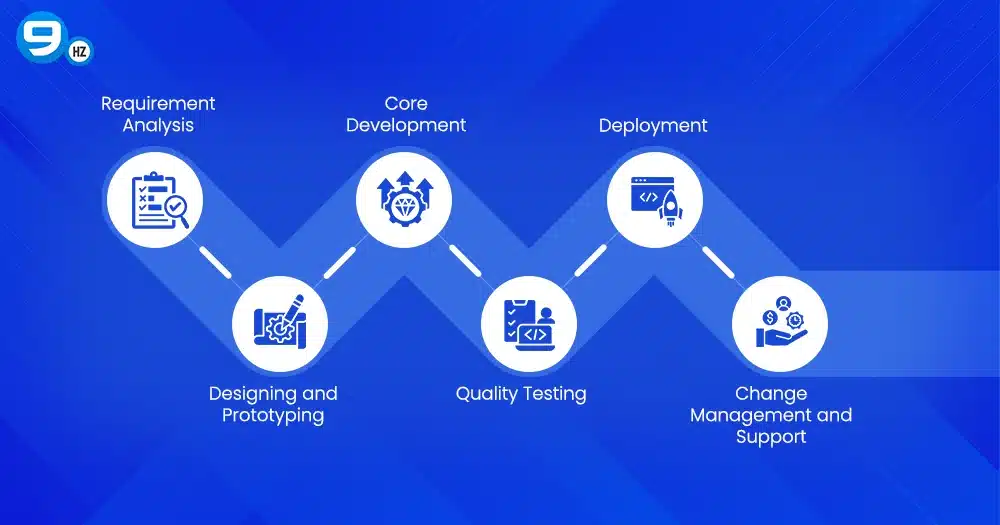
The process to implement the insurance software can differ from one company to another according to their respective development methodology and preferences. However, the overall implementation process remains unchanged and goes as follows-
This is the first step of the insurance software development process where the businesses have to identify their pain points, core challenges, and user needs. The identification of all these factors helps to weigh the efficiency of the software by the end of development.
Once the client is sure about the project goals and features, they partner with the right insurance software development company. The development partner builds a design prototype that offers an idea about features, design, and navigation. This prototype is approved by the client.
This is the most crucial phase of the software development process, where the entire frontend and backend of the software are curated. It also includes the data migration and integration to meet the compliance needs and security standards. The software is made functional at this step.
As the name suggests, this phase is dedicated to performing the range quality tests to ensure that the final software doesn’t carry any errors or bugs. For the same, tests like unit testing, functional testing, security testing, etc., are carried out.
This is the final stage where the software is deployed to the respective marketplace. It can be deployed on the Apple App Store, Google Play Store, or the internal tech ecosystem of the client organization. This step makes the software accessible to the target audience.
It has to be ensured that the stakeholders in the insurance company can use the new features and capabilities. For the same, a change management plan consisting of training sessions, gradual roll-out, etc., is implemented. The insurance software development company provides consistent maintenance and support to ensure the long-term operability of the software.
According to the views shared by decision makers in the insurance industry, the software and AI solutions have showcased significant ROI after implementation. Here is a picture of how much ROI that insurance companies are leveraging through software development and AI implementation-
Here are the key metrics that most of the insurance companies use to calculate their ROI from software implementation-

As interpreted in the above section, it is highly important to choose the right insurance software development company for your project. The NineHertz carries an experience of 15+ years in building FinTech solutions. We have partnered with the insurance firms globally to help them digitize their operations and multiply their revenue.
Here are some of the reasons that many insurance brands trust us for their technical needs:
We work with domain-specific experts who help us understand the key challenges, gaps, and opportunities in the particular industry. Thus, our developers build the solutionsaccordingy to the real-time needs of companies and end-users.
The NineHertz focuses on establishing a strong foundation for the project. Thus, we provide a free consultation to understand key business requirements, features, and give the right guidance on the software development. We also commit to the budget and timeline and stick to it.
Our team of insurance software developers deploys the agile project management methodology that helps to build the software in less time. The development approach ensures not to compromise on the quality of the final output i, irrespective of the short timeline.
We prioritize the data safety of our clients and their projects. Therefore, we keep the non-disclosure agreement (NDA) at the center of the development process. It ensures that any information related to the project or client is kept confidential between the concerned parties.
Our team promises the long-term performance of the software. So, we provide the post-deployment maintenance and support in which our developers consistently monitor the software performance, add new features, remove bugs or errors, and provide periodic updates.
Digitizing the operations in the insurance industry is no longer an option but a necessity to grow sustainably. It helps to reduce claim settlement cycles, curate personalized policies, analyze proof of incidents, automate underwriting, and much more. When estimating the cost of custom insurance software development, the ROI has always been more significant for such software.
If you are also looking to build an insurance software, fill out the contact form or reach out to our team via. Get a free consultation and make an informed decision at [email protected].
The smart AI software and agents help to manage intake and validate documents, aggregate data risks, check coverage, and route the cases according to their respective niche and complexity. Thus, it reduces the workload for human employees while also eliminating the chances of errors.
Yes, custom insurance software has been consistently delivering a good ROI. They have increased revenue by 5-10% while intelligent analytics offer 3000-900% ROI to insurance companies.
It costs anywhere between $40,000-$300,000 to build the customized insurance software. However, the exact development cost is highly influenced by a range of factors like project complexity, development timeline, location of developers, technology stack, and more.
The insurance software must contain features like an admin panel, quote & filters, policy details, payment gateway, claim filing, customer support, document upload and storage, push notification, etc.

It’s shocking that one malformed payload could have leaked customer data through an API edge case. It happens when there…

Any enterprise managing 500+ operations at times across the globe to cover supply chain, production lines, customer service centres, and…

Innovation has been a game-changer for asset tracking, with the introduction of barcode labels, asset tags, and the integration of…