So, when did you last open Netflix? Maybe yesterday- Right?
Did you know it is one of the top real-life examples of SaaS product development?
Don’t be surprised if there are plenty more we use daily without even realizing it, such as Google Drive, Dropbox, or Zoom, to have an online chat with our friends or family.
The SaaS market isn’t just growing—it’s accelerating at hyper-speed. Irrespective of size, companies or organizations use at least 112 SaaS apps and spend $1000 to $3500/ employee in each financial year.
The global SaaS market is expected to hit $793.10 billion by 2029, growing at a CAGR of 19.38%. Average per-user spending is also set to soar. Put all of this together, and the SaaS product development market is exploding, and it is the right time to invest in it.
Might you have a question—Will SaaS solutions work for my industry? Yes, SaaS is not limited to one industry. Businesses across diverse industries can utilize it for cost-effectiveness and sustainable business growth.
Or if you have a question about how to build a SaaS product, we’ve got your back. We have created an article to help entrepreneurs like you get a complete idea about the development process and various aspects like benefits, cost, challenges, best practices, and more. With the right SaaS development services, turning your product idea into a scalable solution becomes faster and more efficient.
Thus, it’s time to explore the blog. Let’s Go!
Before you find a perfect answer to your question about how to create a SaaS product, it is essential to know the definition and basics.
The process of creating cloud-based software applications is called SaaS product development. SaaS apps are hosted on a cloud server, and users can seamlessly access them online through a browser instead of installing them on their devices.
Software-as-a-Service providers handle infrastructure and maintenance independently. This approach offers key advantages, such as cost-effectiveness, scalability, and convenience.
Like any app development, SaaS application development also involves steps such as ideation, requirement analysis, UI/UX design, frontend and backend development, quality assurance, launch, and maintenance.
In terms of use, users pay a subscription fee monthly, quarterly, or yearly instead of purchasing a one-time license fee. It allows users to use the apps based on their requirements and when they want to use them. SaaS applications scale with usage, making them perfect for all.
How is SaaS implemented? There are three ways to do it.
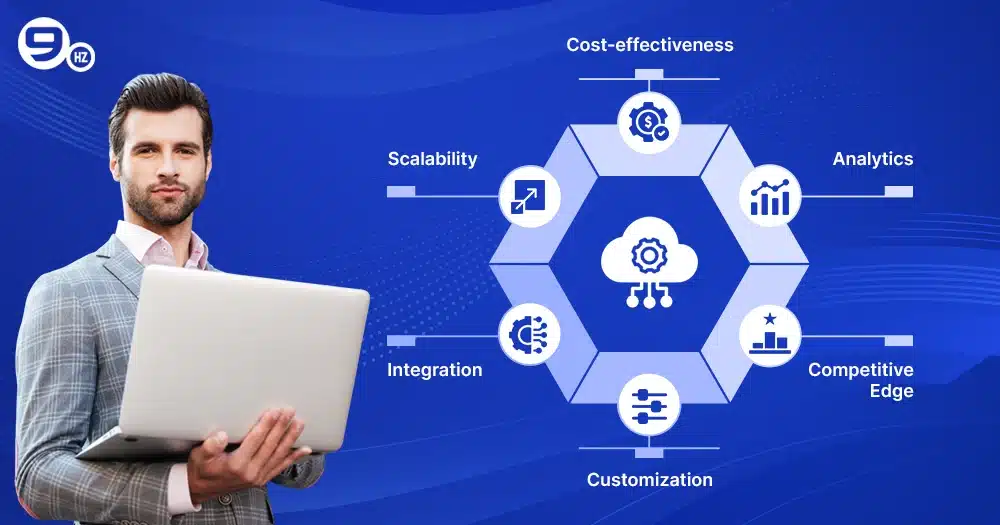
SaaS products offer myriad benefits not only for businesses but also for users. From a business perspective, the question is: Why should you invest in SaaS product development?
The SaaS products save businesses from upfront infrastructure and hardware costs. Companies also save on ongoing expenses since the provider takes care of maintenance and support.
SaaS products scale seamlessly, supporting an expanding user base without sacrificing performance. You can scale your product to meet demand.
Saas products can easily integrate with existing services that help businesses streamline their workflow and boost productivity.
Customization is one of the significant advantages of SaaS product development. Businesses can customize their SaaS app to meet their customers’ emerging demands.
Using SaaS-based applications, you can deliver your services at flexible pricing, which will attract more customers and increase retention rates.
In almost all SaaS tools, you get built-in analytics and reporting tools that you can use to gain deeper insights and design a perfect business strategy.
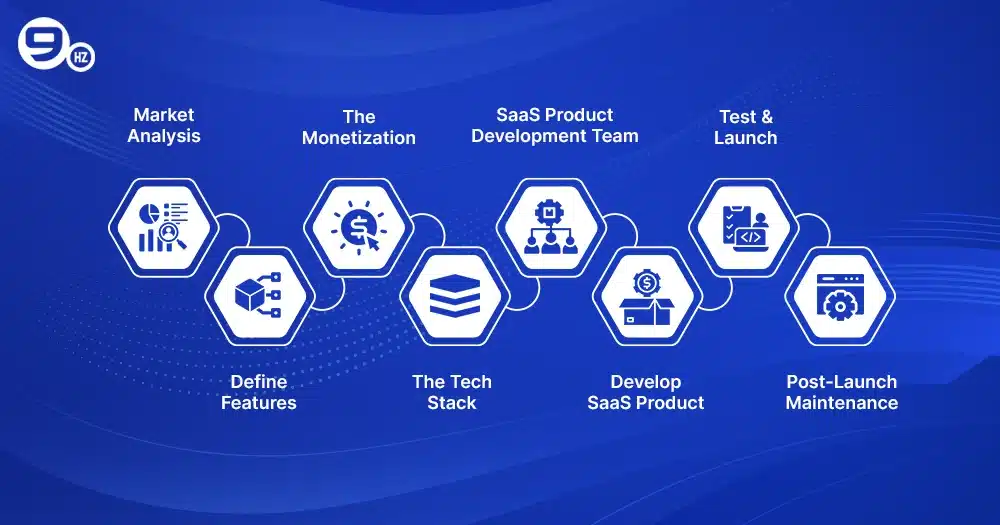
So, how to build a SaaS product? It is a staged process, and each step gradually leads to your dream product.
So, let’s look closely at the steps to develop a SaaS product!
The first crucial step is idea validation to ensure your SaaS product meets the exact needs. Thus, start with market research, such as what products exist with similar intent, who your competitors are, and what the latest SaaS development trends are. Then, identify the gaps you’ll bridge with your software.
Also, determine for whom you’re going to develop your project, and that is your target audience, right?
Once you’ve completed everything, outline the problem statement, value proposition, and target market description. This will all help you later.
What makes a user stick around an app is its features, and SaaS Product development is no exception. If you’re thinking about how to develop a SaaS product, this step becomes even more critical. So, your next crucial step is to prioritize the features. The best professional way to do it is using the Kano Model. It helps a lot when deciding on features.
Also, remember to define features based on your business goals and target audiences.
Monetizing is not about pricing; it is about offering real value with a sustainable business model.
The right monetization strategy ensures long-term profitability. Thus, before you can monetize, you need to determine how to earn and how customers will pay, or they must have options to choose from.
The popular pricing models are categorized as follows:
Talk to our Experts
Get a Free Consultation
Selecting the right stack stack is crucial for developing a robust application. In fact, selecting the right technologies is one of the most important steps while planning how to create a SaaS product.
The tech stack refers to the tools and technology for developing a full-fledged SaaS application consisting of UI/UX, frontend, backend, database, hosting, infrastructure, and others. It includes:
| Layer | Common Technologies |
|---|---|
| Frontend (User Interface) | HTML, CSS, JavaScript, React, Vue.js |
| Backend (Server-Side Logic) | Node.js, Python (Django), Ruby on Rails, Java |
| Database | PostgreSQL, MySQL, MongoDB |
| Authentication | Firebase Auth, Auth0, Passport.js |
| Hosting & Servers | AWS, Google Cloud, Microsoft Azure, Heroku |
| APIs | REST, GraphQL |
| DevOps & Deployment | Docker, Kubernetes, GitHub Actions |
| Monitoring & Analytics | Google Analytics, Sentry, Datadog |
| Payment Integration | Stripe, PayPal, Razorpay |
Who will develop it is more important than finding the right way to develop a SaaS product. It is the work of precision, experience, knowledge, and skills, as you don’t want to face any bounceback after releasing your app.
Choose an experienced SaaS development company, similar to what successful brands have done before. When hiring experts, evaluate their knowledge, check their skills, go through portfolios, read testimonials, enquire about hiring models, and then make a final decision.
At this step, you’ll have the final answer to your question— how to develop a SaaS product? Until reaching this stage, you have decided your goals, tech stack, and SaaS development team. So, from this step, the developers and designers will carry forward your tasks.
Starting with wireframes, the process moves into full UI/UX design. When the design phase is complete, developers build the backend, frontend, database, and integrating services.
The best idea is to start with SaaS MVP development. It will be cost-effective and help you gather real-time feedback from your users.
Rigid testing will help you ensure that your SaaS app or software will work properly on both your and your customers’ sides. Quality analysts will use different testing techniques to ensure that your product is ready for launch. After quality assurance, check the final version and release it for your users.
To reap long-term benefits, support and maintenance should be ongoing. It will increase customer satisfaction and consistency. The process involves fixing defects, upgrading features, and legacy modernization.
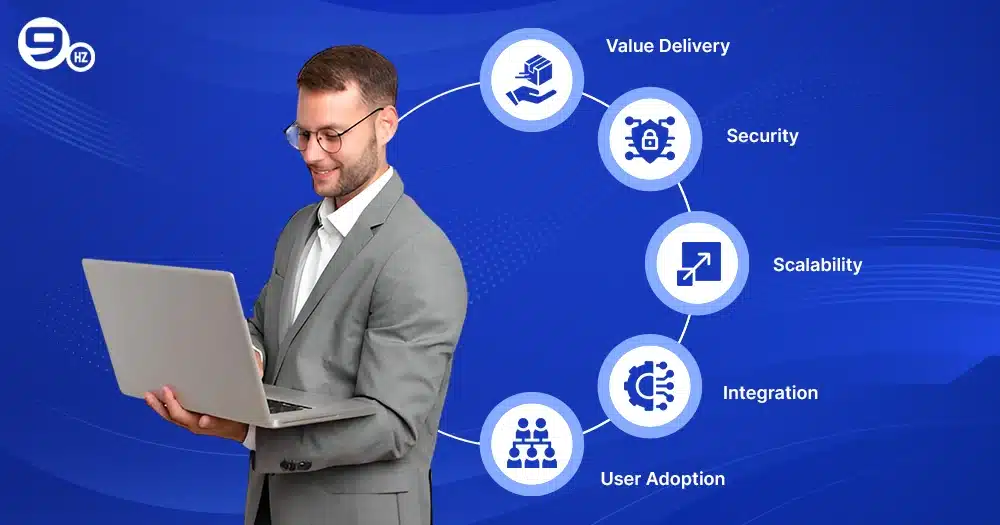
Based on the earlier section, developing a SaaS product is easy. But things are not as they seem. Similar to day and night or heads and tails, there are specific challenges that you must be aware of. Understanding how to develop a SaaS product also means preparing for those hidden challenges.
With the SaaS product market’s rising graph, customers’ expectations are also high. Additionally, business competition is also on the verge. Therefore, creating a customer-centric product is a significant challenge.
Protecting sensitive data is a big hurdle as cyber attacks increase, whether it is a SaaS app for customers or data that your employees will access in-house.
The worst apps don’t scale with the growing user base, and this is true of most failed applications. It is a big challenge in SaaS product development to have a scalable solution that scales in real time with feature updates and security patches.
Integrating SaaS products with existing systems isn’t as easy as it might seem. If the systems are loosely coupled, it can lead to serious issues during real-time execution.
Customers have established preferences, and convincing them to switch from conventional apps to the SaaS product can be a bit tricky.
A SaaS product development strategy helps you outline who you are building the product for and the next steps, like marketing and selling it.
SaaS product strategies differ from one organization to another, and there’s no one-size-fits-all solution.
A strategy that works for one product and across one industry may not work for others. Here’s a general strategy that works for various organizations across industries that you can customize according to your requirements.
The SaaS product strategy begins with identifying your target audience. You have to create a customer persona with their age, location, and pain points.
For example, let us assume that you’re building a SaaS product for school management. You have to decide whether the application is for government schools or private schools, as they have different pain points. This segmentation will help you focus on someone specific rather than trying to please everyone.
You have to choose a pricing model that aligns with the value expected by customers. SaaS companies should experiment with different pricing models, such as freemium or subscription-based pricing.
You can also offer tiered pricing models where there are plans like basic, standard, and premium payment models.
For example, let us consider a train ticket. For the same destination, people pay different prices for a sleeper class and an AC compartment. Similarly, customers pay for your product based on the features.
You can also charge your customers based on app usage. Let us take the example of prepaid mobile recharge; your balance will reduce as you use it. That’s how a usage-based model works.
You need a plan to market your product before launching it. And for that, you need to have answers to questions such as: In which platforms does your target audience spend the most time? Are they on LinkedIn or X? Or do they prefer emails or calls?.
When you have the answers to these questions, figure out the next steps of the campaign. Start marketing your product even before building it for a successful launch.
The next step is to plan how you are going to develop the software and where you are going to store the data. Applications built on single-tenant architecture provide maximum privacy and security. But it is expensive to build and maintain those applications.
SaaS products with multi-tenant architecture are easy to scale and cost-effective. Choose an architecture where there’s an intersection of privacy and cost.
A well-built SaaS application has adaptive features that grow along with the number of users and adjust to changing market conditions.
Let us assume that your SaaS product has 1000 users now. You should have a strategy to run the app without crashing, even when there are 100,000 users. That’s what a scalable architecture can do.
Once you have planned the strategy, the next step is to prepare the SaaS product development process. Many organizations use strategy and development processes interchangeably, thinking that they’re the same.
Talk to our Experts
Get a Free Consultation
The SaaS product development process defines the steps you need to convert your idea into a working SaaS product. A SaaS product development strategy helps you understand what product you are building and why you’re building it. But a SaaS product development process explains how you build the product.
Before developing the code, you have to ensure that people would like to pay for the product you’re building. Once there is proof that there is enough demand for your solution, you have to decide on your approach for product development. Are you going with custom product development or Saas based product development? Because this decision will shape all the steps that follow after this. Let us look into each development method in detail.
Custom SaaS development, building a product for a specific niche or a specific client based on their requirements. For example, if a hospital approaches to build their patient management platform and tells you that it has to integrate with their billing system and support regional languages. Then you build them a custom SaaS that supports their workflows.
Advantages of custom SaaS product development:
Disadvantages of custom SaaS product development:
Custom SaaS works best when you are targeting large enterprises that have specialized needs and when they are willing to pay accordingly.
SaaS based product development follows exactly the opposite method from custom development. In this process, you build a product and sell the same to 1000 customers. All clients get the same benefits and use the same platform. Apps like Slack, Zoom, and Notion are built using SaaS based product development.
This method takes advantage of cloud infrastructure and development platforms to speed up product development. SaaS-based products are also called off-the-shelf solutions or plug-and-play solutions, as they are not customized for each client.
Advantages:
Disadvantages:
Saas based product development methods are useful for startups that would like to launch their products quickly without investing in complex infrastructure.
When you’re clear with the development model, move on to the product roadmap that defines what features you’re going to include in the first version and what the next 12 months of product development are going to look like. Build a prototype to get early feedback and adjust the functionalities of the product. And then you will be left with development, testing, and launching the product.
Usually, people use the terms SaaS product strategy, lifecycle, and process interchangeably, assuming they are the same. However, the SaaS product development lifecycle differs from the SaaS development strategy and process, as it outlines the stages a product undergoes from an idea to its long-term growth.
It describes what happens after a product launch and the lifespan of your SaaS product. The SaaS product lifecycle is a continuous process. Unlike traditional software, SaaS products have to be continuously updated after launch so that they stay valuable to users.
Let us go through the stages in the SaaS product development lifecycle.
Every SaaS product begins as an idea. But the life cycle of a product begins only when you validate in the market. You need to have answers for the most important questions, such as: Is the problem painful enough, and does the solution have a market? Is this the right time to enter? Companies that skip this stage are going to be at risk.
Unlike the SaaS product development process, where you focus on building the product, this stage in the development lifecycle helps you learn fast with feedback. You shape the next version of your SaaS product by interacting with users or identifying features you have missed or the ones you need to add. Your goal in this stage is not to build a perfect product, but to learn what your audience actually wants.
This is the stage where the product becomes live, and users engage with the app. At this stage, the biggest mistake that founders make is measuring success by signup numbers alone. Measure genuine success by the number of users who are returning to the product even after 30 to 90 days. Early retention numbers predict whether your product will have long-term growth or not.
Growth occurs when you double down on what works and strengthen your position in the market. In this stage, there will be an increase in the number of users and revenue. Before hiring new teams and expanding into new markets, ensure that your product is stable enough to support your growth. Premature scaling and ignoring newly entered competitors are some of the costliest mistakes that happen at this stage.
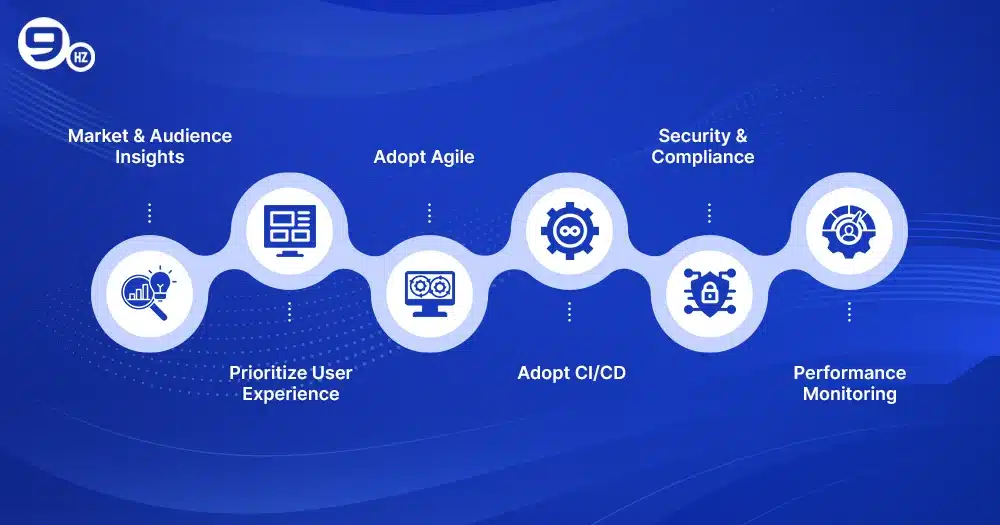
SaaS products are gaining popularity like wildfire. The global SaaS market is currently $266.23 billion and is estimated to grow to $1131.52 billion by 2032 [Fortune Business Insight]. This rising adoption creates multiple opportunities for businesses to launch their applications.
But how to make it a success? Some proven practices can help you with successful SaaS product development.
Know who you’re building for and where you’re going to launch. The first best practice is to know your market and audience. This will give you a clear vision and help you deliver value to your customers.
The success of your app or solution depends on the degree of satisfaction it provides to customers. Along with an appealing design, focus on smoothness so the user can have a delightful experience while using your solution.
Agile development methodology and SaaS product development are the best duo and made for each other. With flexibility and continuous improvement, you can create a successful SaaS product. Adopting agile methods is also the best answer to your question: How to create a SaaS product?
CI stands for Continuous Integration(ensures integration and testing of code changes regularly), and CD stands for Continuous Deployment(automates reliable delivery of updates). This process minimizes bugs and boosts security.
Implement robust security measures, including user authentication, data encryption, and compliance with relevant regulations.
Implementing a robust monitoring and analytics system before product release is crucial for continuous performance and reliability tracking, including measuring uptime and response times.
Hope you got an idea what are the best practices and How to develop a Saas product? So, here comes the most interesting examples of successful SaaS products and consideration for you as some remarkable references.
Let’s explore!
| Successful SaaS Products | Description |
|---|---|
| Slack | Team chat and collaboration for modern workplaces. |
| Dropbox | Cloud file storage and sharing made easy. |
| Zoom | Video conferencing for remote teams and meetings. |
| Shopify | E-commerce platform for online store creation. |
| Salesforce | CRM software to manage customer relationships. |
| Notion | All-in-one workspace for notes and projects. |
| Trello | Visual task management with boards and cards. |
| HubSpot | Marketing, sales, and service CRM platform. |
| Airtable | Spreadsheets meet databases for teams. |
| Figma | Collaborative design tool for teams and prototyping. |
Okay, so you’ve got an excellent idea for a SaaS app. But you need an experienced team to craft it as a success. Choosing the right SaaS development services provider is the best call you need to make.
Instead of falling into the low price trap, look for the experts who have actually made it for businesses and brands, ensuring the quality of the solution with real cost-effectiveness.
Saas product development requires expertise, so the first step to finding your right partner is to search for the names on the internet. Once you find it, make a shortlist and then:
Based on the above you can make your call. Whomsoever SaaS developers you hire they should be able to walk you through the process of how to build a SaaS product, step by step rather than making false commitments.
After reading this guide, we hope you now have a clear vision of what you need to do to make SaaS product development successful. Instead of building a conventional app for business, developing a SaaS app is a smart decision with benefits like cost-effectiveness, scalability, and more. Partnering with a reliable software development company can help you navigate this process smoothly and bring your SaaS product to life efficiently.
The entire game depends on whom you are going to develop it for, what pain points it will cover, what challenges it will solve, and who will develop it. If you are looking for an experienced SaaS development company, The NineHertz is your go-to partner.
We specialize in custom SaaS development, and our team is composed of certified SaaS developers who deliver out-of-the-box solutions that simplify clients’ challenges. Our knowledge of working with the latest tech stack and agile methodologies allows us to deliver what we commit to our clients, meeting their needs. We are open 24/7 to discuss your idea and how we will turn it into an exceptional SaaS solution.
So, when are you planning to launch your very own SaaS product? Give us a call!
The process of creating cloud-based software applications is called SaaS product development. SaaS apps are hosted on a cloud server, and users can access them online through a browser instead of installing them on their devices.
The SaaS product development process is a step-by-step workflow to build your product. Without a development process, teams may not understand their roles and responsibilities clearly, which can lead to miscommunication.
A SaaS product development strategy helps you outline who you are building the product for and the next steps, like marketing and selling it. SaaS product strategies differ from one organization to another, and there’s no one-size-fits-all solution.
Talk to our Experts
Get a Free Consultation
SaaS-based products are also called off-the-shelf solutions or plug-and-play solutions, as they are not customized for each client. Saas based products are scalable, and the marginal cost to add a new customer is zero. This approach allows you to launch your products quickly and is cost-effective compared to custom development.
The SaaS product lifecycle describes what happens after a product launch and the lifespan of your SaaS product. It is a continuous process. Unlike traditional software, SaaS products have to be continuously updated after launch so that they’re valuable to users.
The SaaS software or app runs through browsers, and users access it after paying for subscriptions. Conversely, traditional software requires installation on a device and a one-time licensing fee.

It’s shocking that one malformed payload could have leaked customer data through an API edge case. It happens when there…

Any enterprise managing 500+ operations at times across the globe to cover supply chain, production lines, customer service centres, and…

Innovation has been a game-changer for asset tracking, with the introduction of barcode labels, asset tags, and the integration of…