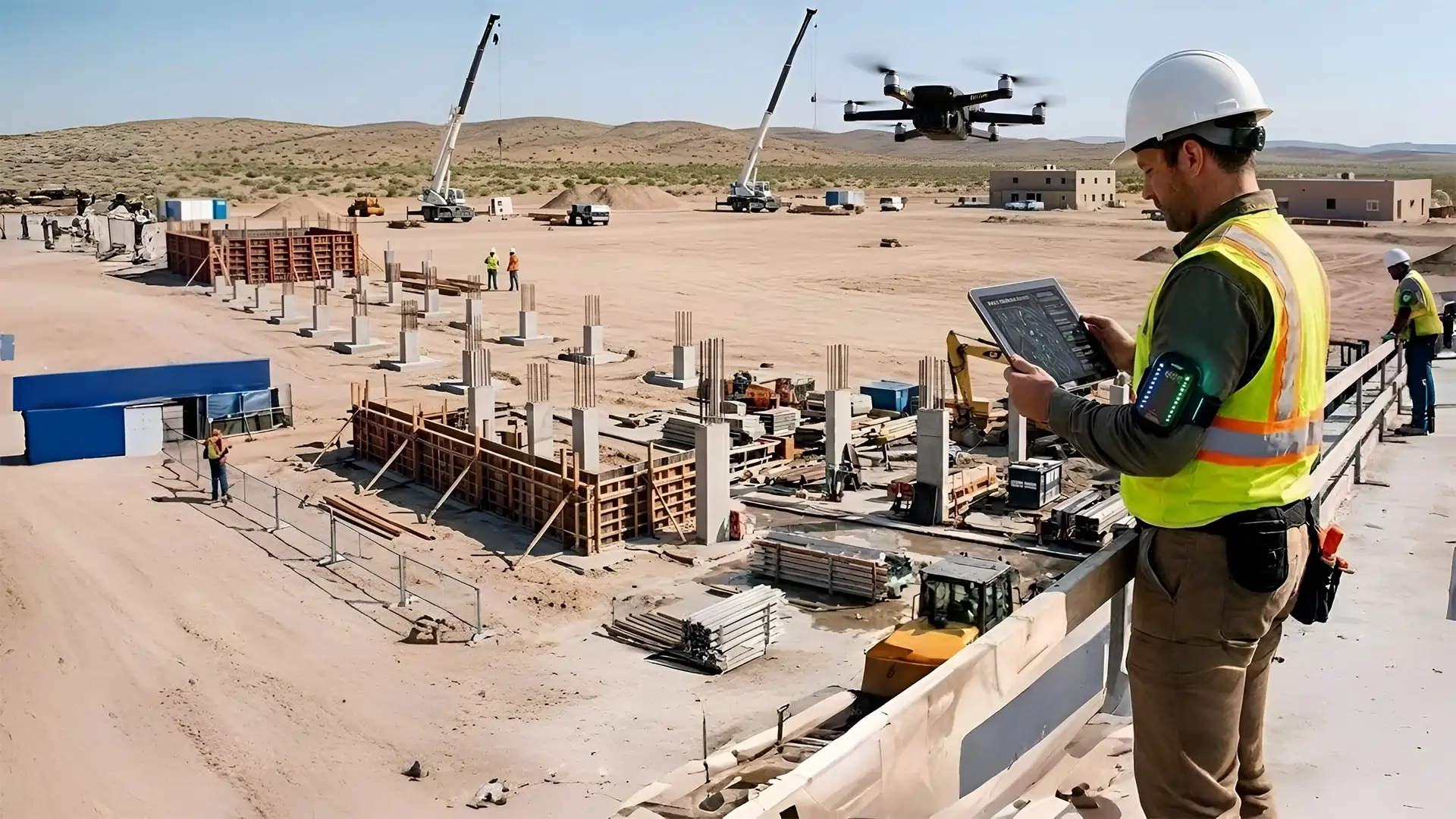
The construction industry struggles with project delay, cost overrun, and coordination gaps worldwide. As the project grows, managing real-time visibility of operations, workforce activity, and site conditions becomes challenging.
Safety adds another layer of complexity. According to the U.S. Bureau of Labor Statistics, nearly one in five workplace fatalities in 2022 occurred in construction. That statistic alone explains why many companies are looking for better ways to monitor job-site conditions.
Productivity is also a long-standing concern. Despite improvements in machinery and building materials, construction productivity has grown at only about 1% annually since 2000, compared with around 3% in manufacturing per year, according to McKinsey.
This is where IoT in construction project management starts to make a noticeable difference.
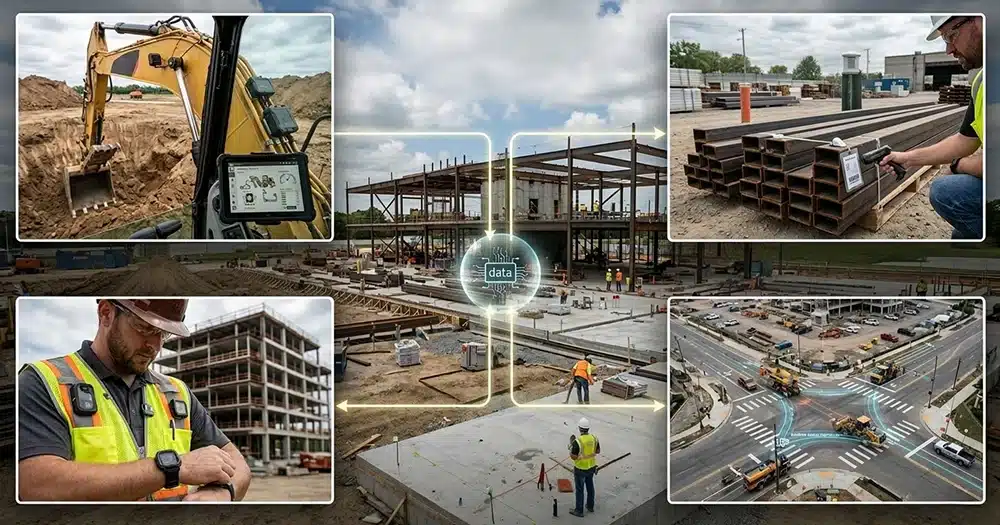
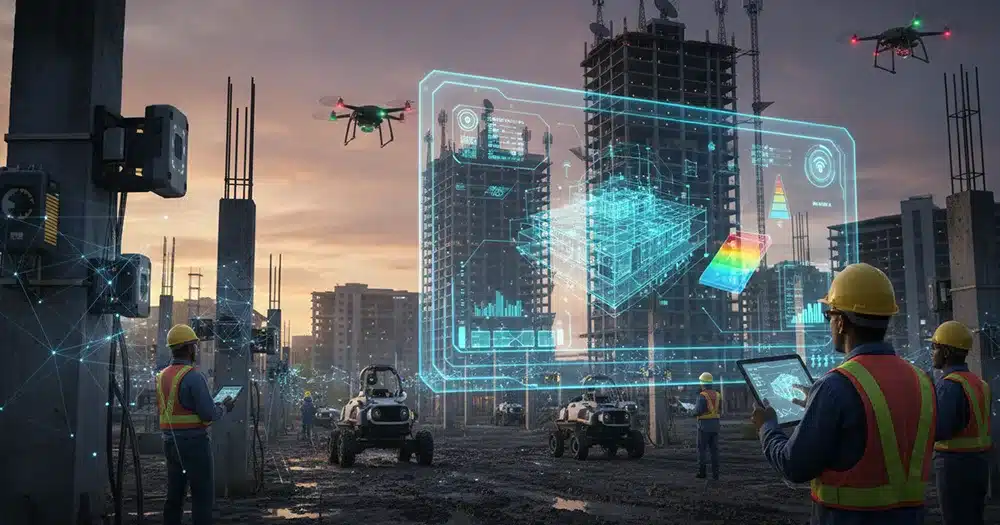
Instead of relying only on manual supervision, construction teams can now collect operational data directly from the job site. Sensors monitor equipment performance. GPS trackers locate materials. Wearable devices detect safety risks. Together, these technologies create a continuous stream of information that project managers can actually use.
The idea sounds technical, but the goal is simple: give managers a clearer picture of what’s happening on site.
And once teams can see the full picture, they usually make better decisions.
At a basic level, IoT in construction project management means connecting physical assets on a construction site to digital systems that collect and analyze data.
These assets include equipment, materials, environmental sensors, and sometimes even worker safety devices. Each device collects small pieces of information, temperature readings, vibration levels, location data, and operating hours, and sends them to a central platform.
Over time, those data points begin to reveal the exact picture of the project on the site.
For example, sensors on equipment let site managers know whether machines are working properly or just sitting idle for long periods of time. GPS systems allow managers to track the location of their materials and tools as they move throughout the day. Environmental sensors can give an indication of conditions that may affect worker safety and construction quality, such as heat and dust.
Put all of that together, and managers gain something they rarely had before: real-time visibility across the job site.
Within the broader IoT in construction industry ecosystem, several technologies usually work together.
Sensors monitor structural stress, temperature, or equipment performance. RFID tags and GPS systems provide location information for tools, materials, and vehicles across large buildings. Drones provide construction inspectors with aerial images for inspections and monitoring progress. Wearable devices provide real-time information on the worker’s location and environmental exposure.
None of the foregoing items can transform construction management overnight. But when they operate together, they create connected construction environments where managers can monitor operations continuously instead of relying on occasional updates.
And that shift, from periodic reporting to continuous monitoring, is what makes IoT valuable in construction.
For decades, construction projects ran on observation. Site supervisors walked through the site, checked machines, spoke with crews, and tried to piece together what was happening. Most of the time, that system worked. But it depended heavily on experience and constant attention.
Instead of waiting for updates, IoT in construction project management gives quick updates. Equipment sensors report operating hours. GPS trackers reveal where machines are moving. Environmental sensors quietly monitor conditions in the background.
The site doesn’t suddenly become simpler. But it becomes easier to understand.
Heavy machinery is expensive, and yet many contractors don’t fully realize how much time machines spend idling. Once companies install telematics sensors on equipment, the data tells a clearer story. Machines that seemed constantly active sometimes sit unused for long stretches between tasks. With that information in hand, project managers start adjusting schedules and reallocating equipment.
Some construction fleets have reduced idle machine time by around 10–15% simply by tracking how equipment is actually used.
Anyone who has worked on a large construction site knows how easy it is for tools or equipment to vanish for a few hours. A crane gets moved to another zone. A generator is borrowed by another crew. Someone spends half the morning searching.
Connected asset tracking systems quietly solve that problem. Managers can see where equipment is located without sending someone to walk the entire site.
Construction plans are rarely static. Weather shifts, materials arrive late, and equipment occasionally breaks down at the worst possible moment. When managers rely only on manual reports, they often learn about problems very late. IoT systems shorten that delay.
Environmental sensors can detect humidity conditions affecting concrete curing. Equipment monitoring systems can warn that a machine is overheating before it fails. These signals allow managers to respond earlier rather than scrambling after something goes wrong.
Traditional safety inspections rely heavily on human awareness. Supervisors watch crews and identify risks during walkthroughs. That process remains important, but connected technology adds another layer.
Smart helmets, connected vests, and environmental sensors quietly track conditions across the site. If a worker enters a restricted area or experiences a fall, alerts can reach supervisors immediately.
No system removes risk entirely. Construction will always involve physical work in dynamic environments. But earlier warnings can make a difference. And that’s the pattern with IoT in construction project management overall. It doesn’t replace human judgment. It simply gives teams better information to work with.
When people discuss the benefits of IoT in construction, they mainly discuss the technology, such as sensors, trackers, and dashboards. The real value will be reflected in day-to-day business practices.
Construction sites are characterized by heavy machinery and high-rise buildings, as well as the ever-changing risks associated with working environments. Even experienced crews face hazards. Wearable sensors and environmental monitors give safety teams an additional layer of awareness.
If air quality drops or workers enter restricted zones, alerts appear quickly. Organizations using connected safety devices have experienced an average of 20% to 30% fewer incidents.
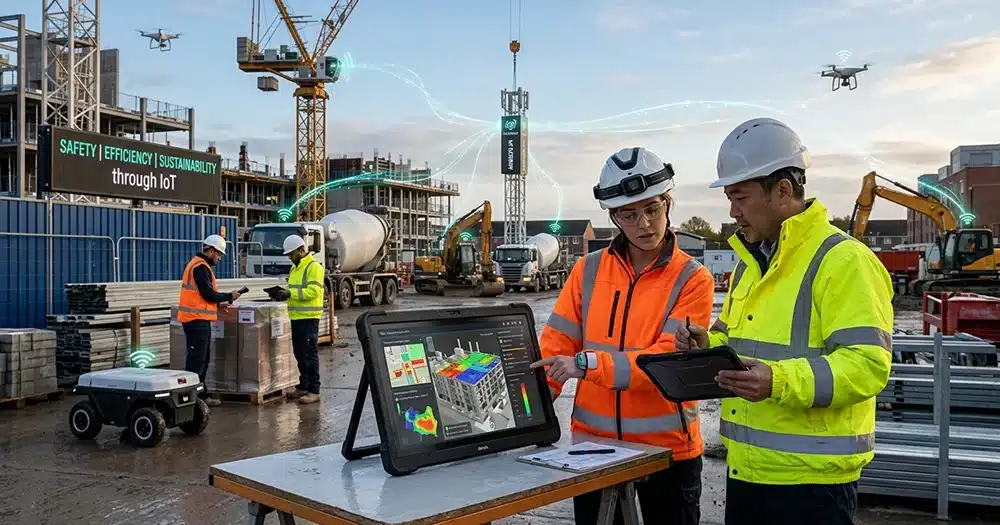
Traditionally, maintenance of equipment has been done based on a predetermined schedule; equipment is maintained every few months or every certain number of hours of operation. That system works, but it doesn’t always reflect the machine’s real condition.
IoT sensors track vibration patterns, engine temperature, and pressure levels continuously. Maintenance teams get early signals when metrics drift outside of their normal ranges. Instead of waiting until equipment fails, problems are addressed sooner by being aware of them early.
In the heavy industrial sector, predictive maintenance programs save maintenance costs by between 15% and 25%.
Construction productivity often slows because teams lack visibility into resource usage. Machines wait for crews. Materials arrive late. Workers shift between tasks inefficiently.
IoT monitoring systems expose those inefficiencies.
When managers analyze equipment activity and worker movement patterns, they start spotting bottlenecks that previously went unnoticed. Coordination improvements can sometimes shorten project schedules by a day or more.
Construction sites contain thousands of tools, vehicles, and pieces of equipment. Losing track of equipment isn’t unusual. GPS trackers and RFID tags help companies locate assets quickly, which reduces unnecessary purchases and prevents delays.
Over time, the accumulation of data creates a historical reference that allows managers to review past data for equipment usage, safety incidents, and construction time to improve planning for future projects.
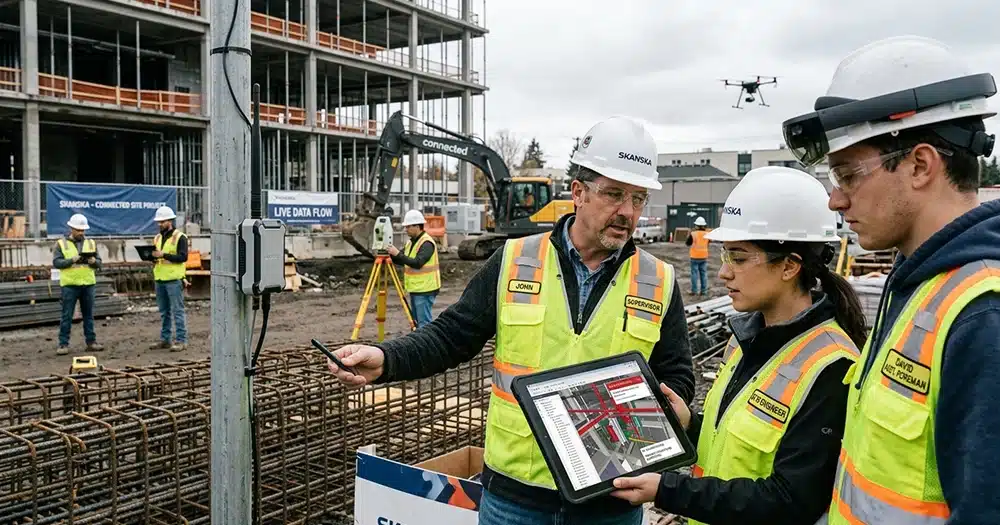
It’s one thing to talk about connected construction technology in theory. The more interesting question is how companies actually use it.
On large job sites, machines and tools move constantly. Excavators shift between zones. Trucks are used to transport materials between different areas of the site, and GPS allows construction managers to accurately track these trucks and the frequency with which they are used.
Better visibility helps contractors optimize equipment fleets and avoid unnecessary rentals.
Smart helmets and wearables enable the real-time tracking and monitoring of construction workers. So if a construction worker falls or enters a hazardous area, the supervisor receives an immediate alert. This allows the safety team to respond in much less time than if they had to rely on the manual reporting of an accident.
Many construction works require specific weather. To ensure that these conditions are met, sensors monitor the construction site for temperature, humidity, vibration, and dust. Monitoring these conditions allows the construction team to maintain a safe work environment for both the workforce and the materials.
One example is how concrete curing is monitored with embedded sensors. These sensors allow for the monitoring of the temperature and strength of the concrete as it cures to determine when the concrete has achieved optimal strength for the load it will bear.
The use of embedded sensors for monitoring infrastructure continues to grow, including bridges, tunnels, and high-rise buildings. These sensors track the vibration, strain, and load of the structure over its life cycle.
As the health of the infrastructure is monitored by the sensors, any detection of abnormal trends can be investigated by the engineers.
IoT has improved operations in the field of fleet logistics through the use of telematics systems. Telematics uses satellite technologies to monitor the location of vehicles, fuel usage, and the efficiency of various routes. Construction firms can coordinate deliveries using telematics information to improve their transportation operations across multiple construction job sites.
All these monitoring systems do not provide an instant revolution in construction. Instead, they all provide managers with better visibility of their operations than they had before.
While IoT offers many advantages, using IoT in construction project management is not always easy. On paper, it appears that the technology would be beneficial; however, it is quite common for companies to face an issue or problem while trying to use IoT for managing construction projects.
Installing sensors, trackers, connectivity systems, and analytics platforms requires upfront investment. The size and scope of your initial pilot project may only require a dozen sensors on your job site connected to a monitoring dashboard. When you scale up to larger, more complex installations, the requirements will multiply exponentially.
Some of the connectivity issues that can impede IoT solutions are the areas where many construction jobs occur; they are most frequently in areas with unreliable network coverage. Job Sites on remote highways, large industry sites, and infrastructure projects are very unlikely to have access to strong connectivity. Since IoT devices rely on communication networks to transmit data, weak signals can interrupt monitoring systems.
Connected devices generate a constant stream of information. Sensors report temperature changes, machine performance metrics, environmental conditions, and location data throughout the day. Without well-designed dashboards, that information can overwhelm project managers rather than help them. Good IoT platforms filter the data and highlight only the insights that actually matter.
Construction teams have long relied on experience and practical judgment to run projects. Introducing digital monitoring systems sometimes feels unfamiliar at first. Workers may wonder how the technology will affect their routines.
To successfully implement IoT in construction, companies should invest in employee training about how IoT systems enhance safety and coordination instead of merely replacing skill sets.
Construction organizations generally rely upon project management applications, accounting software, and BIM modeling application software systems, which need to be connected with IoT-based data. Failure to integrate IoT-based data into project management applications will result in additional and isolated technology platforms.
Eventually, every construction company evaluating IoT in construction project management reaches the same question: Is it financially worth it?
The answer usually becomes clearer when companies examine where operational costs actually occur.
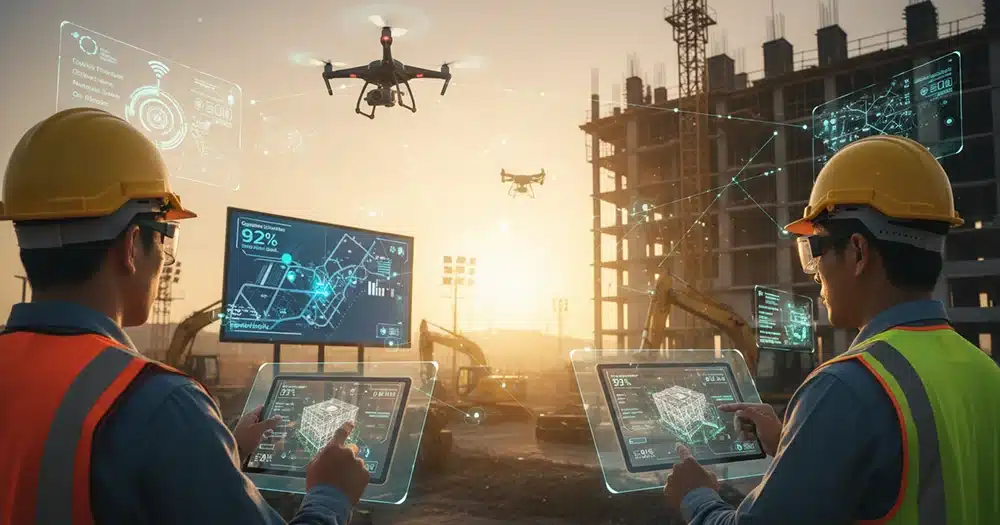
Equipment failure causes a lot of immediate slowdown in the progress of a construction project. Crews wait, schedules shift, and budgets begin to stretch. Predictive maintenance systems built on IoT monitoring can reduce downtime by detecting performance changes before equipment breaks down.
Across equipment-heavy industries, predictive monitoring has reduced downtime by 30–40% in some deployments.
Construction sites operate like small ecosystems. Machines, materials, and crews must move in coordination for work to progress smoothly. When one piece of that system falls out of sync, inefficiencies spread quickly.
IoT monitoring platforms allow managers to see how resources are actually used. Idle equipment becomes visible. Delays in material deliveries become easier to detect.
Once these inefficiencies are visible, companies can address them. Even small improvements in coordination often translate into measurable cost savings.
Delays remain one of the biggest challenges in construction. When teams can monitor site conditions in real time and respond to problems earlier, projects tend to move more smoothly.
Industry research suggests that combining connected monitoring systems with analytics can reduce overall construction costs by roughly 10–15% in certain scenarios.
The exact return varies by project, of course. But the general pattern is becoming clearer: better visibility leads to better decisions.
Deploying IoT in construction project management involves more than installing sensors. Companies need platforms that collect data, analyze it, and present insights in a usable form.
Construction companies need a technology partner that knows about operations and connected systems when they are using Internet of Things technology. That’s where The NineHertz enters the picture.
We have more than 15 years of experience and have worked on more than 1,300 projects in over 100 industries, helping companies around the world use digital solutions that can grow with them.
The NineHertz provides services for IOT development, including firmware for devices, mobile and web applications, integration with cloud analytics for sensor data, and platform development. These solutions help companies get data from devices and turn it into useful insights.
We have developed IOT systems like tracking vehicles in real time, sending alerts for maintenance, and watching how drivers behave. As we evaluate IoT solutions, we make sure to evaluate them for scalability and security by utilizing encrypted data, authentication controls, and cloud-based architectures.
The technologies associated with the IoT in construction industry are still new, and many construction organizations are just beginning to discover the benefits associated with connected monitoring systems.
AI helps manage large amounts of sensor data collected from construction projects and analyzes them for trends that humans may overlook. In addition to providing updates on the state of an asset, the platforms also provide predictive information to construction companies about future asset conditions before those assets fail.
The development of 5G technology greatly benefits construction jobsites by providing high-speed, low-latency internet for simultaneous communications amongst thousands of connected devices. This facilitates improved monitoring systems to be used, such as autonomous equipment and real-time drone inspection of work activity.
As construction companies continue to be subject to pressures to monitor their environmental impact, monitoring the energy, emissions, and waste produced by a construction project via IoT sensors will allow for a better understanding of a company’s footprint, so that changes can be made to reduce the company’s footprint.
Digital twin technology can be defined as a representation of an asset that allows construction professionals, through the integration of real-time data into a model of an asset, to run simulations of how the asset will behave based on different conditions.
This ability allows construction industry professionals to significantly improve their engineering predictive capabilities in order to develop more accurate long-term maintenance plans for major infrastructure projects.
The broader trend is clear: construction sites are becoming more connected.
1. Can IoT be used in small construction projects?
Yes. The small construction company begins with simple asset tracking. Entry-level systems can provide the same level of visibility, safety, and resource management despite fewer sensors.
2. What is the ROI of IoT?
IoT has a monetary benefit because it helps to reduce equipment downtime, avoid material waste, and improve workforce productivity. Furthermore, predictive maintenance and resource tracking often deliver measurable cost savings to your business.
3. How does an IoT device receive data from a remote construction site?
IoT devices receive data through cellular networks, satellite communications, low-power wide-area networks (LPWAN), or Wi-Fi gateways. This procedure allows the data received from the IoT devices at a remote construction site to be sent via a cloud platform.
4. What Internet of Things devices are commonly used on construction sites?
Examples of Internet of Things devices include environmental sensors, equipment telematics systems, radio-frequency identification trackers, smart wearables, connected drones, and structural monitoring sensors installed in machinery or infrastructure.
Construction projects are complex and require a combination of workers, machinery, materials, and environmental factors to succeed. Traditionally, construction managers relied on experience and observation for coordination among these factors to keep projects on track.
The use of technology has allowed project teams to identify problems more rapidly and make better-informed decisions. That approach still matters, but it has limits. This is why IoT in construction project management is gaining attention across the industry.
Connected sensors, asset trackers, and monitoring systems provide a clearer view of job-site activity. Equipment performance, worker safety conditions, and environmental factors can all be monitored continuously.
With better information, project teams can respond to problems faster and make more informed decisions. The technology itself will continue evolving. But the underlying idea remains simple: the more clearly companies can see what’s happening on-site, the better they can manage construction projects. And in an industry where small delays can quickly become expensive ones, that visibility matters.

Imagine a city where you can see everything happening on the streets in real-time. In this city, you can find…

The Internet of Things (IoT) is changing industries by connecting everyday devices to the Internet, enabling real-time data collection, monitoring,…

Merging Artificial Intelligence (AI) with IoT is one of the groundbreaking approaches in the technology domain. On one side, IoT…