Enterprises deploying dozens of AI tools and models may automate daily operations, but they may also find them scattered across departments without a proper coordination layer. Different AI models, agents, and systems use different frameworks, with no shared memory or governance schema to audit what they did in the process.
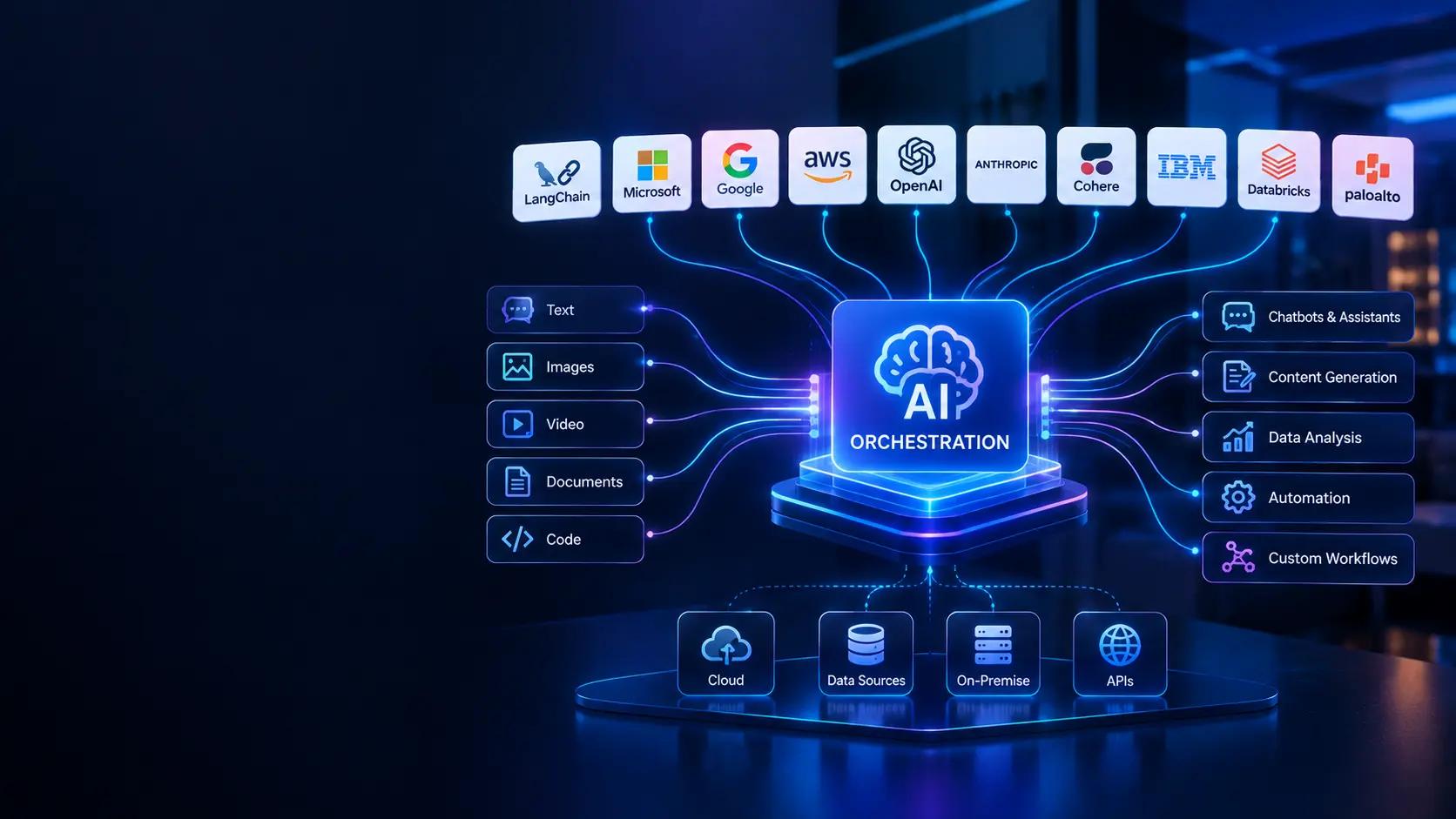
This is where AI Orchestration fills the gap between individual agents or models and a unified automated workflow. Instead of a pile of disconnected agents, you get one layer that routes tasks between them, handles the data handoffs, and keeps them working toward the same goal. According to IBM’s Institute for Business Value, companies using an orchestration layer are 13 times more likely to actually scale their AI deployments, and they see noticeably fewer of the weird errors that occur when agents operate unaware of each other.
More and more AI orchestration companies are becoming a consequential vendor to address the coordination shortage. This article focuses on a list of ten vendors as top companies in the AI orchestration market, evaluated against a structured framework rather than feature checklists alone.
AI orchestration is a process to coordinate all the concerned AI agents, models, tools, datasets, resources, and systems to work together towards a unified task or goal. AI tools are built to perform a specific function alone to automate basic and repeated tasks, and each tool or agent can do its job perfectly in isolation.
But when it comes to working collectively for a bigger outcome, they may lack coordination, observation, context, and memory sharing, failing to carry on an integrated workflow. AI orchestration fills this gap and gives operations teams a unified operational layer. AI orchestration companies are increasingly popular vendors among enterprises aspiring to scale their Artificial Intelligence investments.
An orchestration platform routes tasks between multiple AI agents, tools, and models and manages them to produce the desired outcomes. It calls for human approval only when the stakes demand it; until then, all the AI agents work together under a single coordinated system, sharing context and memory as required.
For instance, in the customer service department, AI orchestration coordinates AI chatbots, virtual agents, CRM, speech analytics, predictive routing, and ML models to provide a satisfactory response to the customer.
For most of the organizations, Artificial Intelligence is not the pain point, but integrating several frameworks and tools safely is the real hard part. IBM’s research for 2026 found that only 45% of organizations using AI agents have centralized governance over them. AI orchestration companies for enterprises handle this issue for businesses experimenting with their AI footprint.
We built an Orchestration Evaluation Matrix (OEM) to answer the query of most enterprise buyers: ‘How to find best AI orchestration companies’. This matrix analyses the popular vendors against consistent criteria, categorised into five major dimensions to score and select the top companies in AI orchestration market:
| Criteria | What It Measures |
|---|---|
| Governance & Control | Audit trails, permissioning, human-in-the-loop approvals |
| Interoperability | Ability to coordinate agents across frameworks and vendors, not just its own |
| Enterprise System Depth | Native connections to CRMs, ERPs, data platforms, and legacy systems |
| Scalability Under Load | Performance managing hundreds or thousands of concurrent agents; licensing, implementation effort, and the engineering overhead to maintain it |
| Total Cost of Orchestration | Licensing, implementation effort, and the engineering overhead to maintain it |
These dimensions include almost all the major factors every enterprise buyer looks for to meet their unique orchestration requirements.
Here is a list of Top Companies in AI Orchestration Market, evaluated and selected based on the OEM framework:
| Company Name | Year of Establishment | Company Size | Known For |
|---|---|---|---|
| The NineHertz | 2013 | 300 employees |
|
| Lindy | 2023 | 50-60 employees |
|
| Orkest | 2020 | 70 employees |
|
| Mastra | 2024 | 49 employees |
|
| Relevance AI | 2020 | 73 employees |
|
| Stack AI | 2022 | 57-78 employees pre-acquisition (acquired by Asana, May 2026) |
|
| Taskade | 2017 | 19-21 employees |
|
| Dify | 2023 | 28-50 employees |
|
| AutoGen / AG2 | AutoGen: Mar 2023
AG2: Nov 2024 |
Not publicly reported |
|
| SuperAGI | 2023 | 90-150 employees |
|
After evaluating different AI development vendors on the OEM scoreboard, the following Top AI orchestration companies are ranked as per their features and offerings:
The NineHertz is an AI-native engineering firm that provides a comprehensive suite of services focused on the Build, Run, and Evolve framework. Operating across diverse sectors such as healthcare, finance, and logistics, the firm leverages its proprietary ContinuumAI framework to modernize legacy systems and deploy autonomous workflows. It designs and orchestrates the AI ecosystem to coordinate and govern various applications, APIs, agents, and events, replacing fragmented handoffs with observable systems.
NineHertz is a preferred choice as an AI orchestration company due to its 24/7 runtime, eliminating the pileup of follow-ups instead of waiting for manual intervention. The team checks and analyses every step of the operational workflow to identify decision points, bottlenecks, and ownership of different agents. Developers then investigate existing approval loops, invisibility in the process, audit gaps, and exceptions no one is handling. company’s 1400+ connectors are there to link the orchestration platform to cloud apps, APIs, on-prem systems, and every running custom material on the client’s side.
OEM Score: Strong across all five criteria, with particular depth in enterprise system integration and total cost of orchestration. Implementation and governance are delivered as one engagement rather than a separate line item.
Lindy is a US-headquartered, Slack-first AI teammate platform that lets non-technical teams configure agents in natural language across email, calendar, and CRM tools. Its Agent Swarms feature coordinates multiple agents across departments, and its Pipedream partnership gives it more than 5,000 integrations.
OEM Score: Strong on ease of use and interoperability for SMB and mid-market teams; weaker on formal governance — Lindy does not publish an explicit EU data-residency posture, which matters for regulated buyers.
Orkes deploys a conductor engine and open-source agentic workflow to build AI orchestration for microservices, APIs, and AI agents together. Provides extensibility to various AI models and agents, including LangGraph, OpenAI Agents SDK, Google ADK, CrewAI, or custom agents. Workflows can pause for human approval and resume automatically, and native SDKs cover Java, Python, Go, and TypeScript.
OEM Score: High on scalability and interoperability, built to survive failures and long-running execution. It is a strong fit for engineering-led teams that need orchestration to sit underneath existing microservices, not replace them.
Mastra is a popular AI orchestration company known for orchestrating complex multistep agentic processes with its open-source TypeScript framework. It unifies agents, memory, tools, workflows, and observability into one package for developers building on a modern JavaScript stack.
OEM Score: Strong for TypeScript-native engineering teams. Enterprise governance features exist but require in-house implementation effort, since Mastra is a framework rather than a managed platform.
Relevance AI positions its orchestration as an AI workforce model, where agents are hired, trained, and managed the same as employees. The platform connects to more than 2,000 integrations and includes RBAC, audit trails, and an evaluation suite for testing agent behavior before production.
OEM Score: The platform is a great choice for governance and interoperability, particularly for sales, marketing, and customer success workflows. However, the cost predictability requires an active pilot programme before scaling, as the pricing is usage-based.
Stack AI is a no-code platform built for compliance-heavy industries such as healthcare and finance, with certification in SOC 2 Type II, HIPAA, GDPR, and ISO 27001. Its agentic development lifecycle brings software engineering discipline versioned changes, staged environments, and approvals to agent deployment.
OEM Score: One of the strongest governance scores in this list; enterprise system depth is solid with native SharePoint, SAP, Salesforce, and Workday connections, though self-serve pricing tiers have narrowed as the company leans further into enterprise sales.
Taskade leverages machine learning-driven forecasting and adaptive scaling to streamline multi-agent orchestration into existing workloads. It combines tasks, docs, and mind maps with agents that can research, draft, and trigger automations across more than 100 integrations.
OEM Score: Best suited to teams that want orchestration inside an existing collaboration tool rather than a standalone platform.
Dify builds agentic workflows, knowledge pipelines, observability, and tool support on one canvas. It supports self-hosting or private cloud deployment, which matters for organizations that can’t send prompts and outputs to a third party. Self-hosting, open source, and managed workspace are key highlights of the platform.
OEM Score: Strong interoperability and low total cost of orchestration for teams with the engineering capacity to self-host. Governance tooling is solid but requires more manual configuration than fully managed enterprise platforms.
Microsoft’s AutoGen offers architect conversation-driven multi-agent orchestration, but the company placed it in maintenance mode in October 2025. However, AutoGen’s original creators have continued active development of AG2, a community-led fork.
OEM Score: Valuable for research and prototyping multi-agent conversation patterns, but enterprises developing new production systems can evaluate only AG2 rather than the classic AutoGen model, as it is still in maintenance mode.
SuperAGI is an open-source framework for autonomous agent orchestration with a built-in GUI and tool marketplace. The company offers a collaborative apps marketplace articulated with workflows relying on a reason-and-act loop.
OEM Score: The original open-source framework has seen limited recent development, but the commercial GTM platform remains active. The buyer must clarify the platform with the vendor before signing an agreement.
Also Explore: Legacy Software Modernization Companies

Both terms usually get interchanged, but the difference is significant and highly impacts enterprise projects’ budgets. Automation simply refers to following and executing a fixed script of instructions. The moment an event falls outside its rulebook, it breaks. The scope of the automation is limited to a specific task, whereas the orchestration includes end-to-end multistep processes. Let us dig into the key differences between the two to eliminate confusion while evaluating AI orchestration companies for enterprises:
| Criteria | AI Automation | AI Orchestration |
|---|---|---|
| Definition | Executes a fixed, rule-based action for a single task | Coordinates multiple agents, models, and tools across a full process |
| Scope | Individual tasks; involves a single agent | Spans multiple tasks through multi-agent access |
| Adaptability | Follows a fixed script; breaks when a case falls outside it | Adjusts based on context and changing conditions |
| Decision-making | Deterministic, rule-based | Context-aware, often involves reasoning agents |
| Business value | Best for high volume, repetitive tasks.
Saves time and efforts Reduce errors |
Adds greater strategic value.
Enhances customer experience. |
| Governance & audit | Logs that the action happened, not the reasoning | Maintains a single audit trail across the entire multi-agent process |
| Human involvement | Minimal — set-and-forget | Built-in checkpoints for human-in-the-loop approval |
| visibility | Lacks transparency as everything happens in the background | Dashboards and monitoring tools provide oversight |
Do not replace existing automation with orchestration; instead, layer them. Automation still handles the repetitive, low-variability steps; orchestration governs how those steps connect into a larger, adaptive workflow.
The next phase of this market is governance, not capability. Enterprises have already proven agents can perform tasks, but the open question is whether organizations can run thousands of them safely, with clear ownership and audit trails, rather than one team per silo. Three major shifts are expected to accelerate in the near future:
Top Companies in AI Orchestration Market are increasingly bolting orchestration into their generative AI applications roadmap from the beginning.
Running more than a handful of AI agents without a shared governance layer is a clear sign that orchestration is overdue. Safely scaling AI agents is the real struggle of most enterprises, stalling their investments in AI experimentation. The proliferation of intelligent agents across organizations is a governance and integration problem that AI orchestration addresses.
The solution to ‘How to find the best AI orchestration companies’ is not in picking the platforms with the most integrations. Rather, it is more about matching governance depth, enterprise system reach, and total cost of orchestration to your organization’s current position and requirements. Orchestration needs vary from industry to industry as per their regulatory environments and volume of AI agents deployed.
The best way to choose among AI orchestration companies starts by analysing the existing workflow and then weighing vendors against criteria like the OEM framework rather than feature lists alone. Organizations that need orchestration paired with the underlying engineering to modernize their agents can get their checklist done with frameworks like Build, Run, and Evolve.
AI orchestration is the coordination layer that manages how multiple AI models, agents, and tools work together within a governed workflow. It decides sequencing, permissions, and audit trails across the entire process rather than performing a single task.
Orchestration combines scattered agents, increases their efficiency through shared memory and context, creates a single audit trail across previously siloed automations, and helps organizations scale their AI ecosystem from isolated pilots to production.
Cost highly depends on the orchestration model and usage. For instance, Dify and Mastra are cheap to license with open-source frameworks, but are expensive on the enginnering hours. Whereas managed platforms charge subscription fees but set you free from the governance and support issues. Most vendors do not show the implementation and governance cost in their invoice at the beginning. Thus, while researching AI orchestration companies for enterprises, always enquire about those third costs for accurate budgeting for your next orchestration partnership.
An AI agent is appointed to complete a single task using tools and some sort of reasoning. Whereas, when more than one agent enters the frame for a bigger goal or complex function, AI orchestration adds more value. It is the coordination layer placed over multiple agents to govern them to work together using shared context and memory, and enforces permissions between them.

Are you searching for a Best CRM software development company to strengthen your relationship with the stakeholders? Customer Relationship Management…

In this rapidly evolving marketplace, where things change quickly, finding the right SaaS development company in USA is a…

Searching for a SaaS development company in India to turn your product idea into reality? Well, picking the right SaaS…