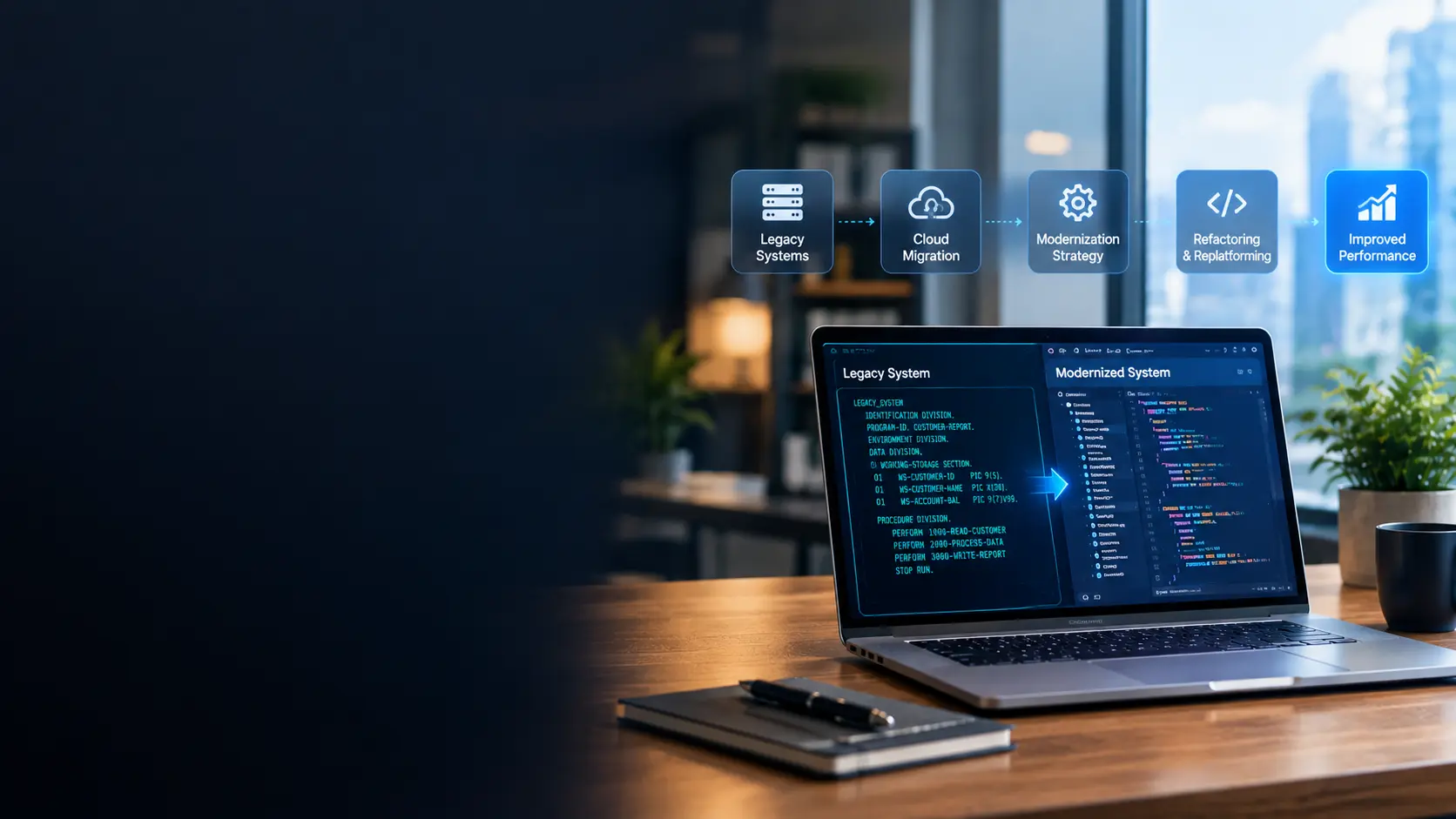
Legacy software rarely becomes a problem overnight. It usually happens bit by bit. An application gets another patch, an old integration stays in place, documentation falls behind, and the developers who know the system best become harder to replace. Eventually, even small changes can take too much time, cost too much, or put critical business processes at risk.
The scale of the problem is substantial. McKinsey found that CIOs estimate technical debt can account for 20% to 40% of the value of an entire technology estate, while 10% to 20% of technology budgets intended for new products can be diverted to dealing with technical debt.
That puts businesses in a difficult position. Continuing with the legacy system means consistently carrying its technical and operational baggage. Replacing it all at once can cause high cost, migration risk, and disruption. Modernization provides a second path, but the approach must align with the application, architecture, data, integrations, business priorities, and more.
This is where choice of software development partner matters. A good company should be able to evaluate your current environment, determine what to keep or replace, choose an appropriate modernization strategy, and advance the system without losing the business capabilities that currently work.
This guide lists and compares the 10 best legacy application modernization companies in 2026, listing and comparing their services, technical capabilities, expertise and what makes each one worth a look.
A strong legacy modernization company needs more than cloud migration experience. The selection focused on the capabilities that can directly affect the success, risk, and long-term value of a modernization project.
These legacy modernization companies were chosen based on their experience with aging applications, databases, architectures, or business-critical systems.
Companies that support rehosting, re-platforming, refactoring, rearchitecting, rebuilding, and replacement were given stronger consideration. The correct approach will depend on the state and function of each legacy application.
Technical expertise in cloud migration, microservices, APIs, containers, and cloud-native architecture was examined for each legacy systems modernization company.
Experience with enterprise application integration and also with data migration, transformation, and validation and integration was considered.
Application security, identity management, data protection, and compliance requirements were part of the evaluation process as well, particularly for businesses modernizing legacy systems that handle sensitive or regulated data.
Case studies, results with clients, technology partnerships, certifications and other forms of verifiable evidence that differentiate legacy application modernization firms from those that make broad claims about their services.
Post-modernization services, including application support, monitoring, optimization, maintenance, and performance management, were also taken into consideration in the evaluation of each legacy software modernization company.
Here are 10 top legacy system modernization companies for cloud migration, re-engineering, application modernization and software transformation.
| Name of the Company | Founded Year | Services Offered |
|---|---|---|
| The NineHertz | 2013 |
|
| Rishabh Software | 1999 |
|
| Softlabs Group | 2003 |
|
| TechAhead | 2009 |
|
| Facile Technolab | 2010s |
|
| Mind Studios | 2013 |
|
| Syberry | 2011 |
|
| Simform | 2010 |
|
| Nitor Infotech | 2006 |
|
| Tagar Computer Systems | 1990 |
|
Here are 10 legacy modernization companies that stand out for their application modernization expertise, cloud capabilities, re-engineering services, and experience working with older technology environments.
The NineHertz offers legacy application modernization services to companies that need to migrate older applications to modern architectures without impacting mission-critical operations. They can re-architect applications, migrate them to the cloud, re-platform them, break up monoliths into microservices, reduce technical debt and conduct system audits. The company also supports incremental modernization, which can help businesses update older components in pieces rather than needing to replace an entire application at once.
The NineHertz is an AI-native engineering company that enables its clients to harness the best AI applications for efficient and fast software modernization without losing features and capabilities. Their proprietary ContinuumAI framework ensures that all the upgrades are ethical, efficient, and focused on driving the anticipated results.
Get in Touch Today!
Rishabh Software specializes in modernizing older applications and maintaining the business logic contained within the applications that organizations already rely on. These services encompass application modernization consulting; migration of legacy applications to the cloud; application rehosting, re-platforming, re-architecting; database migration; UI and UX modernization; and microservices adoption. It also runs in Azure and AWS environments, providing organizations with an alternative for running legacy applications in the cloud.
Softlabs Group specializes in legacy software modernization on older Java, .NET, and enterprise application platforms. Its modernization work that has been documented includes Java migration, .NET modernization, monolith decomposition, cloud transformation, and application re-engineering. The company also has experience in finance, healthcare, manufacturing, government and logistics, where legacy systems often underpin critical business processes.
TechAhead also designs legacy application modernization on the B2B side, as well as the B2C side. It specializes in application re-engineering, modernization to the cloud, microservices, data migration, API Development, containerization and automated quality assurance. It also cites experience in industrial manufacturing, health care, fintech, banking, oil and gas, construction, telecom and e-commerce.
Facile Technolab focuses on modernizing old application stacks, especially legacy Microsoft technologies such as .NET Framework, ASP.NET Web Forms, Classic ASP, and Windows Communication Foundation. Its starting point is codebase and dependency analysis and works toward modern .NET, ASP.NET Core, Azure, modern APIs, database modernization, and phased migration. Its modernization work, the company says, also extends to manufacturing, healthcare, financial services, and information technology.
Mind Studios does software modernization by means of application re-engineering, refactoring, architecture improvements, migration and rebuilding. Its focus is on cleaning up technical debt and old architectures, while keeping the functions the business still needs. It is a good option for enterprises seeking to gradually modernize an application rather than refactoring the whole app upfront.
Syberry uses a combination of automated code analysis and human engineers in an AI-assisted process for modernizing legacy applications. This process entails application assessment, dependency mapping, technical debt analysis, security analysis, rehosting, refactoring, rearchitecting, API development, containerization and DevOps integration. In addition, the company claims to have modernization experience in healthcare, finance, energy, utilities, e-commerce and other sectors.
Simform considers applications and the application environment to evaluate which application migration strategy to pursue for application modernization. It services everything from application assessment to end-to-end migration, rehosting, refactoring, re-platforming, re-architecture, and redesign of applications. This enables a modernization approach at an organization determined by the current architecture and purpose of the systems rather than a one-size-fits-all approach to every legacy system.
Nitor Infotech modernizes apps and products for companies operating on legacy and aging tech stacks. Its modernization capabilities include legacy application evaluation and re-engineering, architecture evolution and migration to new technology. The company has also written about modernizing a legacy ColdFusion application that was ported to Java, using AI-assisted development tools.
Tagar Computer Systems specializes in software architecture and legacy modernization for systems where long-term reliability and retention of business knowledge is important. Starting from legacy code, dependencies, data flows, and business rules, its process defines a target architecture and staged migration route. Tagar explicitly includes work in military, medical, industrial, government, communications, and other high-reliability contexts.
Legacy modernization companies do much more than just move an old app to the cloud. Their work may include application assessment, code and architecture modifications, data migrations, integrations, security patches and updates, testing, and support. The ideal combination of services varies with the actual condition of the system and the business’s goals for the system.
A typical legacy application modernization company will start with an assessment of the existing codebase, architecture, dependencies, integrations, performance, and technical depth. This evaluation helps identify what within the system can remain, what must be changed, and how modernization will be most beneficial.
Application re-engineering is transforming an existing application without a complete rebuild from the ground up. This mostly includes code refactoring, architectural changes, framework upgrades or removal of legacy dependencies. This approach works as long as the current business logic is still applicable to how business is done today.
Outsourcing companies specializing in legacy modernization, for example, help shift legacy applications to computing environments such as AWS, Microsoft Azure, and Google Cloud. Depending on the system, they may rehost the system with little change, re-platform some parts, or make larger changes to take advantage of cloud native services.
There is a requirement to integrate new applications with legacy systems. Legacy application modernization companies use APIs, integration layers, and event-based connections between legacy applications and enterprise resource planning, customer relationship management, e-commerce, analytics, and third-party platforms.
Newly upgraded systems must undergo full functional, integration, load, performance, security, and regression testing before shifting into production. Most legacy system modernization companies also offer application monitoring, maintenance, optimization, troubleshooting, and support after migration.
Also Explore: AI Orchestration Companies
The right legacy systems modernization company focuses on understanding your existing technology environment before advising you on what you should change. A provider that begins with your business requirements, application dependencies, data, integrations, and technical constraints can help you devise a modernization strategy tailored to your system, rather than fitting it into a mold.
Check to see if the vendor has experience with the technologies of your current applications. Experience with older Java, .NET, PHP, COBOL, mainframes, databases, or proprietary systems can make a major difference when the application contains years of accumulated business logic.
Ask how the provider decides between rehosting, replatforming, refactoring, rearchitecting, rebuilding and replacement. Any good legacy application modernization company should be able to articulate to you why a specific strategy makes sense for your application, rather than suggesting the same strategy for all projects.
Simply moving an application to the cloud does not modernize it. Look for experience with cloud native architecture, microservices, APIs, containers, automated deployment and modern observability. That is important if your goal is to make the system easier to scale and change post-migration.
Your legacy system undoubtedly still interfaces with other applications, databases, and business processes. Also see if they are able to develop and integrate APIs as well as migrate, transform and validate data without taking down any of the systems that are connected.
A modernization project can impact revenue-generating applications and mission-critical operations. It is important that you know how it goes about dependency mapping, testing, backup and recovery, security, phased releases, rollback planning and business continuity. These nuances can inform you more about a provider than a long list of technologies.
Case studies will show if they have dealt with systems similar to yours. Look at the issue, the modernization, the technological fix, and the defined metric instead of generic client logos. It is also worth understanding who will actually be working on the project, and what technical expertise they bring.
This relationship shouldn’t stop when the updated application goes live. Seek a legacy modernization vendor that can offer ongoing monitoring and maintenance, performance optimization, security updates and tech support as the application evolves.
The cost of legacy application modernization typically starts from $20,000 to $50,000 for a relatively simple application and can exceed $200,000 for complex enterprise systems. Large modernization programs consisting of multiple applications and integrations, significant data migration, or major architectural changes can be over $1 million. The final budget depends on the complexity of applications, size of the codebase, integrations, data requirements, and security, as well as whether you will be doing rehosting, replatforming, refactoring, rearchitecting, or rebuilding.
The price tag also includes more than development. The final number can be impacted by assessment, architecture planning, data migration, testing, cloud infrastructure, deployment, and post-modernization support.
Large modernization programs with multiple applications and integrations, large data migration, and/or significant architecture changes can exceed $1 million. The final cost will depend on the complexity of applications, size of codebase, integrations, data and security, and if you will be doing rehosting, re-platforming, refactoring, rearchitecting, or rebuilding.
The price tag includes more than development, too. The final number can be influenced by the assessment, architecture planning, data migration, testing, cloud infrastructure, deployment, and post-modernization support. A thorough evaluation of the current system will provide you with a better estimate and will uncover technical debt, dependencies, integration points, as well as what work will be required to attain the target architecture.
Need to modernize a legacy application? Contact The NineHertz to evaluate your current system and develop a plan for modernization based on your business needs.
your existing system and build a modernization roadmap tailored to your business requirements.
Time is also a factor in a modernization project and will depend on things like the complexity of the applications being modernized, integrations, any data handling, and the overall modernization scope, but it can take anywhere from several months to more than a year.
The technologies involved often include any combination of cloud, microservices, APIs, containers, Kubernetes, modern frameworks, managed databases and DevOps tooling.
Yes, based on system requirements, legacy applications can be migrated by rehosting, replatforming, refactoring or rearchitecting.

In this rapidly evolving marketplace, where things change quickly, finding the right SaaS development company in USA is a…
A react native app development company in India can help escalate your business to the next level via a high-performing…

Are you looking for the top AI development company in the USA? Guess what, you’ve come to the right destination.…