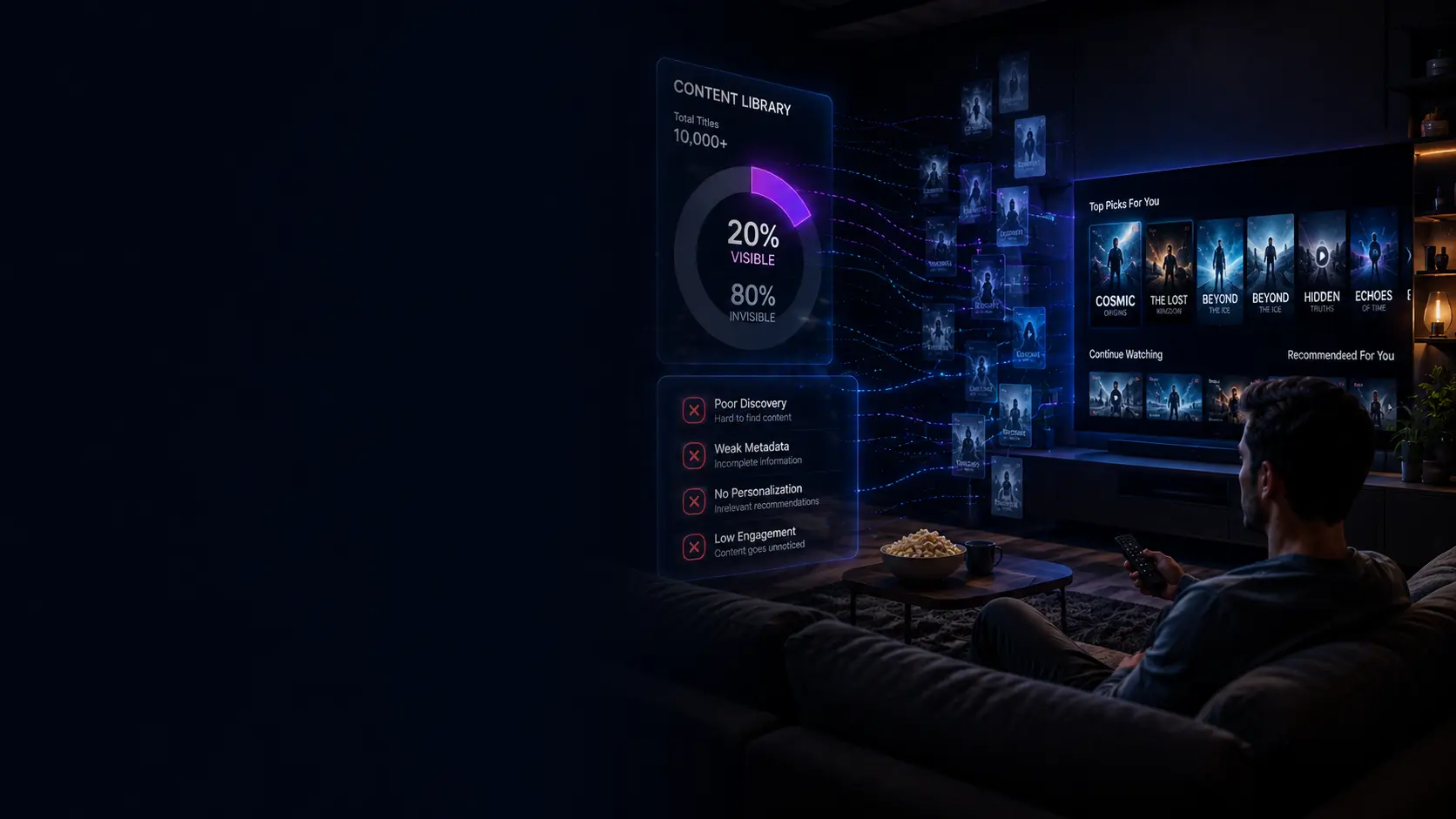
Quick Answer: Content intelligence architecture is the data infrastructure layer that connects subscriber behavior, content metadata, and catalogue performance signals into a unified model – enabling OTT platforms to surface the right title to the right subscriber at the right moment, reduce passive catalogue spend, and make content investment decisions that map directly to retention and revenue outcomes.
Here’s something nobody puts in an acquisition deck: you’re probably paying licensing and infrastructure costs on a catalogue that the majority of your subscribers will never find.
That’s not an exaggeration. OTT data analytics research shows roughly 20% of a platform’s catalogue drives 80% of its retention value. The other 80% – titles that cost real money in rights fees and server capacity – generates engagement close to zero. That’s not a content quality problem. It’s an architecture problem.
Global studios collectively spent over USD 230 billion on content in 2024. The global OTT market hit USD 306.1 billion in 2025 (source). And yet most platforms are still making acquisition decisions without a working model of what their existing catalogue actually does for subscribers. They buy based on gut, competitor signals, and aggregate viewership benchmarks that don’t map to the subscriber behavior driving retention.
Netflix’s recommendation engine drives nearly 80% of all viewing hours on the platform – and saves the company over $1 billion annually in reduced churn. That engine doesn’t work because Netflix has more content. It works because Netflix has the data architecture underneath it to know, title by title and cohort by cohort, exactly what each piece of content does for which subscriber type.
Most mid-tier platforms don’t have that. This post is about building it.
Most OTT platforms carry catalogue utilization rates that would alarm any CFO who reviewed them honestly. A large percentage of licensed or produced titles gets opened by fewer than 3% of subscribers – often once, by a handful of users, then never again.
This isn’t random. It’s structural.
The home screen and recommendation rails – the two primary discovery surfaces on any OTT product – are biased toward recency and popularity by design. New releases dominate the top rows. Popular titles cycle through trending carousels. The recommendation engine, trained primarily on high-volume behavioral data, keeps surfacing the same 200–300 titles to 90% of users.
The long tail of your catalogue doesn’t just go unwatched. It goes unseen.
OTT subscribers spend 60–90 seconds deciding what to watch before they switch to another platform, scroll TikTok, or just give up. Every second your interface spends showing them content they’ve already seen – or titles that don’t match their taste signals – is a second of attention you lose permanently. That accumulated inaction becomes passive churn. Subscribers don’t cancel immediately. They just stop opening the app.
Catalogue utilization rate is the percentage of your library that generates meaningful engagement over a defined window – typically 30, 60, or 90 days. Low utilization doesn’t automatically mean the content is bad. It means subscribers aren’t finding it.
The distinction matters enormously for investment strategy. A title with high completion rates and strong re-watch patterns among a small cohort isn’t a failure – it may be the retention anchor for exactly the subscriber segment most at risk of churning. Treating it as dead weight because aggregate view counts are low is how platforms bleed high-LTV subscribers to niche competitors who surface that content better.
Platforms with structured metadata governance achieve materially higher completion rates and recommendation click-throughs than those treating metadata as a post-production checkbox. The mechanism is simple: recommendation engines can only surface content they can meaningfully classify. Incomplete or generic metadata creates classification failure. Titles get dumped into broad genre buckets and never matched to the subscriber cohorts most likely to engage with them.
Pro tip: Audit your catalogue for metadata completeness before any recommendation engine overhaul. The engine is only as precise as the taxonomy it runs on.
Metadata is the connective tissue of content intelligence. Every recommendation rail, every search result, every algorithmic surface, every cross-platform rights decision runs through it. Yet most platforms treat metadata like a post-production administrative task – a checkbox to tick, not an asset to maintain.
The downstream effects are predictable. Recommendation engines plateau. Discovery surfaces feel repetitive. Long-tail content never reaches the audiences it was licensed to serve.
Poor metadata doesn’t announce itself as a technical problem. It shows up as a content problem – at least, that’s what it looks like from the outside.
Subscribers tell you the platform has nothing to watch when you have 10,000 titles. Completion rates fall after episode one because auto-play recommendations are genre-adjacent but behaviorally wrong. New subscribers who came in for a specific title churn within 30 days because the post-acquisition journey doesn’t connect them to anything else fast enough.
None of that gets fixed by buying more content. All of it gets fixed by enriching the metadata infrastructure that governs how existing content gets matched to people.
Live and unscripted content has it worst. Most of it goes untagged and unindexed – buried without descriptive metadata to guide discovery algorithms. Research shows 60% of catch-up viewing for live content happens on the day of airing, with 35% occurring within the first 15 minutes. Without real-time metadata enrichment, that demand window closes before the content can be surfaced to anyone.
A metadata model capable of supporting genuine content intelligence operates across at minimum five dimensions:
Most platforms have solid taxonomic metadata. Almost none have integrated behavioral and lifecycle metadata into the same model. That gap is where catalogue value evaporates.
Pro tip: Map your metadata completeness by content type – originals, licensed catalogue, live, and archive – separately. The coverage gaps are almost never uniform, and fixing them requires different workflows for each.
Here’s how most content acquisition decisions still get made: a mix of historical viewership data for comparable titles, competitive intelligence on what rival platforms are buying, and executive judgment about audience appetite. The result is often a $50M rights acquisition that drives a short-term subscriber spike followed by completion churn – subscribers who signed up for one title, finished it, and left.
Deloitte’s Fall 2025 report showed 39% of consumers canceled an SVOD subscription in the prior six months. Platforms without sticky deep-catalogue journeys lose subscribers the moment the marquee title ends. That’s not a content failure. It’s a post-watch architecture failure.
Most platforms evaluate content for acquisition pull – will this title bring in new subscribers? – without simultaneously modeling retention anchor value. Those are different questions with different answers.
A title that attracts 500,000 new subscribers but retains none of them after 30 days has negative unit economics once you factor in acquisition cost, infrastructure, and rights fees. A title that attracts 50,000 subscribers but retains 80% of them for 6 additional months may be the highest-ROI asset in your catalogue.
Data-driven acquisition models that accurately attribute subscriber behavior to specific titles can add over $4 million in incremental revenue through better resource allocation alone – before any marketing optimization is layered on top. Platforms that can predict which content will drive high-retention cohorts, not just initial sign-ups, operate at a fundamentally different level of capital efficiency.
Translating this into operational practice means connecting three data layers that most platforms currently manage in silos:
When those three layers connect, you stop asking “will this title get views?” and start asking “will this title change the retention curve for subscriber cohorts we’re at risk of losing?” That’s a materially different – and commercially more accurate – question.
Boost content discovery with AI-powered recommendations.
Every title in your catalogue performs across four dimensions simultaneously. Most platforms measure one or two. The ones consistently outperforming their content spend measure all four.
Acquisition gravity measures a title’s demonstrated power to drive new subscriber registrations – first-touch attribution, influenced attribution, and competitive displacement from rival platforms.
High acquisition gravity titles are the ones worth featuring in above-the-line marketing. They’re also the most dangerous to over-index on, because acquisition gravity and retention value have a weak correlation at best.
Retention depth measures how a title – or a sequence of titles – affects a subscriber’s likelihood of remaining on the platform past the churn window. This isn’t just completion rate. It’s what subscribers do after they finish the title: do they explore the catalogue, or do they stop opening the app?
Platforms using advanced behavioral data to tailor recommendations see retention rates up to 40% higher than those relying on aggregate popularity signals. The retention value of any title is inseparable from the recommendation journey that follows it – which means retention depth modeling has to account for catalogue connectedness, not just individual title performance.
A title that performs at 2% average engagement across your full subscriber base may perform at 45% engagement within a specific behavioral cohort – subscribers who binge drama series on weekday evenings, for instance, or subscribers in a specific market who consistently engage with a particular production origin.
Cohort specificity is where the long tail becomes commercially valuable. Titles that look like failures by aggregate metrics are often anchor assets for high-LTV subscriber segments. Finding those segments and building discovery pathways that connect them to their anchors is one of the highest-return activities in catalogue management.
Every title has a demand curve. New releases spike. Licensed catalogue fades. Originals sometimes get a second-life bump when a sequel or related property drops. Knowing where each title sits on its lifecycle curve – and how that intersects with its rights window and cost basis – determines whether renewal, promotion, or retirement is the right call.
Platforms typically find 8–15% of content spend that can be reallocated toward titles with stronger retention signal without any budget increase – simply by retiring underperforming titles before their rights windows expire and reinvesting in proven catalogue depth.
This distinction reshapes how you build content investment strategy – and it’s one most acquisition frameworks still miss.
A crime drama with strong acquisition pull for the 35–50 demographic may simultaneously serve as a retention anchor for early-churn-risk subscribers who entered the platform through an action franchise. Same title, two completely different strategic functions, two completely different performance metrics.
Managing catalogue strategically means building a matrix – not a list – of what each title does for which subscriber segments, then organizing discovery, marketing, and renewal decisions around that matrix rather than aggregate performance averages.
Subscriber journeys don’t run on individual titles. They run on sequences. A new subscriber who enters through a high-acquisition-gravity title needs a curated post-watch journey that connects them to retention anchors within 48–72 hours. Platforms that get this wrong suffer completion churn – subscribers who genuinely enjoyed what they watched, but couldn’t find the next thing and quietly left.
Amazon’s AI system analyzes data from over 200 million global subscribers, combining viewing habits and purchase history to suggest content. The sophistication isn’t in the algorithm alone – it’s in the data architecture that feeds it. Behavioral sequences, not individual title views, are the prediction signal.
Pro tip: Build your post-watch journey mapping by cohort before you build it by title. Understanding where different subscriber types go after content completion reveals the catalogue gaps that cause churn – and often points to licensing opportunities competitors haven’t identified.
Getting deep catalogue visible requires rethinking your discovery surface architecture from the ground up. Most OTT home screens are organized around editorial logic – curated rows, trending sections, genre shelves that reflect human editorial judgment rather than individual behavioral signals. That made sense when catalogues were small. At 5,000+ titles, it’s a discovery liability.
The Four-Layer Discovery Architecture
A content intelligence architecture that activates deep catalogue operates across four layers:
A recommendation model trained on behavioral sequences, completion patterns, skip behavior, session chaining, and device-time context – not just genre labels and explicit ratings. This layer drives the primary viewing surface and needs continuous retraining on fresh behavioral data, not static preference snapshots.
Programmatic curation of editorial content – collections, themed rows, post-watch journeys – built on cohort behavioral patterns rather than individual-level signals. This addresses the cold-start problem for new subscribers and surfaces deep catalogue to users whose behavioral data is still thin.
A search layer capable of processing intent-based queries – mood, theme, narrative type – not just title and cast lookups. Subscribers who type “something like Breaking Bad but shorter” need a search infrastructure that understands thematic and tonal similarity, not just metadata string matching.
Structured title pages for each catalogue asset, genre landing pages targeting discovery queries, and VideoObject schema markup enabling rich results in search engines. High-intent users searching for content are already in discovery mode – capturing them at that moment is one of the most cost-efficient subscriber acquisition mechanisms available.
None of these layers work without a metadata feedback mechanism that continuously enriches content taxonomy based on behavioral outcomes. A title classified as “thriller” that consistently performs well with subscribers who primarily watch literary drama needs its metadata updated to reflect that behavioral adjacency – otherwise the recommendation engine will never connect it to the right cohort.
This feedback loop – behavioral signal → metadata enrichment → improved recommendation → new behavioral signal – is the compounding mechanism that separates platforms with improving catalogue performance from those that plateau.
The final – and commercially most significant – layer is the feedback mechanism that connects catalogue performance data back to content investment decisions.
Most platforms have two separate workflows: a content analytics workflow that measures what’s happening in the catalogue, and a content acquisition workflow that decides what to buy next. These two workflows rarely talk to each other in real time. Acquisition decisions are made on external market signals and historical benchmarks. Performance data informs the post-mortem, not the decision.
Organizations that aggregate behavioral, performance, and financial data to make real-time content decisions are gaining a measurable competitive advantage. The architecture required to close this loop has three components:
A per-title unit economics calculation that maps rights cost against engaged subscriber count, LTV contribution by cohort, and rights window remaining. This transforms content spend from a budget line into a performance metric – one that can justify or challenge any acquisition decision against a consistent standard.
An AI model trained on historical performance patterns, external demand signals (social sentiment, search trend data, competitive platform behavior), and subscriber cohort characteristics to forecast how candidate acquisition titles will perform before the acquisition decision is made.
A structured review cadence – monthly for performance monitoring, quarterly for acquisition planning, annually for rights renewal strategy – that brings the title economics model and predictive demand intelligence into the same room as the acquisition decision-makers.
Data-driven content strategies informed by audience demand data directly improve resource allocation and can distinguish titles that drive new subscription revenue from those that retain churn-risk subscribers – two entirely different asset categories requiring different acquisition logic.
In plain terms: your content budget is probably funding assets that 80% of your subscribers will never encounter – and you’re missing the data infrastructure to identify which titles are actually holding your most valuable subscriber segments on the platform.
The starting point is almost never the recommendation engine. It’s the metadata layer underneath it. Before any investment in algorithmic infrastructure, an honest audit of metadata completeness – title by title, content type by content type – will surface the structural gaps that prevent existing intelligence investments from performing.
The second priority is closing the loop between content performance and content investment. If the team making acquisition decisions doesn’t have access to real-time per-title retention analytics, they’re making multi-million dollar decisions with the wrong data.
The third priority is building the cohort-level discovery architecture that activates the long tail – not because those titles are intrinsically valuable in aggregate, but because they anchor your highest-LTV subscriber segments.
The NineHertz is an AI-native engineering firm that operates across the Build, Run, and Evolve framework. For OTT and media platforms, this means engineering the full content intelligence stack – from metadata governance pipelines and behavioral analytics architecture to AI-powered content discovery platforms and subscriber lifecycle intelligence systems.
The firm’s proprietary ContinuumAI framework is built for environments where data architecture and AI inference must evolve continuously alongside subscriber behavior – exactly the operating context of a growing OTT platform. Working with ISVs, digital natives, and enterprise media companies, the team builds systems that connect catalogue depth to commercial outcomes, not just engagement metrics.
Related capabilities include:
U.S. annual churn hit 40% in 2025, driven by subscription rotation – households moving between platforms to watch marquee releases, then leaving. In that environment, catalogue depth without discovery intelligence is a cost, not a competitive advantage. You’re paying for content most subscribers will never find, while the subscribers most likely to stay long-term can’t locate the titles that would keep them.
Building content intelligence architecture is not a technology project. It’s a commercial imperative. The platforms that close the loop between catalogue performance and content investment – and build the discovery infrastructure to activate their long tail – will compound subscriber LTV while competitors keep chasing acquisition volume.
The NineHertz works with OTT and media platforms to design and build the data infrastructure, AI systems, and product architecture that make this kind of intelligence operational. If you’re evaluating your content intelligence maturity or planning the next phase of your platform’s development, connect with top OTT app development companies for a technical and commercial scoping conversation.
It’s the connected data infrastructure that links subscriber behavioral signals, content metadata, catalogue performance analytics, and investment decision workflows into a unified system. At its most mature, it runs as a continuous feedback loop: behavioral data enriches metadata, enriched metadata improves recommendation precision, improved recommendations generate richer behavioral data.
Discovery surface architecture is biased toward recency and aggregate popularity. Deep catalogue titles fail to reach relevant subscriber cohorts not because subscribers wouldn’t value them, but because incomplete metadata prevents recommendation engines from classifying and surfacing them accurately. Combined with a 60–90 second browsing window, the long tail stays invisible regardless of its quality.
A complete content ROI model maps each title across four dimensions: acquisition gravity, retention depth, cohort specificity, and lifecycle trajectory. Platforms that build this four-dimensional view consistently identify 8–15% of content spend that can be reallocated without reducing catalogue value – and often without any additional budget.
Metadata quality determines recommendation precision, and recommendation precision determines subscriber retention. A subscriber who finds relevant content within the first few sessions after registration has a materially higher probability of remaining past the first churn window. The relationship compounds over time: better metadata enables more precise behavioral segmentation, which enables more accurate cohort-level curation, which reduces passive churn.
The practical trigger is when subscriber LTV is flat or declining despite catalogue growth, when completion churn is occurring after marquee titles, or when content acquisition decisions are being made without per-title retention analytics. Each of those signals indicates the platform is spending on content without the infrastructure to make that spend commercially defensible.

A react native app development company in India can help escalate your business to the next level via a high-performing…

Key Takeaways OTT platforms now face monthly subscriber churn rates of 5.5%, nearly triple the 2% recorded in 2019, and…

Key Takeaways AI is changing the landscape of fitness apps, providing more sophisticated personalized workouts from machine learning, computer vision,…