AI agents have gone from being a “concept” to being a “necessity” for businesses in a very short period. As companies look for ways to improve productivity by automating tasks or making faster decisions, intelligent agents are paving the way for many businesses’ operational processes today. The U.S. AI agent market, valued at about $1.6 billion in 2024, is projected to grow more than eightfold by 2030, reflecting accelerating adoption across industries.
A lot of firms have started implementing AI agents in certain tasks, but only a small percentage have successfully scaled them across their entire operations. One major reason is the lack of clarity around high-impact AI agent use cases, making it difficult to justify broader adoption. Integration complexity, unclear ROI, and a lack of knowledge are some of the key challenges that get in the way of development.
This is where the right AI partner makes all the difference. An experienced AI agent development company can help you pinpoint the most valuable use cases, build systems that scale with your business, and implement automation that actually delivers measurable results. Companies that get beyond these problems early are already witnessing efficiency gains as intelligent automation becomes a normal part of doing business.
This blog lists the 20 best AI agents and explains what they can do, when they should be used, and how businesses can choose the right agent to go from testing to making a big difference in their business.
AI agents are computer programs that can reach certain goals with little human intervention. Agents are different from regular AI, as they employ reasoning and break down big goals into smaller, more manageable tasks. They use external tools like web browsers or databases to engage with the physical and digital worlds and keep data from past experiences to learn from them.
These solutions transform AI assistants from passive responders into proactive partners capable of managing entire workflows, from research and analysis to decision-making and execution. To fully understand their potential, it’s important to recognize the difference between agentic AI and AI agents.
As AI agents go from testing to deployment in businesses, it’s important to know which platforms are truly being used widely. The table below lists the ten most popular AI agents, along with their capabilities, integrations, and real-world uses.
| Tool | Key Features | Ideal For | Notable Users/Integrations |
|---|---|---|---|
| CrewAI | Role-based agent orchestration, task delegation, and team workflows that run on their own | Creating independent agent teams for specific roles | Developers, startups; works with LangChain and OpenAI |
| Sintra AI | No-code automation, integration with SaaS tools, and multi-agent collaboration tailored for operation | A team that wants to automate internal workflows, ops team, and non-technical users | Integrates with tools like Slack, Gmail, Google Drive, Notion, and CRMs |
| Devin AI (Cognition Labs) | Full-cycle software development, which includes planning, coding, debugging, and deployment | Automation of full-cycle software engineering | Software teams, GitHub, and cloud platforms |
| Vertex | Managed platform for custom and base models, fine-tuning, vector search, RAG, pipelines, and MLOps | Enterprise and data teams building production-grade AI apps on Google Cloud | Deep integration with Google Cloud services |
| Microsoft Copilot | Adding natural language support to Office apps, code suggestions, and automation | Increasing M365 productivity (emails, documents, code) | Businesses: GitHub Copilot and Microsoft 365 |
| Perplexity | Web search in real time, sources referenced, and conversational research | Quick, accurate research with sources | Researchers, professionals, APIs, and browser add-ons. |
| Agentforce (Salesforce) | Customizable AI agents for sales, service, marketing automation | Sales and customer agents driven by CRM | Salesforce users; Einstein and CRM integrations |
| Claude (Anthropic) | Constitutional AI for safety, strong reasoning, and making artifacts | Coding and reasoning tasks that are safe and reliable | Anthropic API and AWS Bedrock are two tools for developers. |
| Cursor | AI-based code editor, tab completion, editing multiple files, and debugging | Using AI to make code editing better | Programmers: Git, LLMs, and VS Code fork |
| ChatGPT Deep Research | Web browsing, making reports, deep dives that happen over and over again | Full web-based research reports | OpenAI API, plugins, and GPT models are for researchers. |
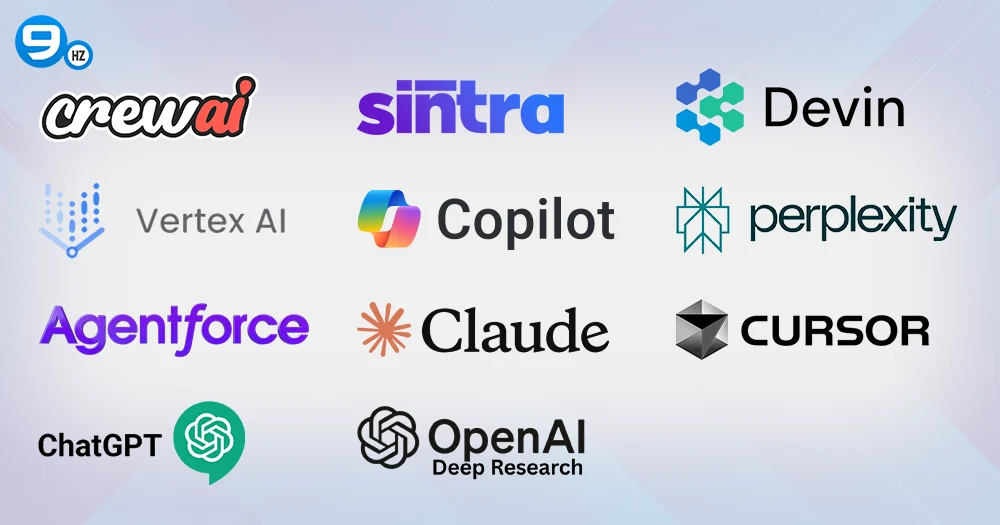
AI agents are changing the way that software can do things on its own. Below is a complete list of the 20 best AI agents, along with their main strengths, the types of people they are meant for, and how they work with other technologies. This will help you make smart technology decisions.
CrewAI creates structured role-playing AI teams, where agents act like workers (researcher, planner, executor). It is more reliable than early autonomous agents, as it enforces clear obligations instead of letting people think for themselves.
Sintra AI provides a complete team of pre-configured AI assistants, covering multiple job categories such as marketing, sales, customer service, and operations, rather than only one AI assistant. Each participant acts like a distinct specialist employee member, with the assistance of an aggregate, centralized AI system known as the “Brain AI,” which stores the brand, tone, files, and customer cultics.
Role-specific AI with out-of-box workforce capabilities for available agents.
Subscription‑based SaaS with multiple plan tiers (SMB to growth teams).
Devin AI is a big step forward for autonomous development tools because it acts as a full software engineer instead of just a coding assistant. It plans projects, writes code that is ready for production, fixes bugs, and more on its own.
Enterprise customers can create customer-grade agents that can conduct customer service through text, voice, and backend processes, using vertex AI agents through Agent Builder + Dialogflow CX + Gemini. At this time, vertex AI allows businesses to access their data through their corresponding system to solve the customer’s problem, such as checking orders, updating accounts, and guiding customers end‑to‑end rather than just answering FAQs.
Enterprise-ready agents providing true resolution through aggregate Gemini-based data.
Pay per use on google cloud vertex ai
(on a per-request and infrastructure basis).
Microsoft Copilot adds AI to everyday productivity apps, turning Word, Excel, Outlook, and Teams into smart assistants. Copilot doesn’t need new tools; it improves existing workflows so that employees can quickly automate reporting, summarize meetings, and analyze data.
Perplexity changed AI search by mixing conversational answers with verified citations. It makes professionals more likely to trust research done by AI. It pulls live web data all the time, checks the sources, and shows structured results, which is different from regular chatbots.
Agentforce adds autonomous sales and service automation to Salesforce’s CRM platform. With the help of Salesforce Data Cloud and powerful reasoning engines, it lets AI agents qualify leads, answer questions from customers, and suggest what to do next using real customer data.
Claude stresses secure and dependable reasoning, which makes it especially useful for businesses that deal with private data. Its lengthy context window lets users look at whole documents, repositories, or policies all at once.
Cursor changes the way software is made by putting AI directly into the coding environment. This lets developers talk to whole codebases.
ChatGPT Deep Research is like an independent research analyst that can browse, check, and combine material from many sources before sending structured findings. This shows how conversational AI is changing into agents that can do tasks and obtain information on their own.
Zapier Central takes traditional automation and turns it into conversational AI agents that can run workflows across thousands of business apps. Users don’t have to manually create complicated integrations. Instead, they tell the agent in simple language to handle tasks like updating CRMs, sending notifications, or managing leads.
Lindy AI talks about the idea of AI employees who can do the same jobs over and over again without needing to be told to do them, such as scheduling, follow-ups, and coordinating administrative activities. Lindy is easy to use and makes managers’ jobs easier by taking action instead of waiting for orders.
n8n blends the flexibility of open source with visual workflow automation, letting teams design complex AI pipelines while still having complete control over their infrastructure. n8n is very appealing to businesses that want to own their data because it lets you store your own data and make bespoke integrations. It is different from closed automation solutions.
Zendesk AI agents are dedicated support agents that respond to many support requests independently while following policy and brand tone. Utilizes generative AI and intent models embedded in Zendesk to determine the request, determine available knowledge, conduct actions in the back end and refer to human agents as needed.
No training support agents that handle up to 80%+ of customer support interactions.
Available on eligible Zendesk plans, with “Advanced” AI agent capabilities as an add‑on.
Botpress combines powerful LLM reasoning with visual chatbot design. It lets organizations use conversational bots on websites, messaging apps, and customer service channels. Over time, it has changed from rule-based chatbot software into a modern AI agent platform that can have conversations in context and use analytics to improve performance.
AutoGPT was the first to let AI systems divide big goals down into smaller activities that can be done without constant human supervision. Early versions were just tests, but later versions made memory management and task stability better.
Relevance AI goes beyond single agents by letting businesses build coordinated AI teams that handle research, analytics, and operational operations. Its visual interface lets non-technical teams use AI-powered assistants that are linked to enterprise data.
Elicit is an expert in scientific research workflows because it makes it easy for users to find, summarize, and compare academic papers. It is different from other AI assistants because it only looks at evidence-based reasoning and literature analysis.
Rasa gives businesses full control over conversational AI by letting them deploy it on their own servers and customize their NLP pipelines. Rasa is different from SaaS chatbot platforms because it isolates language comprehension from business logic. It allows businesses to use whichever model they prefer.
UiPath combines AI agents with robotic process automation, which lets businesses automate both structured and unstructured workflows across all of their systems. Because it has changed from rule-based automation to AI-enhanced decision-making, it can now handle things like invoices, compliance monitoring, and ERP operations on its own.
When picking an AI agent, you need to do more than just look at the features. Companies that get actual benefits see AI adoption as a way to run their business, not as an experiment. The goal is to go from testing tools to putting systems into production that are reliable.
Choose one main objective and focus on that. Successful AI implementations have focused on getting a specific measurable outcome and have avoided excessive trial and error. It is very important for the agent to understand when a task is completed, that the workflow can be repeated, and how you will measure success.
An AI agent provides value if it can interface with the other systems in your organization. Assess whether the agent can call functions, access APIs, and integrate with the main platforms you work with (e.g., CRM systems, Cloud Infrastructure, collaboration tools, etc.). You should consider the accuracy of the tools working consistently more important than how complex the models are.
Enterprise agents should be kept safe at all costs. Data protection features, approval workflows, human-in-the-loop controls, audit trails, and transparent reasoning logs are some of the ways you can check for compliance and accountability.
To execute creative tasks, the most efficient agents utilize AI reasoning but operate according to rule-based logic on more structured job requirements, such as financial calculations and compliance checks. Make sure that as agents are scaled, their performance does not change, nor does their cost structure.
Using real historical scenarios, test the agent. Inspect its behavior when subjected to imperfect inputs and quantify the return on investment by comparing time saved, reduction in manual work and efficiency of operational costs before the full-scale deployment.
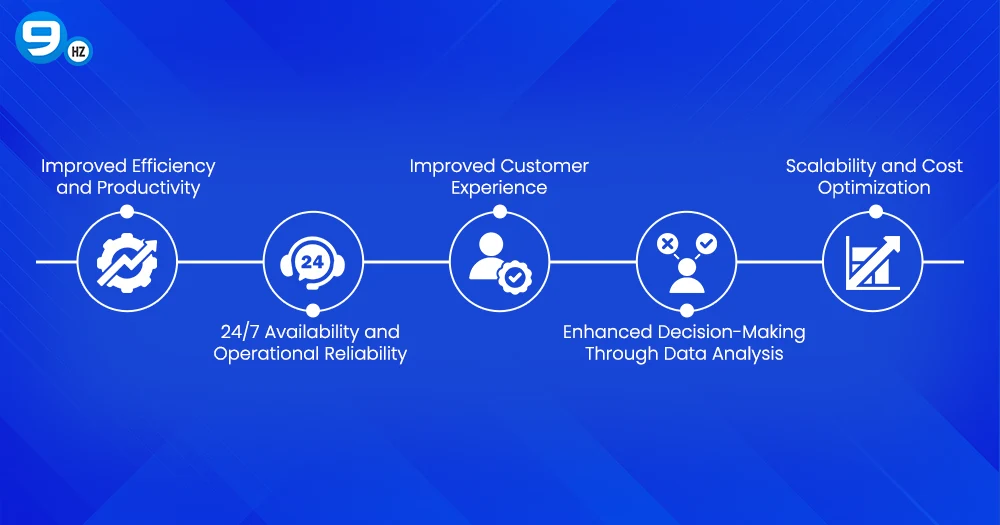
The use of AI agents has essentially automated complex, multi-step workflows across different businesses, where they historically required human oversight, resulting in a transformation of organizations. Unlike previous forms of automation tools, AI agents can respond to new input, provide context-specific decision-making for their activities and have the ability to grow with your company.
AI agents can provide relief from burdening, repetitive, time-consuming, manual work associated with data entry, report generation, workflow coordination, and system monitoring. Employees can concentrate on the company’s major revenue-producing areas: strategic development, innovation, and customer engagement, which generate higher value for the business.
AI agents operate continuously around the clock without getting tired or needing breaks. This allows companies to have uninterrupted workflows, immediate task performance, and available 24/7 customer support across disparate time zones to maintain a consistent level of service quality.
New AI agents can rapidly respond to customers by using their past purchasing data, preferences, and contextual details. As a result, there are positive developments in the areas of reduced waiting times, increased customer interaction, improved customer satisfaction ratings, and increased levels of repeat purchase behavior.
AI has the capability to filter through vast sets of both structured and unstructured data in order to identify patterns of behavior, provide predictive insight, and guide management to make better decisions based on data and not just be reactive.
When an organization employs additional staff capacity, the cost of running a business always increases linearly. But when the organization utilizes AI agents for handling additional workload, there is no additional cost associated with them.
If you want to know about the AI agent development cost, connect with our experts today to get a tailored estimate and discover how AI can scale your operations efficiently and cost-effectively.
Most of the time, companies find that pre-built AI Agents are easier to integrate; however, these agents typically do not fit their workflows, security requirements, or competitive strategies. While deciding between a pre-built or developing an custom AI agents, one should consider how the AI agent will impact their day-to-day operations.
| Decision Factor | Existing (Pre-Built) AI Agents | Custom AI Agents |
|---|---|---|
| Setup Time | Fast deployment with little setup needed | Needs planning, design, and building |
| Business Fit | Generic workflows that could be used by multiple businesses | Workflows that closely resemble the way that your business operates |
| Customization Level | Little customization is possible with pre-built AI agents | Build the agent to meet your specific needs |
| Integration Capability | Integration with systems is dependent on the availability of connectors | Integration with databases, APIs, and other internal systems |
| Competitive Advantage | Competing companies are likely using pre-built AI agents | Competitive edge over other companies because of the unique automation advantages |
| Scalability | Could hit the restrictions of the platform or the price tiers | Scales depends on how the business and infrastructure grow |
| Security & Data Control | Data managed within the vendor ecosystem | Full control over data, rules, and compliance |
| Automation Complexity | Works well for simple tasks | Handles complicated business processes with several steps |
| Long-Term Cost | Lower cost to join, but higher subscription fees | More money up front, but lower costs over time |
| Flexibility | Dependent on the vendor’s roadmap | Full control over features and growth |
| AI Intelligence Optimization | Reasoning that works for everyone | Learned about the company and its internal data |
| ROI Potential | Gradual improvement in efficiency | Changes that lead to higher productivity |
The NineHertz, a leading AI development company, builds custom AI agents for each business that are architecturally designed to work with real-time business operations rather than pre-coded templates. By architecting agents uniquely to their specific work process, decision-making logic, and operational objectives, they analyze how business processes actually operate, identify processes where automation can be used, and then build AI agents that integrate seamlessly with their client’s CRM, in-house systems, and data pipelines.
Each solution developed by The NineHertz is specifically engineered to have a scalable architecture, memory management, governance/fail-over capabilities and continuous monitoring. This results in a custom AI agent that integrates within your business process while providing real, measurable results in the area of efficiency and automation.
AI agents are quickly going from being test tools to being a key part of business infrastructure. Companies that get real results don’t just use tools without thinking about how they fit into their workflows, how well they are governed, and how they can measure their success.
Pre-built agents make it easy to try things out quickly, but custom AI agents offer better integration, scalability, and a long-term edge over the competition. Businesses that invest early in structured AI adoption will be ahead in an economy that is becoming more automated and driven by AI. They will also be more productive and make decisions faster.

Are you looking for the top AI development company in the USA? Guess what, you’ve come to the right destination.…

Key Takeaways Multi-agent systems can improve task specialization, coordination, and scalability by distributing complex workflows to specialized AI agents. Sequential,…

Key Takeaways AI supply chain risk monitoring uses real-time data and predictive models to flag disruptions before they escalate into…