
The growth of insurance companies has always been dependent on customer satisfaction, regulatory compliance, and communication with the key stakeholders. The modern health insurance software is helping companies to ensure all these growth factors simultaneously. A custom health insurance software development allows policyholders to choose an insurance plan according to personalized requirements, get instant resolution of basic queries, connect with insurance experts in real time, and adhere to all the defined regulatory requirements.
According to Markets and Markets, the insurance platform market was valued at $116.16 billion in 2025. The market is further expected to grow with a CAGR of 12.3% to reach a valuation of $207. 52 billion by 2030. Insurance companies are consistently partnering with insurance software development companies to transform their manual operations into automated ones with the help of next-generation software. If you are also looking to build a health insurance software, we will guide you throughout the health insurance software development cost, process, roadmap, things to consider, and everything that you should know to make an informed decision.
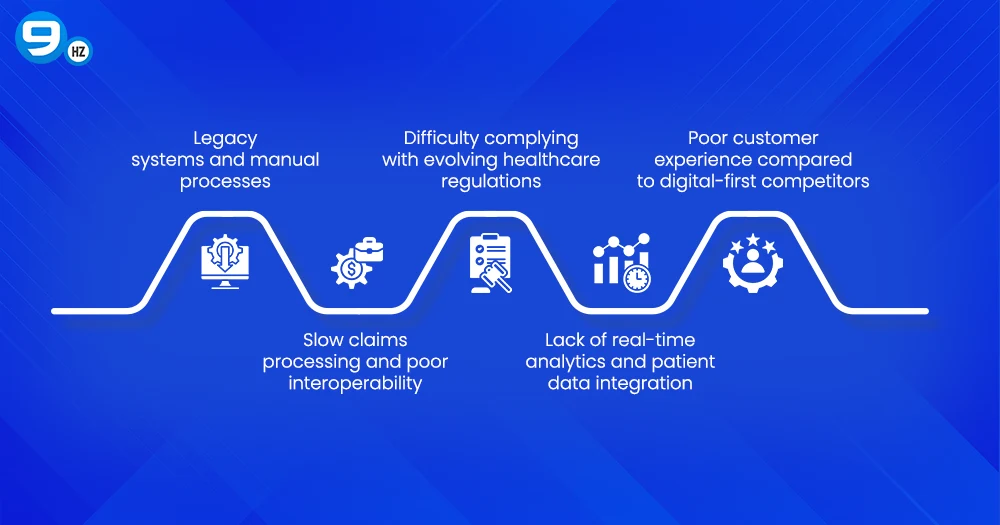
Before talking directly about the benefits and roles of the new health insurance system, it is highly important to understand the limitations of traditional software. It will ensure that you build software that is more advanced and capable of replacing outdated digital solutions.
The legacy insurance software based on the monolithic architecture is designed for limited product lines. Thus, they can adapt to the modern, dynamic, and multi-channel insurance ecosystem. With these outdated systems, insurers have to rely on the manual processes of underwriting, documentation, and reconciliation, which slows down the operations while increasing the chances of human errors.
Health insurance claims include several stakeholders like hospitals, pharmacies, diagnostic labs, and regulatory bodies. The older insurance solutions operate in siloes that lack interoperable data frameworks. Thus, the process of manual verification and repeated documentation requests makes the claim process slower, which directly impacts customer satisfaction and overall brand image.
The healthcare industry has always been prone to changing regulatory norms and compliance. Most of the outdated health insurance solutions don’t comply with new regulations, while often lacking the flexibility to adopt new compliance mandates. Thus, tasks like policy updates, document requirements, and reporting changes have to be carried out manually. Non-compliance with these standards often attracts penalties, operational disruption, and reputational damage.
The decision-making based on real-time data can help the insurers to identify high-risk profiles, curate personalized policy plans, and predict future risks. However, the legacy systems are not capable of handling huge data volumes, structuring the information, and extracting the actionable insights. The required manual intervention brings unnecessary delays and costs. At the same time, it also increases the chances of fraud, underwriting inaccuracy, and customer turnover.
The insurers using the modern health insurance software often outperform those relying on legacy systems by providing personalized policies, dynamic pricing, and instant support. Also, features like quick onboarding, real-time claim tracking, transparent communication, and mobile-powered claim submission encourage insurance companies who adopted advanced software solutions. Therefore, companies with outdated software are at high risk of losing their customers in the near future.
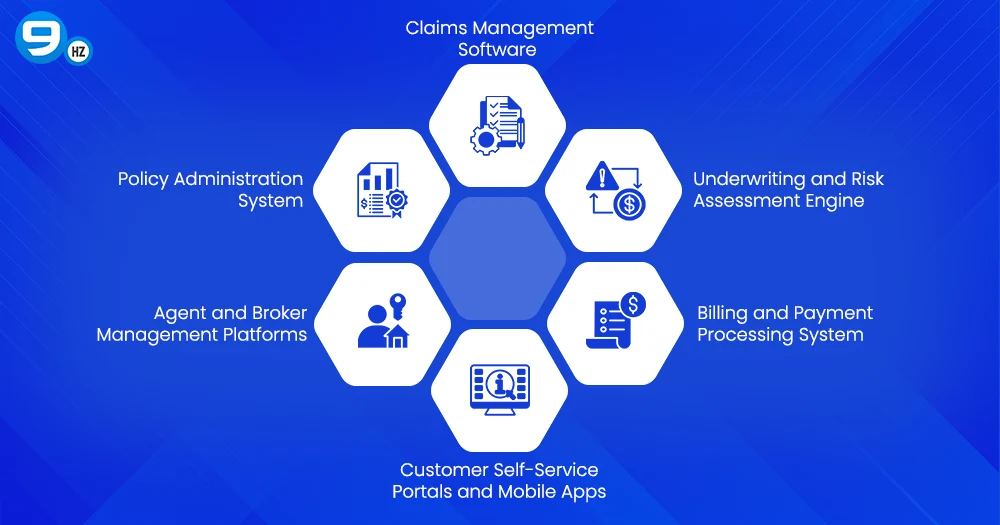
Health insurance is a vast domain with space for diverse software to streamline workflows in different departments, for different stakeholders. Thus, hiring an insurance software development company helps in identifying the right type of software according to business goals and real-time requirements. Here are some of the most preferred custom insurance software development systems that help to automate workflows, reduce human errors, and increase customer satisfaction.
Custom insurance software development consists of the policy administration system that helps to manage the entire policy lifecycle while taking care of product configuration, enrollment, endorsement, renewals, cancellation, and much more. The solution is designed to help insurers to configure complex coverage rules, manage waiting periods, and automate the benefit calculation without delving into heavy coding.
As the name suggests, claim management software helps in the submission and verification, as well as settlement or adjustments of the health insurance claims. The software is used to eliminate the need for manual intervention and facilitate automated document recognition, AI-powered validation, and rule-based workflow. Claim management software also helps in detecting fraud by accurately analyzing the submitted documents and aligning them with the rules mentioned in the policy.
An underwriting and risk assessment software uses predictive analytics and artificial intelligence to evaluate the high-risk policy holders. The software doesn’t only rely on the static questionnaire to collect the data but also fetches information from health records, wearable devices, lifestyle data, and historical claims. Fostering data-driven underwriting, it also helps the insurance companies to curate dynamic pricing models with personalized policy offerings.
The billing and payment processing system handles the monetary processes of the company, including premium invoicing, reconciliation, payment collection, and curating the periodic finance reports. The software can be integrated with the payment gateways, digital wallets, and banks to support billing cycles. The billing processing system is highly effective in reducing manual errors while bringing financial transparency throughout the workflow.
This is one of the most used solutions in the insurance industry that empowers customers and policyholders to access their entire insurance journey on their smartphones. The users can easily view the coverage details, provide reviews, download and store documents, submit claims, track claim status, and update their personal information in real time. At the same time, customers can also connect to experts via chat or call without sharing the contact information.
The agent and broker management solutions help to centralize the sales operations, performance analytics, commission tracking, and partner lifecycle management. The features like digital onboarding help in partner registration, compliance checks, and document verification. It can be integrated with existing customer relationship management software that helps track customer satisfaction in real time and make informed decisions.
When looking for health insurance software development, companies generally choose between a custom solution and off-the-shelf software. While most of the insurers randomly choose between the two, the overall goals and outcomes can make a significant difference. Let’s understand the difference between custom health insurance software development and off-the-shelf solutions.
| Factor | Customized Solutions | Off-the-shelf Solutions |
|---|---|---|
| Flexibility | Custom solutions offer complete flexibility according to business model, claim workflow, and underwriting rules. Features, UI, UX, and theme can be customized according to the brand image. | It comes with limited flexibility and supports general use cases. |
| Scalability | These solutions are designed with a scalable cloud architecture that supports high policy volumes, product lines, and AI integration. | Scalability is dependent on the vendor roadmap and requires higher licensing tiers for additional modules. |
| Compliance | Customized solutions are engineered in adherence to region-specific insurance regulations and evolving data privacy laws. | Compliance is dependent on vendor release cycles. |
| Integration Capabilities | The custom solution can be integrated into legacy systems like electronic health record systems, payment gateways, CRM, and AI tools. | The integration options are very limited, with space for only defined connectors. |
| Long-Term Cost Implication | Requires a higher upfront cost but eliminates the need for periodic licensing costs. | Lower investment in the beginning, but requires incurring subscription and licensing fees. |
| Deployment Time | Long development and implementation cycle for customized designs and features. | Short development time due to less-defined features and limited customization. |
| Competitive Advantages | Helps to attract and retain customers with personalized policy models, different products, and enhanced customer experience. | Standard capabilities limit the chances for innovation and thus lack competitive advantages. |
As the name suggests, custom health insurance software includes a tailored solution from scratch, with design, navigation, features, and compliance curated to specific business needs. The customized solutions are designed to fit exact business processes and thus have higher scalability. In this type of software, each component is designed for a particular business process, which means it takes more time and investment.
Off-the-shelf insurance solutions, on the other hand, are the ready-made solutions offered by the vendors. These solutions can be deployed into the system with little personalization and changes. High level of customization is not possible in off-the-shelf development, and thus it can be deployed in the least time and cost.
The average health insurance software development cost ranges between $40,000 to $300,000. However, there are software development projects with different complexity levels that completely redefine the overall cost. For instance, the simple insurance software development that only provides customer support can be developed for a few thousand dollars. On the other hand, building a full-fledged AI solution that automates the overall workflow requires hundreds of thousands of dollars.
The following table will help you understand the cost to develop health insurance software.
| Component | Estimated Cost Range | Estimated Development Time Duration |
|---|---|---|
| Basic System | $40,000-$60,000 | 3-4 months |
| Mid-Level Platform | $60,000-$100,000 | 6-8 months |
| Enterprise Solution | $100,000+ | 8-10 months |
| Mobile Apps | $50,000-$150,000 | 6-8 months |
| AI Analytics Modules | $100,000-$500,000 | 10-12 months |
Custom health insurance software development is a highly complex process, and thus, the overall cost is influenced by a range of factors. The exact development cost can only be determined by analyzing the following components-
The complexity of the features that are integrated into the insurance software impacts the architectural depth, development timeline, and testing efforts. A software carrying only the policy management feature will require less time and effort, and thus can be developed with lower cost. On the other hand, a software designed for real-time claim adjustment, AI underwriting, and telehealth integration will require numerous integration capabilities, increasing its costs.
A standalone system requiring no integration can be cost-efficient. However, developing a health insurance software that can integrate into the hospital digital ecosystem, including software such as electronic health records, pharmacy networks, diagnostic labs, and third-party administration solutions, increases the development cost. It requires data standardization, API connectivity, secure data exchange, and interoperability frameworks, which makes the software costlier.
AI is still a novel concept, and thus, the human resources who excel at using this technology are limited. Imparting the AI capabilities into the solutions requires professional support, continuous optimization, huge data volume, model training, and rigorous testing. All these factors increase the overall development cost for health insurance software.
The health compliances like GDPR and HIPAA are crucial to consider during health insurance software development. To ensure that the solution aligns with the regulatory requirements, we ensure a secure data store, audit trails, role-based access control, consent management, and more, which makes the overall software more reliable. However, imparting all these features definitely increases the overall development cost.
Insurance software is designed to store sensitive health and financial information, which makes it important to deploy a highly secure infrastructure. It requires investment to build a multi-layer encrypted system, identity and access management feature, secure cloud architecture, multi-factor authentication, penetration testing, threat monitoring, and much more.
It might sound vague, but the location of an insurance software development company, along with its team size, can significantly impact the cost. Hiring a team from countries like the USA, UK, or Australia can cost you more than twice as much as hiring a team from an Asian country like India with the same expertise, experience, and number of developers.
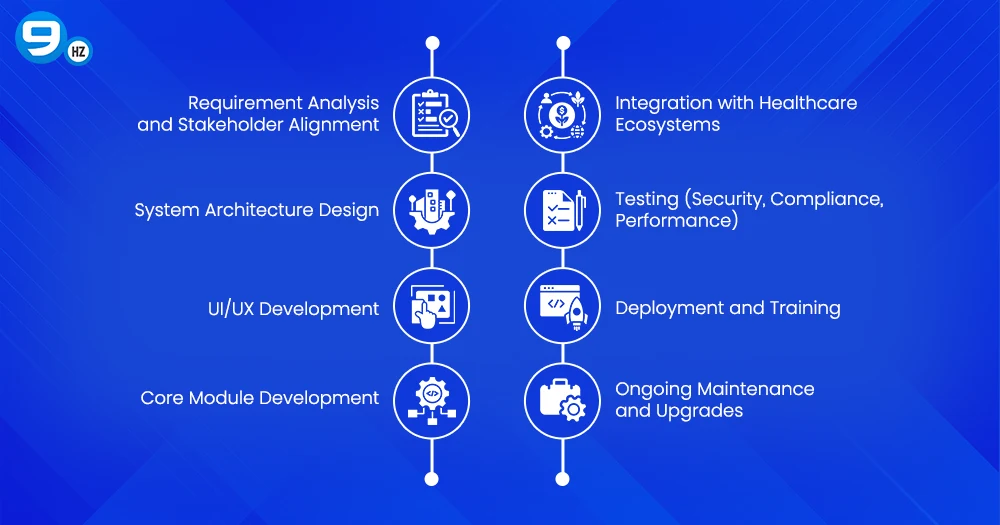
The implementation process for health insurance software might differ according to project management methodology. However, there are certain phases that act as the key performance indicators of the project.
The first step of the health insurance software implementation process is dedicated to defining business objectives, business workflow, regulatory obligations, and more. Key stakeholders of the company collaborate with each other to determine the essential features and navigation.
System architecture design consists of cloud infrastructure design, database design, microservices architecture, integration framework, and compliance control. It acts as the foundation of the project that defines processing time and future AI capabilities.
As the name suggests, this phase is dedicated to building a seamless user interface that allows the key users to navigate through the information and features. A prototype is delivered to the client that helps to assess the overall theme and provide feedback.
This is the core development phase of the software, where the frontend and backend of the software are developed. It consists of building modules like policy administration, underwriting engines, billing systems, claims management, and broker portals.
In this step, the new health insurance software is integrated into the hospital’s legacy system. The insurance software is connected to electronic health records, telehealth platforms, payment gateways, regulatory databases, etc.
The testing phase is conducted to ensure that the end software doesn’t carry any bugs or errors. For the same, different types of tests are carried out, which include vulnerability assessment, penetration testing, compliance checks, performance testing, unit testing, automated testing, etc.
This is the end phase of the project in which the insurance software is deployed to a defined marketplace or internal tech ecosystem. This phase makes the software available for the end users. A training session is also conducted to ensure that the concerned stakeholders can use the features to automate their tasks.
Ongoing maintenance refers to the IT support provided by the insurance software development company to ensure the long term performance and optimization of the software. For the same, our experts dedicatedly monitor the software utilization in real time, identify bugs, provide periodic updates, and also add new features according to changing customer expectations.
General statistics from insurers that have adopted health insurance software showcase 90% increased customer engagement, 4% higher revenue growth, 50% reduced agent workload, and an overall 190% ROI. At the same time, automation has accelerated workflow 2.5x while reducing the claim rejection rate by 6%.
The overall return on investment for the health insurance software development is calculated based on several factors. It includes-
The first key metric to determine the ROI of health insurance software is reduced operational costs. This software can automate the different tasks like reporting, underwriting, claim validation, and much more that saves the workhours for humans. The saved time can be further invested in more crucial tasks to reduce the overall operational costs.
AI-based validation engines and automated claims adjudication shorten the claim processing cycles. Thus, faster settlements reduce the escalation costs, customer complaints, and strengthen the policyholder trust. Short turnaround times strengthen the financial efficiency while reducing the pending liability reserves.
AI-powered analytical solutions are capable of detecting suspicious claim patterns, inflated invoices, and duplicate billing. Early detection of suspicious revenue leakage and unnecessary payouts, it can inform the concerned authorities to take preventive measures. Thus, the solution saves a lot of revenue, which reflects in the overall return on investment.
The key features like self-service portals, personalized policy plans, faster approvals, and transparent claim tracking elevate customer satisfaction. The seamless digital experience increases the renewal percentage while reducing the churn rates. By retaining the existing customers, custom health insurance software development makes the overall process more cost-efficient.
As interpreted earlier, automation reduces the workload for employees, sales agents, claim handlers, and other stakeholders. The saved time can be invested in other critical and more important tasks, leading to a significant revenue increase. Higher productivity per employee increases the overall revenue for the company.
AI-integrated analytical dashboards turn the raw insights into claim trends, loss ratios, and operational bottlenecks. The key practices, like smarter pricing, product development, and risk assessment, reduce the uncertainty that enables strategic growth planning.
Irrespective of the development cost and the features that you impart in your health insurance software development, the effectiveness of the end solution is highly dependent on the development partner. Thus, it is highly important that you choose the right partner for custom health insurance software development.
However, the lack of technical knowledge and no prior experience can make it challenging to identify and onboard the right development team. Therefore, we have enlisted some of the key considerations that can help you evaluate the expertise of a development company.
First of all, make sure that your software development company carries profound expertise in the healthcare and insurance domain. It will enable them to impart the right features and align the software with the end-user expectations.
The software development company should have good knowledge of building custom health insurance software that complies with regulations like GDPR, HIPAA, and regional laws to avoid legal conflicts.
Along with traditional software development, the development team should have good expertise in the industry 4.0 technologies like artificial intelligence, machine learning, cloud integrations, etc., to make future-ready solutions.
Have a glance at their client portfolio and case studies to know about the projects they have worked on. If the portfolio carries projects similar to yours, it can be a good idea to consider them as your project development partner.
The firm that you hire for your health insurance software development must provide post-deployment maintenance and support. It ensures the seamless performance of the software in a live environment.
Make sure that your software development partner builds a scalable solution that can be integrated with the emerging technologies and new features. The software should be capable of handling an increasing user base and data volume.
As interpreted in the earlier section, it is highly important to hire the right health insurance software development company to achieve the project objectives and long-term goals. The NineHertz is a leading health insurance software development company with experience of over 15 years. We have partnered with the insurance brands globally to help them build next-generation software, multiply revenue, and enhance customer experience.
A custom health insurance software development enables the insurance companies to automate their time-consumingg and repetitive tasks, utilize human resources in more productive tasks, and reduce human errors. The key benefits, like reduced operational costs, faster claim settlements, improved fraud detection, and higher customer retention leads to sustainable business growth. Building a relevant software requires an upfront investment of $40,000 to $300,000, depending on the business-specific requirements and features.
If you are also looking to build a custom health insurance software, The NineHertz invites you for a free consultation session. Connect with our experts and make an informed decision.
The modern insurance software must include features such as automated renewals, customer self-service portals, well-documented APIs, rating engines, integrated premium financing, automation workflow, predictive analytics, personalized policy plans, dynamic pricing, etc.
Yes, insurance software development is suitable for startups as well as large insurers. The features and technology stack can be customized according to particular business requirements, ensuring the investment amount falls within the budget of respective businesses.
Yes, we build insurance software that can integrate with legacy systems like underwriting software, CRM software, payment gateway, ERP software, insurance management software, etc.
The technologies like AI, ML, computer vision, natural language processing, generative AI, cloud platforms, containerization, API, and Middleware are used to build the modern insurance software.
The insurance software helps to automate manual tasks, claim processing, underwriting, and policy issuance, and reduces human errors. Thus, it boosts the workforce productivity and fosters data-driven decisions that bring better accuracy and efficiency.
Yes, The NineHertz builds AI-powered insurance software solutions while imparting technologies like predictive analytics, natural language processing, computer vision, big data analytics, and much more.
Custom software can store and handle sensitive data better than off-the-shelf solutions, as it is equipped with safety measures like end-to-end encryption, role-based access control, and multi-factor authentication.
A health insurance software must meet the regulatory requirements like GDPR, HIPAA, and PCI DSS, along with the regional laws, to avoid legal challenges and earn customer reliability.
Yes, insurance software is supported and integrated with certain mobile applications and websites for better accessibility and easy navigation.
Outsourcing the insurance software development to development companies in countries like India helps to save a high cost while minimizing time-to-market. It also helps to access a global talent pool to choose an experienced development team.

Key Takeaways Insurance mobile apps are the digital interface designed for policyholders where they can track, manage, and file a…

Key Takeaways Insurance claims management software is a must rather than just a mere option in environments where the volume…

Key Takeaways With the end in sight of digital healthcare and InsurTech, insurers need to focus on developing mobile health…