
Imagine your biggest supplier has sent an email about experiencing an unexpected situation, like a war or a natural disaster. And you know this isn’t a delay but a complete disruption to your operations.
If you receive such an email in the morning, your entire plan will collapse, even with a backup. You need at least 6 weeks to scale your production even when a backup supplier is available. You will be at risk of missing orders that you have already committed to for the quarter.
Many U.S. manufacturing and distribution companies face disruptions like this every day. And 73% of supply chain leaders admit they weren’t proactive enough to predict disruptions earlier.
In a recent report by Gartner, companies are losing 7 to 12% of their annual revenue. This is because they weren’t able to predict disruptions and take actions to prevent them.
That’s when predictive tools come in. By analyzing past data and current market trends, they can detect patterns that humans would easily miss. Instead of acting when it’s too late, predictive models provide insights weeks in advance. And the result is that managers depend less on their instincts and make better decisions when it comes to inventory. Predictive analytics helps them plan everything with data backing every move they make.
In this blog, let us see how predictive analytics can improve supply chain optimization.
Predictive analytics is a field in data analytics that uses past data and real-time inputs to predict what will happen in the future. You already have a tremendous amount of data in your system to manage the supply chain operations. Predictive analytics in supply chain management works by taking advantage of available data and forecasting shifts in demand or supplier delays.
Instead of reacting to problems after they occur, supply chain managers foresee problems with predictive analytics, such as stock-outs or supplier delays, and adjust inventory accordingly. They collect data from various sources, like ERP systems, IoT sensors, and analyze market trends to convert that data into useful insights.
Traditional analytics can only tell you what happened in the past. But predictive analytics shows you what can happen in the coming weeks or months. For example, if historical models show a continuous spike in demand in Q4, the predictive tools trigger procurement to ensure that you have enough stock in advance.
Most supply chain problems are buried in the data, and you will pay an expensive price when you overlook them. Predictive analytics in supply chain optimization goes beyond processing big data. It converts raw data from various sources into insights that are required to run your business without disruptions.
Here are the functions of predictive analytics in supply chain optimization:
Getting your inventory levels right is one of the hardest things to do. When you order too much to maintain the stock, your cash is tied up, and ordering less than required is also going to be problematic. Predictive models solve this issue by predicting which items your customers may prefer to buy and when they’ll buy. For example, Walmart runs its previous year’s holiday sales through predictive models to know which products will sell out quickly and which products will stay on the shelf after January.
A truck stuck in traffic is going to produce a costly bill, which could’ve been avoided, and bring the wrath of unhappy customers. Companies are able to improve their delivery speed with predictive analytics and also cut down on fuel costs. DHL uses predictive analytics to analyze traffic and weather conditions. This helps them reroute trucks in real time to avoid delays.
Supplier risk monitoring is an important process where supply chain managers cannot go wrong. Most of them find out that a supplier is struggling only after not receiving orders on the expected date and time. Supply chain analytics enables managers to analyze supplier performance data and identify potential delays at an early stage.
For example, Toyota uses predictive analytics to monitor supplier performance and flag suppliers who show signs of frequent delays.
COVID-19 exposed that most supply chains were built for a stable world. Companies that used predictive analytics maintained the right levels of inventory and found out supply shortages before they led to disruptions. And the companies that existed on the gut feeling of managers and Excel sheets suffered.
Many businesses started using predictive analytics to forecast demand, and Amazon is one of them. It uses predictive analytics to anticipate which regional product demands and positions inventory closer to where it will be needed. This led to shorter shipping times and enhanced customer satisfaction.
Through scenario modeling, you can run “what if” simulations to evaluate strategies that minimize costs without compromising on product quality. Using predictive analytics is the best way to identify inefficiencies in your warehouse operations and cut down on unnecessary expenses.
Predictive analytics enables you to make informed decisions backed by data. Here are a few benefits of supply chain analytics that change your business operations:
Traditional forecasting depends on averages of past data. But predictive analytics takes 20 to 40 variables into account. You make a decision after considering various factors like weather conditions, promotional calendar, and search trends.
In a recent research by McKinsey, AI-based forecasting is 20% to 50% more accurate when compared with forecasts by traditional analytics.
A Gartner study found that nearly 68% of organizations were hit by severe or mild disruption in the previous year, and most of them never expected it.
Predictive analytics provides you with a sharp vision to identify a devastating situation before it happens. This foresight helps you identify disruptions and allows you to take action before you face any consequences.
Imagine you announce a sale and then send a “sorry, we are out of stock” message in just a few hours. Predictive analytics helps you to not get into that situation by avoiding guesswork. Insights from AI models keep warehouses lean without holding excessive stock.
Dynamic pricing strategies:
Markets keep fluctuating, and the prices keep changing according to demand. In such situations, organizations find it challenging to maintain their profits. Predictive analytics tools are capable of foreseeing price trends and the purchasing behavior of customers, allowing companies to change their prices based on demand.
Every inventory decision and production schedule comes down to one simple question: How much will customers buy and when? The process of predicting requirements is called demand forecasting, and this is where things go wrong for most businesses.
Traditional demand forecasting methods work only when the market conditions are stable and predictable. But supply chains today face a lot of uncertainty, and this is how predictive analytics improves how predictive analytics improves demand forecasting.
In demand forecasting, accuracy is one of the most important traits. And without accurate forecasts, you cannot optimize inventory levels and ensure customer satisfaction.
If you’re wondering how predictive analytics achieve such accuracy, it is because they combine market intelligence with customer behavior and competitor analysis. The forecast model updates and refines itself to changing market conditions and forecasts demand with great accuracy.
In addition to forecasting, predictive analytics provide insights that streamline operations. It analyzes past data and identifies inefficiencies and areas for improvement. For example, predictive analytics in the supply chain can identify seasonal demands and enable you to adjust your inventory levels accordingly.
The most important question in the minds of supply chain managers is “Are all our suppliers credible and dependable?”
Predictive analytics gives a data-driven answer to this question, eliminating the guesswork. Usually, you find out about supplier performance only after a late delivery or after encountering a quality issue. This is a reactive approach. But predictive analytics allows you to handle such difficult situations smoothly.
It is now possible to predict when a supplier will cause an issue by analysing historical data and external market trends. For example, predictive models catch if a supplier’s on-time delivery rate drops or when raw material costs blow up and send you alerts. Due to this, you can secure alternate suppliers before production is disrupted.
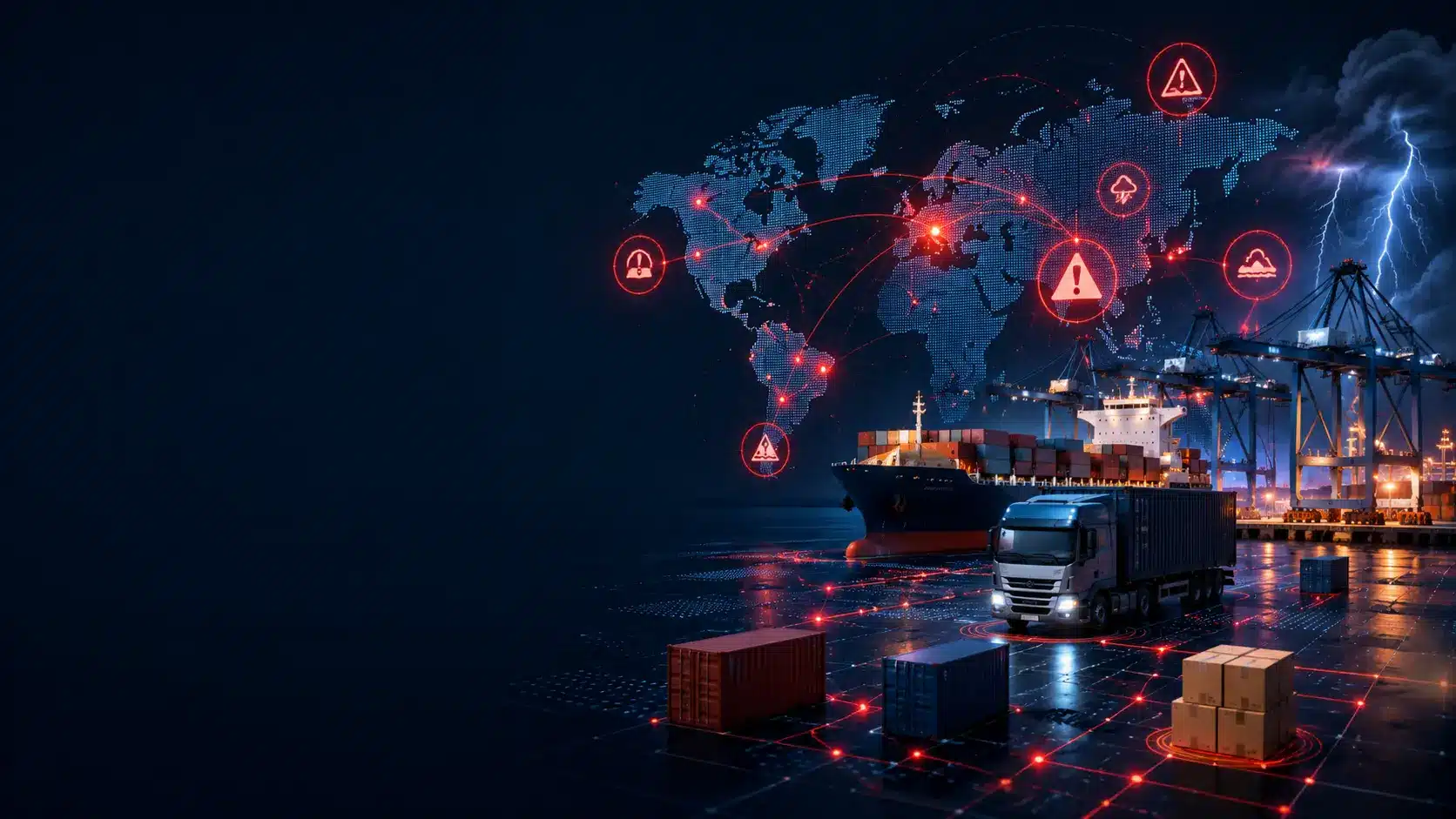
Predictive analytics has become a game-changer for risk management in the supply chain. Predictive tools can now monitor external risks such as geopolitical tensions, economic conditions, or weather events.
For example, if a predictive tool forecasts a flood in specific regions, you can pull out the stock from that region in advance so that you don’t face any disruptions in the future.
Predictive analytics generates scorecards based on a supplier’s performance. You get an idea of their quality and lead time by looking at a single dashboard. You can easily know whether a supplier is reliable or not based on the insights provided by predictive models instead of trusting them blindly.
Running a supply chain is expensive, as it involves managing trucks and warehouses. Yet, most of the operational costs hide in unnoticeable things.
Businesses overlook things such as a truck sitting too long at their facility and a warehouse getting filled with unwanted inventory. Though this looks inevitable on the outside, these are just signs of a supply chain reacting rather than predicting.
According to the American Transportation Research Institute, detention (the period where the truck sits idle) costs over $15 billion a year in the supply chain industry.
To reduce detention costs in the supply chain, you have to take care of delays before they happen and not after the invoice arrives. This is where predictive analytics enters and helps reduce detention costs by analysing details like past data and port congestion to anticipate when delays are likely to occur.
Inventory carrying costs are a budget killer that no one notices, as it looks futuristic. But this is just poor demand forecasting in disguise. Predictive analytics reduces inventory carrying costs by overcoming the disadvantages of traditional analytics.
Companies using predictive tools have seen a reduction in fuel consumption as they are capable of detecting inefficient routes and adjusting them.
If you’re a supply chain manager, you would come across problems such as a delayed shipment or a warehouse that is overstocked. Usually, you won’t realize that these problems exist until the damage is done. Real-time data changes this situation by letting you know what’s happening and act on it while it’s still happening.
Earlier, managers used to make supply chain decisions based on data that was days or weeks old. They worked on Excel sheets and trusted their instinct to make a decision. This approach worked when the supply chain was simpler.
Today, you can detect an issue almost immediately with the help of real-time sensors and IoT. Managers are able to fix problems before they escalate instead of reviewing them after things go wrong.
For example, Lenovo partnered with IBM to apply AI to improve their response time and the way they handled their risk management. As a result, they were able to reduce the response time to address supply chain disruptions from days to minutes.

Many companies think that implementing predictive analytics in the supply chain is simple. All they have to do is feed the data and make smarter decisions to cut supply chain software development cost. But there is a huge gap between saying this technology works and this technology works for our organization.
Can you guess why? Implementing predictive analytics is not just a simple software installation. It changes how the business operates all at once. Here are a few common challenges your company will face while implementing supply chain analytics.
This is the challenge nobody puts in the project plan, but ends up causing more trouble than any other technical problem. When you introduce predictive analytics, you are indirectly telling your teams that the algorithm is going to help them make decisions they have been making themselves. So teams have to understand why they should trust predictive models and how it acts as a decision support tool.
You realize the importance of predictive analytics in supply chain, the moment when something goes wrong. Predictive tools are only as good as the data quality they’re being fed. Many organizations face challenges because of fragmented data and issues with data inconsistency. Poor data quality leads to unreliable predictions, which collapses trust in the whole predictive analytics system.
Most companies don’t understand the importance of having skilled people on the team. Even when you have the best predictive analytics tools in your company, only someone who understands analytics and the operational side of the supply chain can interpret what it’s telling them. Finding and nurturing the right talent is one of the common challenges organizations face, even though they realize the importance of predictive analytics in supply chain.
Most supply chains weren’t designed to use predictive analytics in supply chain. Different platforms connecting to modern analytics tools are built by various vendors with different data standards.
Integrating predictive tools with legacy systems presents many technical challenges. Most of the companies underestimate how important integration work is before running their first meaningful project.
The world’s largest retailers have been using predictive analysis at a huge scale for years. And those companies have seen fundamental shifts in how their supply chains are operating. Here’s what implementing predictive analytics in supply chain looks like in the real world.
Walmart predicts demand before even customers know what they want: Walmart has 11,000 stores across 28 countries in the world, and even a few forecasting errors can lead to millions of dollars of misplaced inventory.
Walmart’s AI systems combine machine learning models and predictive analytics to create a 360-degree view of demand and supply.
Amazon ships products before its customers order them: Many businesses have set Amazon’s supply chain as their benchmark today. This is because they have applied predictive analytics not to respond to demand but to anticipate it.
Amazon’s anticipatory shipping model moves products close to customers even before they order. Between 2019 and 2023, Amazon’s inventory turns improved by 12% per year, and its inventory backlogs reduced by 20%. This proves the importance of using predictive analytics in supply chain management.
Nestlé reduces its procurement costs through predictive analytics: Nestlé has one of the most complex food and beverage supply chains in the world. They apply predictive analytics at the procurement level to manage this complexity. They have achieved 10% of savings in procurement costs, which is almost a billion dollars in annual savings.
Predictive analytics is changing from a tool that helps humans make better decisions to a tool that makes a decision and executes the task on its own. Here are the future trends in supply chain analytics.
For years, predictive analytics was only about providing useful insights for humans to make the right decisions. Agentic AI changed that by deciding and acting on an issue without waiting for a human to take up the task.
For example, in the future, AI can monitor inventory levels and replenish the stock levels without human intervention.
A digital twin is a virtual replica of your supply chain, which is used to test decisions before implementing them in real time. Digital twins are game-changers in preventing disruptions by anticipating equipment failure.
Demand forecasting is the most important element in supply chain analytics. But traditional models built on historical data are not as accurate as modern predictive tools powered by AI and ML. As these tools improve themselves with every new data point, the accuracy is only going to increase every time.
Implementing predictive analytics in the supply chain has unparalleled benefits, which are crucial in the context of its role. Supply chain operations usually occur on a large scale, with numerous associated operations. On the other hand, industry and consumer demands are skyrocketing, so you need to be resilient to handle complex tasks.
Adopting predictive tools is perfect for your supply chain business, from improving service quality to handling challenges. AI-powered solutions will make all processes seamless, such as inventory management, warehouse automation, logistics optimization, procurement, planning, and more.
The only thing you need to take care of is to be ready with a perfect implementation strategy and a team to make it real. As a trusted supply chain software development company, The NineHertz is here to help you start to end, i.e., ideation to deployment. Share your needs with us and get a perfect solution today.
Predictive analytics is a field in data analytics that uses past data and real-time inputs to predict what will happen in the future. You already have a tremendous amount of data in your system to manage the supply chain operations. Predictive analytics in supply chain management works by taking advantage of available data and forecasting shifts in demand or supplier delays.
Predictive analytics uses AI, ML, and current trends to analyze past data and forecast future demands with high accuracy. It goes a step further in demand forecasting by answering two important questions: “What will happen in the market?” along with “Why will it happen?” This accuracy allows businesses to optimize their inventory with accuracy.
Predictive analytics in supply chain provides you with a sharp vision to identify a devastating situation before it happens. This foresight helps you identify disruptions and allows you to take action before you face any consequences.
Key Takeaways AI supply chain risk monitoring uses real-time data and predictive models to flag disruptions before they escalate into…

The global supply chain covers a complex network of manufacturers, suppliers, distributors, wholesalers, retailers, and customers. So, how does a…

Maintaining a healthy relationship with suppliers is pivotal for businesses to ensure their long-term sustainability in a competitive market. For…