AI-native product development has moved past the experimentation phase. ISVs are no longer asking whether AI features belong on their roadmaps. They’re asking how to engineer them at production scale, with the same reliability and ownership. That shift is changing what “building in India” actually means.
India’s overall AI talent pool is also expanding quickly, expected to grow from about 600,000–650,000 professionals to more than 1.25 million by 2027. It is also worth noting that the hiring base is widening beyond the top metros.
Traditional offshore and GCC models were built to scale headcount and standardize processes. They assumed the work itself was predictable, with fixed specifications and linear delivery. AI-native engineering partner changed the nature of software delivery, introducing a level of variability that traditional GCCs weren’t designed to absorb. As a result, teams need to be structured differently from the outset.
This is where location stops being a cost lever and becomes a structural issue, as different cities offer various densities of AI-specific engineering talent. This unevenness shapes hiring speed, attrition risk, and outcomes that directly compound into roadmap delivery.
Tier-1 cities like Bengaluru and Hyderabad have the deepest specialist pools and offer the fastest path to scale. Tier-2 cities in India, such as Jaipur and Indore, are becoming credible for retention and long-term team stability. But these cities have trade-offs of their own.
In this article, we will explore both tiers across the factors that determine outcomes for an AI-native ODC: talent availability, scaling, and retention, giving CTOs and ISV decision-makers a framework for choosing a city.
A traditional ODC is built around a simple operating assumption: work can be defined upfront, assigned, and then tracked until completion. You break the work into tickets or sprints, and if more work comes in, you add more people. This setup works well when the output is clear, such as whenever there is an integration of known systems or a delivery with a clear finish line.
However, the traditional ODC approach becomes less effective when the work is uncertain or highly experimental, which happens most of the time with AI product development. The traditional ODCs are good at execution, but less suited to open-ended product engineering where requirements develop during the build.
In AI-native teams, the work often changes as the data or product behaviour changes, so the old model may not be enough. An offshore development center built to use Artificial Intelligence at its core operating system never assumes that the work can be planned once and executed in a straight line. Evaluation has to be continuous, and not a one-time quality assurance gate.
Governance has to be embedded in the workflow, like access controls and monitoring. All these things change the team’s needs from a structural point of view. ML engineers and MLOps specialists are going to be part of the core execution system alongside product engineers who understand model limitations and evaluation criteria.
This operating decision is the reason behind how the performance of your AI-native ODC depends on its location. Three location-based variables determine the success of your ODC.
The talent concentration of the city decides whether the specialized roles of AI-native ODCs can be filled all at once or whether every hire needs months to select the right candidate against a shallow pool.
The same talent pool that’s affordable at 10 engineers carries a very different cost at 50, depending on how concentrated demand is in that city. In a small team, salaries may seem reasonable at the beginning. But once many companies start competing for the same talent in that city, wages rise, and the location becomes much more expensive at scale.
If people stay longer, the team keeps learning, and it gets more effective over time. So retention decides whether the embedded context this team builds compounds or resets every time attrition forces a rehire and re-onboarding cycle.
Tier 1 and Tier 2 Indian cities answer these three questions in different ways. The choice of city affects whether you can hire the right people and keep costs under control as you grow.
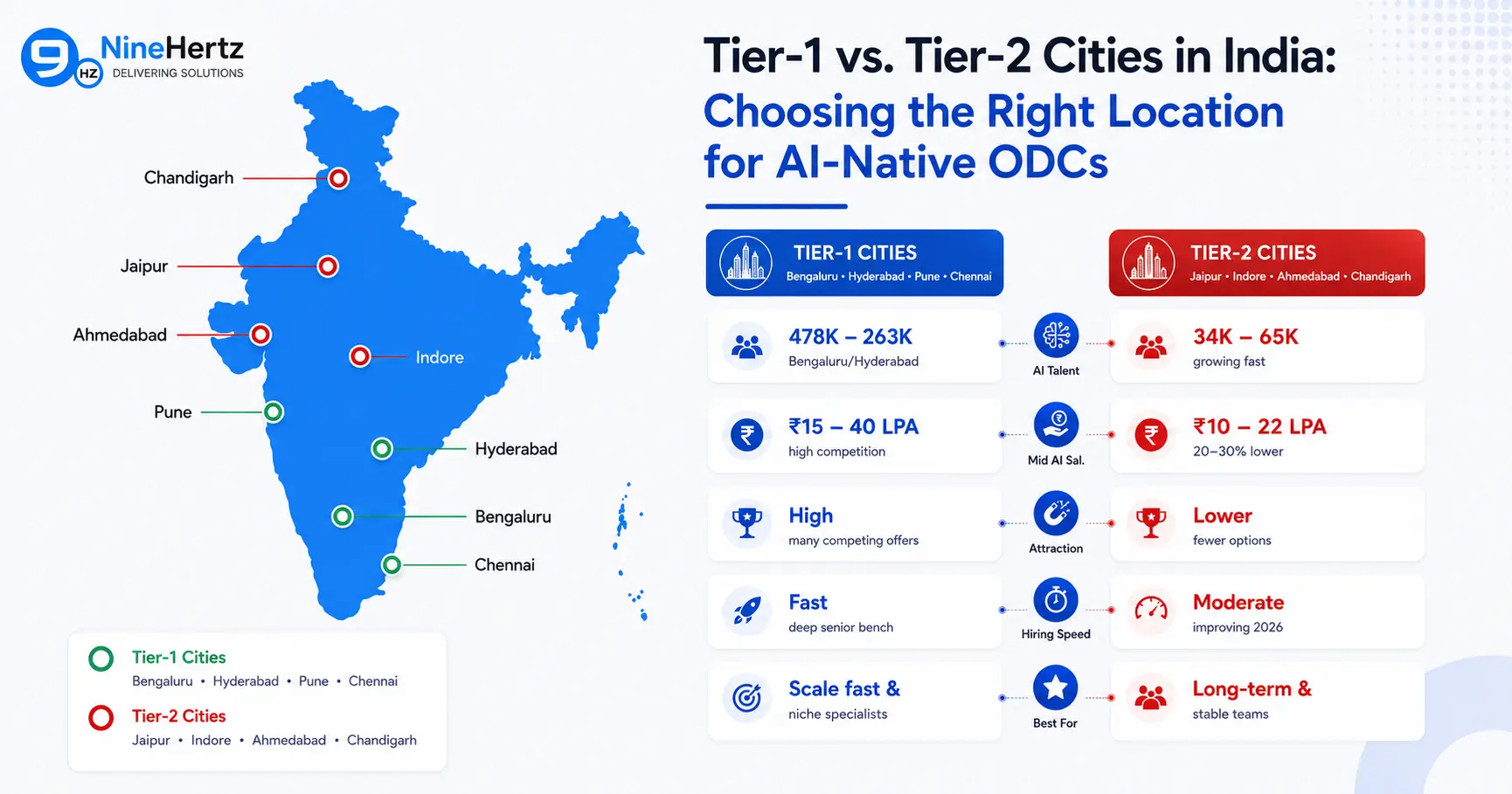
We should first understand how Tier-1 and Tier-2 differ before comparing salaries in these cities. The two tiers are not just “expensive vs. cheap”; they differ in hiring competition, infrastructure maturity, and the consistency with which teams stay intact over time.
Tier-1 cities such as Bengaluru, Hyderabad, Pune, and Chennai have the deepest specialist pools and the fastest access to niche talent. But that concentration also creates stronger competition for the same engineers, pushing up salaries and attrition.
| Factor | Tier-1 Cities | Tier-2 Cities |
|---|---|---|
| Competition for talent | High. Many ISVs, GCCs, and startups are competing for the same people. | Lower saturation in many markets. So, less intense local competition. |
| Attrition risk | Risk is higher due to more nearby options and frequent job switching. | Lower. Especially at places where the local employer base is less crowded. |
| Infrastructure maturity | More mature office, vendor, compliance, and connectivity ecosystem. | Improving quickly. But still more variable across cities. |
| Best suited for | Fast scaling, niche hiring, and large specialist teams. | Long-term team building, retention-focused hubs, and cost-sensitive scaling. |
| AI/ML talent pool size | Bengaluru: 478,620 | Hyderabad: 263,010 | Chennai: 177,955 | Pune: 127,635 | Coimbatore: 46,019; Other Tier-2 hubs are growing quickly. |
| AI learner share | Dominant share of the national workforce. | Nearly 20% of AI learners come from Tier-2 cities. |
| AI hiring growth | Hyderabad: ~51% | Vijayawada: 45.5%; Broader Tier-2 growth is visible. |
| Talent growth rate | Mature but slower-growing base. | Coimbatore: +72% | Ahmedabad: +65% |
Talent depth looks different depending on the role people are hired for. Bengaluru remains the deepest pool overall, and it leads India’s AI/ML talent market with over 478,000 professionals. Along with Hyderabad, it has most of the country’s senior ML roles. So, senior-level hiring is especially concentrated there.
But the city having the deepest talent doesn’t mean it is the easiest place to hire from. In Bengaluru, every AI specialist can choose among multiple competing offers. This situation makes hiring slower and more expensive in Bengaluru.
1. AI Engineers and ML Engineers: These two roles are heavily concentrated in Bengaluru and Hyderabad, with the deepest bench of engineers who have shipped production ML systems. Hyderabad’s Microsoft, Google, Amazon, and Meta campuses have produced a deep pool of senior engineers with ML infrastructure and applied AI experience. This makes Hyderabad the closest substitute to Bengaluru for this role category.
2. Data Scientists and Product Engineers: Pune has a deep university and IT services pipeline that produces solid mid-level engineering talent. So, it is well-suited for data science and analytics-heavy roles at a lower cost compared to Bengaluru for equivalent experience. Chennai’s strength leans toward enterprise and B2B AI, anchored by Zoho, Freshworks, and IIT Madras alumni. It’s more along the line of ISVs who are engaged in applied and product-embedded AI, than research-oriented.
3. Full-Stack Engineers: These types of engineers are not as specialized, and hence, may be more easily recruited in Tier-2 cities. In 2026, approximately 1/3 of the jobs in India will be created in Tier-2 cities. Cities like Coimbatore and Ahmedabad are among the fastest-growing AI/ML talent markets, although they’re growing from a smaller base.
4. The trade-off is consistent across roles: Tier-1 cities offer depth and speed for senior roles and specialized hires. But Tier-2 cities offer a thinner but fast-growing bench at a meaningfully lower cost and competition.
| City | Talent Availability | Competition Level | Hiring Speed |
|---|---|---|---|
| Bengaluru | Very High | Very High | Fast for senior roles. But slows down due to competing offers. |
| Hyderabad | High | High | Fast and offers comparable depth to Bengaluru with less competition. |
| Pune | Moderate to High | Moderate | Fast for mid-level, data, or analytics roles. |
| Chennai | Moderate | Moderate | Speed is also moderate with a smaller pool; a lower attrition rate eases the process of rehiring. |
| Indore | Growing | Low | Moderate for general roles and slow speed for niche AI or ML engineers. |
| Jaipur | Growing | Low | Moderate and improving speed to fill data engineering roles. |
| Ahmedabad | Growing fast | Low | Moderate and improving. |
| Chandigarh | Growing | Low to Moderate | Moderate for AI or ML and faster for general engineering roles. |
| Coimbatore | Growing quickly | Low | Moderate and improving. |
The cost of an AI-native ODC depends less on headcount alone and more on the roles, seniority, and the city you choose.
1. Specialist Talent: In Tier-1 cities, there is more pressure on salary because ISVs and GCCs are all competing for the same talent. The salary of mid-level AI professionals ranges from 15 LPA to 40 LPA, whereas that of senior professionals ranges from 35 LPA to 80 LPA. The techies of Bengaluru enjoy the highest pay amongst all other cities. Tier-2 cities such as Indore and Jaipur offer a lower range of salaries and lower overheads. But there’s a lag time in the hiring of niche talent in these cities.
2. Recruitment Costs: Hiring costs are similar across tiers. Tier-1 hiring is overall quite quick because of the seniority and specialization of the roles, but it can be costly per hire. Specialized AI hiring increases the amount of first-year salary by 10–20%, for the overhead of sourcing, screening, and interviewing. In Tier-2 cities, the non-salary costs are reduced, creating a better total cost of ownership, even as the team size increases.
3. Infrastructure and Operational Costs: This infrastructure has an additional layer with cloud, GPU, software, and workplace costs. The difference between operational costs and real estate costs is lower but not as large in Tier-2 cities as it is for salaries.
| Role | Bengaluru | Hyderabad | Pune | Indore | Jaipur |
|---|---|---|---|---|---|
| AI Engineers (mid-level) | 15 to 40 LPA | 13 to 30 LPA | 10 to 22 LPA | 18 to 30 LPA | 18 to 30 LPA |
| ML Engineers (mid-level, 5 to 8 years) | 35 to 65 LPA | 30 to 55 LPA | Limited ML-specific demand; engineers are ready to relocate for senior roles. | Good for applied ML with slightly lower cost. | Lower cost with slower niche hiring. |
| Data Engineers | 28 to 35 LPA | Comparable to Bengaluru but slightly lower. | Lower cost and decent availability for standard roles. | Lower cost and decent availability for standard roles. | 18 to 22 LPA |
| Product Engineers | Higher than the national average. | Comparable, 10 to 15% lower than Bengaluru. | Moderate to lower than Bengaluru or Hyderabad. | Efficient balance of cost and availability. | Lower cost with a smaller pool. |
| Engineering Managers | Highest pay for AI leadership experience. | Slightly lower than Bengaluru, still premium. | Moderate premium, good for suitable teams. | Lower cost with fewer AI-first leaders. | Lower cost with fewer AI-first leaders. |
Yes. But it depends heavily on team size and being clear about what changes matter.
1. Building a 10-member team: Gathering a team of 10 members is not a problem today in a Tier-2 city. These cities are projected to account for 32% of job openings in India in 2026. All Tier-2 cities have an established and smaller base of AI or ML engineers. Talent availability is no longer an issue, but getting the exact number of people you need to build a team is the major issue. For example, hiring two ML engineers and one tech lead at the same time is something rare and takes time.
2. Scaling to 50 engineers: This is where the gap between cities starts to show. Pune and Chennai have a limited number of ML engineers, and most of them are willing to relocate for senior ML opportunities. A team of 50 members in an AI-native team in Indore or Jaipur is achievable. But most hiring is made across full-stack and product engineering roles.
3. Scaling to more than 100 engineers: Hiring over 100 engineers is where most Tier-2 cities genuinely strain. None of the public hiring and GCC data available leads to a single Tier-2 city independently having more than 100 engineers in an AI-specialist team.
4. University pipelines: Colleges and universities are slowly increasing the supply of AI-capable engineers in Tier-2 cities. IIT Indore and MNIT Jaipur are nationally ranked engineering institutions that produce strong graduates. This means some Tier-2 cities are now offering more AI-focused classes and labs, but still won’t match Bengaluru or Hyderabad very soon.
5. Remote-first hiring: Companies do not have to depend only on people living in one city by leveraging the principle of remote-first hiring. If a company wants to build a large AI team, remote hiring across multiple cities is easier than trying to find all those people in just one Tier-2 city.
In many cases, yes. Tier-2 cities show better retention because the local employer market is less crowded. People face fewer competing offers, and your company can become a more attractive long-term employer in those markets.
For an AI-native ODC, that retention converts into fewer onboarding resets and better continuity in product and model work. Tier-1 cities are usually better for speed and depth, while Tier-2 cities perform better on retention and team continuity.
| Factor | Tier-1 | Tier-2 |
|---|---|---|
| Attrition trends | Higher because of competing offers and frequent job switching. | Lower because the employer market is less saturated. |
| Team stability | Less stability in competitive AI roles. | Becomes stable over longer periods. |
| Product knowledge retention | Resets when people leave the organization. | Gets a better accumulation of product and domain knowledge. |
| Long-term engineering ownership | Strong but not easy to sustain without retention incentives. | Stronger for continuity and steady ownership. |
Tier-1 cities earn their cost premium in specific situations and not by default. Choose major cities only if you need faster access to specialists.
Tier-1 cities are suitable for large innovation hubs of big companies, and the team is expected to work on different projects and not just one narrow product or feature. They are better when the work changes and you need flexibility without having to relocate or rebuild the team. Bengaluru and Hyderabad have many R&D centres, so the local engineers are more likely to have experience working on complex and fast-changing projects.
If you’re looking for a team with advanced knowledge of AI or ML, then Tier-1 cities are worth paying the premium. Cities like Bengaluru and Hyderabad already have enough people with that kind of expertise and experience to make hiring realistic. If you look for that kind of talent in a smaller city, you may take much longer to hire the right talent, or you may have to accept someone who is less experienced and not an exact fit.
If the roadmap requires standing up a sizable team fast, like within a quarter or two, Tier-1 cities offer broader candidate pools and mature recruiting infrastructure. They shorten the time you need to hire in a way that cities with thinner talent pools can’t match yet.
If your need is highly specialized or urgent, Tier-1 cities are the right call. The cost premium is the price you pay to fulfill your requirements quickly. If those conditions don’t apply to your business right now, then it’s worth reading the next section before choosing a Tier-1 city out of habit.
Where Tier-1 cities solve for speed and hiring rare specializations, Tier-2 cities solve a different problem. They build a team that stays and knows the product deeply, where Tier-1 economics don’t allow it.
Independent Software Vendor companies are a good fit for Tier-2 cities because they need a focused team that stays together for a long time. This aligns with the broader trend of AI-native ISVs building product engineering teams in India to gain access to experienced engineering talent while maintaining long-term product continuity. An ISV isn’t running multiple R&D initiatives as it focuses on building and maintaining one product continuously for years. This means the best team structure is a compact group of engineers who are stable rather than a big team with frequent hiring and turnover. Tier-2 cities may not always be the fastest places to hire very niche talent, but they are better at retaining the talent pool. For a product company, that stability is more valuable than rapid hiring.
SaaS companies make better business sense when engineering costs stay controlled and predictable. Hiring quickly is useful, but not as valuable as keeping costs steady over time. If the product is being improved over many launches, it helps a lot when the same engineers stay on the team and retain the context from release after release.
Companies built around the core product or platform from the start share the same profile as ISVs and SaaS companies. Their AI features are deeply embedded in one product software rather than spread across several initiatives. So Tier-2 cities fulfill their requirements better than Tier-1 cities.
Product development is a process that needs a stable team of people who can grow with the product. If your employees are loyal and committed to your business for a considerable amount of time, the scaling is unlimited. Tier-2 cities also have a higher retention rate, and a lower salary base.
When we look at the comparisons made between Tier-1 and Tier-2 cities, the decisions ISVs make are becoming clearer. The following factors matter the most for product development, as none of the cities wins on all these things at once.
Many ISVs find that the right approach isn’t choosing one tier outright, but matching the factor that matters most to them.
ISVs evaluating where to build need more than a city recommendation. They are looking for a partner who can help them build the team and operating model. The NineHertz works with ISVs to create dedicated AI-native engineering teams structured around its ContinuumAI™ framework.
The AI engineers at The NineHertz have product engineering context and model expertise. We understand how a feature behaves in production, not only how it is expected to perform on paper. This difference becomes highly valuable as teams scale past the first few hires.
Scaling is handled as a flexible model rather than showing a fixed headcount commitment. Teams grow from a small pod to over 50 engineers as the roadmap demands, without resetting the hiring or onboarding process every time.
Choosing between Tier 1 and Tier 2 cities for building an AI-native offshore development centre isn’t a single decision. It is a trade-off across various factors that considers different directions depending on what stage your product is in. Tier-1 cities like Bengaluru and Hyderabad have more experienced AI talent. So hiring is faster in those cities if you need a niche role. But metro cities have a high attrition risk, which you have to be careful about.
Tier-2 cities usually cost less and have better retention rates. But the problem is they have a thinner bench for highly specialized roles. So, you may find it difficult to grow a large team from just one city. For companies that need quick hiring for a niche AI role, Tier-1 cities are worth the premium. But if your priority is to build a team with better stability and ownership, betting on Tier-2 cities will be the smartest move.
An AI-native ODC is an offshore development center where AI is built into how the team operates. Instead of treating AI just as an additional feature, it is incorporated into planning and execution, and the team is structured around AI and product engineers who work together as one system.
No one city is the best, and it depends on what the team requires. Bengaluru and Hyderabad are the best places to hire AI or ML engineers with a high level of expertise. In the case of lower operational costs and better retention, it is better to select cities like Indore and Jaipur.
Yes, especially for ISVs and SaaS companies building one product over a long timeline. Tier-2 cities have low attrition rates and base salaries compared to metro cities. When teams have stability, they have product ownership, which AI-native development depends on.

Are you looking for the top AI development company in the USA? Guess what, you’ve come to the right destination.…

Key Takeaways Multi-agent systems can improve task specialization, coordination, and scalability by distributing complex workflows to specialized AI agents. Sequential,…
Key Takeaways AI supply chain risk monitoring uses real-time data and predictive models to flag disruptions before they escalate into…