
Sooner or later, every ISV faces the same question: do we build this ourselves, buy something off the shelf, or bring in a partner to get it done? The answer depends on what you’re building, how fast you need it, and how central this capability is to your product.
Most ISVs get this wrong, not because they skip the thinking, but because they think too narrowly. They weigh upfront cost and miss the maintenance burden. They rush into hiring and lose months to a slow search. They buy a vendor tool and find out two years later that it can’t scale.
A clear software sourcing strategy shapes your roadmap, your margins, and your engineering velocity. This decision matters just as much for ISVs and digital natives building fast-moving products.
This article breaks down each model and gives you a build vs buy vs partner framework to evaluate the choice for your own product.
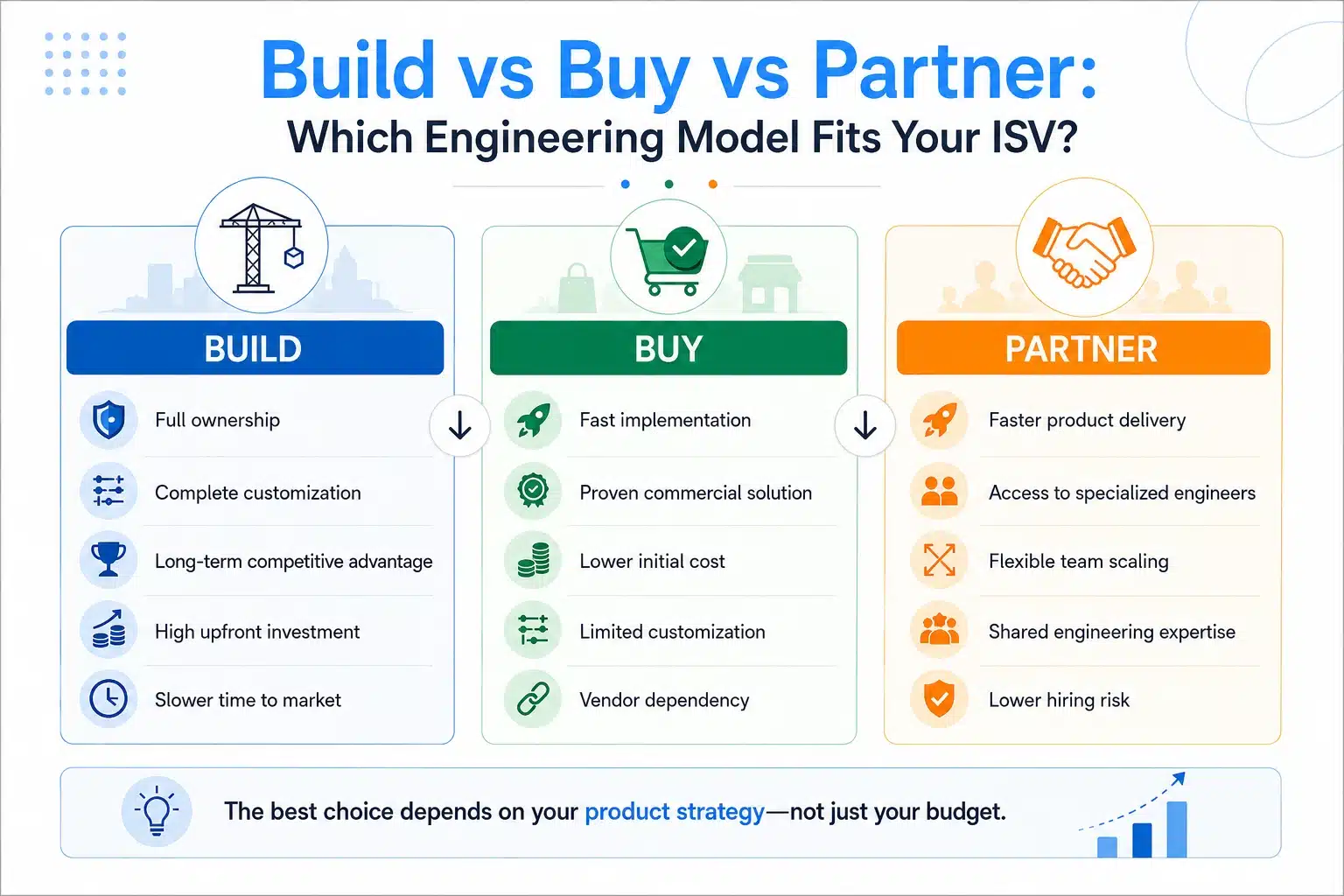
An independent software vendor(ISV) thinks, acts, and makes decisions distinctly from a traditional enterprise. ISVs and Digital Natives not only look for optimized internal workflows or cut operational costs, but also intellectual property(IP), and market valuation also matter for them.
Here is what each path actually means through the lens of an ISV:
Each model works in the right context. Problems arise when one approach becomes the default.
For ISVs, engineering isn’t just a cost center; it’s where product differentiation lives. The features your competitors can’t replicate, the integrations your customers rely on, the performance that keeps churn low; all of that comes from engineering decisions made early. Therefore, the build vs buy vs partner question isn’t just a sourcing question. It’s a strategy question.
A modern software sourcing strategy isn’t about just choosing one path for an entire platform; it is a continuous balancing act across product architecture.
| Features | Build | Buy | Partner |
|---|---|---|---|
| Speed | Slow | Fast | Medium–Fast |
| Cost | High upfront | Recurring licensing | Flexible |
| Control | Full | Low | Shared |
| Customization | High | Limited | High |
| Risk | Execution risk | Vendor risk | Partnership risk |
Engineering sourcing decisions now revolve around ROI, time-to-market, and industrialized AI integration. Now, ISVs and digital natives prefer cloud-native architectures, data-centric operations, and optimized procurement channels to drive scalable innovation and reduce technical debt.
The build vs buy vs partner decision is no longer based on engineering preference alone. Rising talent costs, AI-driven development, and increasing pressure to release products faster are changing how ISVs build engineering capability. Recent industry research shows why many software companies are moving beyond the traditional “hire more engineers” approach.
The focus of ISVs is now on AI-native products instead of mere digitization. Now they are relying on service providers to eliminate fragmented legacy platforms, solve DevOps misalignment, and accelerate monetization.
Hiring used to be the go-to answer when a roadmap needed more hands. That default is breaking down for ISVs and digital natives, and it’s changing how teams think about software sourcing strategy.
A senior engineer search takes three to six months on average. During that gap, features sit unfinished, and sales teams lose deals they can’t demo.
Modern products need MLOps, AI integration, and cloud expertise. Hiring for all of it in-house is slow, and most teams end up with real gaps exactly where the product is heading next.
Every new hire is a long-term cost: salary, benefits, tools, and management time, regardless of whether the roadmap still needs that role in a year.
Instead of locking in manpower that may not match next quarter’s requirements, a build-to-buy partner model enables teams to increase capacity as the roadmap changes.
Technology adoption for ISVs is moving fast. AI-assisted development means smaller teams can now ship work that once needed a much bigger bench, changing the hiring math entirely.
Pro tip: Before opening a hiring requirement, run the numbers on a build vs buy software comparison first. Sometimes the fastest way to hit a deadline isn’t hiring at all, it’s buying or partnering your way there.
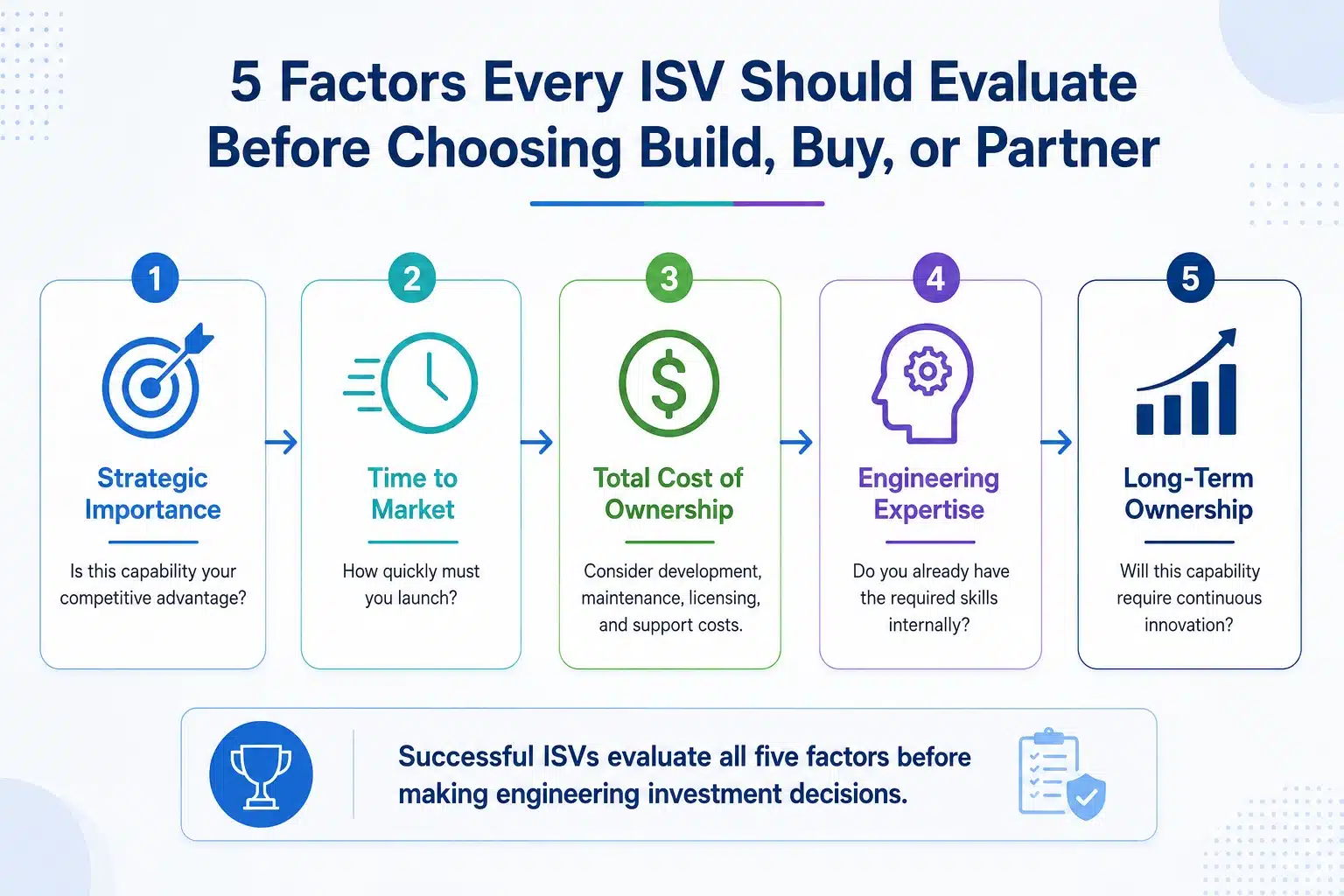
Every ISV eventually faces the Build, Buy, or Partner decision. The right choice depends on balancing speed, control, expertise, and cost. Consider these five factors before deciding. Once an enterprise understands what each model offers, the real question is which one fits its situation. Five factors usually drive that call; thus, before deciding, evaluate the following:
Start by asking if this capability is core to your product or just supporting infrastructure. If it’s something customers pay for directly, or something that sets you apart from competitors, it’s worth having. If it’s a background function like payroll or ticketing, buying an existing solution always makes more sense than building it yourself.
The fastest way to deploy the solution is “Buy,” and that is purchasing an off-the-shelf solution of SaaS API integration. “Partner” with a trusted vendor also accelerates the deployment where they already have infrastructure and a compliance-ready mechanism. “Build” from scratch is the longest route and requires more time as it involves hiring cycles, development timelines, and potential shipping delays.
The sticker price of any option is never the full story. In-house teams carry salaries, benefits, tools, and management overhead long after the first release. Buying looks cost-effective, however adds licensing cost that grows with usage. Partnering usually costs more per hour than an internal hire, but you avoid the cost of idle time between projects.
If you don’t have senior engineers who’ve built this kind of system before, building in-house means a slow, expensive learning curve. A partner brings that experience with them from day one, which matters a lot for specialized work like AI or complex integrations.
In-house gives you full control, but that control comes with full responsibility too. Buying limits how far you can customize as you grow. Partnering is something in between the other two approaches, especially if the engineering partner stays involved for ongoing support rather than disappearing after launch.
| Decision Factor | Build | Buy | Partner |
|---|---|---|---|
| Strategic Importance | Core product capabilities | Standard business functions | Strategic capabilities with external expertise |
| Lead Time-to-Market | Slow | Fast | Fast |
| Total Cost of Ownership | High upfront, lower long term | Lower upfront, recurring fees | Flexible, project-based |
| Talent & Resource Availability | Requires in-house expertise | Minimal internal effort | Access to specialized talent |
| Level of Control | Full | Limited | Shared |
Pro tip: Evaluate “Build, Buy, or Partner” based on your needs instead of considering a company-wide strategy. The “Build” option is good at strategic differentiation, choose “Buy” for speed-to-market, and “Partner” suits well for specialized expertise, flexibility, and scalability. Although A hybrid approach often delivers the best balance of control, speed, and cost.
For engineering the product, a unique perspective is required, and a digital product’s success depends on its uniqueness. When an enterprise needs control over roadmap, proprietary data, intellectual rights, and a competitive moat, Build-in-house is the only viable path and the optimal strategy. Building a capability entirely in-house is a massive commitment of engineering hours, capital, and ongoing maintenance. But it provides complete autonomy.
The Build vs Buy vs Partner decision becomes much easier once you identify what actually drives your product. Every capability doesn’t need an internal engineering team. But if customers choose your product because of a specific feature, building it in-house is usually the better investment.
Your team owns the roadmap from day one and continues improving the capability as customer needs change. That also means every release builds on knowledge already available within the team instead of relying on an external provider.
The biggest advantage is control. Your team decides the architecture, the roadmap, and the pace of change, without waiting on a vendor’s release schedule or a partner’s availability. Product knowledge also stays inside the company. The same engineers who built a feature are the ones who understand its edge cases, which makes debugging and future updates faster. Over time, this builds a real technical asset.
The trade-off is time and risk. Hiring the right engineers can take months for specialized work like AI or complex integrations.
There’s also the cost of mistakes: a team learning a new domain for the first time will make more expensive errors than one that has already solved similar problems elsewhere. Once you build it, you own it forever, including every bug fix, security patch, and infrastructure upgrade for as long as the product exists.
From the Build vs Buy POV, “Buy” works fine if resource drain is the concern and you need a critical feature that is maturely engineered and widely available in the market. Building from scratch is costly and consumes time.
Buying makes sense when a reliable product already solves the problem, and the capability is not something your customers pay for directly.
Authentication, payment processing, analytics, email delivery, and customer support tooling are typical examples. These are functions every SaaS product needs, but none of them are the reason a customer chooses your product over a competitor’s. Spending engineering months building these from scratch is the wrong call.
A good vendor product comes tested, maintained, and ready to integrate. You skip months of engineering work and inherit years of the vendor’s iteration. Support, security patches, and compliance updates come with the subscription. Your engineering team can spend its time making your product different from all the others in the market, rather than re-inventing something that already works.
Vendor tools come with trade-offs. You’re limited to what they’ve built and the customization options they allow. When your product grows, the vendor’s pricing grows with it, sometimes at a rate that makes the original cost look cheap by comparison. If the vendor changes their product direction, gets acquired, or shuts down, you’re dependent on their decisions in ways that affect your own roadmap.
When speed matters but internal capacity is limited, partnering helps ISVs scale engineering without expanding permanent headcount. Here, adopting a digital product strategy and building a partner model is the best approach, where ISVs can scale their capabilities rapidly, utilize shared infra, and achieve rapid market validation without heavy structural overhead.
Partnering is worth considering when you need to move fast on a capability your team doesn’t have the depth to build well right now. A new AI feature, a complex integration, a platform migration, or a full product track that sits outside your team’s current skills: these are situations where waiting to hire, or trying to build with the team you have, costs more than bringing in people who have already solved the same problem elsewhere.
A strong software development partner for ISVs brings a cross-functional team: engineers, QA, DevOps, and often product-facing expertise, without the three to six-month hiring lag.
The best SaaS development company has seen similar builds before, which means fewer mistakes, fewer surprises, and faster delivery.
Product knowledge transfers back to your team during the engagement, so you’re not starting from zero if you decide to bring the capability in-house later. Delivery continues across sprints without the disruption of onboarding new employees one at a time.
The right partner understands your product domain, not just the technology stack. They should be able to own a module or a delivery track, not just execute tickets. Look for partners who ask about your roadmap, not just the immediate scope. They must know the core of the “Build, Run, and Evolve” framework and how to apply it practically for product orchestration.
Red flags include partners who talk only about headcount and hourly rates, have no documentation practices, or can’t explain how they handle IP protection and access controls from day one.
Pro tip: Set clear knowledge transfer milestones from day one. The goal of partnering should never be permanent dependency; it should build capability inside your business over time.
ISVs face trade-offs depending on their stage, team size, and product complexity. Thus, here is the comparison between- Build vs Buy vs Partner, which helps ISVs decide on engineering capability.
| Factor | Build | Buy | Partner |
|---|---|---|---|
| Cost | High upfront, lower long-term | Low upfront, growing license fees | Mid-range, flexible structure |
| Time to Market | Slowest | Fastest | Fast |
| Engineering Control | Full | Limited | High during engagement |
| Customization | Complete | Limited to vendor options | Built to your spec |
| Scalability | Scales with your team | Scales with the vendor product | Scales with partner capacity |
| Risk | Execution and timeline risk | Vendor dependency risk | Partner quality and continuity risk |
| Maintenance | Internal team owns it | The vendor manages it | Shared or transitioned |
| Long-term Ownership | Full | Dependent on the vendor | Transferable |
| Best Fit | Core differentiating capabilities | Standard supporting functions | Custom builds needing speed or specialist skills |
For ISVs deciding whether to build, buy, or partner, cost is often the most obvious consideration. The more difficult part is accounting for the hidden costs that show up later in the form of operational complexity, cloud spend, engineering time, and support load.
Initially, building in-house seems cost-effective, and an enterprise has complete control over the product development. However, it leaves a massive tail of technical debt. On the other side of the coin, fixing bugs, installing security patches, updating code, and other tasks slow down ISV and Digital Natives teams from creating new things.
Every month a feature doesn’t ship is a month competitors can use it to close deals you can’t. ISVs that build everything in-house often underestimate how long it takes, then delay releases quarter after quarter. Every month that a feature doesn’t ship gives competitors more time to win customers.
Buying a vendor tool feels low-risk at first. The risk shows up later, when pricing changes, APIs get deprecated, or the vendor gets acquired and shifts direction. If a core function depends on someone else’s roadmap, you’re making product decisions inside a constraint you don’t control.
If a partner builds a feature and leaves without a proper handoff, your team inherits code nobody fully understands. Documentation gaps here are more expensive than they look.
Every new build, purchase, or partner engagement adds another system or team to coordinate with existing ones. This overhead rarely shows up in the initial cost estimate, but it adds up in project delays, miscommunication, and extra engineering hours spent just keeping everything talking to each other correctly.
Choosing between Build vs Buy vs Partner requires a structured evaluation. These steps help ISVs align sourcing decisions with business goals and select the right product engineering services.
ISVs that start with ‘Should we hire or outsource?’ usually pick the wrong answer. The right starting point is: what does this capability need to do for the product, and what does the product need to do for the business in the next 12 to 24 months? The answer to those questions tells you how much control you need, how fast you need to move, and how central this is to your competitive position. The sourcing model follows from that, not the other way around.
A capability you’re building once and maintaining lightly looks different from one you’ll keep expanding every quarter. If your roadmap shows this as a key investment area over the next two years, that argues for building or partnering with a transition plan. If this is a one-time integration that won’t change much, buying or using a partner for a fixed scope makes more sense. Map the decision to where the product is going, not just where it is now.
Without a framework, sourcing decisions get made by whoever argues loudest in a planning meeting, or by default based on past habits. A structured evaluation forces the team to look at all five factors, weigh them against the business context, and arrive at a decision that can be explained and revisited later. Run this evaluation before any significant capability decision, not after the team has already started building.
| Question | Build | Buy | Partner |
|---|---|---|---|
| Is this capability core to your product differentiation? | Yes | No | Partially |
| Do you need it to live within 60 to 90 days? | No | Yes | Yes |
| Does your team have the skills to build it well? | Yes | N/A | No |
| Will it need heavy customization over time? | Yes | No | Yes |
| Can you afford the long-term maintenance load? | Yes | N/A | Depends on the transition plan |
| Is vendor lock-in a risk you can accept? | N/A | Only for non-core functions | No |
| Do you need to own the IP entirely? | Yes | No | Yes, with clear contracts |
The build vs buy vs partner decision doesn’t have one right answer. What matters is that you make it deliberately, based on your product stage, your team’s capacity, and where the capability sits in your competitive strategy.
For ISVs, engineering capability is one of the most important levers you have. Treat every sourcing decision as a strategic choice, not just a resourcing one. Use a consistent framework, factor in the hidden costs, and don’t let urgency push you into a model that doesn’t fit.
The right decision helps ISVs move faster, reduce costs, and build stronger products.
Every product follows a different path. The NineHertz works with ISVs and digital-native companies to identify the engineering model that best fits their product vision, delivery timelines, and business priorities.
Build is your team building it from scratch. Buy is licensing an existing tool. Partner is bringing in an outside team to build it with you, under your direction.
Build core features that set your product apart. Outsource or buy the rest. The answer depends on how central the capability is, not on habit.
Partnering costs more per hour, but you skip salaries, benefits, and idle time. Building costs less long-term, once the team is already in place.
When hiring takes too long, the skills are specialized, or the work doesn’t justify a permanent hire. A partner gets you moving without the wait.

Key Takeaways India is becoming a global hub for AI-native product engineering, not just support work. The city you choose…

Key Takeaways Due to ineffective architecture, ownership, and governance, the cloud setup can become up to 8x more expensive. Native…

Key Takeaways Engineering velocity is basically the key measurement of how fast a firm converts prioritized deliverables into working software…