
ISVs often face pressure to complete product roadmap commitments made to multiple clients within the stipulated development timelines. Late feature inclusion, delayed releases, and slow product shipments widen the gap between what was promised and what was delivered with each iteration.
Engineering velocity, the center of the operational metric, measures the efficiency and speed of software development and works as a decisive layer to expose how efficiently a software team converts prioritized work into shippable product increments. It determines the credibility of roadmap commitments for the ISVs, addressing product roadmap execution challenges such as headcount constraints and compact release cycles.
According to Stats, superior developer velocity drives 60% higher return and 4 to 5 times more revenue growth in comparison to those bottom-quartile companies. This gap exhibits the performance difference between the top and median engineering organizations, not only due to talent quality but also the structural capacity.
Engineering velocity is the rate at which an engineering firm converts prioritized deliverables into working software, usable for customers. The time period for measuring efficiency and speed is usually fixed, such as two-week sprints.
ISVs work to meet their customers’ expectations of high release frequency, feature quality, and roadmap commitments, unlike enterprise IT shops that build for internal usage. Thus, the velocity carries extra strategic weight for the independent software vendors competing on product cadence. Their prior project success and roadmap predictability directly influence their renewal rates, market position, and net revenue retention.
According to Gartner’s estimates,by 2027, 50% of the enterprise software development firms will use ML-powered engineering platforms to improve their productivity. This reckoning uplift from 5% in 2024 showcases the urgency of engineering velocity as a strategic priority. Enterprise buyers’ product evolution demand is accelerating the cloud-native environment, further intensifying the velocity stake for ISVs operating in SaaS-first environments.
A single catastrophic failure is rarely the reason why software product roadmaps fail. Instead, multiple small velocity losses accumulate across sprints and make quarterly milestones unattainable. If the development team fails to complete planned tasks per cycle, either the quality or the scope of the product suffers. Both terms degrade the backlog results, inflating future estimates.
Engineering velocity tells you how fast a ‘work in progress’ convert in customer faced features, reliability in the roadmap predictions, and the capacity of your team to take on per cycle. Low velocity signals underperformance, pending work per sprint slips to the next cycle, and the whole delivery roadmap shifts from expected dates. For instance, if your competitor ships new features every two weeks and you take two months to ship the same features, you are clearly struggling with product roadmap delays due to slow velocity.
McKinsey research shows:
Inefficient roadmap predictions may suggest on-time delivery in the initial phase but expose product roadmap bottlenecks by mid-sprint, leading to unfinished promises by the end of the quarter. In the case of ISVs, ship timelines are the crucial milestone for revenue, contractual commitments, and market positioning. Delays not only destroy customer trust and future renewal rates but also hand over the market share to fast-performing rivals.
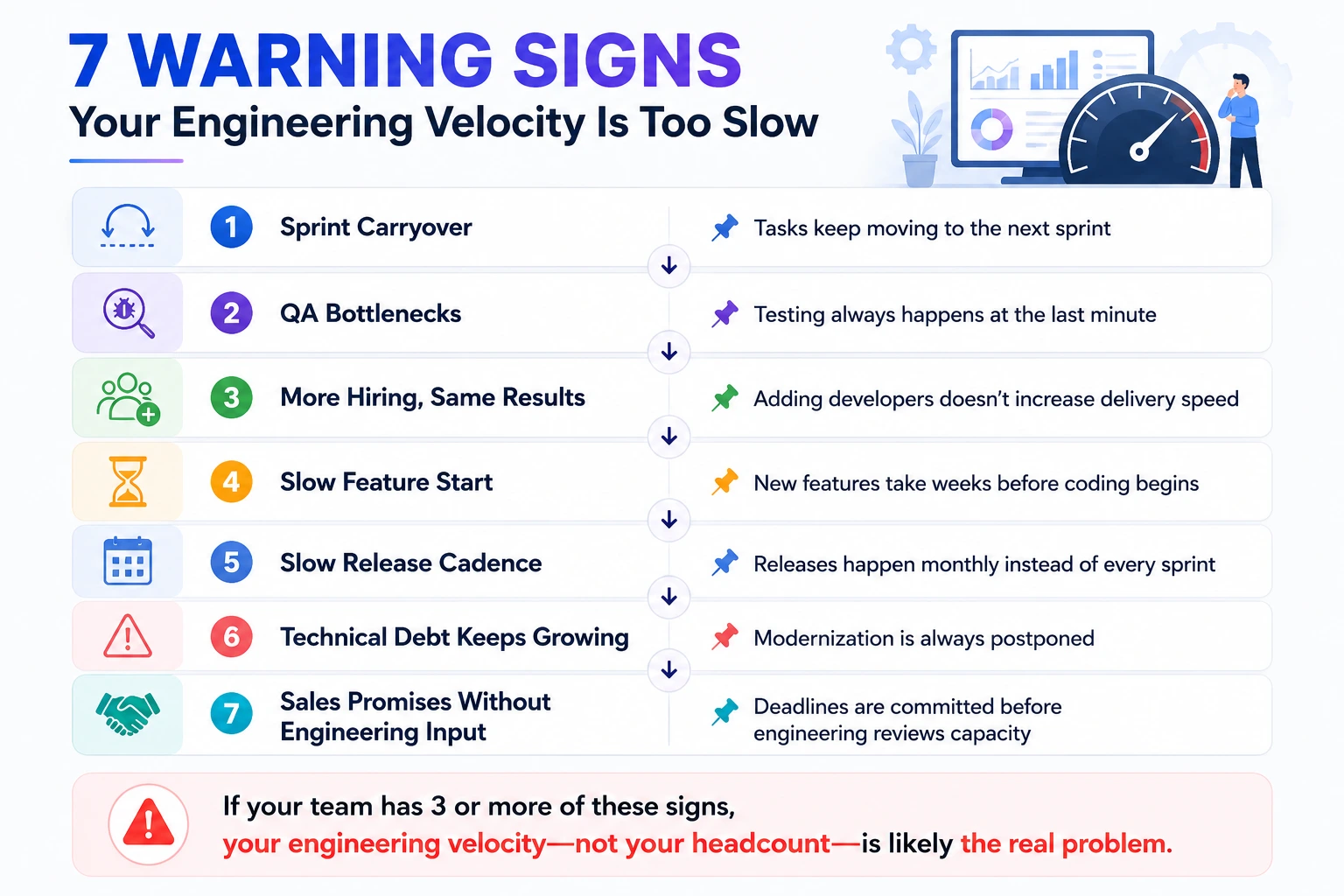
Early diagnosis of the engineering velocity gap prevents ISVs from recurring delivery delays. Software vendors can avert missed release dates, slow fixes, and development teams stuck in the late ship loop. When your team is consistently delivering less work per sprint than what is required in the planned roadmap, it indicates product roadmap bottlenecks and piles up the workflow for the next quarter. In this situation, you can recognize a velocity gap through these seven warning signals:
Unfinished tasks, moving to the next sprint, have become a part of your workflow and not an exceptional event. Once that happens, your velocity numbers stop portraying anything, and they’re not tracking real capacity anymore. Usually, it just means the team has been setting unrealistic targets.
When testing is deferred throughout the sprint until the final release, it delays the entire schedule. It accumulates near the endpoint and signals that quality checks are not occurring during the development process.
Every roadmap discussion ends with one solution: we need to hire more team members. When hiring becomes the only way to address delivery gaps, it indicates that the development process or tool improvement is being avoided.
It takes more than two weeks for the teams just to start meaningful coding; the reason may be architectural friction, unclear requirements, or excessive dependency.
Additional headcount is still not enough to ship the features in a timely manner; the frequency of delivery has reduced in the absence of process maturity. Communication and coordination overheads are absorbing the capacity gains from added engineers.
When modernization discussion is deferred every time to the next quarter, the system complexity compounds even more for future velocity. Current feature ship is prioritized over the technical debt, making the codebase harder and slower to change.
Commercial pressure is the key driver of roadmap commitment rather than engineering input. Stakeholders promise the ship dates without checking their actual capacity, causing systematic delivery failure.
Pro Tip : Assess the last six sprints and compare the planned story points with actual delivery results to map out velocity gaps. If the ratio of delivery rate vs planned estimates is below 75%, the deficit is on a structural level and requires process or architectural intervention rather than team modification.
Whenever the authorities ask, ‘Why are product roadmap deadlines missed?’ the instant reaction lands on a shortage of talent, even if it is not the actual issue. It makes sense to want to fix delivery problems by hiring more people, but that’s not always the right call. Here are the main reasons that show that more developers don’t mean higher engineering velocity:
You hire new people to solve product roadmap execution challenges, but they are busy with the onboarding process. New team members require time to become familiar with the organization’s codebase architectures and create communication overhead. Instead of improving productivity, they add on the responsibilities of monitoring and training for the existing team, reducing overall velocity.
Increasing the number of employees does not eliminate the systematic inefficiencies, but just adds more people to face the same issues. Data suggest that 69% of developers lose eight hours or more per week to friction, as found in the 2024 Atlassian survey. Unclear requirements, approval dependency, and coordinating across misaligned tools consume a significant amount of time for software developers.
Increasing headcounts does not replace the complexity and bottlenecks of legacy systems; it limits the development speed of all employees. New engineers spend their first quarter navigating existing architectural complexity, and by the time they become productive, the structural drag that caused the original delay is still present.
According to McKinsey research, technical debt is the silent killer of technology modernization efforts and amounts to 20%-40% of the value of the entire technology estate. For ISVs, technical debt creates a compounding trap for the new members, also increasing their ramp-up time.
Pro Tip: Focus on why software product roadmaps fail and target the liable factors instead of putting all efforts into team expansion.
Intervene in velocity architecture, align processes and tools, reduce technical debt, and improve the engineering system. Optimise structural complexities to ensure visible team progress with the same size.
Understanding why product roadmap deadlines are missed in growing ISVs requires a deep study of the structural constraints. Here are the four major reasons for the decline in engineering velocity as the ISV organization scales:
Each workaround embedded during a previous deadline crunch becomes a constraint on future delivery capacity. Legacy monolithic architectures, too many service dependencies, and postponed modernization decisions accumulate and drag on future developments. The results are missed deadlines, cancelled projects, and higher costs with the increasing technical debt, as the organization grows.
As the ISVs expand their scope, unstable requirements from competing stakeholders for new features during the development process invalidate the work already completed. The team has to revise their process and rework finished tasks, destroying earned velocity gains.
Development teams manually test and coordinate releases when quality orchestration and continuous integration are missing. That’s hours of a developer’s week spent monitoring a release instead of engineering anything.
As teams grow, engineers get pulled in more directions: new features, bug fixes, maintenance, customer fires, and favors for other teams. Every interruption costs focus, and decisions take longer because nobody is clearly accountable for completing an assigned job.
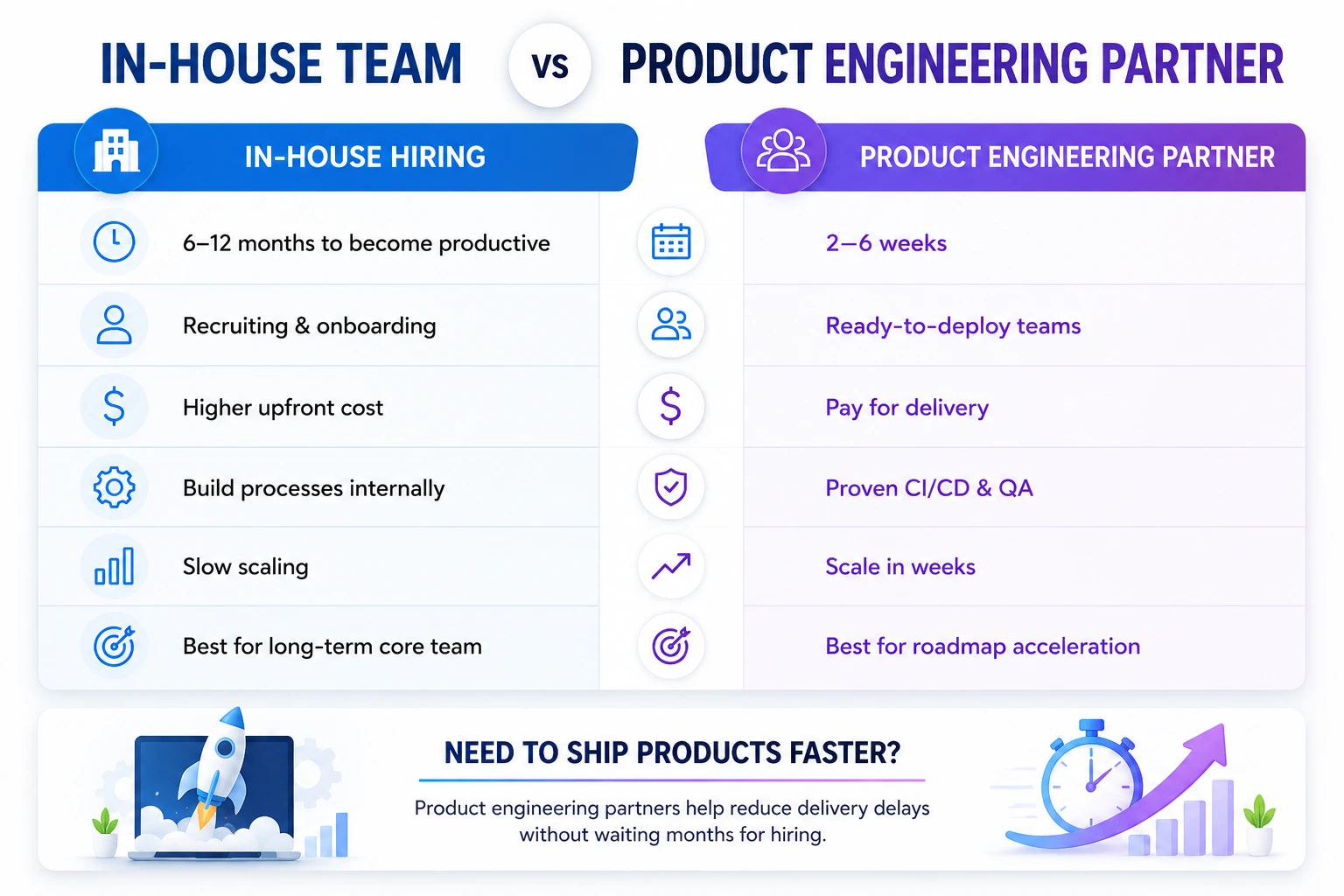
The selection between hiring an in-house engineering team and bringing in a software development partner directly impacts the roadmap delivery timelines. It is a strategic decision and requires a thorough study of the highs and lows of both models to determine which moves faster.
Scaling in-house capacity delivers contextual gain, as the people within the organization will retain long-term knowledge. However, time is a constraint in this approach, consuming months to get productive velocity. Recruiting, onboarding, and ramping engineers takes 6-12 months, and most ISV roadmaps don’t have that kind of runway.
Software development partners are more valuable options, as they are not just ticket filers but rather an extended team. Cost optimization and better quality of services and products are two major drivers of outsourcing. A mature strategic partner works with your team, adds value, and ties in with your business objectives in product development.
ISVs operating with roadmap pressure can reduce stress levels by using product engineering partners to rebuild in the cloud. The vendors have categorized architectural patterns, tooling experience, and process maturity.
Whether you hire in-house staff or go for engineering partners, the outcomes depend on how you operationalize them. Engaging partners in embedded Agile pods, with shared OKRs and sprint data that everyone can see, tends to deliver sustainable gains. However, dropping them in the same old school staff augmentation will create the coordination mess you were trying to escape.
The following table gives a concrete comparison between the two models across different dimensions:
| Dimension | In-House Team Expansion | Product Engineering Partner |
|---|---|---|
| Time to productive velocity | 6–12 months | 2–6 weeks |
| Upfront cost structure | Sunk cost before the first feature ships | Tied to the delivery output from week one |
| Process maturity on arrival | Built from scratch | Pre-established (CI/CD, sprint governance, QA) |
| Risk if engagement ends | None, the team is permanent | Requires knowledge transfer |
| Best suited for | Long-term core IP ownership | Near-term roadmap pressure, cloud-native rebuilds |
| Scalability | Slow to flex up or down | Can scale within a sprint cycle or two |
| Organizational context | High from day one | Builds over time through onboarding |
The fastest-growing ISVs use product engineering partners to absorb near-term velocity pressure and modernize the platform, while simultaneously growing a smaller, more senior in-house team focused on core product strategy and long-term IP.
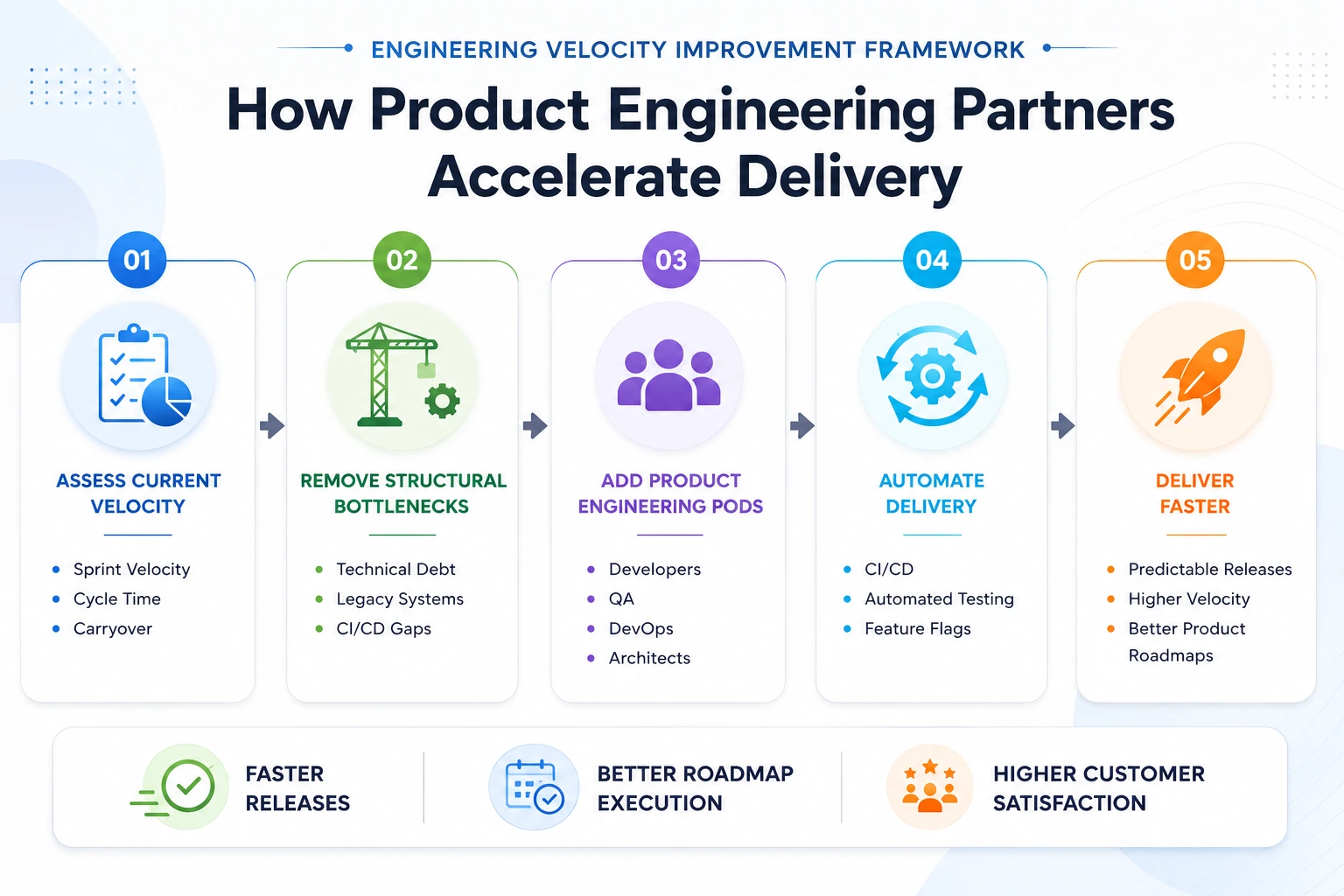
Product engineering partners use a mechanism across five different segments to boost the ISV delivery roadmap:
ISVs can integrate cross-functional PODs, architects, engineers, DevOps, and QA specialists into an existing sprint cycle in weeks, without going through a hectic onboarding process. The partner works on how to deliver product roadmap faster by developing, shipping, and iterating. They use agile, scalable development practices, with automated pipelines that shorten cycles and let teams release more often.
ISVs deploying product engineering partners for cloud-native rebuilds can directly modernize their platform, which the internal team has always been deferring due to busy sprints. It eliminates the architectural constraints limiting velocity, which no size of team was able to fix.
Continuous integration and QA pipelines orchestration speed up the release cycle from multiple-week processes to same-day automated deployment. ISVs can leverage globalized talent to develop and test products continuously, removing the batch-processing pattern that makes traditional release cycles long and unpredictable.
Experienced product engineering partners bring structured backlog governance frameworks that reduce requirements instability. Clear requirement criteria, a standard definition of completed work, and a sprint commitment framework align the engineering efforts with business outcomes.
High-value partners document architectural decisions, codify process standards, and conduct structured knowledge transfer sessions to build institutional capability. They do not leave the ISVs’ internal team dependent; instead empower them to operate faster than before the partnership started.
Pro Tip : Before you look at a partner’s portfolio, look at their sprint telemetry. If they can’t show you delivery transparency across comparable ISV work, they’re a vendor, not a partner.
Measuring engineering velocity with precision is critical to improve it, and following the eight metrics from the operational intelligence layer helps in doing so:
| Metric | What It Measures | Why It Matters |
|---|---|---|
| Sprint Velocity | Story points completed per sprint | Baseline flow rate establishes forecasting reliability |
| Cycle Time | Time from work-in-progress to done | Identifies process bottlenecks and queue accumulation |
| Lead Time | Time from feature request to production | Measures end-to-end delivery responsiveness |
| Deployment Frequency | Releases per time period | Indicates CI/CD maturity and delivery cadence |
| Change Failure Rate | Percentage of deployments causing incidents | Signals quality engineering integration |
| Mean Time to Recovery (MTTR) | Time to restore service after failure | Reflects operational resilience |
| Sprint Carryover Rate | Percentage of committed items not completed | Flags capacity planning accuracy |
| Technical Debt Ratio | Remediation effort vs. development effort | Tracks structural velocity drag |
Pro Tip : Tracking all eight metrics simultaneously from day one is not viable; instead, use a combination of cycle time and deployment frequency first to expose the most common velocity blockers. Once your team establishes a measurement cadence and starts using data to reflect on past sprints, add the remaining metrics.
Engineering velocity is a long-term strategic trench for the ISVs operating in competitive SaaS markets. Organizations that ship features faster and respond to customer feedback rapidly defeat those slow-moving rivals in capturing opportunities. Engineering velocity lists down multiple concrete implications that are:
The financial impact of poor velocity measures a waste of millions of dollars for an enterprise-grade ISV. For instance, a vendor with a $15 million annual engineering budget can save $3 million by closing a 20% velocity gap.
Clients not only evaluate the current performance of the vendors but also see their future potential for consistent delivery. In the dynamic competitive market, ISVs capable of accurately predicting product roadmap and meeting commitments win the customer trust.
AI coding tools are further raising the bar, improving developer productivity and moving high-maturity engineering ISVs ahead of their rivals. The 2025 State of Engineering Management Report states that 62% of software engineers believe they are achieving at least a 25% increase in developer velocity and productivity through AI coding.
ISVs that treat velocity as something to measure, track, and actively improve are positioned in a spot where their competitors struggle to reach.
Product ship roadmap acceleration without proportional headcount expansion requires structural-level modernization. Target the actual constraints limiting developers’ velocity rather than hiring more people.
Reorganize the development team around the product domain rather than technical layers to eliminate interdependencies and allot end-to-end ownership for the entire feature to phase out waiting time.
Automate testing at the source instead of dragging it to the release gate. Teams that write tests alongside code and not after it stop treating QA as the last hurdle and start treating it as part of the build.
Do not create long-term feature branches; instead, merge the trunk-based development to avoid integration conflicts and delays. Flag incomplete work and release what is done to keep the release timelines continuing.
Document each architectural context to save engineers from reconstructing decision logic and reduce onboarding friction. It allows teams to move faster without spending weeks on reverse engineering the codebase instead of contributing to progress.
Deploying a software development partner is the most strategic model to accelerate velocity without hiring new engineers. These vendors will handle platform modernization, CI/CD automation, and specific product surfaces so your team can focus on differentiated product work.
The NineHertz is an AI-native engineering firm that operates precisely at the intersection of engineering velocity and product roadmap delivery. Being among the product engineering partners for cloud-native rebuilds, the company works around the Build, Run, and Evolve framework. NineHertz provides a comprehensive suite of services:
Explore The NineHertz’s SaaS product engineering approach to understand how engineering velocity improvements are operationalized across ISV product roadmaps.
The biggest reason behind the product roadmap failure is structural inefficiency. This further leads to requirements instability, architectural debt, and inadequate CI/CD automation that become primary contributors to underperforming roadmap commitments.
A product engineering partner operates inside your delivery lifecycle, aligned to roadmap outcomes. Traditional outsourcing relationships prioritize billing as per time and tasks, presenting no accountability for your product shipments.
ISVs that engage partners with established Agile POD structures and clear integration protocols typically see measurable sprint velocity improvement within six to eight weeks of engagement.
Starting with a combination of cycle time and deployment frequency exposes the most impactful velocity constraints across the process and pipeline. Later, add the sprint carryover rate and change failure rate to see the accuracy of your capacity planning and check the quality of integration into your workflow.

Key Takeaways India is becoming a global hub for AI-native product engineering, not just support work. The city you choose…

Key Takeaways Build vs Buy vs Partner; each serves a different business need for ISVs. Choosing the wrong one at…

Key Takeaways Due to ineffective architecture, ownership, and governance, the cloud setup can become up to 8x more expensive. Native…