Every year, technology leaders sit in budget reviews that end with the same uneasy compromise. The roadmap has grown faster than the team. Hiring plans are approved but slow to land. Finance wants a lower run rate; product wants to ship sooner; the board wants to know whether the company is building capabilities it will own or renting them from someone else.
The debate usually gets framed as in-house vs outsourced product engineering, and then quickly collapses into an hourly-rate comparison. That framing misses most of what is at stake. How you source engineering capacity determines how quickly you can turn capital into shipped product, who holds the knowledge that keeps that product alive, which risks sit on your balance sheet and which sit in a contract, and whether your best ideas reach customers before a competitor’s.
The right engineering model is not necessarily the one that gives an organization the most developers or the lowest hourly rate. It is the one that delivers the strongest combination of control, capability, speed and economic return for the specific product and moment. A payments platform that defines a company’s competitive position and a one-year modernization program for a back-office system do not deserve the same answer, and treating them the same way is where many engineering strategies go wrong.
This briefing works through the economics, speed, risk, quality and return of each model, with transparent illustrative numbers, and ends with a decision framework a leadership team can apply to its own portfolio.
Before comparing in-house vs outsourced product engineering on cost, it helps to be precise about what each model is. In-house product engineering means the organization directly employs the engineers who design, build and run its products. It also owns everything around them: engineering leadership, product management, architecture decisions, hiring and career development, and the tooling and processes that turn ideas into releases. The defining feature is not where people sit but who carries the long-term obligations: employment, knowledge and accountability.
Outsourced product engineering is often imagined as handing a specification to a vendor and waiting for software to come back. In practice it is a spectrum, and the differences between its points matter more than the label.
| Model | What you buy | Who manages day-to-day work | Who carries delivery risk | Typical fit |
|---|---|---|---|---|
| Staff augmentation | Individual engineers who join your team | Your managers | You | Specific skill gaps, short-term capacity |
| Dedicated development team | A stable, cross-functional team working only for you | Shared: your product owner, vendor team lead | Shared | Sustained roadmaps, multi-year products |
| Managed engineering | An outcome-based engineering function with its own leadership and governance | Vendor, against agreed KPIs | Mostly vendor | Platforms or products you want run to a service level |
| Project-based outsourcing | A defined scope delivered to a fixed price or milestones | Vendor | Vendor, within the contract | Well-specified, bounded work |
The further down the table you go, the more management effort you transfer and the more control you give up. A company that uses staff augmentation keeps engineering ownership and simply adds hands; a company that outsources a whole product to a fixed-price contract has transferred much of its delivery capability, and with it much of the knowledge. Most of the debate about whether outsourcing “works” is really a debate about choosing the wrong point on this spectrum for the job. (For a closer look at each, see how the engagement models compare.)
Salary is the most visible engineering cost and the most misleading one. It excludes the employer’s share of benefits, the cost of finding and replacing people, the tools and environments engineers need, the managers who lead them and the capacity that sits idle when priorities shift.
Start with the verified baseline. The median annual wage for US software developers was $135,980 in May 2025 (U.S. Bureau of Labor Statistics). Benefits account for 30.0% of total employer compensation costs for private-industry workers (BLS, Employer Costs for Employee Compensation, June 2026), so the fully loaded compensation of a median developer is roughly $194,000 a year before a single tool or recruiter is paid for.
Recruitment and turnover add more. SHRM benchmarking puts the average cost per hire across all roles at nearly $4,700 (SHRM, 2022), and specialist technical hiring through agencies typically costs considerably more. Gallup estimates that replacing an employee can cost one-half to two times the employee’s annual salary once lost productivity and onboarding are included (Gallup, 2019).
The least visible cost is commitment. A permanent team is a fixed cost. When a product moves from build to maintenance, or a strategic initiative is paused, the payroll does not pause with it, and that idle or misallocated capacity rarely shows up in a business case.

The model below is a transparent illustration, not a market benchmark. It assumes a US-based team of 10 engineers paid at the BLS median, one engineering manager, and costs escalating at 3.3% a year, the growth in private-industry compensation costs from June 2025 to June 2026 (BLS). Senior engineers, specialists and high-cost metros would raise every line.
| Cost line (in-house, 10 engineers + 1 manager) | Assumption | Year 1 | Year 2 | Year 3 | Three-year total |
|---|---|---|---|---|---|
| Salaries and benefits | $135,980 median salary (BLS); $185,000 manager salary (assumed); benefits 30% of compensation (BLS) | $2,207K | $2,280K | $2,355K | $6,841K |
| Recruitment | $20,000 per technical hire, 11 hires (assumed) | $220K | — | — | $220K |
| Equipment | $4,000 per person (assumed) | $44K | — | — | $44K |
| Tools, licenses, cloud dev environments | $7,000 per person per year (assumed) | $77K | $80K | $82K | $239K |
| Workspace or remote-work costs | $10,000 per person per year (assumed) | $110K | $114K | $117K | $341K |
| Training and development | $2,500 per person per year (assumed) | $28K | $28K | $29K | $85K |
| Attrition and replacement | 12% annual attrition (assumed) × 50% of salary (low end of Gallup range) | $93K | $96K | $99K | $287K |
| Total cost of ownership | $2,778K | $2,597K | $2,683K | $8,058K |
Fully loaded, each seat costs roughly $240,000 to $255,000 a year in this model, against a median salary of $135,980. That ratio, not the salary, is the number to carry into any comparison. It also excludes product management and design, which both models need and which we leave out of both sides.
A vendor’s rate card is the beginning of the cost, not the end. Outsourcing moves some costs off your books (recruitment, benefits, equipment, attrition, much of the management layer) and adds others that are easy to forget: selecting and contracting the partner, discovery and onboarding, knowledge transfer, the internal leaders who must still own the product and architecture, security reviews, travel, and the change requests that appear when scope is not tightly managed.
The distinction that matters most is between buying engineering capacity and investing in an engineering capability. Capacity is hours of work. Capability is a team that understands your domain, follows your standards, owns quality and improves your product over time. The first is cheaper to buy and more expensive to depend on; the second takes more governance up front but compounds.
To keep the comparison fair, the illustrative outsourced model uses the same team size and the same scope as the in-house model, with a dedicated team from an offshore partner.
| Cost line (outsourced dedicated team, 10 engineers) | Assumption | Year 1 | Year 2 | Year 3 | Three-year total |
|---|---|---|---|---|---|
| Engagement fees | $6,000 per engineer-month all-in, including the vendor’s delivery lead (assumed); +5% a year | $720K | $756K | $794K | $2,270K |
| Change requests and scope contingency | 5% of fees (assumed) | $36K | $38K | $40K | $113K |
| Vendor selection and due diligence | One-time (assumed) | $40K | — | — | $40K |
| Discovery, onboarding and knowledge transfer | One-time (assumed) | $60K | — | — | $60K |
| Internal technical leadership and coordination | 1 internal architect/engineering lead + 0.5 FTE coordination, loaded at BLS-based rates | $361K | $373K | $386K | $1,120K |
| Security and compliance reviews | Audits, access reviews, assessments (assumed) | $25K | $26K | $27K | $78K |
| Travel and collaboration | In-person planning and reviews (assumed) | $30K | $31K | $32K | $93K |
| Total cost of ownership | $1,272K | $1,224K | $1,278K | $3,774K |
Notice the second-largest line: the internal leadership the company still pays for. Outsourcing that removes the internal architect to save money is the version that most often fails, because nobody inside the organization can judge the work, challenge estimates or own the long-term design.

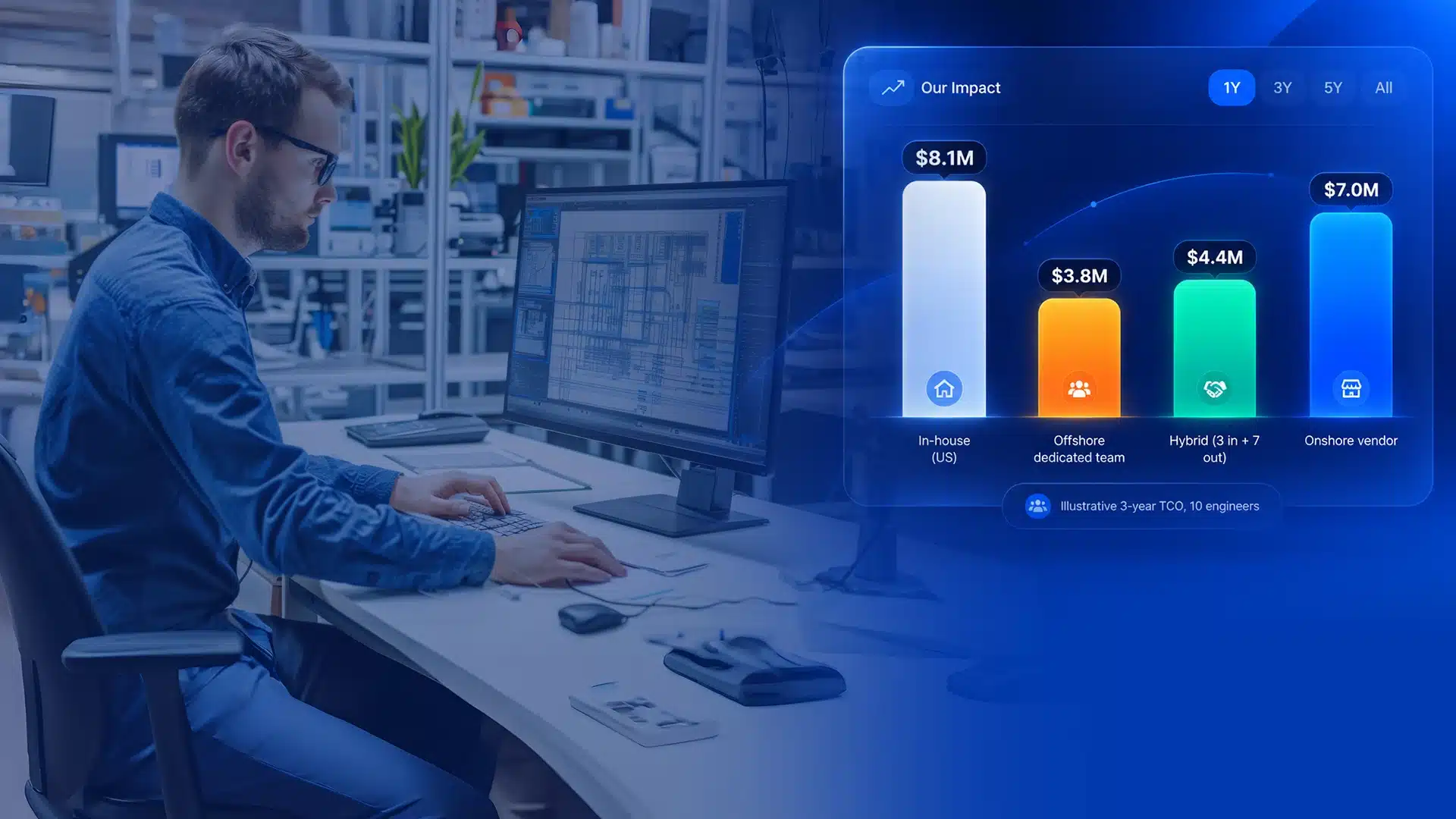
Putting the two models side by side, and adding a hybrid and an onshore-vendor variant, shows where the money really goes.
| Dimension | In-house (US) | Outsourced (offshore dedicated team) | Hybrid (3 internal + 7 external) | Outsourced (onshore vendor, $14,000/engineer-month) |
|---|---|---|---|---|
| Direct engineering cost | Salaries and benefits | Vendor fees | Both, smaller internal payroll | Vendor fees |
| Recruitment exposure | High (every hire and replacement) | Low (vendor recruits) | Low to medium | Low |
| Infrastructure and tools | You fund all seats | Mostly inside the rate | Split | Mostly inside the rate |
| Management overhead | Engineering managers | Internal lead + vendor governance | Internal lead + vendor governance | Internal lead + vendor governance |
| Training | You fund | Vendor funds core skills | Split | Vendor funds core skills |
| Scalability cost | Slow and expensive to scale up or down | Notice-period changes | External share flexes | Notice-period changes |
| Attrition exposure | On your books | Vendor replaces; knowledge risk remains | Concentrated on the internal core | Vendor replaces |
| Operational flexibility | Lowest | High | High | High |
| Long-term ownership | Highest | Lowest unless contracted for | High for core, contracted for the rest | Low unless contracted for |
| Three-year TCO (illustrative) | $8.06M | $3.77M | $4.38M | $6.95M |
Three conclusions follow, and only one of them favors outsourcing.
First, most of the gap between the first two columns is labor-market geography, not the outsourcing model. Compare the in-house team with an onshore vendor and the difference shrinks to about $1.1 million over three years, roughly the recruitment, equipment, workspace, attrition and management costs a vendor absorbs. Second, there is a crossover point: in this model, an outsourced team priced above about $16,800 per engineer-month costs more over three years than building the same team in-house. Senior specialist teams from premium firms can exceed that. Third, the comparison is static. It does not count the productivity a long-tenured internal team gains from deep product knowledge, or the cost of rework if an external team works without strong architectural direction.
Internal engineering becomes the more economic choice when the work is permanent and stable, when the organization can build its team in a lower-cost location of its own (a captive center or a build-operate-transfer arrangement), when the product’s value depends on accumulated domain knowledge, and when vendor rates approach the internal fully loaded cost. Detailed cost structures for offshore teams are covered in our analysis of what an India ODC really costs.

In most in-house vs outsourced product engineering debates, cost per engineer gets the attention, but time to a working team usually decides the outcome. Recruiting a full team takes months: sourcing scarce skills, running interviews, waiting out notice periods and then onboarding people into an unfamiliar codebase. In the illustrative model we assume four months to assemble the in-house team and one month of ramp-up. An established partner that already has a bench, a delivery process and working tooling can typically field a team within weeks, which we model as one month, with a 10% productivity discount for coordination across organizational boundaries.
The arithmetic of delay is simple and unforgiving. If a product will contribute $300,000 a month once launched (an illustrative assumption), every month of delay forgoes $300,000 that cannot be recovered later in the product’s life. In our scenario the outsourced team launches in month 11 and the in-house team in month 14, a difference worth $900,000 before any cost saving is counted.
That logic has limits that experienced executives will recognize. A launch is only valuable if the market is ready and the product is good enough to keep the customers it wins. Faster development is not the same as faster delivery of business value: a team that ships quickly into an unvalidated market, or ships something that must be rebuilt, has spent money to learn what a smaller experiment could have taught. The evidence on large IT programs is a useful corrective to optimism on either side. A McKinsey study with the University of Oxford of more than 5,400 IT projects found that large projects ran 45% over budget and 7% over time on average, while delivering 56% less value than predicted, with software projects carrying the highest risk of overruns (McKinsey, 2012). Neither model escapes those dynamics; disciplined scope and governance do more for speed than any sourcing choice.
Internal teams have their own speed advantages once they exist: short decision loops with the business, no contractual change process and shared context. External teams are fastest when the bottleneck is capacity or a scarce skill; they are slowest when the bottleneck is decision-making inside the client, which no vendor can fix.

Both sides of the in-house vs outsourced product engineering decision carry real risks. They are simply different risks, and they sit in different places.
| Risk | In-house exposure | Outsourced exposure | Practical mitigation |
|---|---|---|---|
| Talent and key-person dependency | High: a few senior engineers often hold critical knowledge | Medium: knowledge concentrates in the vendor’s team | Documentation as a deliverable, pairing, rotation, architecture decision records |
| Attrition | Direct cost and capacity loss | Vendor replaces, but continuity suffers | Contracted retention plans, backups and handover periods |
| Recruitment delays and skill shortages | High for niche skills | Low if the partner has the bench | Use external specialists for niche skills; hire internally for core roles |
| Rising fixed costs | High | Low: variable and contract-based | Keep a flexible layer for variable demand |
| Vendor dependency and lock-in | None | High if code, tools or knowledge sit with the vendor | Code in your repositories, your cloud accounts, exit and transition clauses |
| Intellectual property | Owned by default | Must be assigned by contract | Explicit IP assignment, contributor agreements, audit rights |
| Data security and third-party exposure | Your controls | Extends your attack surface | Least-privilege access, security reviews, contractual obligations |
| Communication, culture and time zones | Low | Medium to high | Overlap hours, shared rituals, a single backlog, a named product owner |
| Quality inconsistency | Depends on your standards | Depends on governance | Shared definition of done, automated tests, code review by internal leads |
| Vendor continuity | N/A | Partner financial or delivery failure | Due diligence, step-in rights, documented environments |
Third-party risk deserves particular attention because it has grown. Verizon’s 2025 Data Breach Investigations Report found that third-party involvement in breaches doubled to 30% (Verizon, April 2025). That is not an argument against outsourcing; it is an argument for treating an engineering partner as part of your security perimeter, with the same access discipline you apply to employees. Intellectual property needs the same rigor, which is why it pays to settle IP ownership in offshore engagements before work begins.
It is tempting to assume that controlling the people means controlling the product. It does not. Internal teams accumulate technical debt, skip documentation and make architectural shortcuts under deadline pressure just as external teams do. What protects quality is not employment status but architectural ownership and engineering governance: who makes the design decisions, which standards are enforced automatically, and whether knowledge is written down where the next engineer can find it.
That is why the internal architect line in the outsourced cost model is not optional. An organization should be able to say, at any point, who owns the architecture, where the decision records live, which quality gates every change must pass, and how a new engineer (internal or external) would learn the system in two weeks. Continuous integration and deployment, automated testing, code review rights and shared documentation make quality visible regardless of who writes the code.
External teams can contribute meaningfully to innovation when they are integrated into product strategy rather than fed tickets. Teams that have built similar platforms elsewhere bring patterns, failure modes and tooling an internal team would take years to accumulate. The failure mode is the opposite arrangement: a vendor working from a fixed specification, with no architectural counterpart inside the client and no obligation to transfer knowledge. That model can deliver a release on time and still leave the organization with a product it cannot change.
Cost-per-developer comparisons tell you what you spend, which is why in-house vs outsourced product engineering should ultimately be judged on return. Return on investment tells you whether the spending was worth it.
ROI (%) = [(Financial benefits − Total investment) ÷ Total investment] × 100
Financial benefits should include the outcomes the engineering investment exists to create: revenue or margin from earlier launches, product adoption and retention, operational savings, avoided costs such as legacy maintenance, and the value of capabilities the company could not otherwise access. Total investment should be the full TCO, including internal oversight and transition costs, not the vendor invoice or the payroll alone.

Assume a new product line that contributes $300,000 a month once launched, evaluated over five years (60 months). The build requires the equivalent of nine months of a 10-engineer team. TCO figures use the five-year extension of the cost models above. These are assumptions for illustration, not a case study.
| Model | Launch month | Months of contribution | Financial benefits | Five-year TCO | ROI |
|---|---|---|---|---|---|
| In-house (US) | 14 | 47 | $14.10M | $13.69M | 3% |
| Outsourced, offshore dedicated team | 11 | 50 | $15.00M | $6.50M | 131% |
| Hybrid (3 internal + 7 external) | 12 | 49 | $14.70M | $7.49M | 96% |
| Outsourced, onshore vendor | 11 | 50 | $15.00M | $12.07M | 24% |
The table is less interesting for its winner than for what moves the answer. Change the contribution assumption and the in-house return changes dramatically: at $500,000 a month, in-house ROI rises to about 72%. Lower the external team’s effective productivity to 70% through weak governance and rework, and the offshore advantage shrinks quickly. Extend the horizon beyond five years for a product that is core to the business, and the knowledge an internal team accumulates starts to matter more than its higher cost. Run the model with your own contribution, rates and productivity assumptions; the structure is more useful than our numbers.
Compare in-house, outsourced and hybrid costs for your roadmap.
In-house engineering earns its higher cost when the product is the company’s competitive advantage. If customers choose you because of what your software does, the people who understand that software, its users and its edge cases are part of the asset, and renting them weakens the moat.
It also makes sense when deep institutional knowledge is essential (complex domain rules, regulated workflows, decades of integration history), when the organization needs continuous architectural control rather than periodic review, when engineering is tightly woven into internal operations, and when demand is stable enough that a permanent team will stay fully utilized. Highly sensitive systems, such as core trading platforms, defense workloads or proprietary algorithms, may justify internal operations even at a substantial premium.
The deciding variables are strategic importance, workload predictability and organizational maturity. A company that cannot yet hire, lead and retain strong engineers will not get the benefits of in-house ownership simply by deciding to have it.
Outsourcing is most valuable when the constraint is time, skill or uncertainty rather than cost alone. Entering a new market, launching before a competitor or a regulatory deadline, building and testing an MVP, modernizing legacy systems, implementing an emerging technology such as generative AI, and absorbing workloads that rise and fall are all situations where a permanent hiring commitment is either too slow or too rigid.
The engagement model should match the situation. A scarce skill for a few months calls for adding specialists to your team through staff augmentation. A multi-year roadmap without the capacity to build a local team suits a dedicated team or an offshore development center. A modernization program with clear outcomes suits managed engineering, as in modernizing legacy systems with AI. A first product release suits a partner that specializes in taking an MVP to production. A well-specified, bounded project is the only case where fixed-scope outsourcing is usually the right instrument.
Most enterprises do not face an either-or decision, and the strongest operating models do not treat it as one. A hybrid product engineering model keeps the capabilities that define the product inside the organization and sources the capabilities that scale, specialize or fluctuate from outside.
| Keep inside | Source externally |
|---|---|
| Product leadership and roadmap decisions | Specialized development for defined modules |
| Technology strategy and architecture ownership | Engineering capacity for peaks and new initiatives |
| Security, compliance and governance | Platform and legacy modernization |
| Business stakeholder alignment | QA, test automation and performance engineering |
| Core intellectual property and data models | Cloud, DevOps and site reliability engineering |
| Engineering standards and quality gates | AI, data engineering and other emerging specialties |
The hybrid works because accountability stays where it belongs. Internal leaders own the “what” and the “why” and the architectural “how”; external teams expand the organization’s ability to execute. In the illustrative model, a hybrid of three internal engineers and seven external engineers costs about $4.4 million over three years, roughly half the all-internal model, while keeping architecture and IP firmly inside.
It is not free of trade-offs. Hybrid teams need one backlog, one definition of done and one set of tools, or they become two teams that blame each other. Internal leaders must have the time and authority to review external work. And the model concentrates key-person risk in a small internal core, which should be deliberately protected with documentation, succession planning and competitive retention.

A partner decision deserves the rigor of a senior hire and the diligence of an acquisition. Technical capability is necessary but not sufficient; the questions that predict success are about leadership, governance, continuity and commercial honesty.
| Area | What good looks like | Question to ask |
|---|---|---|
| Technical capability | Depth in your stack and architecture style | Show us a system like ours you built and still support. |
| Industry experience | Familiarity with your regulations and data | Which compliance requirements in our industry have you engineered for? |
| Engineering leadership | Named architects and delivery leads | Who will own technical decisions on your side, and how often will they change? |
| Security practices | Documented controls and audit rights | How do you provision and revoke access, and can we audit it? |
| IP ownership | Unambiguous assignment to the client | Is all work product assigned to us from creation, including tools and scripts? |
| Communication | Agreed overlap hours and rituals | What happens when a decision is blocked across time zones? |
| Delivery governance | Transparent metrics and escalation | Which delivery and quality metrics will you report monthly? |
| Quality assurance | Automated tests and code review | What is your definition of done, and who enforces it? |
| Team continuity | Retention plans and backups | What was attrition on comparable accounts last year? |
| Scalability | Bench depth by skill | How fast can you add three engineers with this specific profile? |
| Knowledge transfer | Documentation as a deliverable | How would we take this product in-house if we chose to? |
| Commercial transparency | Rate build-up by role | What exactly is included in the rate, and what is billed separately? |
The most revealing question is the knowledge-transfer one. A partner confident in its value will explain how you could leave; a partner relying on dependency will change the subject.
AI-assisted development is changing the economics of both models, though less predictably than vendor marketing suggests. Google’s 2025 DORA research, based on nearly 5,000 technology professionals, found that 90% of respondents now use AI at work and, for the first time, a positive relationship between AI adoption and software delivery throughput. It also found that AI adoption continues to have a negative relationship with delivery stability, and summarized the finding plainly: AI amplifies what is already there (Google Cloud DORA, September 2025).
Controlled evidence is more cautious still. In a randomized study, METR found that experienced open-source developers working on their own large codebases took 19% longer with early-2025 AI tools, even though they believed the tools had made them faster (METR, July 2025). METR’s 2026 follow-up suggests developers are now being sped up, while describing its own data as only weak evidence of the size of that change (METR, February 2026).
For leadership teams, the practical implications cut across both models. Prototyping and iteration are getting cheaper, which favors organizations that can make product decisions quickly. Raw coding capacity is becoming less scarce, while architecture, security review, testing discipline and engineering governance are becoming more valuable, because they determine whether faster code generation produces better products or more instability. And the skills you need from a partner are shifting from headcount toward judgment: engineers who can direct AI tools, verify their output and keep systems coherent. Distributed teams, internal and external, will increasingly be judged on how well they govern that work, not on how many people they supply.

The matrix below summarizes how each model typically performs when leadership teams weigh in-house vs outsourced product engineering. Ratings are directional; the engagement structure and governance you choose can move any of them.
| Decision factor | In-house | Outsourced | Hybrid |
|---|---|---|---|
| Strategic IP ownership | High by default | Medium: depends on contract and code location | High for core IP |
| Specialized talent access | Low to medium: limited by hiring market | High: depends on partner bench | High |
| Fixed cost commitments | High | Low | Medium |
| Workforce scalability | Low | High | High for the external layer |
| Direct management control | High | Low to medium (higher with augmentation) | High over priorities and architecture |
| Speed of capacity expansion | Slow: months | Fast: weeks | Fast |
| Long-term institutional knowledge | High | Low unless knowledge transfer is contracted | Medium to high |
| Variable workload management | Poor | Strong | Strong |
To apply it, score each product or platform on three questions. How strategically differentiating is it? The more it defines your competitive position, the more of it should be owned inside. How predictable is the workload? Stable, long-term demand favors permanent teams; volatile or time-bound demand favors external capacity. How mature is your engineering organization? A company without strong internal architecture and product leadership should build that core first, because no sourcing model compensates for its absence. Products that score high, stable and mature belong largely in-house; low, volatile or immature situations lean external; most real portfolios land in the hybrid middle and should be governed that way.
The question in front of leadership teams is not whether in-house engineering is better than outsourcing. It is which combination of engineering ownership, external expertise, financial commitment and delivery capability will create the greatest long-term business value for each product the company depends on.
Framed that way, in-house vs outsourced product engineering is rarely an either-or answer. Own the decisions that define your product and your risk posture. Build or buy capacity according to how permanent and how differentiating the work is. Pay for governance as deliberately as you pay for engineers. And measure the result in shipped value, not in hourly rates.
At The NineHertz, we work with enterprises across that spectrum, from adding specialists to internal teams to running dedicated product teams and offshore centers that clients can later take in-house, and we start by helping leadership teams decide which parts of their engineering should stay inside.
Find out what to keep in-house and what to source externally.
Often, but not always. Much of the saving usually comes from labor-market geography rather than from outsourcing itself. Against an onshore vendor the gap narrows considerably, and above a certain rate an outsourced team costs more than an in-house one. Compare full three-year total cost of ownership, including the internal leadership an outsourced team still needs.
For in-house teams: benefits, recruitment, tools, workspace, attrition, training, management and idle capacity. For outsourced teams: vendor selection, onboarding, knowledge transfer, internal architectural oversight, security reviews, travel and change requests.
An established partner can usually field a working team in weeks, while hiring a full internal team takes months. Once both teams are running, internal teams often have shorter decision loops. Speed only creates value if the market is ready and the product is good enough to retain customers.
Assign all work product to your company in the contract, keep code in your repositories and cloud accounts, apply least-privilege access, require documentation as a deliverable and include exit and transition clauses. Treat the partner as part of your security perimeter.
A hybrid model keeps product leadership, architecture, security, governance and core IP inside the organization and uses external teams for capacity, specialist skills, modernization, QA, DevOps and AI or data engineering, all working to one backlog and one set of engineering standards.
Use ROI = (financial benefits − total investment) ÷ total investment × 100, where benefits include earlier revenue, adoption, operational savings and avoided costs, and investment is the full total cost of ownership rather than payroll or vendor invoices alone.
It changes what is scarce. Research shows near-universal AI adoption among developers and higher delivery throughput, but also lower stability where engineering practices are weak. Architecture, testing discipline and governance become more valuable in both models, and partners should be judged on how they govern AI-assisted work.